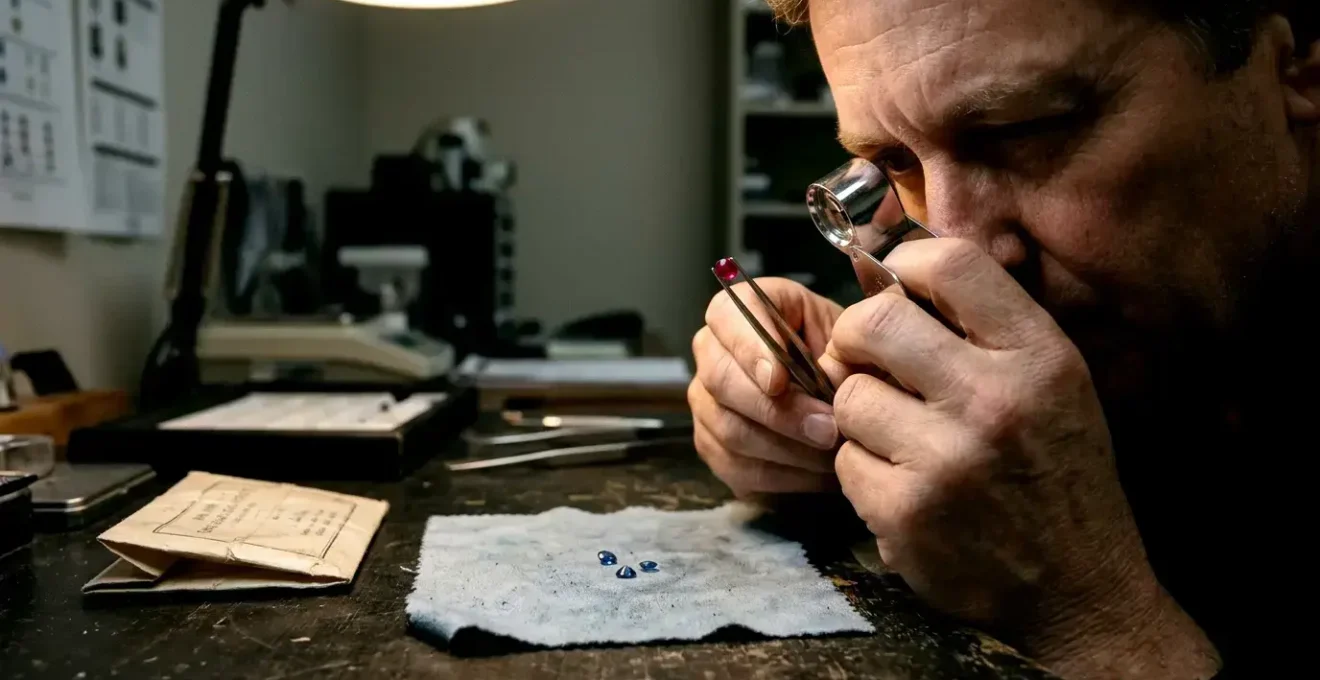
Before buying any ruby or sapphire, assume three things: the stone is highly resistant to scratching but not immune to damage, its appearance may have been modified by treatment, and its accompanying paperwork may establish less than the seller suggests. These assumptions provide a more reliable starting point than colour, carat weight or an attractive description.
Ruby and sapphire are varieties of corundum, a crystalline form of aluminium oxide. Both rank 9 on the Mohs hardness scale, making them suitable for many types of jewellery. Yet the same mineral identity does not guarantee identical commercial value, treatment history or maintenance requirements.
For collectors moving into corundum, the most expensive misunderstandings often concern what cannot be established by appearance alone. A stone may be natural but heated, durable but fracture-filled, or accompanied by a genuine laboratory report that says nothing about geographic origin. Learning to separate these questions makes it easier to assess a purchase before negotiating its price.
Corundum buying rules worth remembering
- Mohs hardness 9 provides excellent scratch resistance, but a ruby or sapphire can still chip when struck at a vulnerable edge.
- Conventional heating is common and generally stable; fracture filling, diffusion and other treatments require separate scrutiny.
- Independent laboratory findings matter more than a seller’s card, especially when the price depends on untreated status or geographic origin.
- Why Can Corundum Survive Daily Wear but Still Chip on One Bad Knock?
- How to Spot Heat-Treatment Clues in Corundum Using Only a Loupe and Side Lighting?
- Ruby vs Sapphire: Which Is the Better Choice for a Ring Worn During Sports Twice a Week?
- The Documentation Mistake: Confusing a Shop Card With an Independent Corundum Report
- When Is Advanced Testing Worth It for Corundum: Under £500, £2,000, or Only Higher?
- The Documentation Mistake: Treating a ‘Certificate’ as Proof of Origin or No Treatment
- Heated vs Unheated: Which Choice Makes More Sense if Your Budget Is Under £2,000?
- How Can Heat Treatment Change a Gem’s Look Without Changing Its Identity—and Why Should You Care?
Why Can Corundum Survive Daily Wear but Still Chip on One Bad Knock?
Corundum survives everyday wear because its Mohs hardness of 9 gives it excellent resistance to scratching. However, hardness is not the same as resistance to impact. Ruby and sapphire have excellent toughness and no cleavage, yet a concentrated blow can still chip a girdle or facet junction. Their durability should never be interpreted as immunity to damage.
The distinction begins with two different physical properties. Hardness measures resistance to scratching, whereas toughness concerns a material’s resistance to breaking or chipping. Quartz, a common mineral in dust and grit, has a Mohs hardness of 7 and ordinarily cannot scratch an undamaged corundum surface. That does not prevent a sharp impact from damaging the stone.
According to GIA’s Sapphire Care and Cleaning Guide, corundum combines excellent toughness with the absence of cleavage. Cleavage is the tendency of a mineral to split along particular crystallographic planes. Corundum’s lack of cleavage is an advantage, although parting may occur in some specimens. Neither property eliminates the possibility of impact damage.
Consider a hypothetical situation: a ruby ring strikes a metal weight during a gym session. The stone’s polished face might have survived years of contact with ordinary household materials, yet the concentrated impact at an exposed girdle edge produces a small chip. Nothing about that outcome contradicts its Mohs rating.
The setting changes the exposure. A well-designed bezel can shield vulnerable edges more effectively than an exposed mounting, although protection depends on the design and workmanship. Low-profile settings can also reduce the likelihood of accidental contact.
Before purchasing a previously worn stone, examine the girdle and facet junctions under a 10x loupe. Look for chips, surface-reaching fractures and abraded facet edges. These features reveal existing condition, not a measurable probability of future failure. An already damaged edge nevertheless deserves particular attention before resetting the stone.
The first rule is therefore straightforward: corundum is exceptionally useful for wearable jewellery, but its condition and mounting still matter. Once physical durability is understood, the next uncertainty is what treatment may have changed inside the stone.
How to Spot Heat-Treatment Clues in Corundum Using Only a Loupe and Side Lighting?
A 10x loupe and directional light may reveal clues consistent with heat treatment in ruby or sapphire, including expansion fractures around included crystals, altered rutile silk and disturbed inclusions. These observations can justify further investigation, but they cannot reliably establish treatment history. Some heated stones show little visible evidence, and laboratory examination remains essential for valuable treatment claims.
Heat can change inclusions because different materials inside a corundum crystal respond differently to temperature. Expansion around an enclosed crystal may produce a disc-like fracture or halo. Under suitable illumination, an observer might notice changes in the surrounding internal reflections.
Rutile silk provides another possible clue. Fine rutile needles can form sharply defined patterns in certain untreated corundum specimens. Heating may modify their appearance, partially dissolve them or produce a less distinct texture. However, sharp silk is not proof of an unheated stone, and cloudy inclusions are not automatically evidence of treatment.
Research published by GIA in A Decade of Ruby from Mozambique: A Review documents heat-related inclusion alterations, expansion fractures and flux-associated features. It also explains why low-temperature treatment can leave limited visible evidence and may require additional analytical methods.
The research concerns Mozambican ruby and specific experimental observations. Its findings should not be treated as a universal visual identification key for every ruby or sapphire deposit.
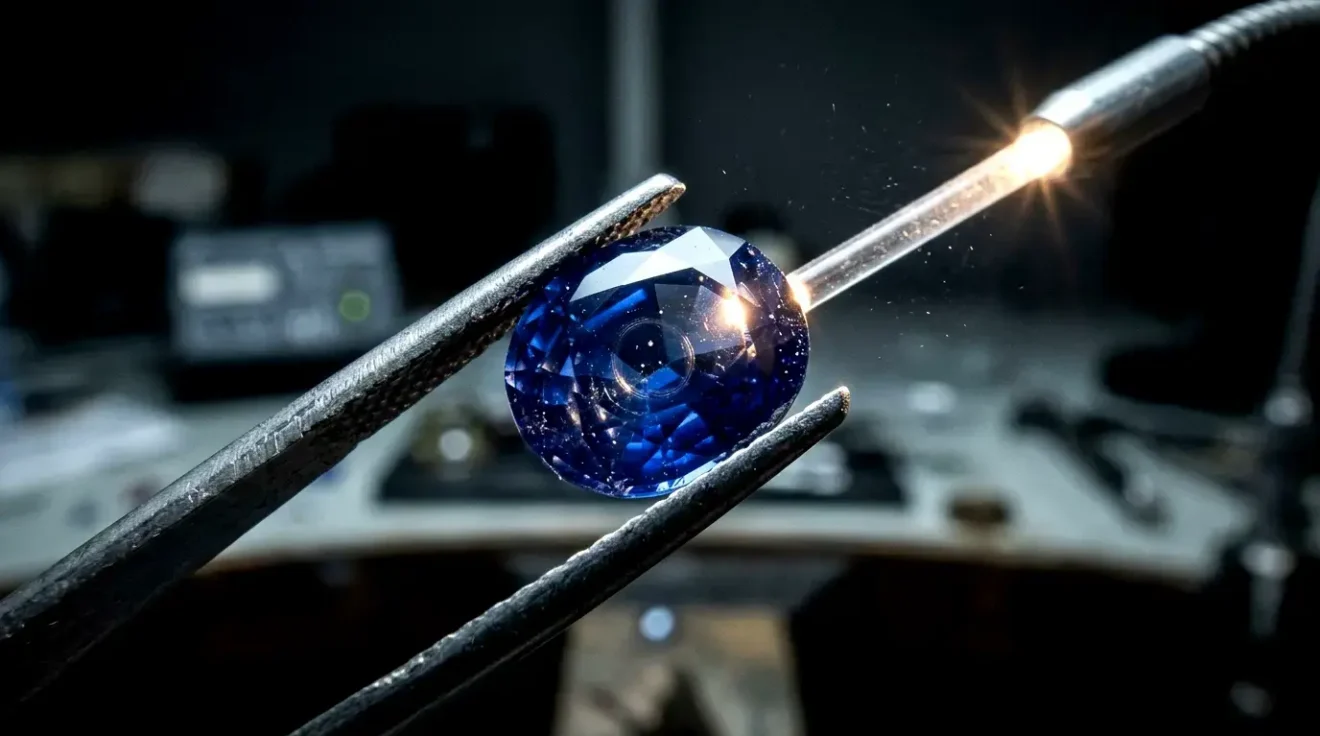
A simple preliminary inspection can be performed without attempting to reproduce a professional gemmological examination:
- Inspect the loose stone over a secure, soft work surface, using suitable gem tweezers or a holder.
- Position one directional light source to illuminate the interior obliquely.
- Use a clean 10x loupe and slowly tilt the stone to reveal inclusions under different viewing angles.
- Look for disc-like features, changes around included crystals, disturbed silk and unusual fracture reflections.
- Record what is visible without assigning a definitive treatment classification.
A professional microscope may reveal features too small or subtle for this method. Glass-filled fractures can also display features that an inexperienced observer might confuse with heat-related changes. Flux-healed fractures and lead-glass filling are distinct treatments and require careful differentiation.
The absence of visible heating clues is not evidence that heating never occurred. Low-temperature treatments are particularly relevant because some may preserve inclusions that a buyer expects heating to destroy. Specialist microscopy and techniques such as FTIR spectroscopy may be necessary.
Any discrepancy between visible features and a seller’s description should prompt clarification or independent testing. This is where a useful observation becomes a purchasing safeguard rather than an unsupported conclusion.
Ruby vs Sapphire: Which Is the Better Choice for a Ring Worn During Sports Twice a Week?
Neither ruby nor sapphire has an inherent durability advantage for an actively worn ring: both are corundum, with the same mineral hardness and broadly comparable toughness. Sapphire may offer a more flexible selection of colours and prices, but treatment, existing condition and mounting matter more than the variety. Removing the ring during sports is the safer choice.
Ruby is red corundum, while sapphire covers other corundum colours, including blue. Both offer excellent scratch resistance. Choosing sapphire instead of ruby does not make the stone immune to a collision with exercise equipment, a hard floor or another ring.
The commercial differences become important when a budget is fixed. Fine ruby with desirable colour and laboratory-supported unheated status can command substantial premiums. Sapphire offers a broader range of colours and qualities, potentially making it easier to find an attractive stone without paying specifically for a rare red colour.
That is a purchasing tendency, not a universal price relationship: a fine blue sapphire can also be exceptionally valuable. Prices cannot be compared fairly without considering colour, transparency, cut, weight, treatment and documentation.
The following decision grid separates gemstone choice from the actual risks of active wear.
| Decision factor | Ruby | Sapphire |
|---|---|---|
| Scratch resistance | Mohs 9 | Mohs 9 |
| Impact considerations | Edges and exposed facets remain vulnerable | Edges and exposed facets remain vulnerable |
| Colour choice | Red, with premiums for desirable colour | Broad colour range, including blue |
| Treatment assessment | Check for conventional heat, filling and diffusion | Check for conventional heat, filling and diffusion |
| Practical mounting | Protective, low-profile setting worth considering | Protective, low-profile setting worth considering |
| Best reason to choose | Strong preference for red | Preferred colour or better available quality within budget |
A buyer attending sports sessions twice weekly should consider how the activity affects jewellery. Contact sports, weight training and activities involving hard surfaces create avoidable opportunities for impact. No gemstone selection compensates fully for these conditions.
For rings worn outside those sessions, a carefully executed bezel or other protective setting can help limit exposed edges. Colour and stone size may also influence how noticeable small signs of wear become, but darker or more saturated colours do not make corundum physically tougher.
Do not select a visibly included stone merely on the assumption that a very clean stone must be glass-filled. Natural corundum can exhibit different clarity levels, and filling must be assessed through appropriate evidence rather than appearance alone.
The better choice is the stone whose appearance, documented condition and replacement cost fit the wearer. Once a particular gem becomes attractive, verifying what the seller claims is more important than deciding whether red or blue is inherently safer.
The Documentation Mistake: Confusing a Shop Card With an Independent Corundum Report
A shop card describes the gemstone as represented by the seller; an independent laboratory report records findings from a separate gemmological examination. The two documents are not interchangeable. A card labelled “certificate” may contain no independent verification of treatment, origin or natural status, so buyers should establish who issued the document before accepting its claims.
Retail cards, invoices and appraisal documents can serve useful commercial purposes. They may identify the stone purchased, state the represented carat weight or record the agreed sale price. However, a statement printed by the selling business is not automatically an independent gemmological finding.
Laboratories such as GIA, SSEF, Gübelin and GRS issue gemmological reports, although the precise services and terminology differ. A buyer should assess the specific laboratory, report type and stated findings rather than relying on institutional names alone.
The distinction becomes particularly important when a stone carries an unheated premium. Imagine a hypothetical purchase in which the retailer’s card describes a ruby as unheated. Subsequent independent examination identifies evidence of heating. The gemstone may still be attractive and natural, but the original price could have been based on an unsupported valuation premise.
A report can also be entirely genuine while referring to a different stone. Its existence therefore needs to be checked against the specimen being offered.
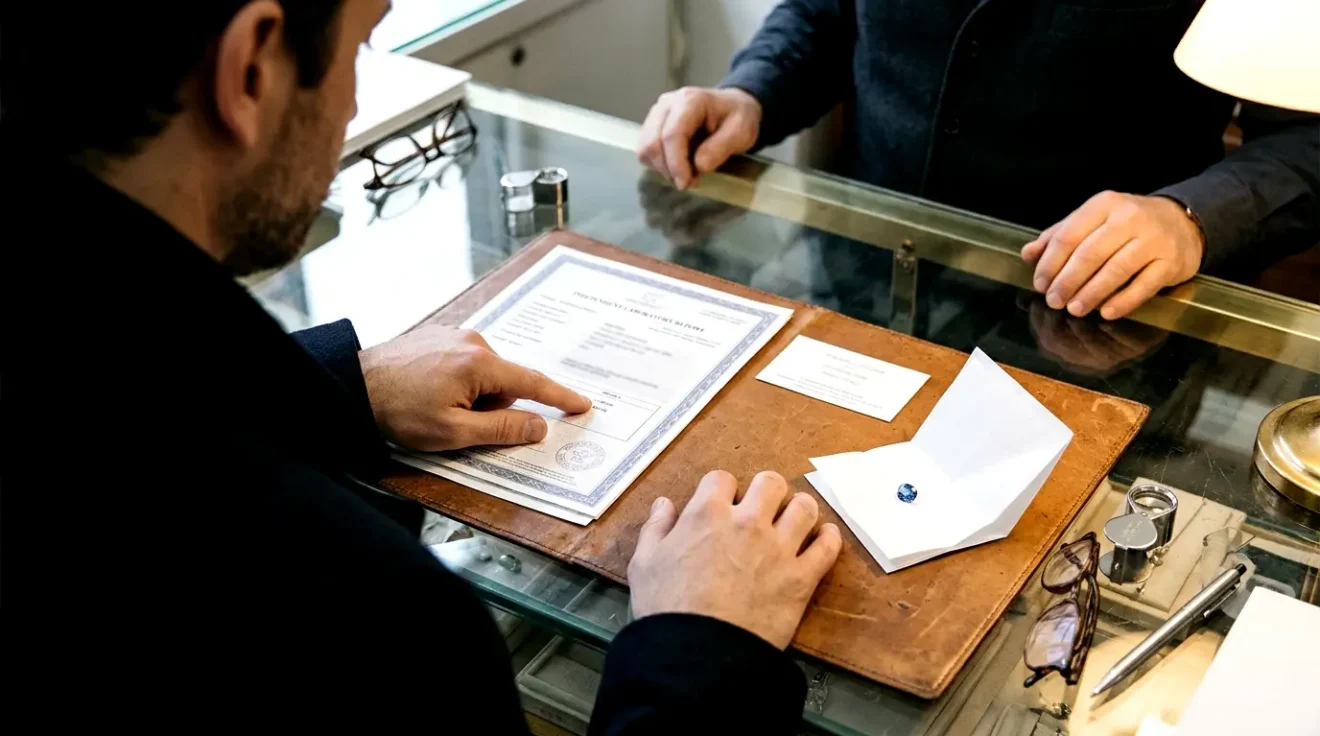
Document verification should happen before payment. Where the issuing laboratory offers an official report-checking service, compare the report number and available record with the document supplied. Check the weight, measurements and description against the physical gemstone, recognising that mounted stones may be harder to measure precisely.
Read the conclusions and limitations in full. A report may identify corundum but not include geographic origin determination. Another may contain qualifications affecting how confidently its findings can be interpreted.
Five checks to complete before purchasing documented corundum
- Identify the issuer. Record the laboratory’s full name and distinguish its report from the seller’s card.
- Check the report reference. Save the report number and any available result from the laboratory’s official verification service.
- Match the gemstone. Record the reported weight, dimensions and identifying details, noting discrepancies with the offered stone.
- Extract the treatment findings. Copy the exact wording about heating, filling, diffusion or inconclusive results into a purchase note.
- Reconcile the sales claims. Obtain a written description of any unsupported claim and agree on independent testing or an appropriate purchase condition before payment.
The completed checks produce a useful record: an identified issuer, verified reference where available, gemstone comparison, documented treatment wording and written clarification of unresolved claims.
Report verification does not automatically guarantee a stone’s value, resale acceptance or insurance coverage. Those questions may require separate valuation and policy assessment.
When the seller’s description and independent findings do not align, the safest response is to resolve the discrepancy before completing the transaction. The next question is how much testing the value and uncertainty of the stone justify.
When Is Advanced Testing Worth It for Corundum: Under £500, £2,000, or Only Higher?
Advanced testing is worthwhile when the financial consequence of an uncertain treatment, identity or origin is greater than the cost of resolving it. There is no universal price threshold. Below £500, basic independent identification may be the priority; around £2,000, treatment findings can become commercially important; at higher values, origin assessment may justify additional expenditure.
The decision is not simply whether a gemstone is expensive. It depends on which uncertainty could change the price and whether the chosen laboratory service can address that uncertainty.
For an inexpensive ruby, a question about lead-glass filling may be more important than geographic origin. For a fine ruby represented as unheated and originating from Myanmar, treatment and origin findings may both substantially influence the asking price.
GIA’s service descriptions distinguish a Colored Stone Identification Report from a Colored Stone Identification & Origin Report. Identification services address the material and detectable treatments, while the origin service adds geographic origin evaluation when applicable and determinable.
These services are described in GIA’s colored stone laboratory report descriptions. The referenced institutional content establishes the distinction between report types, but this source address is an author-environment endpoint rather than a confirmed preferred public production page. Current service availability and fees should be confirmed directly with the laboratory.
| Purchase band | Main priority | When further testing makes sense |
|---|---|---|
| Under £500 | Identity and material treatment disclosure | When a significant misdescription is suspected or basic verification is economical |
| £500–£2,000 | Independent treatment findings supporting price | When an unheated claim or unusual enhancement materially affects the deal |
| Above £2,000 | Treatment documentation and, where relevant, origin evaluation | When origin or treatment is a substantial component of the asking price |
These are decision-making bands, not laboratory fee schedules or universal recommendations. A £400 stone described as rare and untreated may justify more scrutiny than a more expensive conventionally heated stone sold with clear disclosures.
A practical test is to ask: Would a different laboratory conclusion materially change what this stone is worth to me? If so, compare the cost of the relevant service with the amount at risk, including any shipping, handling or insurance costs associated with testing.
Testing must also match the suspected issue. Origin evaluation does not substitute for treatment analysis. Likewise, a routine identification service may not answer every question about particular diffusion processes or subtle heat treatment. Confirm the laboratory’s capabilities and limitations before submission.
When a test is not economically proportionate, accepting some uncertainty may be reasonable, provided the purchase price does not assume an unsupported premium. A loupe inspection can inform that decision but cannot replace missing laboratory evidence.
A proportionate testing strategy protects against paying for claims that cannot be substantiated. However, even when an independent report is obtained, its wording still requires careful interpretation.
The Documentation Mistake: Treating a ‘Certificate’ as Proof of Origin or No Treatment
A certificate or laboratory report does not automatically prove that a ruby or sapphire is unheated or comes from a particular country. Its conclusions are limited to the examinations performed and findings reported. A document identifying natural corundum may establish natural origin of the material without determining geographic origin or resolving every possible treatment question.
The expression “natural corundum” concerns material identity and formation. It distinguishes naturally formed corundum from laboratory-grown material when supported by the examination. It does not, by itself, establish an absence of heating, filling or diffusion.
Geographic origin is another separate question. A laboratory may assess a stone’s characteristics against reference information and issue an origin opinion when sufficient evidence exists. Where the evidence is inconclusive, a report may omit origin or state that it could not be determined.
The difference matters because a seller may present a genuine but limited document alongside a more expansive sales description. For example, a report stating natural ruby does not independently support a shop label claiming “unheated Burmese ruby” unless the relevant treatment and origin findings are also documented.
Even the phrase “no indications of heating” requires interpretation. It describes the laboratory’s observational conclusion based on its methods and available evidence, not an absolute guarantee that the stone has never experienced elevated temperatures.
Read a corundum report in four separate parts:
- Material identification: Does the report identify ruby, sapphire or corundum, and does it establish natural versus laboratory-grown status?
- Treatment findings: Does it explicitly discuss heat, filling, diffusion or other detectable enhancements?
- Geographic origin: Is a country stated, omitted or described as undeterminable?
- Qualifications: Are there limitations, inconclusive findings or explanatory notes that narrow the interpretation?
A report should not be expanded beyond its actual wording. A treatment section that does not address a claimed enhancement is not equivalent to an explicit negative finding about that enhancement.
Geographic origin also should not be confused with a guarantee of quality. Fine corundum can come from more than one locality, and colour, transparency, cut, weight and treatment remain important to valuation.
Once the report’s scope is understood, buyers can make a more rational comparison between heated and unheated material without assigning value to evidence that the report never supplied.
Heated vs Unheated: Which Choice Makes More Sense if Your Budget Is Under £2,000?
For a budget under £2,000, conventionally heated ruby or sapphire will often offer more attractive size or colour for the money than an otherwise comparable unheated stone. Unheated material can be the better choice when natural treatment history is itself a collecting priority. Neither option is automatically superior; the decision depends on purpose, documented treatment and available quality.
Conventional heat treatment is widely accepted in the corundum market. It can improve appearance without turning natural ruby or sapphire into a synthetic gemstone. By contrast, attractive unheated stones can command premiums when a reliable independent report supports the absence of detected heating.
The buyer therefore faces a familiar trade-off: allocate more of the budget to visible characteristics or pay for the scarcity associated with untreated status.
Consider an explicitly hypothetical comparison. Two sapphires are offered within the same £2,000 budget. One is larger, conventionally heated and attractive in colour. The other is smaller and supported by an independent report stating no indications of heating. Without further quality and price information, neither is objectively the better purchase.
For a frequently worn ring, the heated stone may be appealing if its treatment is properly disclosed and the setting protects it. Conventional heating does not inherently make corundum less suitable for ordinary jewellery use.
For a collector specifically seeking untreated gems, the smaller stone may better satisfy the collecting objective. The premium should nevertheless be supported by laboratory evidence rather than a merchant’s assertion.
Do not confuse unheated with untreated in every possible sense. Heating is only one category of enhancement, and the report must be read for other relevant findings. Conversely, a stone described as heated should not automatically be assumed to be glass-filled or diffusion-treated.
Low-temperature heating introduces additional uncertainty. Some treatments can alter colour without producing obvious changes in rutile silk or other familiar inclusions. Even specialist assessment has limitations, making the exact report conclusion more useful than an absolute claim made without qualification.
A sensible purchasing decision under £2,000 rests on three questions: Is the stone primarily for wearing or collecting? What visual characteristics are being obtained for the price? What independent evidence supports the treatment description?
With those questions answered, heat treatment becomes a commercial attribute rather than a simplistic measure of whether a gemstone is good or bad. Understanding the physical changes caused by heating explains why that distinction matters.
Key takeaways before considering heat treatment
- Natural identity and treatment history are separate facts: a heated natural ruby remains natural corundum.
- The financial significance of heating depends on colour, quality, rarity and credible independent findings.
- Conventional heating should not be confused with glass filling, diffusion or flux-assisted processes, which may affect value and care differently.
How Can Heat Treatment Change a Gem’s Look Without Changing Its Identity—and Why Should You Care?
Heat treatment can change the colour or apparent clarity of ruby and sapphire by altering microscopic inclusions and colour-related features within the crystal. The gemstone nevertheless remains corundum because its fundamental mineral identity is unchanged. This matters because treatment can substantially affect market value, disclosure requirements and care without changing the name of the mineral being sold.
Corundum is crystalline aluminium oxide. Its colour depends on trace elements and related crystal characteristics. Heating under controlled conditions can modify some of the features responsible for colour and transparency, although the outcome varies with the stone and treatment conditions.
In certain sapphires, high-temperature treatment can dissolve or modify fine rutile inclusions, reducing a milky appearance and improving transparency. Other heating conditions can change colour through interactions involving trace elements or microscopic inclusions.
In ruby, heat may affect included crystals, internal fractures and the appearance of silk. In some treatment processes, flux is used during heating and can enter fractures, potentially contributing to their healing. These observations concern specific processes and should not be treated as inevitable results of every heating procedure.
The distinction is fundamental: mineral identity is not the same as treatment history or market value. A natural sapphire remains natural sapphire after conventional heating, but a documented unheated example of otherwise comparable quality may command a different price.
Heating also needs to be distinguished from other corundum treatments:
- Conventional heat treatment: Generally stable under normal wearing conditions and commonly accepted when disclosed.
- Lattice diffusion: Can modify colour through the introduction or redistribution of elements. Colour penetration and durability implications vary with the specific process.
- Beryllium diffusion: A particular diffusion treatment that may alter colour and requires appropriate testing for reliable identification.
- Lead-glass filling: Uses glass to fill fractures or cavities and can introduce substantial care concerns, including sensitivity to certain chemicals.
- Flux-assisted heating: May produce healed fractures and characteristic internal features, requiring assessment distinct from ordinary heating and glass filling.
Some diffusion-treated stones can have colour concentrated near the surface, meaning repolishing or recutting may alter their appearance. By contrast, the care issues associated with lead-glass filling can involve the stability of filling material itself.
These distinctions affect practical ownership. Ordinary untreated and conventionally heated corundum can generally be cleaned with warm soapy water. Fracture-filled, cavity-filled or dyed material may require gentler cleaning, such as a damp cloth, because standard jewellery-cleaning procedures could damage treated areas.
The commercial consequences are equally important. Buyers, valuers and insurers may need accurate information about treatment when describing or assessing a stone. A report identifying natural corundum but failing to establish the claimed treatment status should not be used to justify an unheated premium.
Rather than asking only whether a ruby or sapphire has been heated, ask what treatment has been identified, what remains uncertain and how the answer influences the agreed price and intended use.
Before purchasing, compare the seller’s written description with the independent report’s exact treatment wording, inspect the stone’s condition and assess its intended setting. If a treatment or origin claim materially affects the price but lacks adequate support, request appropriate independent examination before committing.
Can natural ruby or sapphire be treated and still be genuine?
Yes. Natural ruby or sapphire remains natural corundum after conventional heat treatment. Natural formation and treatment history are separate attributes. A laboratory-grown corundum gemstone, however, is not natural merely because it has the same mineral composition. Buyers should verify both identity and treatment using the applicable report findings.
Does a flawless-looking sapphire mean it has been glass-filled?
No. Apparent clarity alone cannot establish glass filling. Natural sapphires vary in clarity, and some internal features may be difficult to observe without specialist equipment. Glass filling requires its own diagnostic evidence. A very clean appearance should neither be regarded as proof of treatment nor as a guarantee that the stone is untreated.
Can a laboratory always determine where a ruby was mined?
No. Geographic origin determination is an expert assessment based on the characteristics of the stone and the laboratory’s available reference information. Some specimens cannot be assigned a sufficiently confident origin. A report identifying natural ruby does not automatically include a geographic origin conclusion.
Should a corundum ring be cleaned with an ultrasonic cleaner?
Cleaning suitability depends on the stone’s condition and treatment. Untreated and conventionally heated corundum is generally durable, but fracture-filled or cavity-filled stones may be damaged by unsuitable cleaning methods. Warm soapy water is a practical choice for ordinary untreated or heat-treated material; filled or dyed stones may require cleaning only with a damp cloth. When treatment is uncertain, avoid aggressive cleaning until appropriate advice is obtained.
Is a gemstone appraisal the same as an identification report?
No. An appraisal addresses a specified valuation purpose, whereas a gemmological identification report addresses the material and other findings within its testing scope. The two may complement each other, but neither should be assumed to provide information outside its stated purpose. An insurance valuation, for example, is not automatically proof of unheated status or geographic origin.