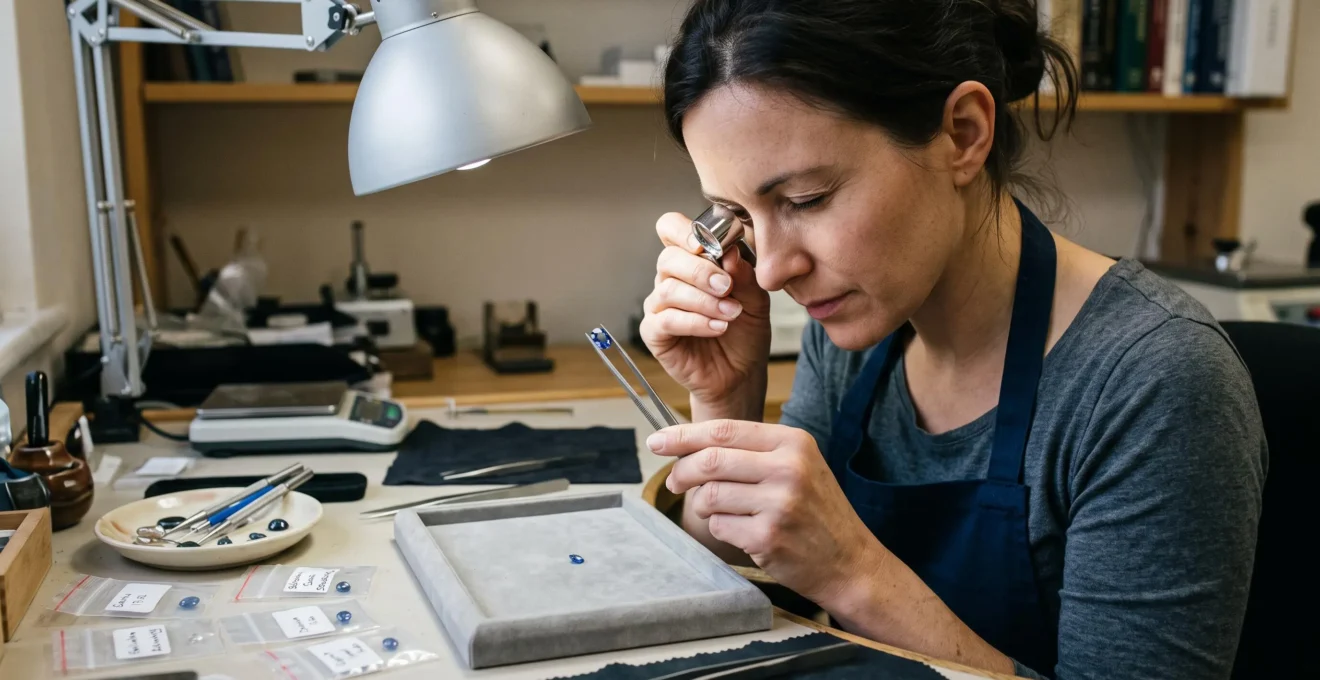
Flame-fusion gemstones often provide the most accessible clues under a standard 10x loupe, particularly when curved growth striae or gas bubbles are present. Flux-grown stones can also reveal their laboratory origin through characteristic residues or metallic inclusions, although their internal textures may closely resemble natural gemstones. Modern HPHT and CVD diamonds are considerably harder to classify by ordinary visual examination.
The difference begins with the environment in which each crystal forms. A molten feed, a chemical flux, a high-pressure metal solvent and a gas-phase reactor impose different conditions on crystal growth. Those conditions influence the inclusions, internal structures and growth features that remain after cutting.
For collectors, the important distinction is between a feature that raises suspicion and one that establishes origin. A clean interior does not prove that a stone is natural, while a fingerprint-like inclusion does not automatically prove that it is synthetic. Understanding the growth process makes a loupe inspection more informative without turning it into a substitute for professional identification.
Lab-grown gemstone detection: the essentials
- Most accessible clues: Flame-fusion corundum may display curved striae and gas bubbles; some flux-grown gems reveal distinctive metallic or flux-related inclusions.
- Most difficult cases: HPHT and CVD diamonds often require specialized testing, even when examined by an experienced gemologist.
- Best buying practice: Ask for the precise growth method, inspect physical quality separately and retain written documentation of origin.
- Why Does the Lab Growth Environment Leave Different Signatures Inside the Same Mineral?
- How to Ask a Seller Which Lab-Grown Method It Is — With One Simple Question
- Czochralzki vs Flux-Grown: Which Lab-Grown Option Looks More « Natural » in Jewellery?
- The Consistency Myth: Assuming All Lab-Grown Stones Are the Same Quality
- When Should You Verify the Growth Method: Only for Resale, or Even for Everyday Wear?
- Why Can a Synthetic Stone Perform Better in Daily Wear Even If It’s « Less Romantic »?
- The Wording Trap: « Created, » « Cultured, » and Other Terms That Hide Synthetic Origin
- Should You Buy a Synthetic Alternative if You Want Daily Wear Without Babying the Stone?
Why Does the Lab Growth Environment Leave Different Signatures Inside the Same Mineral?
The growth environment leaves different signatures because each synthesis method exposes a crystal to distinct temperatures, pressures, chemical surroundings and growth rates. Those conditions determine which foreign materials become trapped and how internal structures develop. Even when two gemstones have the same chemical composition and crystal structure, their microscopic features may tell different formation stories.
Natural and synthetic ruby, for example, are both corundum. The distinction is not their basic mineral identity but the environment in which crystallization occurred. A flame-fusion ruby develops from molten material, whereas a flux-grown ruby crystallizes from a high-temperature solution. These processes can leave different inclusion populations and growth structures.
The same principle applies to diamond, although its principal laboratory production methods operate very differently from those used for many coloured gemstones.
| Growth method | Typical environment | Potential observations | 10x loupe limitation |
|---|---|---|---|
| Flame fusion | Molten feed material solidifying into a crystal | Curved growth striae and gas bubbles | Useful when features are sufficiently pronounced and accessible |
| Flux growth | Crystal formation from a molten chemical solvent | Flux residues, wispy inclusions and occasionally crucible-related metallic particles | Some inclusions resemble those in natural or treated stones |
| Czochralski pulling | Seed crystal withdrawn from a melt | Potential growth-related variations, often relatively clean interiors | Absence of inclusions is not diagnostic |
| Hydrothermal growth | Crystal formation in a heated, pressurized aqueous system | Characteristic internal growth structures in some materials | Fine structures may require more sophisticated microscopy |
| HPHT diamond growth | High-pressure, high-temperature growth using a metallic solvent-catalyst | Possible metallic inclusions and distinctive growth-related characteristics | Many examples lack decisive visible clues |
| CVD diamond growth | Carbon deposition onto a diamond substrate from a gas environment | Possible growth-related structures, pinpoint inclusions or carbon-related features | Reliable identification often requires laboratory instruments |
The GIA’s technical review of laboratory gemstone growth methods explains how differences between melt, flux and hydrothermal growth generate characteristic internal features. It also demonstrates why microscopic interpretation is not always straightforward: naturally formed or subsequently treated gemstones can display superficially similar inclusions.
A handheld loupe can reveal sufficiently large gas bubbles, pronounced striae, conspicuous metallic inclusions and surface-reaching damage. However, laboratory techniques such as spectroscopy, ultraviolet imaging and advanced microscopy may be necessary to interpret difficult growth structures.
Post-growth treatment adds another complication. Annealing can alter growth-related characteristics, while fracture filling or laser drilling may change the appearance of defects. These interventions must be evaluated individually rather than assumed to erase or establish synthetic origin.
For a collector, the central rule is that a loupe provides evidence, not a complete origin determination. The seller’s description of the growth process determines which evidence is worth looking for first.
How to Ask a Seller Which Lab-Grown Method It Is — With One Simple Question
Ask the seller: « Which growth method was used — HPHT, CVD, flux, or flame fusion? » This question moves the discussion beyond the generic label « lab-grown » and toward a specific production process. A precise answer can guide inspection and documentation, although a seller’s inability to identify the method does not, by itself, indicate dishonesty.
Begin by confirming the gemstone’s mineral species. HPHT and CVD are the principal commercial routes for laboratory-grown diamonds, whereas flux, flame fusion, hydrothermal growth and Czochralski pulling are relevant to different coloured gemstone products. The list of possible answers should therefore fit the material being sold.
A specialist dealer may know the manufacturer and growth process. A secondary-market seller, estate dealer or marketplace reseller may only have an earlier invoice or identification document. In those situations, a useful follow-up is: « What does the certificate or laboratory report actually say about the growth process? »
| Seller’s answer | What it establishes | Recommended next step |
|---|---|---|
| Specific method, with written documentation | A stronger basis for understanding the declared production process | Check the document and its relationship to the stone |
| « Lab-created » or « synthetic, » without a method | Declared laboratory origin, but not a particular synthesis technique | Ask whether a report specifies the method |
| « The previous owner didn’t know » | An information gap rather than proof of misrepresentation | Request available records or independent testing |
| Refusal to clarify whether the stone is natural or synthetic | Unresolved origin disclosure | Avoid relying on the listing for an important purchase |
For a reported flame-fusion ruby, look for curved striae or bubbles. For a flux-grown emerald or ruby, inspect visible internal structures cautiously, recognizing that fingerprint-like features are not exclusive to synthetic stones. With HPHT or CVD diamonds, prioritize reliable identification documentation because a normal loupe examination may reveal no usable growth clues.
The distinction between declaring synthetic origin and identifying the exact process matters. Not every laboratory report specifies the growth method, and an ordinary retail listing is not necessarily required to describe the production technique in detail.
A confident purchase does not depend on the seller knowing every manufacturing detail. It depends on clearly establishing what is being sold, identifying remaining uncertainty and deciding whether that uncertainty is acceptable at the asking price.
Czochralzki vs Flux-Grown: Which Lab-Grown Option Looks More « Natural » in Jewellery?
Flux-grown gemstones often produce a more naturally included appearance than relatively clean Czochralski-pulled material. Wispy veils and irregular internal features can resemble inclusions in mined gems, while pulled crystals may offer a clearer, more uniform appearance. Yet neither visual style reliably establishes origin, and the most natural-looking inclusions can sometimes provide clues to laboratory growth.
The Czochralski process begins with a seed crystal contacting a melt. Controlled rotation and withdrawal allow a larger crystal to develop. The process is used for synthetic ruby, sapphire, spinel and other materials, and it can yield crystals suitable for high-clarity, consistently coloured jewellery.
However, it would be misleading to claim that all pulled gemstones exhibit curved striations or uniform colour zoning. These features are not universal diagnostic characteristics of the process, and stones from different producers may vary.
Flux growth operates through a chemically more complex environment. Crystal material dissolves in a molten solvent and crystallizes under controlled conditions. Residual flux and particles from the growth apparatus can become incorporated into the developing gem.
Those inclusions create an interesting identification paradox. A flux-grown ruby may look convincingly natural because of its internal texture, but a recognizable crucible-related metallic inclusion can provide evidence of synthesis. Conversely, a natural ruby subjected to flux-assisted heat treatment may develop residues that resemble features in flux-grown synthetic material.
The appearance of a natural inclusion is not the same as proof of natural origin. Its diagnostic value depends on composition, shape, arrangement and the complete microscopic context.
| Buying consideration | Czochralski-pulled | Flux-grown |
|---|---|---|
| Typical visual appeal | Clean, orderly appearance | Potentially more textured, included appearance |
| Internal evidence | May contain few conspicuous inclusions | May contain flux-related veils or metallic particles |
| Natural-looking character | Can appear unusually clean | May resemble included natural material |
| Loupe identification | Often inconclusive without diagnostic features | Potentially informative, but not necessarily definitive |
| Suitable preference | Uniform colour and high clarity | Naturalistic internal character |
Both methods can produce attractive jewellery stones. The more important durability factors are the underlying mineral species, structural condition and cutting quality. A well-cut pulled ruby does not automatically outperform a flux-grown ruby simply because the interior looks cleaner.
Choose pulled material when a crisp, high-clarity visual effect is the priority. Consider flux-grown material when the texture of the gemstone is part of its appeal. In either case, request an explicit synthetic-origin statement and, when known, the production method on the purchase documentation.
The choice should therefore be based on the individual stone rather than an assumed ranking of manufacturing methods. Visual character is only one dimension of quality.
The Consistency Myth: Assuming All Lab-Grown Stones Are the Same Quality
Lab-grown gemstones are not automatically uniform in quality because controlled production does not eliminate differences between crystal-growth conditions, cutting or finishing. Seed quality, temperature control, growth duration, impurities and post-growth processing can influence appearance. Two synthetic rubies produced through the same method may still differ in colour, clarity, symmetry and visible defects.
Commercial synthesis makes it possible to produce material with more controlled characteristics than many natural formation environments, but repeatability is not perfection. A growth run can produce internal defects, while cutting can introduce chips, poor facet alignment or an uneven girdle.
The distinction is particularly important when comparing inexpensive mass-produced material with gemstones manufactured through slower, technically demanding processes. Flame fusion can support economical large-scale production, whereas flux growth may involve complex conditions and extended growth periods. The resulting retail price still depends on factors beyond the process, including size, quality, availability and commercial positioning.
CVD diamonds also vary in quality and post-growth treatment history. GIA‘s examination of laboratory-grown diamonds demonstrates that changing production practices and treatments create significant differences among stones sold under the same general synthetic-origin description.
A buyer should inspect the physical gemstone rather than treat the production method as a quality guarantee. Under a properly illuminated loupe, a practical evaluation includes:
- Girdle condition: Look for chips, abrasions and vulnerable thin areas.
- Facet alignment: Check whether junctions meet cleanly and polishing appears consistent.
- Culet and pointed areas: Inspect for damage or exposed, fragile geometry.
- Internal features: Look for conspicuous inclusions, fractures or unusual surface-reaching defects.
- Face-up colour: Compare the stone under two different suitable light sources to identify any noticeable shift or uneven appearance.
These checks evaluate observable quality, not geological origin. A flawless-looking synthetic gemstone might still lack reliable documentation, while a visibly included natural gemstone can be correctly represented and professionally graded.
Growth method explains how a gemstone was created; cutting, condition and visual performance determine how successfully that material has become a finished jewellery stone. The next question is how much verification those qualities and declarations justify.
When Should You Verify the Growth Method: Only for Resale, or Even for Everyday Wear?
Verify the growth method whenever uncertainty could affect the purchase decision, insurance documentation, appraisal or future representation of the gemstone. For modest everyday jewellery, clear written synthetic-origin disclosure may be sufficient. For expensive, inherited or potentially resold pieces, independent identification becomes more valuable, especially when the claimed origin materially influences the price.
Verification should be proportional to the stakes. Establishing that a stone is laboratory-grown is generally more important than identifying its precise synthesis technique, unless the method itself is part of the description, valuation or collecting interest.
The distinction matters particularly with diamonds. GIA’s 2024 research on laboratory-grown diamond identification explains why HPHT and CVD diamonds can require advanced analytical methods even when experienced examiners find no decisive evidence through conventional microscopy.
Real identification case: growth markings hidden from ordinary observation
In its 2024 research, GIA documented two HPHT-treated CVD diamonds weighing 0.60 and 1.93 carats. Their distinctive markings were not visible through ordinary visual inspection or microscopy.
The markings became apparent under deep-ultraviolet illumination. These cases demonstrate that the absence of obvious growth features cannot be used to establish natural origin or exclude a laboratory-growth process. They do not establish how frequently this particular situation occurs.
For resale, accurate identification protects against misrepresentation. It does not guarantee liquidity or a particular secondary-market price. The available source material does not establish a universal resale-value comparison, so a collector should avoid assuming that laboratory-grown material will retain a predictable proportion of its purchase price.
Documentation has another purpose: preserving identity when a gemstone changes hands. A receipt stating only « ruby » may leave a future recipient uncertain about origin. A clear synthetic-origin description, growth-method information where available and an identifiable report reference provide a more useful record.
A useful verification ladder has three levels. First, obtain written disclosure from the seller. Second, examine an appropriate independent gemological report and confirm precisely what it identifies. Third, request specialized laboratory testing when an existing report is unavailable, inadequate or inconsistent with the stone.
Some GIA laboratory-grown diamond report formats identify HPHT or CVD growth and record findings concerning post-growth colour treatment. Not every report format necessarily provides the same details, so the actual document matters more than the generic word « certificate. »
Five checks to complete before buying a lab-grown gemstone
- Ask the seller to state whether the stone is natural, laboratory-grown or an imitation. Keep the written product description.
- Request the growth method and record the precise answer, including « unknown » if applicable. Keep the seller’s written response.
- Inspect the girdle, facet junctions, culet and visible inclusions using suitable lighting and a 10x loupe. Record any observed defects.
- Check any laboratory report against the actual gemstone, including identifying details and the scope of its conclusions. Retain the report reference and verification result.
- Ensure the receipt accurately describes the stone’s synthetic origin and any established treatment or method information. Keep a copy with the gemstone’s purchase records.
The purpose of verification is not merely preparation for resale. It is to keep the gemstone’s identity clear throughout ownership, while allowing a sensible amount of effort to be spent on an everyday purchase.
Why Can a Synthetic Stone Perform Better in Daily Wear Even If It’s « Less Romantic »?
A synthetic gemstone can outperform a natural alternative in daily wear when it belongs to a more durable mineral species or has fewer structural weaknesses. Laboratory origin does not itself create hardness or toughness. A synthetic ruby retains the fundamental properties of corundum, while its condition, inclusions and cut influence how well it tolerates actual jewellery use.
Origin, hardness, toughness and stability describe different characteristics. Hardness concerns resistance to scratching; toughness concerns resistance to breaking or chipping; stability concerns reactions to environmental influences such as heat, light and chemicals.
Corundum has a Mohs hardness of 9, making synthetic ruby and sapphire strong candidates for jewellery exposed to regular abrasion. A natural emerald or opal may need more protective handling, but this comparison concerns mineral properties rather than a universal advantage of synthetic growth.
The relevant comparison can also occur within one mineral species. A natural stone with substantial fractures or filled fissures may be less suitable for an exposed setting than an otherwise comparable laboratory-grown stone with fewer structural defects. Yet a synthetic specimen with fractures, problematic inclusions or a poorly protected edge may also be vulnerable.
Cleaner crystal growth can reduce certain weaknesses, but it does not make a gemstone unbreakable. Thin girdles, exposed corners and unsuitable settings remain potential failure points regardless of origin.
For diamonds, different synthesis and treatment histories complicate any simplistic prediction of fracture performance. There is no adequate basis in the supplied evidence for claiming that CVD or HPHT diamonds are universally tougher than mined diamonds.
The emotional aspect is separate. A collector may value the geological history and rarity associated with natural formation, while another buyer may care primarily about reliable appearance during regular wear. Neither preference determines the physical performance of the finished jewellery.
A deliberately selected synthetic gemstone can therefore be a satisfying daily-wear choice, provided that durability claims remain specific and the stone’s laboratory origin is disclosed without ambiguity.
The Wording Trap: « Created, » « Cultured, » and Other Terms That Hide Synthetic Origin
Terms such as « created, » « cultured, » « grown » and « above-earth » do not always communicate gemstone origin with equal clarity. The safest descriptions explicitly distinguish laboratory-grown material from mined gemstones and from imitations. Buyers should establish the material’s actual identity in writing instead of assuming that attractive marketing language explains its composition or production process.
The distinction between a synthetic gemstone and a simulant is fundamental. A laboratory-grown ruby is corundum produced artificially, whereas a red glass imitation or another material designed to resemble ruby is not synthetic ruby. Similar appearance does not establish equivalent mineral identity.
Terminology also operates within different regulatory contexts. In the United States, FTC guidance on advertising diamonds and laboratory-created gemstones addresses clear disclosure of laboratory origin and distinguishes synthetic stones from imitations. Those US-specific principles should not be assumed to represent identical legal requirements in every English-speaking country.
| Term | How to interpret it | What to confirm |
|---|---|---|
| Laboratory-grown / lab-grown | Explicitly indicates laboratory origin when correctly used | Mineral species and any relevant treatment |
| Laboratory-created / lab-created | Common explicit terminology for synthetic origin | Whether the material matches the named gemstone species |
| Synthetic | Indicates artificially produced material corresponding to the named mineral | The precise gemstone identity |
| Man-made | Broad description of artificial production | Whether the product is synthetic or merely an imitation |
| Created / grown | May be understandable in context but can be insufficient alone | Explicit laboratory-origin disclosure |
| Cultured | Requires careful contextual interpretation | Clear clarification of non-mined origin where applicable |
| Above-earth | Promotional expression rather than a precise growth-process description | Whether the gemstone is laboratory-grown and what it consists of |
A listing that describes a gemstone as « created » is not necessarily misleading. The question is whether the overall presentation makes synthetic origin clear. Conversely, a description that repeatedly avoids identifying a gemstone as mined, laboratory-grown or simulated leaves a meaningful information gap.
There is also no established evidence that ambiguous marketing terminology consistently corresponds to gemstones that are easier to identify under a loupe. An inexpensive flame-fusion ruby may show distinctive curved striae, but its advertising vocabulary does not predict whether those features will be visible in a particular specimen.
For collectors, vague language and visible inclusions should be treated as separate questions. The first concerns disclosure; the second concerns gemological identification. Neither resolves the other automatically.
The strongest safeguard is uncomplicated: obtain a product description that identifies the gemstone and its origin plainly. Once identity is clear, the buying decision can focus on whether the gemstone itself suits the intended jewellery.
Key takeaways before choosing a stone
- Choose the mineral and protective setting for the stresses of actual use; synthetic origin alone does not guarantee durability.
- Treat visible inclusions, manufacturing information and written disclosure as complementary evidence, not interchangeable proof.
- Decide how much natural origin matters emotionally or financially before comparing price, appearance and long-term ownership plans.
Should You Buy a Synthetic Alternative if You Want Daily Wear Without Babying the Stone?
A synthetic alternative is often worth considering for everyday jewellery when it offers the preferred appearance, suitable mineral durability and an acceptable price without relying on natural origin for its appeal. The strongest candidates are well-cut laboratory-grown diamonds, rubies and sapphires in appropriately protective settings. However, wear resistance still depends on the individual stone and the jewellery design.
Start with the mineral species rather than the natural-versus-synthetic label. A laboratory-grown diamond remains diamond, and synthetic corundum remains corundum. Their fundamental material identities are more relevant to scratch resistance than the location in which crystallization occurred.
Then consider exposure. A ring worn during active daily routines experiences different risks from a pendant protected by its position on the body. Raised settings, exposed corners and thin edges can introduce vulnerabilities even when the central gemstone is relatively hard.
Budget introduces another consideration. Laboratory-grown material can give buyers access to an appearance or mineral species that would be less affordable in a comparable natural gemstone. However, the best value is not necessarily the lowest purchase price; durability, workmanship, disclosure and buyer satisfaction also matter.
| Buying situation | Practical direction | Important qualification |
|---|---|---|
| Frequently worn ring | Consider durable synthetic diamond or corundum with a protective setting | Inspect cut quality, corners and girdle condition |
| Travel jewellery | Consider a disclosed synthetic option that meets the desired appearance and budget | Lower replacement anxiety does not eliminate loss or damage risk |
| Active lifestyle | Prioritize suitable stone selection and secure construction | Remove jewellery for activities likely to involve heavy impacts |
| Natural-origin collecting | Consider natural material with appropriate identification | The geological origin is part of the intended value |
| Heirloom or estate planning | Prioritize documented origin, condition and identifiable records | Do not assume future resale value for either category |
| Preference for natural-looking inclusions | Compare actual specimens rather than labels alone | Visual realism is not proof of natural formation |
There are legitimate reasons to prefer a natural gemstone. Geological origin may be central to collecting satisfaction, and a buyer may want a stone with a particular natural history or documented provenance. Equally, a buyer seeking a clear, durable ruby for everyday wear may find little practical benefit in paying for natural origin.
The synthesis method should influence the inspection plan, not predetermine the purchase. Flame-fusion corundum deserves scrutiny for curved growth features; flux-grown material requires careful interpretation of its inclusions; and HPHT or CVD diamonds may require a reliable laboratory report rather than a loupe-based judgment.
Choose a gemstone whose mineral properties fit the intended use, whose visual character genuinely appeals and whose origin can be documented clearly. Before paying, ask the seller to state the growth method when known, examine the finished stone and retain the relevant written records. That approach makes « lab-grown » an understood purchasing decision rather than merely a label.
Can a 10x loupe reliably distinguish a lab-grown diamond from a natural diamond?
No. Some laboratory-grown diamonds contain useful identifying features, but many HPHT and CVD diamonds cannot be reliably classified using a standard 10x loupe. Specialized screening and laboratory examination may be needed to establish origin, particularly when post-growth treatments affect observable characteristics.
Do curved growth lines always indicate a synthetic gemstone?
Curved growth striae are characteristic identification clues in certain flame-fusion gemstones, especially synthetic corundum. However, an examiner must distinguish true growth striae from other internal features and viewing effects. Their presence should be interpreted alongside the gemstone species and additional evidence.
Can a flux-grown ruby contain inclusions that resemble those in natural ruby?
Yes. Flux-grown gemstones can contain fingerprint-like structures resembling natural inclusions. Some natural gemstones subjected to flux-assisted heat treatment can also develop superficially similar residues. Identification may therefore require detailed microscopy or additional gemological analysis rather than judging the overall appearance of the inclusion.
Does every laboratory-grown diamond report identify HPHT or CVD growth?
No. The information depends on the issuing laboratory and report format. GIA has documented report formats that identify HPHT or CVD growth, but buyers should inspect the specific report rather than assume that every document provides production-method details. The report’s identity, findings and relationship to the actual diamond should be checked.
Can a gemstone without visible inclusions be assumed to be natural?
No. Both natural and laboratory-grown gemstones may appear exceptionally clean under ordinary magnification. Inclusion visibility depends on the material, its growth history, cutting and any subsequent treatment. An absence of visible features is not evidence sufficient to establish natural origin.