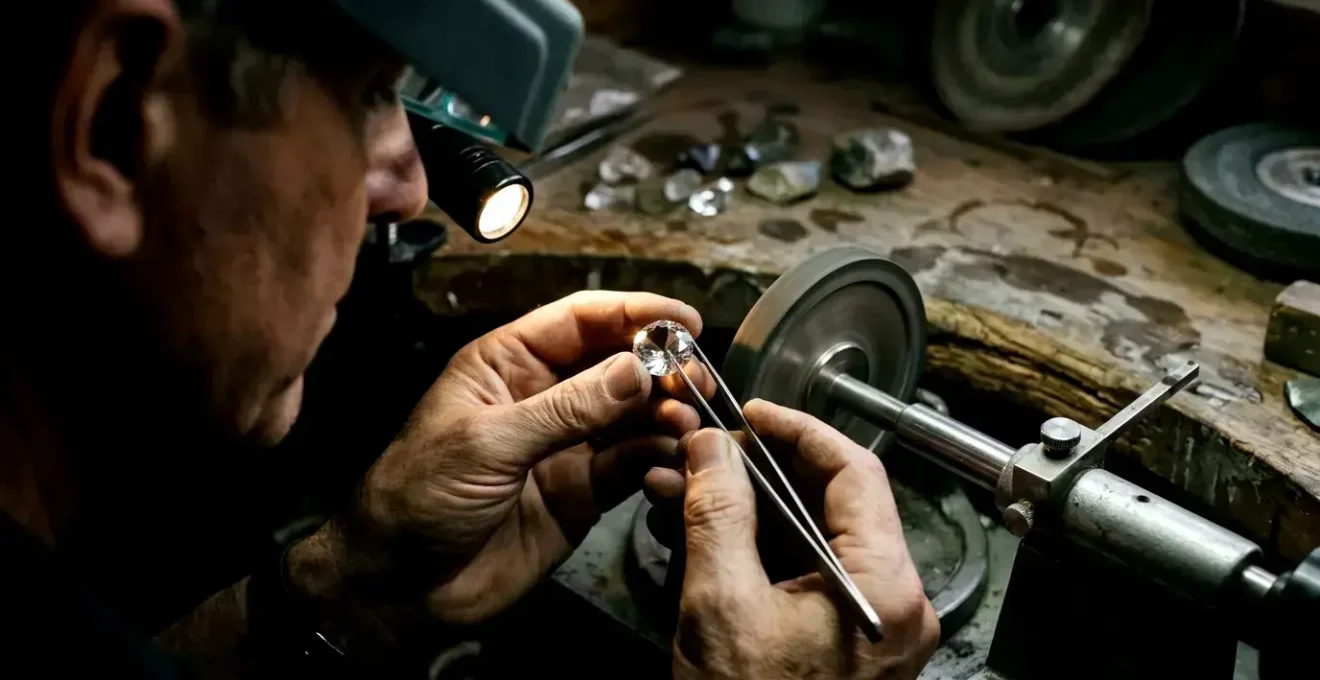
A gemstone can have perfectly polished facets and still look lifeless. Another stone, finished with the same equipment and technique, can produce striking flashes of light. The difference is not necessarily craftsmanship. It often begins inside the rough crystal, long before the first facet is cut.
Crystal structure influences how light travels through a mineral, how its optical properties change with direction, and where the material may split under mechanical stress. These characteristics affect both the appearance of a finished gemstone and the decisions required to cut it successfully.
For lapidary beginners, understanding these relationships changes how rough stones should be evaluated. A promising colour is not enough. The crystal’s refractive index, transparency, absorption, cleavage, natural habit and intended orientation all deserve attention before material is removed.
The practical objective is to distinguish problems that polishing can solve from those requiring a different cutting design, a different orientation or a different piece of rough altogether.
Crystal Structure and Gemstone Brilliance: The Essentials
- A mirror-like polish improves surface quality, but refractive index, absorption, inclusions and facet geometry determine how effectively a gemstone returns light.
- Natural crystal faces, growth patterns and optical behaviour can help guide orientation before sawing, although they must be interpreted alongside the mineral’s identity.
- Evaluate rough under different lighting conditions, identify cleavage risks and plan the intended table direction before committing to a cut.
- Why Can a Perfect Polish Still Look Dull in Certain Crystal Structures?
- How to Use Crystal Faces and Habit to Predict Cutting Direction Before You Saw Anything?
- Hexagonal vs Cubic Crystals: Which Is the Safer First Faceting Project for New Cutters?
- The Orientation Mistake That Causes Windowing Even With a « Correct » Pavilion Angle
- In What Order Should You Preform a Cleavable Crystal to Avoid Losing 30% of the Rough?
- Why Do Some Deep Sapphires Look Almost Black Under Restaurant Lighting?
- Why Is Colour the Least Reliable Trait for Identification Compared With Optical Behaviour?
- Which Formation Process Produced Your Mineral, Based on 5 Visible Clues You Can Check at Home?
Why Can a Perfect Polish Still Look Dull in Certain Crystal Structures?
A perfect polish can look dull because surface smoothness and internal light return are different properties. Polishing reduces surface irregularities and improves the clarity of reflections, but it cannot change a gemstone’s refractive index, eliminate strong internal absorption or correct unfavourable facet proportions. Crystal structure establishes important optical properties, while cutting determines how effectively those properties are used.
Imagine two transparent stones with equally smooth facets. Both reflect light directly from their polished surfaces. Yet light entering each crystal may behave differently because the materials have different refractive indices, absorption characteristics and optical symmetries.
Refraction changes the direction of light as it crosses the gemstone’s surface. Total internal reflection can redirect light inside the stone toward the observer when the ray meets a facet at a suitable angle. If the geometry does not support that return path, light may escape through the pavilion instead.
The refractive index determines the critical angle for total internal reflection. For a gemstone surrounded by air, a lower refractive index generally requires a larger angle of incidence inside the stone to achieve total internal reflection. This is why pavilion proportions cannot be chosen independently of the material.
In GIA‘s technical article on coloured stone darkness and brightness, Al Gilbertson discusses the relationship between refractive index, cutting depth, absorption and windowing. The examples include refractive indices of approximately 1.54 for quartz, 1.589 for beryl, 1.74 for grossular garnet and 2.417 for diamond. These values illustrate why one cutting design cannot automatically deliver the same optical result in every material.
Dispersion can separate white light into spectral colours, contributing to fire when lighting and facet geometry permit. Birefringence, meanwhile, describes the direction-dependent refractive behaviour of anisotropic crystals. It may affect apparent facet doubling and optical performance, but it does not automatically produce greater brilliance.
Absorption is another limiting factor. A deeply coloured, strongly absorbing crystal can return relatively little visible light even when its facets are correctly polished. The situation may become more complex when absorption differs by optical direction or across colour zones.
For a preliminary examination, compare the material under a small directional light and broad diffuse illumination. A concentrated source helps reveal flashes and reflection patterns, while diffuse light makes overall transparency, colour distribution and dark regions easier to assess. On faceted material, rotate the stone and distinguish moving surface reflections from persistent areas of internal darkness.
These observations are screening methods, not measurements of refractive index or proof of a particular crystal system. A bright surface highlight cannot establish that a future cut will return light efficiently.
Before trying another polishing compound, check whether the darkness originates in facet geometry, absorption or the material itself. Those causes require different remedies, and some cannot be corrected after the gemstone has been cut.
How to Use Crystal Faces and Habit to Predict Cutting Direction Before You Saw Anything?
Natural crystal faces and overall habit provide clues to crystallographic orientation before a stone is sawn. By examining the arrangement of faces, growth striations, elongation and possible cleavage surfaces, a cutter can develop an initial orientation map. That map helps identify cutting options, but the mineral species and its known cleavage and optical properties must also be considered.
A crystal’s habit is its characteristic external form. It may be elongated, tabular, prismatic, equant or irregular. These shapes reflect aspects of crystal symmetry and growth conditions, although different minerals can develop similar habits.
Start by rotating the rough beneath a fixed light. Look for naturally developed faces that produce consistent reflections, then examine how those faces meet. Repeated geometric relationships can help identify potential crystallographic directions.
Growth striations add information. Their orientation may help distinguish one family of faces from another, while growth features and colour zoning can reveal useful internal or external reference directions.
However, a flat face is not automatically a cleavage plane. Natural crystal faces form during growth, whereas cleavage reflects crystallographically controlled weakness in the solid. A crystal face, fracture surface and cleavage surface may appear similarly flat without sharing the same origin.
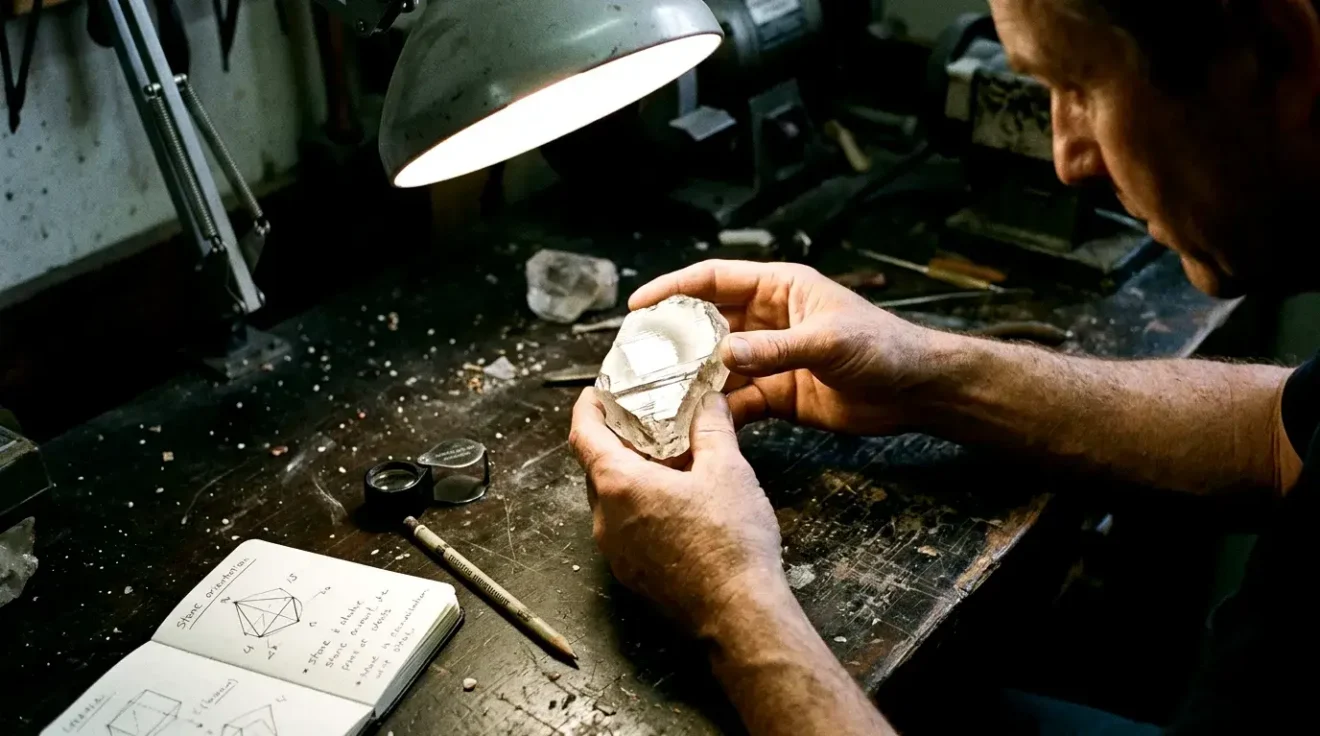
The cutting decision should combine this external evidence with an inspection of inclusions, fractures and colour distribution. For a known anisotropic mineral, optical orientation may deserve as much attention as the most convenient external shape.
Consider a hypothetical elongated crystal with a transparent central region and visible growth markings. Sawing perpendicular to its longest dimension might produce an attractive outline. Yet if that direction also places a strongly absorbing optical direction beneath the future table, the finished gemstone could become unnecessarily dark.
The opposite orientation might require more waste during preforming but provide a better appearance. The correct choice depends on the actual material rather than a universal rule about cutting parallel or perpendicular to elongation.
Five Checks Before Your First Saw Cut
- Identify the likely mineral. Record the proposed species and the evidence supporting that identification.
- Map the external habit. Draw the rough from two viewpoints and mark recognisable natural faces and growth striations.
- Inspect internal features. Mark visible fractures, major inclusions and colour zones on the drawing.
- Compare possible orientations. Record at least two potential table directions and the optical or mechanical concerns associated with each.
- Document the chosen plan. Mark the intended cutting direction on the rough and keep a dated sketch or photograph for comparison after preforming.
These checks do not replace optical measurements or reliable mineral identification. They provide a record of the assumptions behind an otherwise irreversible operation.
Once the first saw cut removes a natural reference face or a significant portion of the rough, reconstructing the original orientation can become difficult. That is why orientation planning belongs before preforming, not after it.
Hexagonal vs Cubic Crystals: Which Is the Safer First Faceting Project for New Cutters?
Cubic crystals can be easier for beginners to orient optically because they are isotropic, whereas hexagonal crystals are uniaxial and can display direction-dependent optical behaviour. However, crystal system alone does not determine cutting difficulty. Cleavage, toughness, cost, inclusions, available rough and polishing behaviour may matter more than whether a mineral is cubic or hexagonal.
The fundamental distinction concerns symmetry. Cubic gemstones are optically isotropic under ordinary conditions: their refractive index does not vary with light-vibration direction. Hexagonal gemstones are optically anisotropic and have ordinary and extraordinary refractive indices.
The Open University‘s mineralogy lesson on isotropic and anisotropic materials explains this relationship between crystal symmetry and optical properties.
The distinction gives cubic materials one practical advantage: cutters do not normally need to manage crystallographically dependent pleochroic colour when selecting the table direction. Hexagonal materials can introduce another decision because their appearance may vary with orientation.
That does not mean every hexagonal gemstone displays obvious pleochroism or that every cubic gemstone is mechanically forgiving.
Cleavage and directional polishing behaviour depend on the specific mineral and its bonding. They cannot be reliably ranked from crystal system alone.
The following comparison separates the optical advantage from the other factors that determine whether a beginner’s project is manageable.
| Decision factor | Cubic crystals | Hexagonal crystals |
|---|---|---|
| Optical symmetry | Isotropic under normal conditions | Uniaxial and anisotropic |
| Orientation-dependent colour | No ordinary crystallographic pleochroism | Possible when the mineral is pleochroic |
| Cleavage risk | Depends on mineral species | Depends on mineral species |
| Polishing difficulty | Cannot be predicted from symmetry alone | Cannot be predicted from symmetry alone |
| Beginner suitability | Potentially simpler optical orientation | Useful for learning directional optical behaviour |
Cost changes the recommendation. A beginner may learn more confidently from affordable, sound hexagonal rough than from an expensive cubic crystal that makes every mistake financially significant.
Similarly, an optically straightforward cubic specimen with problematic cleavage or extensive fractures may be a worse training material than a clean crystal of another system.
A practical first-project decision should therefore rank the actual rough by affordability, soundness, visibility of defects, established cutting guidance and the ability to evaluate the final result.
For someone specifically learning optical orientation, a well-identified pleochroic crystal can be educational. For someone learning basic faceting geometry and polishing, a clean, inexpensive, mechanically manageable specimen may be the better choice regardless of symmetry.
Choose the crystal that allows repeated, understandable experiments without excessive breakage or expense. Its symmetry should inform the project, not dictate the decision by itself.
The Orientation Mistake That Causes Windowing Even With a « Correct » Pavilion Angle
A gemstone can show windowing despite a supposedly correct pavilion angle because the angle may not suit its refractive index, optical orientation or complete facet geometry. In anisotropic materials, effective refractive behaviour can vary with direction. Nevertheless, windowing is primarily a light-return problem, and orientation alone does not explain every window in a finished stone.
A window is a region through which light passes without sufficient internal reflection to hide the background. Instead of returning towards the observer, a substantial portion of the light escapes through the pavilion.
Place a visibly windowed gemstone over printed material and some of the background may appear through its centre. The appearance can change as the stone is tilted.
For an optically isotropic material, the refractive index is independent of crystallographic orientation. Changing the direction of the rough does not change that fundamental optical property.
In an anisotropic material, light propagation is more complicated because refractive behaviour depends on the direction of propagation and polarisation. A generic pavilion-angle recommendation that ignores these properties may not fully describe the stone’s performance.
Even so, it would be misleading to assume that every standard pavilion angle becomes invalid when an anisotropic crystal is rotated. The magnitude of any orientation-related effect depends on the material and its optical properties.
Facet layout, crown geometry, pavilion geometry and viewing conditions also influence whether a window is visible.
Another frequent source of confusion is extinction, which appears as dark regions rather than transparent windows. Absorption can create additional darkness. These phenomena may coexist, but they are not interchangeable.
For example, a strongly absorbing tourmaline may have an optically unfavourable direction that produces a dark appearance even when its pavilion is capable of returning light. Making the stone deeper does not necessarily solve that absorption problem.
Before faceting a known pleochroic crystal, examine it in transmitted light from different directions. Compare colour saturation and transparency, rotate the specimen and mark the direction that appears most promising for the intended face-up colour.
Then evaluate that direction against the proposed facet design, refractive-index information and yield. The visually most transparent direction is a useful candidate, not an automatic optimum: balancing colour, brilliance and rough retention may require a compromise.
If the mineral’s optical orientation cannot be established confidently, avoid treating a generic angle table as a guarantee. Confirm the material and use cutting information appropriate to its optical characteristics.
The best correction depends on which optical mechanism is responsible. Once that distinction is understood, the next challenge is preserving the crystal while creating the necessary geometry.
In What Order Should You Preform a Cleavable Crystal to Avoid Losing 30% of the Rough?
Preform a cleavable crystal by identifying vulnerable planes first, designing the finished shape around them, and removing material in controlled stages that avoid stressing those planes. No universal sequence guarantees that 30% of the rough will be saved. Actual losses depend on crystal shape, cleavage quality, fractures, cutting direction and the final design.
Cleavage is a mineral’s tendency to separate along particular crystallographic planes. These planes reflect structural directions in which atomic bonding offers relatively less resistance to separation.
The International Gem Society‘s article on gemstone cleavage explains this relationship and distinguishes cleavage from fracture and parting. It also describes cleavage quality using categories ranging from none to perfect.
For a cutter, the important distinction is between material that merely looks intact and material that may split when grinding, pressure or impact interacts unfavourably with an existing weak plane.
A practical preforming sequence begins with observation rather than immediate material removal.
- Map potential cleavage planes. Examine the rough for repeated planar breaks, visible separations and vulnerable edges. Interpret these features in light of the identified mineral’s known cleavage.
- Choose the intended finished silhouette. Position the proposed gemstone so major weak planes are not unnecessarily exposed or placed under avoidable mechanical stress.
- Mark the critical boundaries. Identify regions that can be removed without crossing a visibly compromised area or leaving an unsupported fragile projection.
- Begin controlled material removal. Use an appropriate lapidary method and avoid aggressive pressure on vulnerable faces and edges. Work progressively rather than forcing the rough to match the final outline immediately.
- Refine and reassess. Inspect newly exposed surfaces for fractures or cleavage-related features before proceeding to the next stage.
This is a general risk-management sequence, not a mineral-specific operating procedure. Different materials may require different tooling, support and cutting practices.
To estimate potential yield, compare the dimensions of the largest plausible finished stone with those of the starting rough. Record the mass of the rough, the proposed design and the approximate material that must be removed.
Such an estimate is preliminary. Density, internal defects, cutting losses and the finished geometry affect the actual weight retained.
For instance, a hypothetical piece with a large internal separation may offer a better chance of producing a smaller, sound gemstone than a larger stone whose pavilion intersects that separation. The larger outline might preserve more weight initially but create a future breakage risk.
The goal is therefore not simply to maximise immediate retained mass. It is to balance usable yield with mechanical integrity and visual performance.
Take particular care when a proposed facet arrangement leaves a weak plane near an exposed edge. A stone that survives preforming may still be vulnerable to later impact or setting pressure.
Preserving material only counts as success when the resulting gemstone remains suitable for finishing and use. The same principle applies to optical decisions: retaining more depth is not necessarily desirable if that depth creates excessive absorption.
Why Do Some Deep Sapphires Look Almost Black Under Restaurant Lighting?
Deep blue sapphires can look nearly black in dim restaurant lighting because their colour absorption combines with a long internal light path and limited illumination. Strongly absorbing material may transmit or return too little visible light to reveal its blue colour clearly. Crystal orientation, iron-related absorption, facet geometry and the spectrum of the light source can all contribute.
A sapphire’s apparent colour depends on which wavelengths of visible light survive absorption and reach the observer. In many blue sapphires, iron and titanium-related electronic processes contribute to the characteristic colour, although the relevant chemistry and its expression vary between stones.
As the distance travelled by light through an absorbing material increases, more light can be removed from the transmitted beam. Consequently, a deep sapphire may appear darker than a shallower example of comparable material.
This does not mean that depth alone determines darkness. Two sapphires of similar dimensions can differ considerably in absorption, inclusions, colour zoning and facet geometry.
Warm indoor lighting adds another variable. Compared with daylight or a bright inspection lamp, a dim warm source offers a different distribution and quantity of visible light. A strongly saturated blue stone may therefore display fewer conspicuous blue reflections.
Corundum belongs to the trigonal crystal system and is optically uniaxial. Certain blue sapphires also exhibit dichroism, meaning their apparent colours can differ with viewing direction.
The result is that the direction chosen for the table may influence face-up colour and brightness. Orientation can help optimise the appearance, but it cannot remove the fundamental absorption of the material.
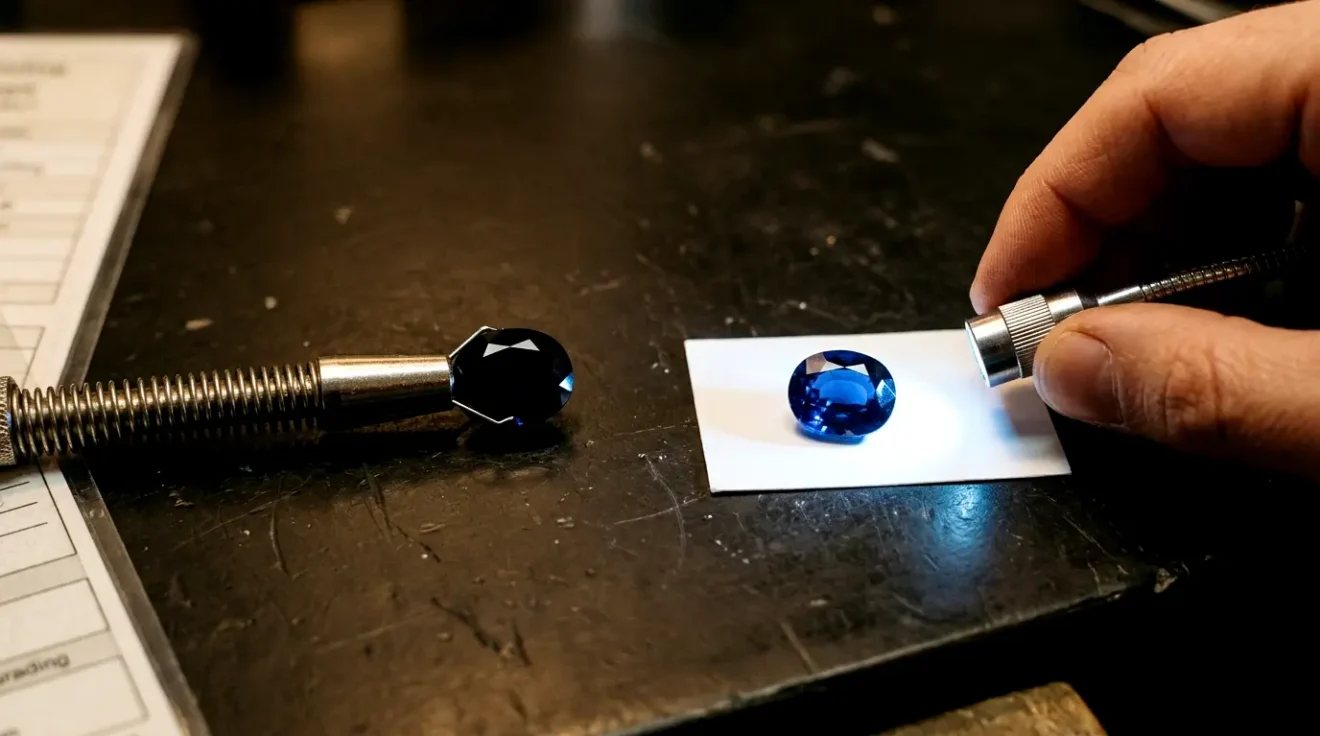
When evaluating a dark sapphire, compare three lighting environments: a bright directional inspection light, diffuse daylight and subdued warm indoor illumination.
Keep the observation method consistent. View the stone face-up, rotate it slowly and note whether the centre remains readable, whether dark zones change with movement, and whether any blue reflections remain visible.
A bright spotlight may produce attractive flashes even when much of the gemstone is dark under ordinary lighting. It is therefore insufficient as the only buying test.
Also distinguish darkness caused by absorption from extinction associated with cut geometry. A sapphire may exhibit both, and the appropriate cutting response depends on their relative contributions.
For collectors who expect to wear a sapphire indoors, the decisive question is not how impressive it looks in direct sunlight. It is whether its colour and brightness remain appealing under the illumination encountered during normal use.
Test the material in the lighting conditions that matter to the intended use. A sapphire that performs well there is often a more satisfying choice than one whose beauty depends on unusually intense illumination.
Why Is Colour the Least Reliable Trait for Identification Compared With Optical Behaviour?
Colour is an unreliable standalone identification trait because different minerals can share similar hues, while the same mineral may occur in several colours. Optical properties such as refractive index, birefringence and pleochroism provide more direct evidence about crystal structure. However, no single visual optical observation can identify every gemstone, and reliable conclusions often require complementary tests.
Colour arises from interactions between light and the material’s electronic structure, including effects associated with trace elements, defects and other colour-producing mechanisms. Lighting, treatments and viewing conditions can change how that colour appears.
Consequently, a red gemstone is not necessarily ruby, and a blue gemstone is not necessarily sapphire.
Ruby and some red garnets can look similar to an inexperienced observer. Yet ruby is a variety of corundum with anisotropic optical behaviour, while garnets belong to the cubic system and are ordinarily isotropic.
Similarly, blue sapphire and tanzanite can overlap in perceived colour, but they belong to different crystal systems and exhibit different optical characteristics.
The distinction is explained in GIA’s research on pleochroism in faceted gems, which describes isotropic, uniaxial and biaxial optical behaviour and discusses the directional colours of gemstones including sapphire, tourmaline and tanzanite.
For a beginner, the most useful approach is to build an evidence hierarchy rather than jump from a visually attractive colour to a mineral name.
- Observe transparency and internal features. Use a loupe to examine inclusions, growth features and fractures. These may provide clues but are seldom conclusive on their own.
- Look for optical doubling where appropriate. Some birefringent gemstones can show doubled facet junctions or internal features under magnification. Its absence does not prove isotropy.
- Test directional colour. A suitable dichroscope can help reveal pleochroism in transparent anisotropic stones. Ordinary coloured filters are not equivalent to a dichroscope.
- Check refractive behaviour instrumentally. A gemological refractometer, when suitable for the specimen, can provide refractive-index evidence and information about birefringence.
- Combine independent results. Compare optical observations with established physical and mineralogical characteristics before assigning an identification.
One of the strongest distinctions is between isotropic and anisotropic behaviour. The former is associated with cubic symmetry, while the latter occurs in the other crystalline systems under ordinary gemological conditions.
Nevertheless, an isolated observation may mislead. A doubly refractive crystal viewed along an optic axis may not display obvious doubling. Strongly coloured material may also show weak or difficult-to-observe pleochroism.
A refractive-index measurement can be more diagnostic than a colour comparison, but it must still be interpreted correctly. Similar indices across different minerals, specimen limitations and measurement conditions can prevent a unique identification.
The practical benefit extends beyond naming the stone. Optical classification helps predict whether orientation-dependent colour may influence the finished cut.
A reliable identification process combines several properties instead of relying on hue alone. The next stage is to use the rough’s visible history of growth and alteration to understand what additional cutting risks may be present.
Key Takeaways Before Examining Your Rough
- Identify the likely mineral before interpreting crystal faces, cleavage or directional optical behaviour; external appearance alone may be misleading.
- Evaluate transparency, fractures, inclusions and growth features together rather than treating any single clue as conclusive.
- Use visible features to develop a cutting hypothesis, then verify important assumptions before committing valuable material to the saw.
Which Formation Process Produced Your Mineral, Based on 5 Visible Clues You Can Check at Home?
Five visible clues can help narrow down how a mineral formed: crystal habit, growth striations, inclusions, cleavage or fracture patterns, and associated host material. Together, they may suggest growth in a cavity, formation from a melt, metamorphic recrystallisation or another geological process. They cannot reliably establish formation history or crystal system on their own.
The geological environment influences which minerals can grow, how crystals develop and what surrounding materials or defects they may preserve. Those features can affect the quality of gemstone rough and the cutting decisions it requires.
Some observations can be made with the naked eye. A loupe and a controlled light source make finer features easier to examine.
The following table connects each visible clue with the kind of interpretation it can support.
| Visible clue | What to examine | Possible interpretation and limitation |
|---|---|---|
| Crystal habit | Prismatic, tabular, equant or irregular form; repeated face arrangements | May help identify crystal symmetry and growth characteristics, but habit is not unique to a formation process. |
| Growth striations | Fine lines or repeated surface growth features | Can reveal directions and episodes of crystal growth, but generally cannot establish geological origin alone. |
| Inclusions | Visible mineral particles, cavities, internal features or zoning | May preserve evidence of growth conditions, although reliable interpretation often needs microscopy and identification of the inclusions. |
| Cleavage and fractures | Repeated flat separations versus irregular cracks | Can provide clues about mineral structure and mechanical history, but fractures may form long after original crystal growth. |
| Associated host material | Attached rock, matrix minerals or cavity surfaces | May constrain the geological environment when the association is original and correctly identified. |
For example, a hypothetical crystal found attached to the wall of a natural rock cavity, alongside other identifiable cavity minerals, may support a hypothesis of growth from mineral-bearing fluids. That interpretation would need confirmation from geological context.
Another hypothetical specimen containing aligned inclusions and deformation-related features might suggest that it experienced geological stress or recrystallisation. Such features are not sufficient to identify a particular metamorphic event.
Formation history does not determine crystal symmetry directly. Crystal system is a property of the mineral’s internal structure. The same mineral species can occur in different geological settings while retaining its underlying symmetry.
This distinction matters because visible habit and formation clues should not be used as substitutes for proper identification. A prismatic crystal may offer useful orientation information without revealing whether it formed in an igneous, metamorphic or hydrothermal environment.
For lapidary planning, focus on the consequences that can actually be observed: fractures, colour zoning, inclusions, weak areas and the distribution of transparent material.
Growth conditions can influence these characteristics, but the relationship is not deterministic. Slow growth does not guarantee a flawless crystal, and rapid growth does not necessarily produce unusable rough.
Recrystallisation, deformation and later alteration may modify or erase older growth features. Heat treatment can also change some inclusions and colour-related characteristics, making interpretation more difficult.
A useful field record should distinguish direct observations from hypotheses. Note the visible habit, photograph the specimen from several angles and describe the matrix or inclusion features without assigning an unsupported origin.
Where precise identification or geological provenance materially affects value, use appropriate gemological or laboratory testing. Visible clues provide a starting point, not a certificate of origin.
Before buying or cutting the next piece of rough, record what the specimen actually shows, identify the uncertainties and choose the next test accordingly. This approach turns crystal structure and growth evidence into practical decisions without relying on colour, appearance or assumptions alone.
Can repolishing make a naturally dark gemstone brighter?
Repolishing can improve reflections if scratches, surface damage or poorly finished facets are reducing apparent brightness. It cannot remove internal absorption or change the mineral’s refractive index. Changing the facet geometry may improve light return in some cases, but doing so can reduce weight and may not solve darkness caused by the material itself.
Does a higher refractive index always mean a more brilliant gemstone?
No. Refractive index influences light bending and the conditions for total internal reflection, but brilliance also depends on facet geometry, transparency, absorption and lighting. A well-cut gemstone with a lower refractive index can show attractive light return, while a poorly proportioned high-index gemstone may perform badly.
Can crystal cleavage be identified reliably with a loupe?
A loupe may reveal flat internal separations or surfaces consistent with cleavage, but their appearance alone does not reliably distinguish cleavage from other planar features. Identification of the mineral and knowledge of its characteristic cleavage directions are essential. Deliberately striking a valuable specimen to test cleavage risks damaging or destroying it.
How can a beginner check for pleochroism without expensive equipment?
Rotating transparent rough under consistent lighting may reveal direction-dependent colour in strongly pleochroic material, provided suitable optical directions are visible. A gemological dichroscope offers a more controlled observation. Weak pleochroism, specimen geometry or an unfavourable viewing direction can make the effect difficult to detect, so a negative visual test is not conclusive.
Should beginners prioritise crystal orientation or rough weight when planning a cut?
Neither should be considered in isolation. Orientation can affect colour and mechanical risk, while cutting geometry influences light return and yield. Compare plausible designs using the actual specimen’s transparency, defects, cleavage and optical properties. A smaller sound gemstone with balanced appearance may be preferable to a heavier result compromised by darkness, fractures or vulnerable planes.