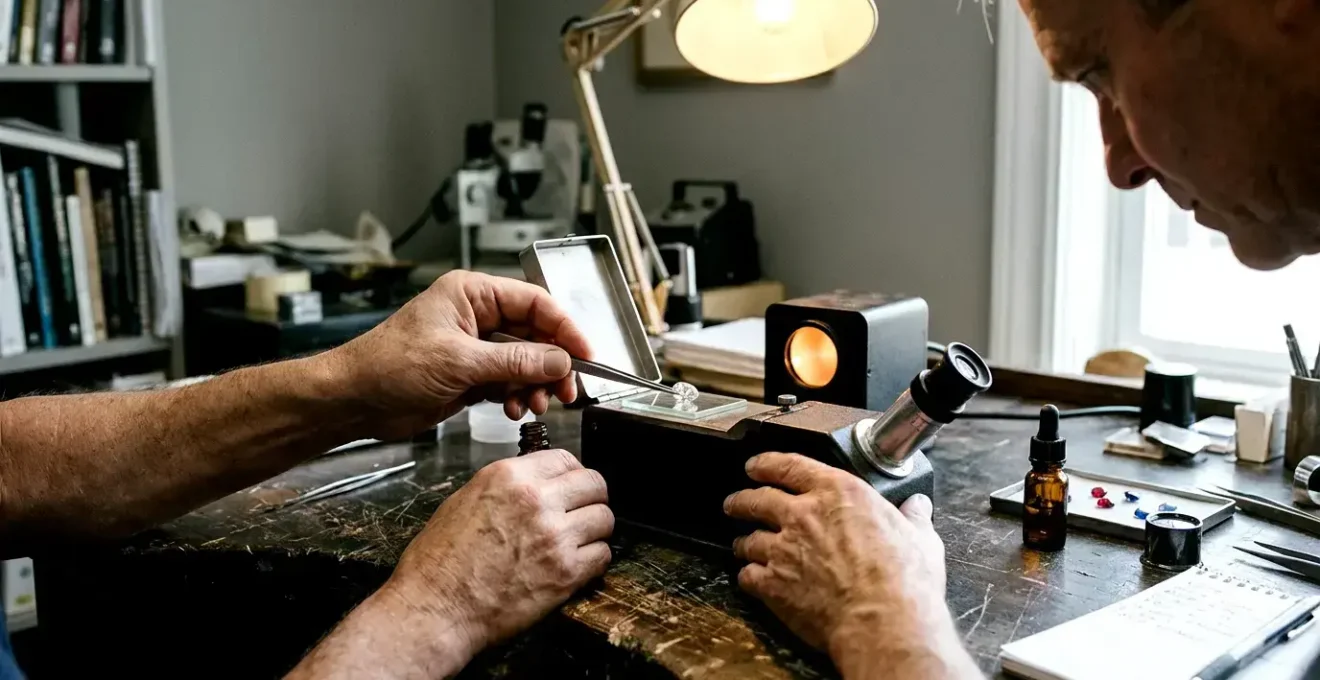
A gemstone listing mentions a refractive index of 1.76. Another seller advertises a stone with an RI of 1.72. Does that make the first gem more brilliant, more valuable, or more likely to be genuine?
Not necessarily. Refractive index (RI) measures how strongly a material slows and bends light. It helps gemologists distinguish materials that may look nearly identical, but it does not independently establish a gemstone’s identity, natural origin, treatment status, or beauty.
For buyers, RI is most useful as a consistency check. A measured value can support or contradict the species named in a listing. When combined with optical behavior, inclusions, cutting quality, and other observations, it becomes a practical way to reduce uncertainty before paying.
The important distinction is between what an RI number describes about the material and what the finished gemstone actually looks like. Understanding that difference helps prevent both mistaken identifications and disappointing purchases.
Gemstone refractive index: the buyer’s essentials
- RI helps narrow gemstone identity, but overlapping ranges mean it cannot prove authenticity alone.
- Higher RI can influence light return and fire, but cut quality, color, and lighting determine much of the visible result.
- For doubly refractive stones, a single reading may miss important information. Ask for the measured range and supporting tests.
- Why Doesn’t a Higher Refractive Index Always Mean a More Brilliant Stone?
- How to Use RI Ranges to Narrow 5 Lookalike Stones Down to 2 in Under 3 Minutes?
- Glass Imitation vs Low-RI Natural Stone: Which Will Look Better in Low Light?
- The Single-Reading Mistake: Why One RI Reading Can Mislead You on a Doubly Refractive Gem
- How to Do a 4-Minute Optical Check at Home Using a Loupe and One Torch
- Refractometer vs Polariscope: Which Tool Solves More Problems for a Beginner on a Budget?
- How Do You Get a Reliable Refractometer Reading When the Stone Is Small or Mounted?
- When Should RI Be Your First Test vs Your Last Test in an Identification Workflow?
Why Doesn’t a Higher Refractive Index Always Mean a More Brilliant Stone?
A higher refractive index does not guarantee a more brilliant gemstone because RI describes a material’s optical behavior, not the quality of its finished cut. Pavilion angles, facet alignment, polishing, color absorption, and lighting all affect perceived brightness. A well-cut lower-RI gemstone can look more attractive than a poorly cut higher-RI alternative.
RI influences the critical angle at which light undergoes total internal reflection. This matters because a gemstone’s pavilion must be designed to return useful light toward the observer rather than allowing it to escape through the bottom.
According to GIA’s analysis of colored gemstone brightness and windowing, lower-RI materials generally need different cutting proportions to avoid unwanted light leakage. The relationship between RI and pavilion geometry is therefore more informative than RI alone.
Two common cutting problems illustrate the distinction:
- Windowing: light passes through parts of the gemstone, sometimes allowing the background beneath it to become visible.
- Extinction: areas appear excessively dark because of light-path geometry, absorption, or a combination of factors.
A higher-RI material may offer greater flexibility in certain cutting designs, but an unsuitable pavilion can still produce unattractive light return. Conversely, a carefully proportioned gemstone with a lower RI can deliver appealing brightness and color.
There is also a difference between brilliance and fire. Brilliance generally concerns returned white light, while fire refers to the separation of light into spectral colors. Fire depends on dispersion and the cut, not simply on the RI value.
| Characteristic | What RI indicates | What the buyer should inspect |
|---|---|---|
| Brightness | Potential for light bending and internal reflection | Face-up light return and dark areas |
| Fire | RI alone does not quantify dispersion | Visible spectral flashes under suitable lighting |
| Color | Does not establish hue or saturation | Color consistency in different lighting |
| Cut quality | Helps explain suitable cutting geometry | Windowing, symmetry, and polish |
Consider two gemstones with the same reported RI. One has a well-proportioned pavilion and crisp polishing; the other has shallow pavilion facets. Their material properties may match, yet the second can appear noticeably less lively because more light escapes through its window.
Daylight and jewelry-store lighting introduce another variable. Directional spotlights can emphasize flashes and reflections, while diffuse illumination reveals different aspects of color and brightness. Neither lighting condition changes the stone’s intrinsic RI.
The practical buying rule is to use RI to evaluate material identity and optical potential, then judge the actual gemstone face-up under more than one lighting condition. The next challenge is using RI to distinguish stones that look alike.
How to Use RI Ranges to Narrow 5 Lookalike Stones Down to 2 in Under 3 Minutes?
Use refractive-index ranges as an elimination tool rather than a definitive identification test. Start with a shortlist of plausible gemstone species, compare their expected optical behavior with a properly measured RI, and remove candidates that are clearly incompatible. A three-minute screening exercise may narrow five possibilities to two, but its speed and accuracy depend on measurement quality.
Imagine a red gemstone offered without a reliable identification report. Its appearance might suggest ruby, spinel, garnet, tourmaline, or glass imitation.
Color alone cannot resolve the question. Different gem materials can share similar hues, and lighting can make them appear even more alike.
The first useful distinction is whether the measured RI falls within the expected range of a candidate material. The second is whether the gemstone behaves as a singly or doubly refractive material.
GIA‘s gemstone identification case study explains that ruby and sapphire are doubly refractive, whereas spinel and garnet are singly refractive. That difference provides a valuable additional test when color is inconclusive.
Hypothetical screening: five red gemstone candidates
Suppose a gemologist examines an unidentified red stone and obtains a repeatable RI reading, then observes optical behavior consistent with double refraction. The original shortlist contains ruby, spinel, garnet, tourmaline, and glass.
The double-refraction evidence makes ordinary isotropic spinel, garnet, and glass less plausible, potentially leaving ruby and tourmaline as the leading candidates. This conclusion assumes the observation is reliable and the specimen is not an unusual composite or anomalous material.
The remaining candidates still require comparison with appropriate reference data and further gemological observations. The example demonstrates a screening method, not a validated three-minute identification guarantee.
The correct sequence is straightforward:
- Write down the five plausible material identities before interpreting the measurement.
- Obtain a reliable RI reading and note whether one or two shadow edges appear.
- Compare the observation against recognized reference ranges and optical properties.
- Remove candidates that are clearly inconsistent with the evidence.
- Use pleochroism, inclusions, apparent heft, and other suitable tests to assess the remaining possibilities.
Apparent heft can offer a clue, but it is not a measured specific gravity. Accurate density testing requires an appropriate method and is often impractical on mounted jewelry.
Overlapping RI ranges are the major limitation. A measurement compatible with two species cannot distinguish them without additional evidence. Measurement uncertainty can also prevent a confident exclusion near a range boundary.
The strongest result of this process is not a guessed identity but a smaller, evidence-based shortlist. That distinction becomes especially important when a natural gemstone is compared with a convincing imitation.
Glass Imitation vs Low-RI Natural Stone: Which Will Look Better in Low Light?
Neither glass nor a low-RI natural gemstone is guaranteed to look better in dim lighting. Their appearance depends on cut, transparency, color, surface quality, dispersion, and the available light. Some glass imitations look relatively flat, while others can appear lively. Natural origin and refractive index alone cannot predict which stone will look more attractive.
Ordinary glass is often associated with relatively modest optical performance, particularly when the imitation has simplified cutting, uneven polishing, or visible manufacturing defects. However, glass formulations differ considerably, and some are designed to imitate the appearance of valuable gemstones.
A 2026 Gems & Gemology study of glass-ceramic gemstone imitations examined a particular silicon-aluminum-magnesium-zinc material with a measured RI between 1.60 and 1.63.
The researchers found that this material could imitate several gemstone types and that reliable characterization required combining optical measurements with chemical and spectroscopic evidence. Glass-ceramics contain crystalline phases within a glass matrix and should not be treated as identical to ordinary amorphous glass.
1.60–1.63
The measured refractive-index interval for the specific glass-ceramic imitation system investigated in the 2026 study. It is not a universal RI range for glass.
Gems & Gemology, Summer 2026, glass-ceramic gemstone research.
When comparing two stones in a shop, use the same lighting conditions. Begin with diffuse ambient light, then examine each stone under a small directional light source.
Look for differences in facet reflections, transparency, windowing, and color distribution. An unusually uniform appearance may justify closer inspection, but it is not proof of glass. Natural and synthetic gemstones can also display relatively uniform color.
Under weak illumination, the light source itself may dominate the result. A well-cut imitation could show attractive flashes while a heavily included or poorly cut natural stone looks dull.
High-RI lead-containing glass formulations further complicate the comparison because their optical properties can overlap or exceed those of certain natural gemstone materials. The word « glass » does not imply a single refractive-index value.
Buyers should also avoid scratch testing. Scratching can permanently damage a gemstone, its coating, or its setting, and hardness is not reliably established through an improvised consumer test.
Density measurements, microscopic observations, and appropriate optical testing are safer routes to identification when performed correctly.
The better-looking stone is not necessarily the more valuable or accurately described one. Visual appeal and material identity are separate buying questions, and a trustworthy purchase requires evidence for both.
The Single-Reading Mistake: Why One RI Reading Can Mislead You on a Doubly Refractive Gem
One refractometer reading can mislead because many crystalline gemstones are anisotropic: their refractive indices vary with optical direction and polarization. A single observed shadow edge may reveal only part of that behavior. Rotating the gemstone and recording the relevant shadow-edge patterns helps distinguish doubly refractive materials from isotropic stones and supports more reliable identification.
In isotropic materials, such as ordinary glass and cubic crystalline gemstones, optical behavior is generally the same in every direction. A properly examined isotropic gemstone typically produces one constant refractometer shadow edge as it rotates.
Anisotropic gemstones behave differently. Depending on their crystal structure and the direction of light propagation, they can produce two refracted rays with different optical properties.
The difference between appropriate principal refractive indices is called birefringence. This property is particularly useful when comparing materials with overlapping RI values.
The technical discussion in The Journal of Gemmology explains how refractometer shadow edges change as gemstones rotate. Uniaxial gemstones have two principal refractive indices, while biaxial gemstones have three.
For a uniaxial gemstone, one shadow edge may remain constant while another changes with rotation. The maximum separation can help reveal the relevant principal values.
Biaxial gemstones require more careful interpretation because two variable edges may be present. Subtracting two arbitrary readings is not necessarily a valid measurement of maximum birefringence.
A practical observation sequence is:
- Place a suitable polished facet in optical contact with the refractometer.
- Locate and record the visible shadow edge or edges.
- Rotate the stone through several positions while maintaining proper contact.
- Observe which edges remain constant and which change.
- Record the relevant extrema and interpret them according to the material’s optical character.
This procedure assumes the refractometer can measure the material’s RI and that the operator can distinguish genuine shadow edges from reflections or poor contact.
For example, ruby and red garnet can share broadly similar appearances, but ruby is doubly refractive while garnet is ordinarily singly refractive. Sapphire and spinel present another useful comparison.
However, an observation along an optic axis may conceal double refraction. An absence of visible splitting in one direction does not prove that a gemstone is isotropic.
For a buyer, a reported RI range accompanied by optical-character observations is more informative than an unexplained single number. When professional equipment is unavailable, a simpler visual examination can still identify reasons to request further testing.
How to Do a 4-Minute Optical Check at Home Using a Loupe and One Torch
A four-minute home check can reveal visible inclusions, suspicious bubbles, possible assembly boundaries, and occasional optical doubling. Use a clean gemstone, a 10× loupe, and one small torch or flashlight. The examination cannot measure RI or establish authenticity, but it can help determine whether a seller’s description deserves further professional verification.
Choose a stable table with a neutral background and avoid handling the gemstone directly over a hard floor. Clean the stone gently using a method appropriate to the material; some gems and treatments are sensitive to water, heat, or cleaning chemicals.
Begin by observing the stone face-up and from the side. Note whether the color is distributed evenly, whether facets appear sharp, and whether the pavilion shows obvious windowing.
Next, use the loupe with the torch positioned at an oblique angle. This grazing illumination can make certain internal features and surface defects easier to notice.
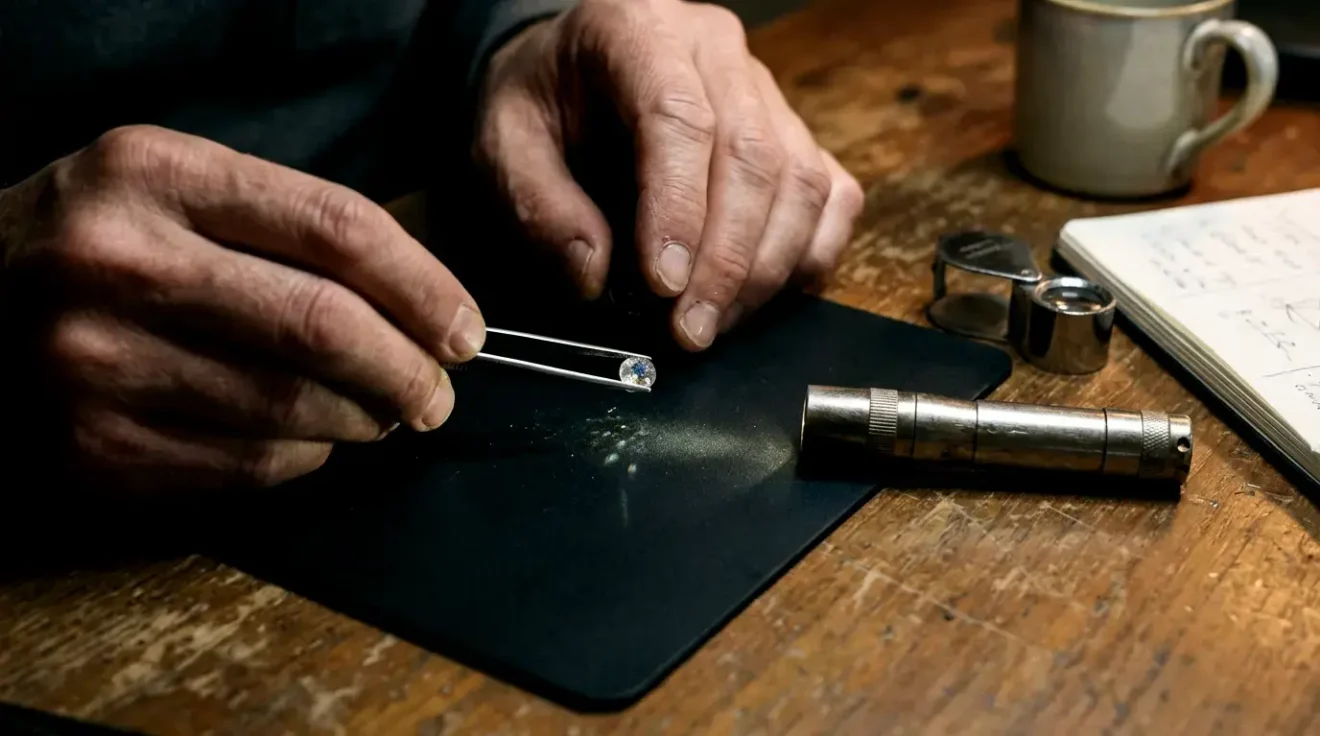
Look for rounded gas bubbles, curved internal features, fractures, and possible junctions between layers. Some features may suggest manufactured or assembled materials, but no single inclusion type reliably identifies every imitation.
Switch to transmitted light by placing the torch behind the gemstone. Inspect an accessible facet junction or internal edge for apparent doubling. This can sometimes support the possibility of double refraction, although many doubly refractive stones show no obvious doubling under a loupe.
Your five-action gemstone screening checklist
- Inspect the clean stone face-up and record one observation about brightness or windowing.
- Use the loupe under grazing light and write down any visible bubbles, fractures, or unusual inclusions.
- Illuminate the stone from behind and note whether an internal edge appears doubled.
- Rotate the stone and record any consistent change in color or visible optical effects.
- Compare the observations with the seller’s description and write one specific question requiring clarification or professional testing.
Color changes with viewing direction may suggest pleochroism, but they can also result from lighting geometry and reflections. Similarly, an apparent doubling effect may arise from facet reflections rather than genuine birefringence.
Coatings, synthetic growth features, and treatment residues cannot be reliably diagnosed through this short examination. Some features are too small or ambiguous to interpret without specialized instruments.
The outcome should be a documented observation, not a definitive gemstone name. If the stone is expensive or the listing makes significant authenticity claims, professional testing remains the appropriate next step.
Refractometer vs Polariscope: Which Tool Solves More Problems for a Beginner on a Budget?
A refractometer provides quantitative optical measurements that can help distinguish gemstone species. A polariscope gives qualitative information about optical character, especially whether a material behaves as isotropic or anisotropic. For beginners, a polariscope may be a simpler starting point, while a refractometer becomes more useful when accurate RI values are needed to separate visually similar materials.
The tools answer different questions. A refractometer asks how strongly the material refracts light. A polariscope investigates how the material behaves between polarized filters as its orientation changes.
That makes the polariscope useful for sorting candidates into optical categories. It cannot, however, identify a gemstone species from optical character alone.
It is also important not to assume that a polariscope automatically separates glass from natural gemstones. Ordinary glass and cubic minerals such as spinel and garnet are generally isotropic. Some glass can also display anomalous double refraction caused by internal strain.
The refractometer is more quantitative but requires correct optical contact, suitable facet geometry, and careful interpretation of shadow edges.

The comparison becomes clearer when linked to specific buying and identification tasks.
| Decision factor | Refractometer | Polariscope |
|---|---|---|
| Primary result | Numerical RI and optical behavior | Qualitative optical character |
| Species discrimination | Useful when RI ranges differ | Limited without other tests |
| Learning requirements | Optical contact and shadow-edge interpretation | Rotation patterns and anomalous behavior |
| Mounted stones | Often difficult to measure | Sometimes accessible, depending on the setting |
| Best beginner use | Comparing candidate materials quantitatively | Learning isotropic and anisotropic behavior |
If the main goal is learning optical classification, a polariscope can offer a practical introduction without the contact-liquid technique required by a standard refractometer.
If the main goal is distinguishing gemstones that share a color but have different RI ranges, a refractometer offers more directly useful evidence. Its value depends on whether the materials fall within the instrument’s measurable range.
For occasional jewelry purchases, neither tool is necessarily the best investment. An independent gemological examination may provide more dependable information than purchasing equipment without sufficient training.
Once a refractometer becomes part of the workflow, measurement technique matters as much as instrument selection, particularly when the gemstone is small or already mounted.
How Do You Get a Reliable Refractometer Reading When the Stone Is Small or Mounted?
Reliable refractometer readings require suitable contact between a polished gemstone facet and the instrument’s measuring surface. Small stones offer limited contact area, while jewelry settings may obstruct usable facets. Careful positioning, appropriate contact liquid, consistent illumination, and repeated observations can improve reliability, but some mounted gemstones cannot be measured accurately without professional intervention.
A standard gemological refractometer typically uses a high-RI contact liquid to establish optical contact between the gemstone and the instrument’s measuring surface.
The amount of liquid should be controlled. Excess liquid can complicate handling, while inadequate contact can produce weak or misleading shadow edges. The correct procedure depends on the instrument and the material being tested.
For small loose stones, select a clean, polished facet with sufficient surface area. A stable position and suitable illumination make the shadow edge easier to distinguish.
Where possible, use the monochromatic light recommended for the instrument. This helps reduce ambiguity in readings caused by different wavelengths of light.
Repeat the measurement after repositioning the stone. If the material is anisotropic, rotate it appropriately and record the observed shadow-edge behavior rather than treating every difference as random error.
Mounted gemstones introduce additional restrictions:
- The setting may prevent a sufficiently flat facet from contacting the instrument.
- Prongs, bezels, and adjacent stones can obstruct positioning.
- The gemstone may be too small to produce a clear reading.
- The instrument may be unable to measure the material because its RI exceeds the available range.
Where conventional contact measurement is impossible, a trained gemologist may consider other techniques, including suitable spot readings on curved surfaces, specialized optical methods, or examination after professional removal from the setting.
These alternatives are not interchangeable with a full conventional refractometer measurement. A spot reading, for example, may provide less complete information about birefringence.
Surface coatings and assembled gemstones create another problem. A reading obtained from an accessible surface may describe that surface material rather than the entire object.
A doublet can contain different materials bonded together. Consequently, a single measured RI does not necessarily establish the composition of every layer.
When an accurate reading cannot be obtained, the correct result is inconclusive, not an estimated value selected to match the seller’s description.
Measurement uncertainty should determine the next test. This leads to the final purchasing decision: when should refractive index be checked immediately, and when is it better used after other evidence has been collected?
Key takeaways before choosing your next test
- A clean, loose gemstone with an accessible polished facet is generally a better candidate for conventional RI testing than a tightly mounted stone.
- Overlapping RI ranges and complex optical behavior make supporting observations essential.
- An incomplete measurement should trigger further investigation, not a forced identification.
When Should RI Be Your First Test vs Your Last Test in an Identification Workflow?
Use refractive index early when a gemstone is loose, accessible, and likely to have a diagnostically useful RI range. Delay or omit conventional RI testing when the stone is mounted, assembled, coated, or otherwise difficult to measure. The best sequence begins with non-destructive observation and uses each subsequent test to resolve a specific remaining uncertainty.
For an accessible loose gemstone, a refractometer can rapidly eliminate incompatible species. Its usefulness is especially high when the likely candidates have distinguishable optical properties.
However, the first action should still be visual inspection. Examining the stone’s transparency, apparent color, inclusions, surface condition, and possible assembly boundaries helps determine whether a conventional RI reading will be meaningful.
A practical workflow can follow this sequence:
- Record the seller’s claimed identity, origin, treatment disclosures, and any existing report details.
- Inspect the gemstone visually, noting possible inclusions, coatings, or assembled construction.
- Measure RI when suitable and compare the result with appropriate reference information.
- Investigate optical character, pleochroism, density, or other relevant properties as needed.
- Refer unresolved or commercially significant questions for professional laboratory examination.
The exact order can change. A polariscope may be useful before RI measurement when optical character is the main uncertainty. Density testing can help in certain circumstances but is not always practical or appropriate.
Advanced spectroscopy and chemical analysis become relevant when standard gemological observations cannot resolve the identity, treatment, or composition of a specimen.
Destructive testing should not be a routine part of consumer gemstone identification. Valuable gemstones and jewelry should be examined using suitable non-destructive techniques whenever possible.
For a buyer reviewing a report, ask whether the recorded optical properties are consistent with the gemstone species named. Where relevant, a measured RI range and birefringence information can provide useful supporting evidence.
Not every report includes RI measurements, and the absence of a numerical value does not automatically make a report unreliable. Laboratories may use different instruments and reporting conventions.
Equally, a matching RI does not prove that the report belongs to the particular gemstone being offered. Verify the report number with the issuing laboratory, compare the listed measurements and identifying characteristics, and check whether the report’s description matches the actual stone.
The most important distinction is between material identification and broader commercial claims. RI can support identification, but it cannot independently establish geographic origin, treatment history, natural versus synthetic growth, or market value.
Before buying, request the seller’s available gemological documentation, compare its identifying details with the actual stone, and seek independent testing when uncertainty could materially affect the purchase. Treat RI as one useful piece of evidence within a complete identification process, never as a standalone guarantee.
Can two different gemstones have exactly the same refractive index?
Yes. Different gemstone species can have overlapping RI ranges, and an individual measurement may be compatible with several materials. Optical character, inclusions, density, and other gemological properties are often needed to distinguish them. A matching RI supports an identification hypothesis but does not confirm it independently.
Does a refractive-index reading prove that a gemstone is natural?
No. Natural and laboratory-grown examples of the same gemstone species can share essentially the same optical properties. Certain imitations may also overlap the RI ranges of natural materials. Establishing natural origin generally requires additional observations or laboratory analysis.
Why might a gemstone report show two refractive-index values?
Many crystalline gemstones are doubly refractive. Their optical properties vary according to crystal structure, polarization, and direction. Two reported principal RI values may describe this behavior, while their difference provides birefringence information. Biaxial gemstones have three principal indices, so interpretation can be more complex.
Can refractive index change when a gemstone is heated or treated?
Some treatments can alter optical properties, but the effects depend on the gemstone and treatment. A coating may affect what is measured at the surface without representing the underlying material. An ordinary RI reading cannot reliably establish whether a gemstone has been heated or treated.
Is refractive index enough to determine what a gemstone is worth?
No. RI is a physical property useful for identification, not a pricing scale. Gemstone value can depend on confirmed identity, color, cut, clarity, size, treatment status, origin when relevant, and market conditions. Two gemstones with similar RI readings may have very different commercial values.