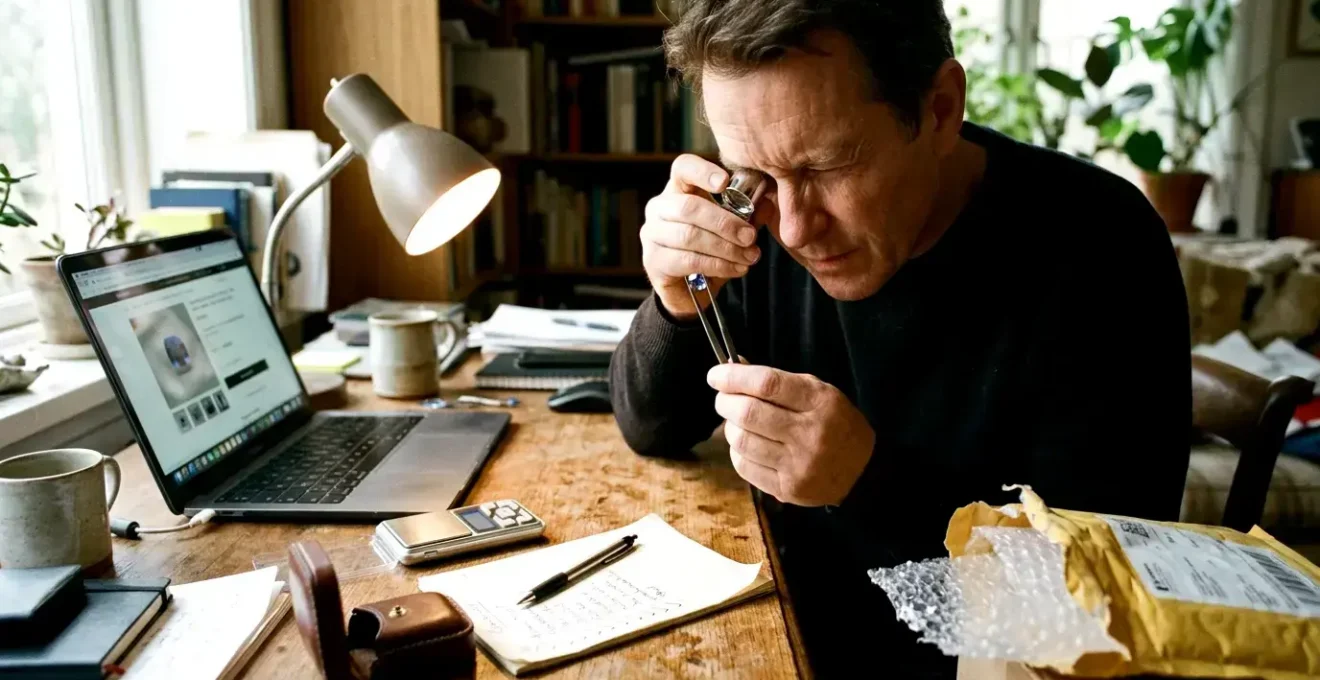
Authenticating a gemstone does not require becoming a gemmologist, but it does require separating what a seller claims from what can actually be verified. A convincing photograph, an attractive price or an elaborate provenance story cannot establish whether a stone is natural, synthetic, treated or accurately described.
A practical buyer can reduce the risk of fraud through three successive stages: screen the listing and seller before payment, inspect the physical stone immediately after delivery, and obtain formal laboratory documentation when the value or intended resale justifies the expense. Each stage answers a different question and requires a different level of expertise.
This approach works across online marketplaces, jewellery fairs and auctions, although the available return rights and inspection opportunities vary by country and transaction type. The objective is not to test every inexpensive purchase professionally. It is to identify warning signs early, preserve evidence and know when independent verification becomes necessary.
The three-stage gemstone authentication method
- Before paying: verify the seller, written gemstone disclosures, photographs, return conditions and payment protections.
- Immediately after arrival: document the package, compare the stone with the listing and check its weight, dimensions and visible characteristics.
- Before resale or a major financial commitment: obtain an appropriate independent laboratory report or professional appraisal, depending on the question being answered.
- Why Do Most Fake-Gem Sales Succeed Because of the Story, Not the Stone?
- How to Authenticate an Online Gem Listing Using a 7-Point Evidence Checklist?
- Return Policy vs Pre-Purchase Verification: Which Protects You Better on High-Risk Listings?
- The Social-Proof Trap: Assuming a Gem Is Authentic Because a Creator Promoted the Seller
- When Should You Authenticate: Before Paying, Immediately After Arrival, or Only Before Resale?
- How to Authenticate an Online Gem Listing Using a 7-Point Evidence Checklist?
- Lab Report vs Independent Appraiser: Which Is Better if You’re Buying Online and Can’t View?
- Which Gemological Laboratory Service Do You Actually Need Before You Spend £150+?
Why Do Most Fake-Gem Sales Succeed Because of the Story, Not the Stone?
Gemstone fraud can succeed because buyers are persuaded by the circumstances surrounding a stone before examining the evidence supporting its identity. Stories about inherited collections, urgent estate sales or privileged access to a mine create emotional pressure and make an apparently exceptional purchase feel difficult to refuse. A believable narrative, however, is not proof of authenticity.
Three recurring sales narratives deserve particular scrutiny.
- The desperate seller: someone claims to need immediate cash following an inheritance, relocation or unexpected expense. Ask why the stone is being sold privately and whether its previous ownership or purchase can be documented.
- The insider deal: the seller claims direct access to a mine, a dealer network or a privileged source. Ask for the business identity, the actual origin documentation and the evidence supporting the claimed supply relationship.
- The once-in-a-lifetime find: the stone is presented as exceptionally rare, substantially undervalued or unlikely to remain available. Ask what specific gemological characteristics establish that rarity and whether an independent report supports the description.
These stories are not automatically fraudulent. Legitimate private sellers may have limited paperwork, particularly when selling inherited jewellery or older collections. A missing historical invoice is different from a fabricated certificate or an origin claim that changes whenever the buyer requests evidence.
Look for inconsistencies rather than judging the seller solely on presentation. Warning signs include documents with incompatible dates, named previous owners who cannot be verified, photographs appearing under different seller accounts and descriptions that change between conversations.
Price anchoring creates another vulnerability. A seller first presents an allegedly exceptional market value, then offers a substantial discount. The buyer starts evaluating the discount instead of asking whether the original valuation or gemstone identity is credible.
A useful safeguard is to establish verification requirements before contacting the seller. Decide which documents, photographs and disclosures are necessary independently of the asking price. The FTC consumer guidance on buying gemstones and diamonds recommends researching seller reputation and obtaining written information about the purchase, including gemstone characteristics and treatments.
The central distinction is simple: a legitimate seller should be able to distinguish what is known, what is documented and what remains uncertain. If a story becomes more elaborate while supporting evidence remains unavailable, postponing payment is the sensible decision.
How to Authenticate an Online Gem Listing Using a 7-Point Evidence Checklist?
An online gemstone listing should pass seven checks before payment: seller identity, photographic evidence, written material disclosure, treatment disclosure, return conditions, payment protection and access to independent verification. These checks do not prove authenticity individually, but together they help identify listings where the seller cannot substantiate important claims.
The first step is to distinguish documentary evidence from visual presentation. Attractive photographs are useful for assessing a listing, but lighting, image processing and camera settings can substantially influence the apparent colour and clarity of a gemstone.
Use the following sequence to evaluate the purchase.
- Seller identity and trading history: establish the seller’s real business identity, contact details and trading history. Search for independent reviews and complaints. An established digital presence is useful but does not guarantee that a particular stone is genuine.
- High-resolution photographs: request sharp macro photographs of inclusions, the face-up appearance, the side profile and the pavilion. Ask for images under daylight and warmer artificial lighting. Compare the results rather than relying on one promotional photograph.
- Written material disclosure: obtain confirmation of the gemstone species and whether the material is natural, laboratory-created or an imitation. These categories are not interchangeable.
- Treatment disclosure: ask whether the stone has undergone heating, dyeing, irradiation, fracture filling or another treatment. Request written clarification of anything not disclosed in the listing.
- Return conditions: establish the applicable return period, notification deadline, shipping responsibility, refund procedure and any exclusions. Save the seller’s written response.
- Payment method: favour payment methods offering meaningful dispute procedures or a suitable escrow arrangement. Avoid irreversible transfers when the seller’s identity or the stone’s description remains uncertain.
- Independent verification: determine whether a recognised laboratory or independent professional can examine the stone and whether the transaction can be structured to preserve its identity throughout the process.
Photographic requests should be specific. A buyer should ask for a macro image showing inclusions, a daylight photograph, a warmer-light comparison and a side view revealing the cut proportions. A short video showing the same stone from several angles can also help establish visual consistency, although it cannot replace laboratory identification.
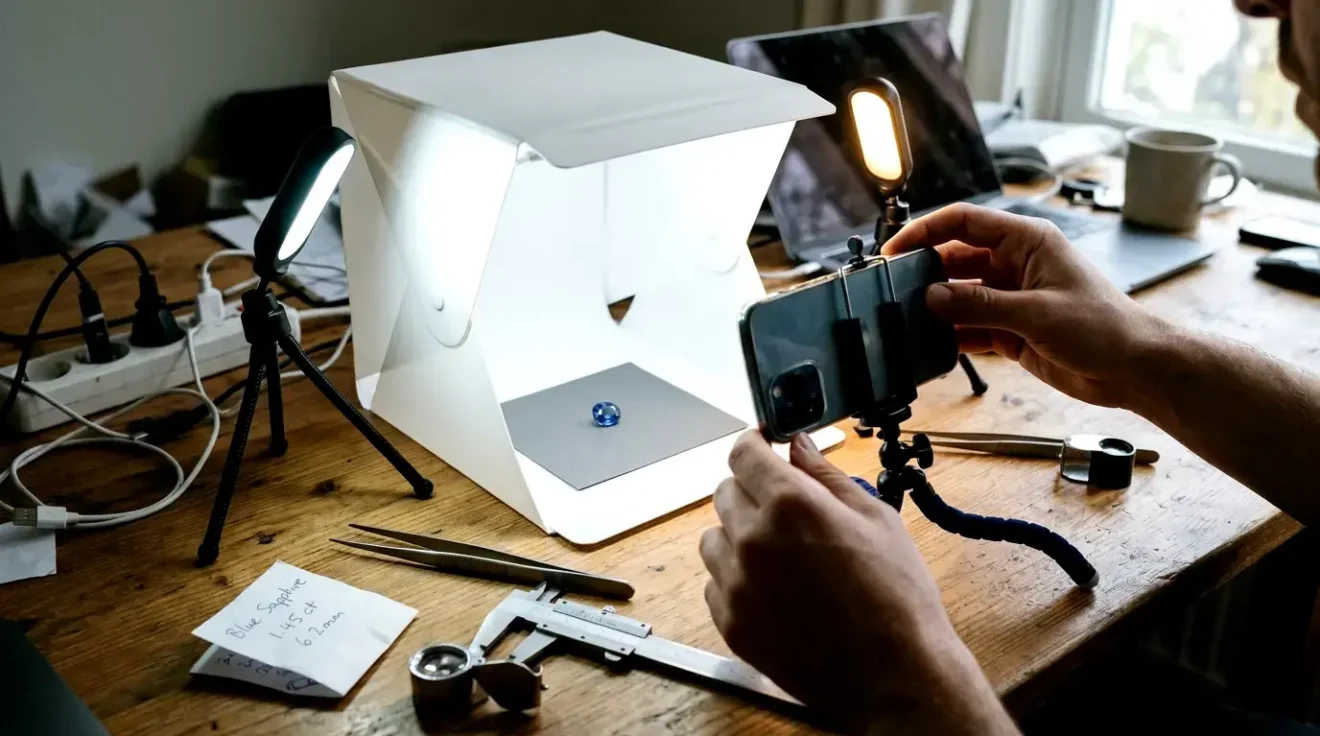
Cross-check the seller’s online presence across marketplaces, trade forums and independent review platforms. Reverse image searches can reveal whether the same photograph appears in unrelated listings or under different seller identities. Such a match is a reason to investigate, not conclusive proof of fraud: dealers sometimes legitimately use shared catalogue imagery.
The seven checks should not carry identical weight. Seller identity, precise written disclosures and a credible verification route are particularly important. Photographs support the assessment but are easier to manipulate and cannot establish whether a stone is natural or synthetic.
Terminology also matters. The FTC distinguishes natural gemstones, laboratory-created gemstones and imitations. Laboratory-created stones can share the chemical, physical and visual properties of natural counterparts, while imitation materials do not have the same properties. Words such as « genuine », « rare find » and « gem-quality » do not independently establish geological origin, treatment status or market value.
A listing that passes six checks but fails the independent verification test should not automatically be rejected or approved. The importance of the missing evidence matters. If the seller refuses to disclose treatments or provide a credible identity, do not proceed. If the only missing element is an independent examination, consider escrow or a written purchase condition allowing post-arrival verification and return.
Your five-step pre-purchase evidence record
- Record the seller’s business identity, contact details and independent review findings in a saved document.
- Save the listing and request macro, daylight, warm-light and side-profile photographs.
- Obtain written confirmation of gemstone identity, natural or laboratory-created status and known treatments.
- Save the complete return conditions, payment terms and any written verification agreement.
- Record the laboratory or independent professional proposed for verification and the transaction conditions attached to that examination.
A seller who cannot provide several essential elements should not receive the benefit of the doubt simply because the listing looks professional. When documentation is insufficient, the safest alternative is to delay the transaction until an independent examination can be arranged.
Return Policy vs Pre-Purchase Verification: Which Protects You Better on High-Risk Listings?
Pre-purchase verification generally offers stronger protection when a gemstone is expensive, unusually described or difficult to replace because it addresses uncertainty before money changes hands. A return policy provides an opportunity to recover funds after payment, but it depends on deadlines, contractual conditions, documentation and the seller’s cooperation. For higher-risk purchases, combining both safeguards is usually more sensible.
The difference is between preventing a questionable transaction and retaining a remedy if something goes wrong. Neither option is universally sufficient.
| Criterion | Return policy | Pre-purchase verification |
|---|---|---|
| When it operates | After payment and delivery | Before committing or completing payment |
| Main benefit | Provides a potential refund route | Reduces uncertainty before purchase |
| Primary limitation | Deadlines, exclusions and possible disputes | Time, professional fees and logistical complexity |
| Evidence required | Listing, transaction and condition records | Stone identification and credible examination arrangements |
| Best application | Lower-risk purchases with enforceable return conditions | High-value or high-uncertainty purchases |
Return rights also depend on the country and the way the transaction is conducted. In the United Kingdom, qualifying distance purchases generally give consumers 14 days from receiving the item to notify the seller of cancellation, followed by another 14 days to return it. The seller generally has 14 days after receiving the returned item to issue the refund.
The UK Government guidance on returns and refunds also explains that consumers may handle goods as they would in a shop to examine them. However, statutory cancellation rights have exceptions, and an online purchase should not automatically be treated like an in-person auction or private sale. A voluntary seller return policy is not the same as a statutory consumer right.
There are practical risks beyond the legal deadline. A seller may dispute whether the returned gemstone is the original stone, or question its condition after examination. International returns can also involve additional shipping and customs complications. These possibilities make documentation particularly important.
For that reason, photograph the package before opening it, record the unboxing process and retain the original packaging, transaction documents and correspondence. Avoid altering, cleaning aggressively or conducting destructive tests on the stone during the return period.
A hybrid approach is often more practical than choosing only one protection. When pre-purchase testing is impossible, use the return window as an inspection period: compare the received stone with the listing, document its condition and arrange an appropriate independent identification check before the deadline.
For lower-value purchases, the cost of professional verification may be disproportionate to the potential financial loss. For a more expensive stone with uncertain origin, treatment or identity, the cost of an independent examination may be justified. The relevant threshold depends on the buyer’s financial exposure, experience and intended use, not a universal purchase amount.
A return policy should be treated as a fallback rather than proof that a seller is trustworthy. Where the gemstone’s description is central to the purchase price, establishing that description before payment is the stronger starting point.
The Social-Proof Trap: Assuming a Gem Is Authentic Because a Creator Promoted the Seller
An influencer endorsement does not authenticate a gemstone. A creator may recommend a seller because of an advertising agreement, affiliate arrangement, personal experience or commercial relationship, but none of these establishes that a particular stone is natural, untreated or correctly described. Promotion is evidence of exposure, not independent gemological verification.
Social proof works because buyers interpret visible popularity as a form of reassurance. A seller with frequent posts, enthusiastic comments, live demonstrations and a large following can appear more credible than an unknown specialist. Yet the size of an online community cannot establish the physical identity of a gemstone.
Creators may also lack the technical training needed to distinguish natural stones from laboratory-created materials or to assess treatments. Even an honest recommendation may rely entirely on information supplied by the seller. Commercial responsibility and liability also depend on the applicable jurisdiction and the specific advertising relationship; an endorsement should never be confused with a laboratory guarantee.
Audit a promoted seller independently rather than relying on the creator’s reputation.
- Check the seller’s registered business identity and contact details where applicable.
- Look for independent reviews outside the creator’s own channels and affiliate ecosystem.
- Compare the seller’s descriptions across marketplaces and previous listings.
- Check whether named laboratories issued the reports being advertised.
- Request written disclosure distinguishing natural, laboratory-created, imitation and treated material.
The wording of promotional claims deserves particular attention. The term « genuine » may indicate that a stone is a real mineral rather than an imitation, but it does not automatically establish that the material formed naturally. Similarly, a laboratory-created gemstone is not necessarily an imitation: it can have the same chemical, physical and visual properties as its natural counterpart.
Another issue is the way commercial volume creates familiarity. A seller may show hundreds of transactions and repeat positive customer feedback, yet the buyer still needs evidence about the exact gemstone being purchased. A reputation for selling real gemstones does not establish that every item has been accurately described or that every treatment has been disclosed.
Buyers who have already purchased through a promotional link should return to the same evidence requirements. Save the advertisement, affiliate link, listing, payment confirmation and seller correspondence. Then compare the delivered stone with the written description and obtain independent verification if a material discrepancy remains.
The promotional context may provide useful evidence when contacting the creator, marketplace or payment provider, particularly if the recommendation contained specific factual claims. However, public accountability does not replace formal dispute procedures or the applicable consumer protections.
A trustworthy buying decision should survive without the endorsement. If the stone, documentation and transaction conditions cannot stand on their own, a creator’s confidence should not change the decision.
When Should You Authenticate: Before Paying, Immediately After Arrival, or Only Before Resale?
Gemstone authentication should begin before payment, continue immediately after delivery and be repeated through formal documentation when resale, insurance or a significant financial decision requires it. The three stages protect against different risks: misleading listings, discrepancies between the advertised and delivered stone, and uncertainty about the gemstone’s identity or value in a future transaction.
Waiting until resale is a mistake because basic buyer protection is most useful before the return period expires. The earlier the evidence is collected, the easier it is to compare the seller’s claims with the physical object.
Stage 1: Screen the purchase before paying
Start with the seller’s identity, trading history, photographs, material disclosure and treatment information. Establish the return conditions and decide whether independent verification is necessary before completing payment.
At this stage, the objective is not to determine every gemological characteristic. It is to establish whether the listing is sufficiently documented to justify a purchase and whether a credible remedy exists if the stone differs from its description.
Stage 2: Inspect the gemstone immediately after arrival
The first days after delivery are particularly important because the physical stone can now be compared with the listing. Photograph the unopened parcel, document the unboxing and preserve the original packaging. Record the condition of the gemstone before handling it extensively.
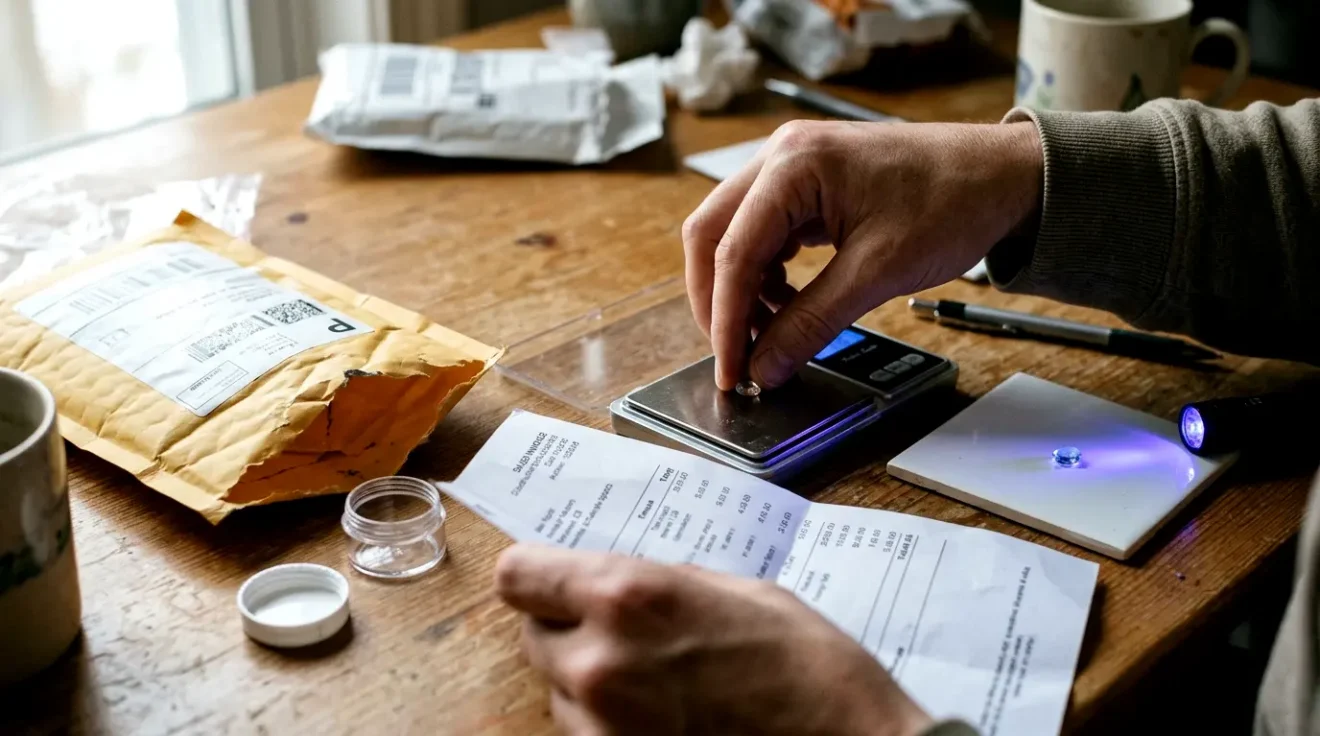
Compare the stated weight and dimensions with the seller’s documentation. A digital pocket scale can help identify a discrepancy, but it must be suitable for the stone’s size and used correctly. Weight alone cannot authenticate a gemstone because different materials and cuts can produce overlapping measurements.
A 10x jeweller’s loupe can help examine visible inclusions, surface characteristics and possible inconsistencies. However, identifying natural growth features, synthetic growth structures or treatment evidence requires appropriate gemological expertise. A buyer should not interpret one inclusion or optical effect as conclusive proof of origin.
Ultraviolet light can provide an additional observation, but fluorescence varies between gemstones and does not independently establish authenticity. Some natural stones fluoresce, some synthetic stones do, and others show little or no reaction. UV observations should therefore be recorded as supporting information rather than a pass/fail authentication test.
Keep all photographs, measurements and correspondence together. If the received stone differs from the listing, contact the seller promptly and follow the applicable return or dispute procedure. Do not wait until the final day of the return window to arrange an examination.
Stage 3: Obtain formal confirmation before resale
A formal laboratory report becomes useful when the stone’s identity, treatment status or geographic origin needs independent documentation. For some gemstones, a recognised laboratory can identify whether the material is natural or synthetic and report detectable treatments. Geographic origin may also be determined for certain stones when the laboratory considers it possible.
A separate appraisal answers a different question: what is the gemstone worth for a particular purpose? A report establishing identity is not automatically a valuation, and an appraisal should not be treated as a substitute for appropriate gemological identification.
The amount spent on verification should reflect the value at risk, the quality of existing documentation and the intended resale or insurance use. A formal report may add confidence to a future transaction, but it does not guarantee a resale price or eliminate every risk of fraud.
Experienced collectors may be comfortable conducting more of the initial physical inspection themselves. First-time buyers should place greater emphasis on written pre-purchase evidence and independent examination, particularly when the purchase represents a substantial financial commitment.
Key decisions before choosing a laboratory service
- Determine whether the unresolved question concerns gemstone identity, treatment, geographic origin or financial value.
- Establish whether the physical stone can be examined without losing the opportunity to return it.
- Preserve the relationship between the listing, the delivered stone and any subsequent laboratory submission.
Authentication is most effective when it is treated as a continuous evidence process rather than a single certificate obtained at the end. The next decision is choosing the professional service that answers the actual question.
How to Authenticate an Online Gem Listing Using a 7-Point Evidence Checklist?
When an online purchase cannot be examined in person, the buyer should distinguish between evidence that describes the seller’s claims and evidence that independently establishes the gemstone’s characteristics. A checklist helps organise the first category, while a recognised laboratory report may be necessary for the second. Neither attractive listing photographs nor a certificate PDF should be accepted without checking their relevance to the stone being sold.
The seven checks already described form the first level of assessment, but their importance depends on the claim being made. A seller offering a simple natural amethyst with clear treatment disclosure presents a different verification challenge from one advertising a rare untreated sapphire with a precise geographic origin.
For this reason, documentation must be interpreted according to its actual wording.
- Natural: indicates a gemstone formed naturally rather than manufactured in a laboratory. It does not automatically mean untreated.
- Lab-grown or laboratory-created: describes material manufactured in a laboratory. It may have the same chemical, physical and visual properties as its natural counterpart.
- Genuine: can indicate a real gemstone rather than an imitation, but does not independently establish natural origin or treatment status.
- Heat-treated: indicates that heat has been used to alter a gemstone’s characteristics.
- Unheated: is a specific treatment-related claim that should be supported by appropriate examination and documentation.
- Gem-quality, dealer direct and rare find: are descriptive or commercial expressions that do not independently authenticate the material.
Payment protection should also be considered part of the evidence process. A credit card or a buyer-protection platform may provide dispute mechanisms, while wire transfers, cryptocurrency and some peer-to-peer transfers may be difficult or impossible to reverse. The precise protection depends on the provider’s terms, transaction type and applicable law.
Consider a seller who provides a professional-looking listing, six of the seven requested elements and an apparently valid laboratory document, but cannot establish that the document corresponds to the stone being sold. The correct response is not to assume that the report is false or genuine. It is to request a controlled independent examination before finalising the transaction.
A laboratory submission arranged by the seller can be useful, provided the buyer can verify the laboratory, report and identity of the submitted stone. Where practical, a transaction can be structured around escrow or conditional payment so that the examination takes place before the buyer accepts the purchase unconditionally.
When the seller refuses any credible verification arrangement, the buyer should reconsider the transaction. A small saving on professional fees is not a meaningful advantage if the central claim remains unverified.
Ultimately, the best online purchase is not necessarily the listing with the most impressive photographs. It is the one where the seller’s identity, gemstone description, payment conditions and verification route can all be independently examined.
Lab Report vs Independent Appraiser: Which Is Better if You’re Buying Online and Can’t View?
A laboratory report is generally the better first choice when the main concern is whether an online gemstone is what the seller claims it to be. An independent appraiser is more appropriate when the question concerns quality, financial value, insurance or resale. These services answer different questions, so selecting the wrong one can leave the buyer with a document that does not resolve the original uncertainty.
A gemological laboratory examines the stone and provides information about its identity and characteristics. Depending on the laboratory and service, a coloured gemstone report may identify the gemstone type, distinguish natural from synthetic material and record detectable treatments.
An appraisal focuses on value within a stated context. It may consider the gemstone’s identity, quality, characteristics and the valuation purpose. It does not necessarily replace laboratory analysis where a specific question about origin or treatment requires specialist testing.
| Buyer question | Laboratory report | Independent appraisal |
|---|---|---|
| Is the stone the claimed gemstone? | Primary service | May rely on existing identification |
| Is it natural or synthetic? | Appropriate identification service | Not necessarily the primary purpose |
| Are treatments detectable? | Appropriate treatment analysis | May use laboratory documentation |
| Is the claimed geographic origin supported? | Origin determination, where available | Not the primary service |
| What is the stone worth? | Not a universal valuation service | Primary service |
| What documentation is useful for resale or insurance? | Identity and characteristics | Valuation for the relevant purpose |
For buyers considering GIA, its GIA coloured stone laboratory reports and services describe gemstone type, natural or synthetic status and detectable treatments. Certain services can also provide geographic origin where determinable, together with measurements, weight, colour and a photograph.
The transaction structure matters just as much as the choice of laboratory. A report is based on the specimen submitted. It does not automatically establish that the specimen is the same stone shown in the original listing. The buyer therefore needs to consider who sends the gemstone, who receives it and how its identity is preserved throughout the process.
For an online purchase, a controlled submission through a recognised laboratory or trusted intermediary may reduce the risk of substitution. If the stone is sent directly by the seller, the buyer should obtain sufficient documentation to identify the specimen and agree on the transaction conditions before payment becomes unconditional.
Certificate verification is another essential step. Do not rely solely on a PDF supplied by the seller. For GIA documentation, the official Report Check service allows buyers to enter a report number and compare the supplied information with the archived laboratory record. Depending on the report date, additional information may include a report image or other supporting documents.
Checking the report number is not the same as verifying the physical gemstone. Compare the available photograph, measurements, weight and description with the stone being purchased. Even a successful database lookup does not prove an uninterrupted chain of custody.
For an online buyer, a laboratory report is usually the logical first professional step when gemstone identity is uncertain. An appraisal can follow once the stone has been adequately identified and its value needs to be established.
Which Gemological Laboratory Service Do You Actually Need Before You Spend £150+?
The correct laboratory service depends on the question the buyer needs answered, not simply on the purchase price. A basic identification report may be sufficient to establish gemstone type and detectable treatment information. Origin determination requires a more specific service, where available, while an appraisal is appropriate when the objective is financial valuation. Paying for every available test is rarely necessary.
The figure of £150 in this question is a decision prompt, not a universal laboratory-testing threshold. The appropriate verification budget depends on the stone’s claimed identity, financial exposure, documentation and intended use. A lower-priced gemstone with an unusually strong origin claim may justify more scrutiny than a higher-priced purchase with straightforward characteristics and credible supporting documentation.
Three broad service categories help organise the decision.
1. Basic gemstone identification
This is the starting point when the buyer needs to know what the stone is and whether it is natural or synthetic. Depending on the laboratory and gemstone, the report may also identify detectable treatments. It is particularly relevant when a seller’s description is central to the purchase decision.
2. Treatment and geographic origin services
Additional analysis may be appropriate when the seller makes a specific claim about treatment status or geographic origin. Not every gemstone has an origin determination service available, and a laboratory may be unable to reach a conclusive geographic determination. Treatment detection also has technical limits, so the absence of a reported treatment should not automatically be interpreted as proof that every possible treatment is absent.
3. Full appraisal documentation
An appraisal is relevant when the buyer needs a professional value assessment for insurance, estate administration or resale planning. It should be commissioned for the appropriate purpose and should not be confused with an identification report. A laboratory report does not automatically establish market value.
Before booking, define the question precisely.
- If the question is whether the stone is natural or synthetic, request an appropriate identification report.
- If the question is whether a treatment can be detected, select a service that covers the relevant treatment analysis.
- If the question concerns geographic origin, establish whether the laboratory offers origin determination for that particular gemstone.
- If the question is whether the purchase price is reasonable, seek an appropriate independent appraisal.
One limitation deserves particular attention: a laboratory report describes the gemstone submitted for examination. It cannot automatically establish that the submitted stone is the same physical specimen advertised online. This is why chain of custody is part of the buyer’s responsibility.
Before arranging an examination, retain the listing, original photographs, seller correspondence, stated weight and dimensions, and any existing report. If possible, ensure that the stone is identified consistently throughout the submission process and that the buyer receives the same specimen examined by the laboratory.
For GIA reports, the GIA Report Check verification service provides a way to compare a report number with the laboratory’s archived record. Buyers should still compare any available specimen photograph and recorded characteristics with the actual gemstone rather than treating database verification as physical authentication.
The final choice should be proportionate to the financial and practical purpose of the purchase. A basic report can answer a narrowly defined identification question, whereas additional origin analysis or valuation may be justified when the transaction depends on those specific claims.
Before spending money on a professional service, prepare the listing, seller disclosures and available documentation, then ask the laboratory which examination is appropriate for the specific gemstone and claim. A clear question, a recognised service and a controlled chain of custody provide a more useful result than an unnecessarily extensive report.
Can a jeweller’s loupe prove that a gemstone is genuine?
No. A 10x loupe can help examine inclusions, surface features and visible inconsistencies, but it cannot reliably establish every gemstone’s natural or synthetic origin or identify all treatments. Use it for preliminary inspection and seek a recognised laboratory report when the distinction matters financially.
Can a gemstone certificate be fake even if its report number is valid?
Yes. A valid report number can belong to a genuine laboratory record without proving that the stone being sold is the specimen described in that record. Verify the report through the laboratory’s official system and compare the available photograph, measurements and weight with the actual gemstone.
Are laboratory-created gemstones considered real gemstones?
Laboratory-created gemstones are manufactured materials that can share the chemical, physical and visual properties of their natural counterparts. They are distinct from imitation stones, which use other materials and do not share the same properties. The important issue is that the seller describes the material accurately.
Does an untreated gemstone always have a higher value?
Not automatically. Value depends on the gemstone type, quality, rarity, market demand and other characteristics. Treatment status can influence value, but the impact varies between gemstones and treatments. A laboratory report can help establish detectable treatments, while an independent appraisal addresses the financial valuation question.
Should a gemstone be authenticated before or after an online purchase?
Ideally, screen the seller and obtain sufficient evidence before payment, then inspect the physical stone immediately after delivery. For higher-risk purchases, arrange independent verification before completing an unconditional transaction where possible. Never postpone basic inspection until resale, because the applicable return period may already have expired.