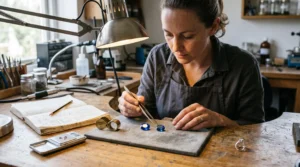
A ring worn every day faces a different test from a gemstone admired occasionally. It encounters door handles, desk edges, cleaning products, temperature changes and the occasional accidental knock. Under those conditions, a stone’s origin matters less to its survival than its mineral properties, treatments and setting.
That makes laboratory-grown gemstones worth considering. A synthetic sapphire is genuine sapphire produced through an artificial growth process, not an imitation made from unrelated material. Its natural counterpart may offer rarity and geological history, but that distinction does not automatically make it more durable.
The challenge is choosing without being misled. Laboratory-grown stones can offer attractive appearance and predictable specifications, yet ambiguous descriptions, undisclosed treatments and unrealistic resale expectations can undermine an otherwise sensible purchase.
The most useful approach is to separate emotional value from practical performance, insist on written identification and choose a ring designed for the way it will actually be worn.
Lab-grown gemstones: the essential buying decisions
- Choose by hardness, toughness, treatments and setting protection rather than natural or synthetic origin alone.
- Require written confirmation of gemstone identity, origin and relevant treatments before paying a deposit.
- Prioritise everyday enjoyment over speculative resale value, especially when buying within a modest budget.
- Why Can a Synthetic Stone Perform Better in Daily Wear Even If It’s « Less Romantic »?
- How to Get Clear Synthetic Disclosure in Writing Before You Pay a Deposit?
- Lab-Grown Sapphire vs Natural Low-Grade Sapphire: Which Is the Better Choice Under £500?
- The Wording Trap: « Created, » « Cultured, » and Other Terms That Hide Synthetic Origin
- When Should You Decide Natural vs Synthetic: Before Design, After Stone Search, or Last?
- Czochralski vs Flux-Grown: Which Lab-Grown Option Looks More « Natural » in Jewellery?
- Spinel vs Garnet: Which Is the Better Choice for a Ring You’ll Wear 300+ Days a Year?
- Which « Semi-Precious » Stones Are Actually Best for Daily Wear If You’re Clumsy or Busy?
Why Can a Synthetic Stone Perform Better in Daily Wear Even If It’s « Less Romantic »?
A synthetic gemstone can be a better everyday purchase when controlled production provides attractive clarity and fewer problematic inclusions at an affordable price. However, laboratory growth does not automatically make a gemstone harder or tougher than its natural equivalent. The real advantage is often obtaining a durable mineral species with desirable characteristics without paying a premium for natural rarity.
Consider sapphire. Both natural and laboratory-grown sapphire consist of corundum, with a Mohs hardness of 9. Their fundamental hardness comes from their crystal structure, not where they formed. A well-made synthetic sapphire therefore offers the scratch resistance associated with sapphire itself.
Natural stones sometimes contain fractures, inclusions or other internal features that affect durability. Controlled growth can reduce certain imperfections, although synthetic stones can also contain stress, bubbles or growth-related defects. A laboratory-grown label is not a guarantee against chipping or thermal damage.
The distinction becomes clearer when separating the values involved in a purchase.
| Decision factor | Natural gemstone | Laboratory-grown gemstone |
|---|---|---|
| Origin story | Geological formation and natural rarity | Controlled growth and documented production |
| Scratch resistance | Depends on mineral species | Essentially the same for equivalent material |
| Toughness | Depends on structure, defects and treatments | Depends on structure, growth defects and treatments |
| Appearance at a given budget | May involve compromises in size, clarity or colour | Can offer more flexibility in size and appearance |
| Emotional appeal | Natural history, rarity and individuality | Chosen symbolism, design and transparent provenance |
For someone wearing a ring more than 300 days annually, functional performance deserves substantial weight. Natural rarity is an emotional or collecting benefit, not a form of physical insurance. It may be worth paying for, but it will not protect a gemstone against a hard impact.
Laboratory-grown stones can still carry personal meaning. A documented origin, a custom setting or a gemstone chosen to commemorate an occasion can matter more to the wearer than geological age.
Once those priorities are clear, the next safeguard is making sure the gemstone delivered is exactly the material the seller described.
How to Get Clear Synthetic Disclosure in Writing Before You Pay a Deposit?
Before paying a deposit, request a written description identifying the gemstone, whether it is natural or laboratory-grown, and any relevant treatments. Ask for the growth method when known and important to your decision. Make sure the description appears on the quotation, order confirmation or invoice, and agree on a remedy if the delivered stone differs materially.
Verbal assurances can be difficult to establish during a dispute. A description reading simply « blue sapphire » may leave the buyer without the explicit origin information needed to distinguish a mined stone from a laboratory-grown alternative.
The FTC guidance on advertising diamonds and gemstones explains the importance of clearly distinguishing mined gemstones, laboratory-created gemstones and imitations. It also addresses disclosure of treatments that affect care, permanence or value.
These are US advertising principles, not universal legal rules governing every English-speaking country. Buyers in the UK, Canada, Australia and elsewhere should check the applicable consumer protections and contractual terms.
For a sapphire purchase, useful written wording might be: « Laboratory-grown blue sapphire (synthetic corundum), Czochralski-grown, treatment status as disclosed in the accompanying specification. » The growth-method statement should appear only if the seller can substantiate it.
For a natural stone, the description should explicitly state natural origin and identify known treatments. Do not assume that a quotation based on natural origin automatically includes independent verification.
Before committing money, request an agreed contractual remedy if an independent examination establishes that the stone does not match its written description. A full refund can be requested as a negotiated term, but it is not automatically guaranteed in every jurisdiction or transaction.
Independent identification may be worthwhile for an expensive or disputed purchase. Ask an appropriately qualified gemmologist or laboratory what its report can establish, what it costs and whether it can identify the specific growth method. Not every appraisal includes advanced laboratory testing.
Five checks to complete before paying a gemstone deposit
- Request the precise gemstone species and variety; obtain a written stone identification.
- Ask whether the stone is natural, laboratory-grown or an imitation; retain the explicit origin statement.
- Request known treatments and growth-method information where applicable; obtain a written specification or confirmation that details are unknown.
- Confirm that the quoted price applies to the exact documented stone; keep the itemised quotation.
- Agree on delivery specifications, verification arrangements and remedies for material discrepancies; retain the signed order terms.
A seller who answers precise questions clearly makes comparison easier. If essential information remains unavailable, the buyer can delay the purchase or choose a more transparent offer.
Lab-Grown Sapphire vs Natural Low-Grade Sapphire: Which Is the Better Choice Under £500?
For a sapphire purchase under £500, laboratory-grown material is often the practical choice when clarity, colour and everyday appearance matter most. Natural sapphire remains appealing when geological origin carries personal significance. Neither choice guarantees strong resale value, and treatment history can matter more to durability than origin alone. Compare complete rings or loose stones on equivalent terms.
At this budget, a buyer may encounter smaller, included or less vividly coloured natural sapphires alongside cleaner-looking laboratory-grown alternatives. These are possible market trade-offs, not universal rules: natural sapphires below £500 are not necessarily heavily treated or visibly included.
The distinction between treatment types is particularly important. Conventional heat treatment does not have the same implications as fracture filling or shallow colour diffusion.
According to GIA‘s Sapphire Care and Cleaning Guide, sapphire combines high hardness with excellent toughness and no cleavage. It also explains that shallow diffusion-treated colour may be affected by surface damage or recutting, while glass-filled fractures can introduce chemical sensitivity.
| Consideration | Laboratory-grown sapphire | Lower-priced natural sapphire |
|---|---|---|
| Visual appearance | Often easier to obtain high clarity and consistent colour | Appearance varies with size, quality and availability |
| Hardness | Mohs 9 | Mohs 9 |
| Treatments | Must still be checked | Must be checked individually |
| Origin appeal | Manufactured origin | Natural geological origin |
| Resale | No reliable appreciation assumption | No reliable appreciation assumption |
| Best fit | Appearance-focused buyer | Origin-focused buyer |
Do not assume beryllium diffusion or glass filling is present simply because a natural sapphire is inexpensive. Nor should a conventional heat-treated sapphire be described as inherently fragile. Ask which treatment was used and what care it requires.
Resale deserves similar caution. A modestly priced laboratory-grown sapphire may have limited secondary-market demand, while a low-grade natural sapphire may attract little interest beyond its jewellery setting. Actual resale proceeds depend on the stone, metal, documentation, buyer and selling channel; there is no sound basis for assigning both options a universal near-zero value.
Instead, calculate the ownership cost: purchase price, setting quality, maintenance, potential repairs and any verification fees. A ring worn happily for years may deliver better personal value than a theoretically more collectible stone that required significant compromises.
Choose natural if its origin is central to the purchase. Choose laboratory-grown if a clean appearance and predictable budget matter more, provided the stone and setting meet the same durability standards.
The Wording Trap: « Created, » « Cultured, » and Other Terms That Hide Synthetic Origin
Gemstone descriptions can be misleading when they use attractive commercial terms without identifying the material. « Created » or « cultured » may refer to laboratory production, but the wording needs context. Buyers should distinguish genuine laboratory-grown gemstones from imitations and require an explicit statement of mineral identity and origin rather than relying on marketing language.
A synthetic sapphire is chemically and structurally sapphire. Cubic zirconia sold as a diamond alternative is not diamond, even if its appearance resembles one. Moissanite is a distinct gemstone material and should not be represented as diamond.
The terminology also varies by jurisdiction. In the United States, the FTC’s jewellery guidance addresses qualifying language for laboratory-created gemstones and cautions against descriptions that imply mined origin when the material is manufactured.
The following terms are worth examining carefully.
| Listing wording | Potential meaning | Buyer response |
|---|---|---|
| Lab-created sapphire | Synthetic corundum | Confirm origin and treatments |
| Created ruby | Often laboratory-grown ruby | Request explicit laboratory-grown identification |
| Cultured gemstone | May indicate laboratory production | Ask whether it is mined or manufactured |
| Simulated sapphire | Imitation resembling sapphire | Identify the actual material |
| CZ diamond | Usually cubic zirconia presented with diamond-related wording | Confirm that it is not diamond |
| Moissanite | A distinct gemstone material | Confirm identity and natural or manufactured origin |
| Natural-looking sapphire | Describes appearance, not necessarily origin | Request an explicit origin statement |
| Geographic or branded gemstone name | May imply provenance or serve as marketing language | Ask for verified origin and mineral identity |
Some descriptions arise from longstanding trade habits rather than deliberate deception. A retailer may use shorthand familiar to suppliers but confusing to consumers. That distinction matters when requesting clarification: a neutral, specific question is often more productive than an accusation.
The financial consequences of ambiguity are uneven. A buyer may pay for an assumed natural origin that was never established, while the seller may believe the wording was sufficient. Written specifications reduce the scope for misunderstanding on both sides.
A practical question is: « Can you confirm in writing whether this is a mined gemstone, a laboratory-grown gemstone of the same mineral species, or a simulant made from another material? »
Once the material is unambiguous, it becomes much easier to compare stones fairly and decide when that choice should influence the ring design.
When Should You Decide Natural vs Synthetic: Before Design, After Stone Search, or Last?
Decide whether natural origin is essential before finalising the ring design. Stone availability, dimensions, quality and budget allocation can all change depending on that choice. Buyers who genuinely value both options can explore them briefly in parallel, but should settle the material before approving a custom setting or paying a non-refundable design deposit.
The order matters because a ring is built around a particular gemstone. A larger laboratory-grown sapphire may require a different setting from a smaller natural stone purchased for the same budget. Changing the stone later can affect proportions, metal requirements, mounting dimensions and overall appearance.
A late decision can also waste research effort. Someone who spends weeks comparing natural sapphires may discover that the desired colour and clarity exceed the budget, then restart the search with laboratory-grown alternatives. That does not necessarily double the work, but it can create avoidable redesign costs.
Three questions help establish the priority early:
- Would knowing the gemstone formed naturally matter more than obtaining the preferred size and appearance?
- Is the purchase primarily about personal symbolism and enjoyment, or does future resale form a meaningful part of the decision?
- Would choosing natural origin require accepting a smaller stone, different colour or more visible inclusions within the budget?
If natural formation is non-negotiable, start with natural stone availability and design around the best suitable candidate. If appearance and budget dominate, compare laboratory-grown materials early. If both remain acceptable, shortlist one realistic candidate of each type.
For an undecided buyer, set a decision date before custom design begins. Compare the candidates using the same criteria: documented identity, dimensions, treatments, appearance, price, setting compatibility and return conditions.
There is no need to make the choice ideological. A natural stone can be personally meaningful, and a laboratory-grown stone can be a carefully considered purchase. Neither choice needs to be defended as universally superior.
Once that decision is made, buyers interested in laboratory-grown sapphire can explore whether different production methods affect the appearance they prefer.
Czochralski vs Flux-Grown: Which Lab-Grown Option Looks More « Natural » in Jewellery?
Flux-grown sapphire may appear more similar to some natural sapphires because its internal features can resemble naturally occurring inclusions. Czochralski-grown sapphire is often relatively uniform and clean. However, neither method guarantees a particular visual appearance, and the growth process generally cannot be identified reliably from an ordinary jewellery photograph or unaided inspection.
Czochralski growth involves pulling a crystal from molten material under controlled conditions. This method can produce substantial crystals with consistent properties suitable for cutting gemstones.
Flux growth takes place through crystallisation from a high-temperature solution. It is typically slower and may produce internal features resembling those found in natural stones.
The GIA’s technical analysis of synthetic sapphire growth methods describes distinctions between flame-fusion, Czochralski, flux and hydrothermal production, including characteristic growth features and differences in manufacturing time.
These observations are useful for understanding why two synthetic sapphires can look different, but they are not a reliable consumer identification test.
Under magnification, certain growth features can provide clues. Curved growth striations are particularly associated with flame-fusion material, while round bubbles or colour banding can occur in some melt-grown stones. Flux-grown material may contain veil-like features or flux inclusions that resemble natural internal patterns.
These features are not universally present, nor are they always visible to consumers. A stone without obvious inclusions is not necessarily Czochralski-grown, and a stone with natural-looking inclusions is not necessarily flux-grown or mined.
| Feature | Czochralski | Flux-grown |
|---|---|---|
| Growth process | Crystal pulled from melt | Crystallisation from solution |
| Typical appearance | Often relatively uniform | May contain natural-looking internal features |
| Growth characteristics | Possible banding or bubbles | Possible flux inclusions and veils |
| Production considerations | Established method for producing substantial crystals | Slower process that can involve greater production complexity |
| Origin verification | Specialist identification may be required | Specialist identification may be required |
Flux-grown material may command a higher price because of production complexity and its appeal to buyers who prefer natural-looking internal characteristics. However, historical manufacturing comparisons do not establish a universal contemporary retail premium.
The irony is that a buyer choosing flux-grown sapphire for its inclusions may deliberately accept some of the visual irregularities avoided by choosing laboratory-grown material in the first place. That is a legitimate aesthetic preference, not a durability advantage.
Request documentation if the growth method influences the price. A gemmological report should be evaluated for what it actually confirms; not every laboratory report identifies a precise manufacturing process.
Growth method is only one aspect of a gemstone purchase. For a ring worn almost continuously, mineral choice and setting protection are more immediately relevant.
Spinel vs Garnet: Which Is the Better Choice for a Ring You’ll Wear 300+ Days a Year?
Spinel is generally the more straightforward choice for frequent ring wear because its Mohs hardness of 8 offers strong scratch resistance. Certain garnets, including tsavorite, can also perform well with suitable care and protective settings. The correct comparison depends on the specific garnet variety, treatments, stone condition and exposure to impacts, not simply the gemstone names.
Spinel is a distinct mineral species, whereas garnet refers to a group of related minerals. Almandine, pyrope, tsavorite and demantoid do not have identical properties. Treating all garnets as interchangeable can lead to poor purchasing decisions.
Hardness is especially relevant to scratches. Toughness describes resistance to breakage or chipping, while stability concerns reactions to light, chemicals, heat and environmental conditions. A stone may resist scratches yet remain vulnerable to a sharp impact.
For a ring worn at work, during childcare or around furniture, the setting can substantially influence the risk of damage. A low-profile bezel may shield exposed edges better than an elevated design with prominent prongs, although no setting eliminates impact risk.
Origin also deserves attention. Laboratory-grown spinel is commercially available, so blue or red spinel should not automatically be assumed natural. Garnets sold in conventional jewellery are generally natural, but an individual listing still needs accurate identification and disclosure.
There is no universal rule that synthetic spinel is tougher than natural spinel. The two share the fundamental properties of the mineral, while individual defects, treatments and cutting can influence performance.
When comparing specific rings, request the exact garnet variety, inspect exposed corners and consider whether the wearer regularly removes jewellery during demanding activities. A protected tsavorite may be a more sensible purchase than a poorly mounted spinel, despite the difference in hardness.
Spinel offers a useful starting advantage, but the best choice is the combination of gemstone and design that fits the wearer’s actual routine.
What matters before choosing your daily-wear gemstone
- Hardness protects against scratching, but toughness and environmental stability also determine practical durability.
- A low-profile, protective setting can reduce exposure to accidental impacts without making a stone indestructible.
- Laboratory-grown origin can make a durable gemstone more accessible, but it does not replace careful identification and treatment disclosure.
Which « Semi-Precious » Stones Are Actually Best for Daily Wear If You’re Clumsy or Busy?
For demanding everyday wear, sapphire, ruby, spinel and chrysoberyl are strong candidates because they combine useful scratch resistance with generally favourable durability. Some garnets can also work well. Avoid choosing solely by the label « semi-precious »: it is a commercial convention, not a scientific durability classification. The safest choice combines a suitable mineral, disclosed treatments and protective ring design.
The familiar distinction between precious and semi-precious gemstones says little about their ability to survive daily wear. Emerald, traditionally considered precious, may contain fractures and oil or resin treatments that require greater care. Spinel, often described as semi-precious, can be a practical ring stone.
Three properties should guide the shortlist:
- Hardness: resistance to scratching. Stones around Mohs 8 or higher offer a useful margin for frequent ring wear, although no universal hardness cutoff guarantees suitability.
- Toughness: resistance to cracks, chips and breakage from impacts.
- Stability: resistance to environmental influences such as chemicals, light, heat and moisture.
Quartz-bearing dust and abrasive surfaces can gradually mark softer stones. However, hardness is not a direct measure of resistance to a ring striking a door frame or countertop.
For an active wearer, the following shortlist provides a practical starting point.
| Gemstone | Daily-wear assessment | Main consideration |
|---|---|---|
| Sapphire or ruby | Excellent candidate | Check treatments and mounting |
| Chrysoberyl | Strong candidate | Inspect cut and exposed edges |
| Spinel | Strong candidate | Protect against sharp impacts |
| Tsavorite garnet | Possible with care | Setting protection matters |
| Topaz | Requires caution | Cleavage increases breakage concerns |
| Emerald | Requires additional care | Fractures and fillings may affect durability |
| Opal | Less suitable for heavy wear | Heat and moisture-related vulnerabilities |
| Pearl | Less suitable for exposed everyday rings | Softness and sensitivity to chemicals |
The GIA’s buying guide to coloured gemstone engagement rings distinguishes hardness, toughness and stability, and discusses protective settings such as bezels and halos. It also identifies opal and tanzanite as less suitable for demanding daily wear.
To assess your lifestyle, consider a typical week. How often does your ring strike hard objects? Do you wear it while exercising, gardening or handling cleaning products? Is the stone mounted high above the finger? Are its corners exposed?
These questions form a practical personal assessment, not a scientifically validated risk score. Frequent knocks and chemical exposure justify a more protective design and more consistent removal habits.
For a particularly busy wearer, a laboratory-grown sapphire or spinel can be appealing because replacement may be less financially or emotionally daunting than replacing a rare natural specimen. Moissanite is another hard, commercially available alternative worth considering, although it is not chemically equivalent to diamond.
Even durable stones should be removed for activities involving heavy impacts or harsh chemicals. A laboratory-grown gemstone is not disposable, and the metal setting itself can bend, loosen or wear.
Choose two or three suitable gemstones, compare their documented treatments and ask a jeweller to propose a low-profile protective setting. Then select the combination you will enjoy wearing without needing to treat every ordinary activity as a threat.
Can a jeweller tell whether a sapphire is laboratory-grown just by looking at it?
Not reliably by ordinary visual inspection. Certain internal features may suggest a growth method, but natural and synthetic sapphires can overlap in appearance. A qualified gemmological laboratory can use specialist examination to investigate origin, although the precise growth technique may not always be identified.
Does laboratory-grown automatically mean ethically produced?
No. Laboratory production does not automatically establish responsible energy use, labour practices or supply-chain transparency. Likewise, natural origin does not by itself establish unethical production. Buyers concerned about these issues should request specific, verifiable information about manufacturing, sourcing and supplier practices rather than relying on broad ethical claims.
Can a synthetic sapphire be repaired or repolished if it becomes scratched?
Potentially, yes. A laboratory-grown sapphire has the fundamental properties of corundum, and a specialist lapidary may be able to repolish or recut it. Feasibility depends on the location and severity of damage, the stone’s dimensions and any treatments. Repair costs may exceed the replacement cost of an inexpensive stone.
Should a laboratory-grown gemstone come with a certificate?
Written identification and accurate sales documentation are important, but not every gemstone purchase requires an independent laboratory report. For a higher-value purchase or a stone with disputed origin, a report from a reputable gemmological laboratory may provide useful assurance. Check what the report actually verifies and whether its cost is justified by the purchase.
Is it safe to clean a lab-grown sapphire with an ultrasonic cleaner?
Untreated sapphire and conventionally heat-treated sapphire are generally durable, but ultrasonic cleaning may be unsuitable for stones with certain fillings, fractures or treatments. The ring setting and other materials also matter. Warm soapy water and gentle cleaning are a sensible default, with specific care instructions confirmed by the jeweller.