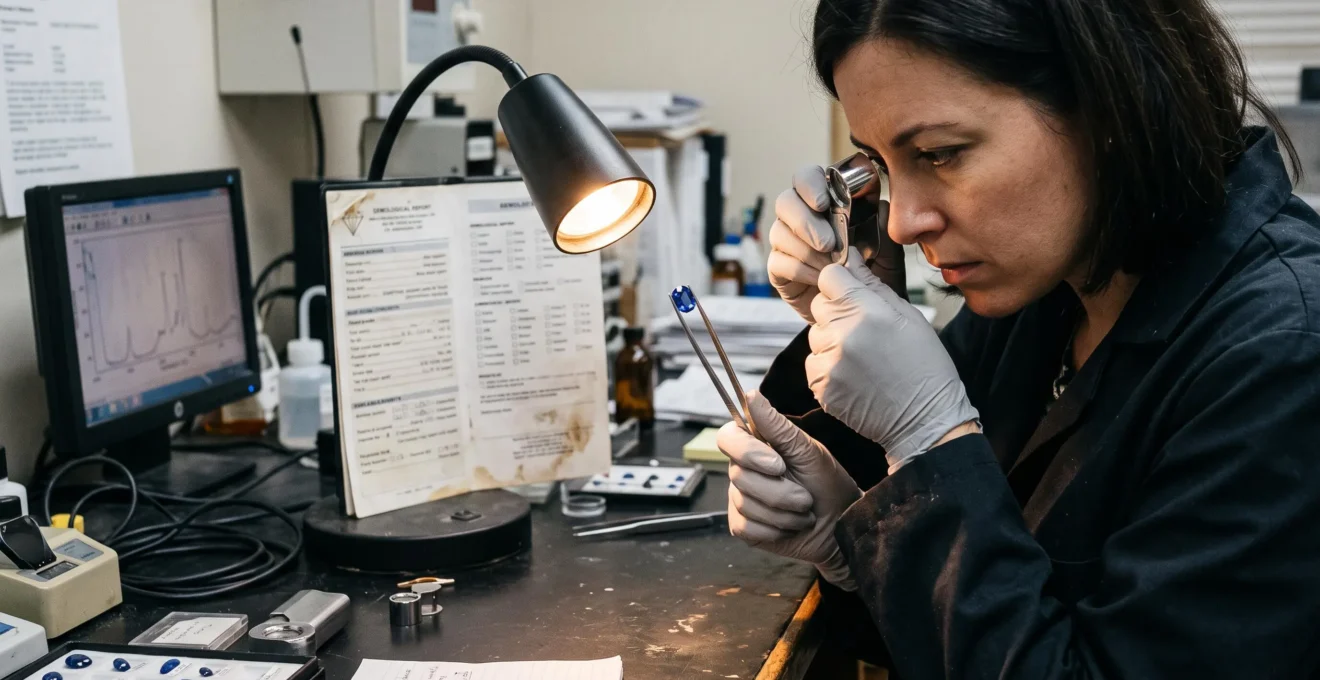
A gemstone’s origin can influence its market value, sometimes substantially. Yet paying for an origin assessment does not mean buying a verified record of where the stone was mined. It means obtaining an expert laboratory opinion based on observable characteristics, chemical composition and comparisons with reference material from known deposits. Those findings can be useful, but they have scientific limitations that matter when a seller asks for a premium.
For collectors, the essential distinction is between identification, treatment status, geographic origin and documented provenance. These are different questions, and answering one does not automatically answer the others. A report may establish that a sapphire is natural and disclose detectable treatments while remaining inconclusive about its geographic origin.
An origin assessment is worth paying for when a recognised locality genuinely affects the stone’s marketability and the report provides evidence that buyers will accept. It is less compelling when the premium rests entirely on a persuasive sales description, a vague laboratory phrase or an unverified mining story. The sensible approach is to establish the facts that most affect the purchase before paying for the most commercially attractive claim.
Origin assessment: the essential points
- An origin report is a scientific opinion based on comparison, not documentary proof of a gemstone’s mining history.
- Treatment detection and identification can protect against more fundamental valuation mistakes than origin testing alone.
- Pay an origin premium only when the locality matters to the market and the evidence is sufficiently credible to support the asking price.
- Why Is Origin Assessment Often “Most Likely” Rather Than Certain, Even With Modern Testing?
- How to Read Origin Language on a Report Without Misunderstanding Certainty?
- Origin Report vs Treatment Analysis: Which One Reduces Your Risk More on Coloured Stones?
- The Premium Mistake: Paying More for Origin Without Any Traceability Evidence
- When Should You Order Origin Assessment: Before Final Payment or Only Once You Own the Stone?
- The Origin-Claim Mistake: Treating One Trace Element as a Location Fingerprint
- How to Choose Between Identification, Treatment, and Origin Services Without Overspending?
- Which Gemological Laboratory Service Do You Actually Need Before You Spend £150+?
Why Is Origin Assessment Often “Most Likely” Rather Than Certain, Even With Modern Testing?
Gemstone origin assessment is often expressed as an expert opinion because the laboratory compares several characteristics against reference stones rather than directly observing where the gemstone was mined. Chemical composition, inclusions and spectroscopic features can support a particular locality, but different deposits sometimes produce overlapping evidence. When the available characteristics cannot distinguish between candidate origins reliably, an inconclusive result is scientifically more appropriate than a definitive country attribution.
The process combines traditional gemological examination with advanced analytical techniques. A laboratory may examine internal inclusions under a microscope, investigate spectroscopic characteristics and measure trace-element concentrations. These findings are compared with reference data collected from gemstones whose origins are known.
The important limitation is that geological formations do not follow national borders. Deposits in different countries can develop under similar geological conditions and consequently produce stones with comparable chemical and microscopic characteristics.
Blue sapphires illustrate this difficulty. The GIA‘s discussion of the geographic origin dilemma identifies significant overlap between the gemological characteristics of stones from Myanmar and Sri Lanka. Madagascar also contains sapphire deposits associated with different geological environments, including metamorphic and basalt-related sources.
Reference databases are another limitation. Their usefulness depends on the availability, quality and representativeness of samples from known localities. An extensive collection for one deposit does not automatically provide equivalent discrimination for another. GIA’s scientific review of analytical methods for gemstone origin determination explains why laboratories combine microscopy, spectroscopy and chemical analysis rather than relying on a single characteristic.
Two practical distinctions matter. An origin opinion identifies the locality that the laboratory considers most consistent with the evidence. A qualified consistency statement communicates that the observed characteristics are compatible with a particular origin, without necessarily establishing that it is the only possible explanation. Neither should be interpreted as a documentary certificate of birthplace.
For resale, this uncertainty is not automatically a disadvantage. A recognised laboratory opinion can support a locality premium where the market values that particular origin. The commercial question is whether buyers will accept the specific conclusion and whether the stone’s quality justifies the premium independently of its geographic label.
Modern testing makes origin evaluation more informed, not infallible. The next step is to examine the actual language on the report rather than assuming that every origin statement carries the same evidential weight.
How to Read Origin Language on a Report Without Misunderstanding Certainty?
Origin wording should be read as a statement of what the laboratory can support, not as a simple confidence score. Expressions such as “consistent with” and “origin opinion” communicate different forms of interpretation, but there is no universal numerical scale that allows buyers to rank every laboratory’s phrases. The laboratory’s own reporting policy, the available evidence and the scope of the examination matter more than an isolated adjective.
Consider three formulations that a buyer might encounter:
- “Origin characteristics consistent with X”: the examined characteristics are compatible with the named locality. The wording does not necessarily exclude other deposits with similar characteristics.
- “Origin opinion: X”: the laboratory provides an interpreted geographic attribution based on its examination. It remains an expert opinion rather than proof of the stone’s mining history.
- “Showing characteristics of X origin”: the laboratory describes similarities between the stone and material associated with that locality. This wording should not automatically be treated as stronger or weaker than another formulation without examining the issuing laboratory’s definitions.
These examples are a practical reading guide, not an official industry-wide hierarchy. GIA’s published discussion explains that reputable laboratories can occasionally reach conflicting conclusions because their research resources, experience and analytical criteria differ.
Before paying a premium, examine three aspects of the report. First, establish whether it identifies a specific deposit or only a country. Second, check the laboratory’s identity and published explanation of its origin services. Third, establish whether the document is a current, authentic report and whether a subsequent examination could change the result.
Be particularly cautious when a seller describes a qualified statement verbally as a definitive attribution. The sales description may remove the very qualification that matters to another buyer, auction specialist or trade professional.
There is also a distinction between an unconditional-looking statement and the limitations contained in the report’s general terms. A report must be interpreted as a complete document, including explanatory notes and service descriptions, rather than through a short quotation reproduced in an online listing.
GIA’s account of differing laboratory opinions also describes how auction houses may disclose conflicting reports so that prospective buyers can assess the available evidence themselves. This illustrates why a report should not be treated as an unquestionable guarantee of resale value.
Once the report’s wording is understood, the next question is whether geographic origin is even the most important uncertainty affecting the stone’s price.
Origin Report vs Treatment Analysis: Which One Reduces Your Risk More on Coloured Stones?
For many coloured-stone purchases, identification and treatment disclosure deserve attention before geographic origin. A locality premium can be commercially important, particularly for exceptional sapphires, but an incorrect understanding of whether a stone is natural, synthetic or treated can undermine the entire valuation. The appropriate priority depends on the stone, the asking price and the buyer’s intended resale market.
Identification establishes what the material actually is. Treatment analysis addresses whether detectable processes have altered the gemstone’s appearance or characteristics. Geographic origin assessment attempts to determine the locality most consistent with the evidence.
These services may use overlapping analytical information, but they answer different questions. Microscopic inclusions, chemical characteristics and spectroscopic features can contribute to more than one assessment. A laboratory may be able to identify a detectable treatment while remaining unable to distinguish between two possible geographic origins.
For rubies and sapphires, this distinction matters particularly when the seller’s price depends on claims such as natural, untreated, or originating from a recognised locality. A stone should not be valued as though all three claims have been established simply because one laboratory document is available.
GIA’s coloured stone reporting service distinguishes between identification reporting and identification with origin assessment. Its reports provide information about the gemstone material and detectable treatments, while eligible origin reports add geographic information when a determination can be made.
The distinction is reflected in the following practical comparison:
| Service | Question answered | Commercial relevance |
|---|---|---|
| Identification | What is the gemstone material, and is it natural or synthetic? | Establishes the basic identity on which valuation depends. |
| Treatment analysis | Which detectable treatments are present? | Helps assess a major factor affecting quality and market value. |
| Origin assessment | Which geographic locality is most consistent with the evidence? | Can support a recognised locality premium where the market values it. |
There is no universal rule that treatment always has a larger effect on price than origin. GIA’s coloured gemstone value guidance specifically recognises that exceptional material from prestigious localities can command substantial premiums. The correct conclusion is narrower: a buyer should establish the features most likely to change the purchase decision before spending disproportionately on geographic attribution.
For example, a high-quality sapphire described as untreated and from Kashmir raises several separate questions. Its identity, detectable treatments, quality and origin all matter. An origin opinion alone does not establish the treatment claim, nor does it guarantee that the stone meets the quality expectations associated with a premium price.
GIA also makes clear that eligible coloured gemstones can be submitted for identification and origin services, and that additional examination services are available. The precise combination and price should be checked against the current laboratory service offering.
Establishing treatment status reduces one important source of uncertainty, but even a technically sound origin report does not establish a documented chain from mine to market.
The Premium Mistake: Paying More for Origin Without Any Traceability Evidence
The central mistake is paying a substantial locality premium while treating a laboratory opinion as though it were a complete mining-history record. An origin assessment evaluates the gemstone’s characteristics against reference evidence. Traceability, by contrast, concerns documentation connecting the material to a mine, parcel, supplier or verified supply chain. These forms of evidence are complementary, but they are not interchangeable.
A laboratory may conclude that a sapphire is consistent with a particular geographic origin. That conclusion can be relevant to valuation, especially where the locality is recognised by collectors and the trade. However, it does not independently document the individual stone’s journey from the original rough material through cutting, dealing and retail.
Traceability requires a different type of evidence. Depending on the supply chain, relevant documentation may include:
- Records identifying the original rough parcel or mining source.
- Supplier documentation connecting the parcel to subsequent transactions.
- Consistent identification records linking the rough and finished gemstone.
- Documentation supporting the chain of custody between participants.
- Independent verification of the relevant supply-chain claims where available.
A single chemical marker or a particular inclusion cannot replace these records. Even a persuasive laboratory opinion remains an interpretation of the physical evidence available at the time of examination.
The distinction becomes commercially important when a seller asks for extra money because a stone supposedly comes from a prestigious locality. The buyer should establish whether the premium is supported by an independently recognised laboratory opinion, documentary provenance, or both.
Consider a hypothetical resale scenario. A collector buys a sapphire at a premium because a report supports a particular locality. Later, another laboratory examines the stone and reaches a different conclusion. The original report does not necessarily become worthless, but the disagreement may make the geographic claim harder to sell at the price originally paid.
This is why the buyer should consider the durability of the evidence, not simply the attractiveness of the claim. A documented supply chain can provide additional historical information that does not depend solely on the interpretation of the stone’s chemistry and inclusions.
The practical lesson is not to reject origin reports, but to avoid paying a documentary premium for evidence that the report was never designed to provide. That distinction becomes particularly important when deciding when to commission the assessment.
When Should You Order Origin Assessment: Before Final Payment or Only Once You Own the Stone?
Where the purchase depends on a particular geographic origin, arranging independent laboratory assessment before final payment generally offers better protection. It allows the buyer to reconsider the price, renegotiate or withdraw if the findings do not support the seller’s claims. Ordering after ownership can still provide useful information, but the financial leverage has shifted: the buyer already owns the gemstone and bears the consequences of an unfavourable result.
The main difficulty is practical. A desirable gemstone may be sold to another collector while testing is underway. The seller may also be reluctant to release the stone for independent examination, and laboratory turnaround times can make a pre-purchase assessment inconvenient.
Those constraints should be addressed through the purchase terms rather than ignored. A buyer who needs an origin opinion to justify the price should establish the testing arrangements before committing to an unconditional transaction.
A conditional purchase arrangement can provide a middle path. The parties can agree that the final payment depends on an independent laboratory examination, with the relevant service and acceptable result specified beforehand. The agreement should identify:
- The laboratory responsible for the examination.
- Whether identification and treatment disclosure are also required.
- The geographic wording or outcome that would satisfy the buyer.
- Who pays for the assessment and any additional examination.
- What happens if the result is inconclusive or conflicts with the seller’s description.
These are suggested contractual points, not a standard procedure guaranteed by any laboratory. The actual agreement should be clear enough to avoid later disagreement about what counts as an acceptable result.
There is also an important qualification concerning mounted stones. It is inaccurate to assume that every origin assessment requires a loose gemstone. GIA’s official coloured stone service documentation states that both loose and mounted gemstones may be submitted for its services. However, individual examination requirements and the suitability of a particular stone should be confirmed directly with the laboratory.
Similarly, the available evidence does not justify a blanket claim that a previous laboratory report automatically prevents a new assessment or that heating during setting always makes origin testing impossible. Eligibility depends on the specific service and gemstone.
For a purchase where the origin premium is modest relative to the cost and risk of testing, a post-purchase assessment may be commercially reasonable. Where the premium is substantial and depends on a precise locality, obtaining independent evidence before releasing the full payment is usually the more defensible negotiating position.
Once the timing has been settled, the buyer still needs to understand what the laboratory actually measures, particularly when a seller reduces a complex chemical interpretation to one memorable element.
The Origin-Claim Mistake: Treating One Trace Element as a Location Fingerprint
No single trace element can reliably identify the geographic origin of a coloured gemstone by itself. Laboratories assess combinations of chemical characteristics, inclusion patterns and other analytical evidence against reference populations. A particular element may provide useful geological information, but it should not be confused with a unique geographic fingerprint.
Corundum, including ruby and sapphire, illustrates the problem. Its trace-element profile may involve several elements, including gallium, magnesium, iron, vanadium and chromium. Their concentrations and relationships can help distinguish geological environments and compare an unknown stone with material from known deposits.
However, a high concentration of one element does not automatically establish a country of origin. The same chemical characteristic may occur in stones from more than one locality because geological processes can overlap.
Two simplified claims frequently encountered in informal selling conversations demonstrate the risk:
- “High vanadium means Kashmir-type sapphire.”
- “High iron proves basaltic origin.”
These statements turn a complex analytical interpretation into an unsupported shortcut. A chemical feature may be relevant to a particular geological comparison, but it cannot independently establish the geographic origin of the individual gemstone.
The problem becomes more pronounced on social media and in online gemstone listings. Sellers often compress technical explanations into a short statement that is easier to remember and repeat. The original analytical qualifications disappear, leaving buyers with a rule that sounds scientific but is not sufficient for a defensible origin conclusion.
A useful response is to ask whether the laboratory considered the complete chemical profile and the inclusion evidence, rather than relying on one particularly noticeable marker. The laboratory’s own scientific explanation should be consulted when the report provides additional methodological information.
GIA’s scientific review explains that origin determination combines microscopy, spectroscopy and chemical analysis, with the results evaluated against reference data. The importance of this approach is that the laboratory examines relationships between characteristics rather than treating one measurement as a definitive answer.
For buyers, the practical distinction is between a scientific clue and a conclusion supported by several lines of evidence. A seller who cannot explain the difference should not be allowed to turn a single chemical measurement into a substantial locality premium.
Once the analytical evidence has been put into perspective, the remaining decision is how much testing is justified for the actual purchase rather than ordering every available service by default.
Key decisions before paying for laboratory services
- Establish the gemstone’s identity and detectable treatment status before treating a geographic claim as the basis of its valuation.
- Only commission origin assessment when the locality has a recognised commercial relevance to the specific stone and its likely resale market.
- Compare the cost of testing with the amount of purchase-price risk it can realistically reduce.
How to Choose Between Identification, Treatment, and Origin Services Without Overspending?
The most efficient way to select gemological services is to start with the question that would most change the purchase decision. Identification establishes what the gemstone is, treatment analysis investigates detectable alterations, and origin assessment evaluates geographic attribution. Spending should follow the financial consequences of getting each answer wrong, rather than the prestige attached to a particular locality.
For a collector buying a gemstone primarily for personal enjoyment, a reliable identification and appropriate treatment information may be sufficient. The buyer may have little reason to pay for a geographic opinion if the locality has no meaningful effect on the intended use or purchase price.
A collector buying for resale or auction has a different objective. If the proposed asking price depends on a recognised locality premium, an independent origin opinion may provide useful supporting evidence. However, that service should not replace identification or treatment disclosure.
The practical hierarchy is therefore:
- Identification: establish the nature of the gemstone and whether it is natural or synthetic.
- Treatment disclosure: understand detectable treatments that could materially affect valuation.
- Origin assessment: investigate locality where the market recognises a premium for the specific material.
This is a decision-making hierarchy rather than an absolute technical sequence. The appropriate submission depends on the stone and the laboratory’s available services. GIA’s reporting structure, for example, includes identification reporting and identification with origin assessment, while treatment information is also included in its coloured stone reports.
Service combinations can make a single submission more efficient than ordering separate examinations at different times. However, there is no evidence in the supplied laboratory documentation establishing that bundled services are always cheaper. The buyer should compare the actual quotation, service scope and turnaround conditions before deciding.
For higher-value rubies and sapphires, it is particularly important to avoid purchasing a geographic opinion while leaving a major treatment question unanswered. A recognised locality cannot compensate automatically for a treatment status that materially changes the market’s assessment of the stone.
Before submitting a gemstone, use this practical five-step checklist.
A five-step gemstone testing checklist
- Identify the gemstone and record the seller’s description, including whether it is claimed to be natural or synthetic. Deliverable: a written list of identity claims to verify.
- List every treatment claim made by the seller. Deliverable: a treatment-status checklist showing which claims require independent examination.
- Identify the geographic claim and establish whether the locality materially affects the asking price. Deliverable: a written explanation of the origin premium being requested.
- Compare the available laboratory services and confirm the scope of the report, including whether origin assessment is available for the specific stone. Deliverable: a laboratory quotation and service specification.
- Decide whether the findings are needed before payment and agree the consequences of an inconclusive or conflicting result. Deliverable: written purchase or testing conditions.
One common overspending mistake is ordering identification only when the buyer already knows that treatment is a major unresolved question. The resulting report may answer the basic identity question while leaving the most important valuation issue unanswered, potentially requiring another submission.
That approach also provides a rational basis for assessing whether a laboratory bill of £150 or more is justified, rather than assuming that a particular price automatically makes a report comprehensive.
Which Gemological Laboratory Service Do You Actually Need Before You Spend £150+?
There is no universal £150 threshold at which a particular gemological service becomes worthwhile. Laboratory charges vary according to the gemstone, its weight, the requested examination, turnaround requirements and available service combinations. The important question is whether the proposed fee buys evidence that could materially change the purchase decision or support the intended resale price.
Before authorising a submission, establish exactly what the laboratory will examine and what the resulting document will contain. A basic identification report should not automatically be assumed to include geographic origin assessment. Equally, an origin report should not be interpreted as an independent documentary record of mining provenance.
GIA’s official coloured stone report and laboratory service details distinguish between its Colored Stone Identification Report and its Colored Stone Identification & Origin Report. Its documentation describes identification information, detectable treatment disclosure and geographic origin information for eligible stones where a determination can be made.
Its published service information also states that both loose and mounted coloured gemstones may be submitted. Follow-up services are available for verification, re-evaluation or updates to original reports. These details should be checked against the current service terms before sending a valuable stone.
The following checklist helps establish whether a laboratory quotation is appropriate:
- Independence and recognition: establish the laboratory’s identity and whether its reports are accepted by the intended buyers and relevant trade participants.
- Service scope: confirm whether the quotation covers identification, treatment disclosure, geographic origin or a combination.
- Origin methodology: review the laboratory’s published explanation of its geographic origin assessment and its limitations.
- Submission eligibility: check whether the gemstone can be examined in its current condition and whether mounting affects the requested service.
- Report follow-up: establish whether verification, re-evaluation or an updated report is available if the findings need further examination.
- Fees and timing: confirm the current price, turnaround time and any additional charges for expedited or supplementary services.
The most useful comparison is not simply between a cheap report and an expensive report. It is between the financial exposure that remains after each service and the additional cost of obtaining the information needed to reduce it.
For example, a collector buying a sapphire for personal enjoyment may reasonably prioritise identification and treatment information without paying for an origin opinion. Another collector purchasing a rare sapphire at a substantial locality premium may have a stronger reason to commission origin assessment, provided the laboratory can examine the stone and the likely market recognises that locality.
GIA’s educational discussion of coloured gemstone value factors provides an important commercial qualification: geographic origin can significantly influence value in particular cases, including exceptional untreated Kashmir sapphire. However, this does not establish a fixed premium or guarantee that every origin report will increase resale value.
The best use of a laboratory budget is therefore to establish verifiable characteristics before paying extra for interpretative claims. A report that confirms identity and discloses detectable treatments may be more valuable to the purchase decision than an attractive locality statement that leaves fundamental questions unanswered.
The final rule is straightforward: ask which answer would most change the decision to buy or the price offered — what the gemstone is, whether it has been treated, or where it most likely originated. Start with that question, confirm the laboratory’s actual service scope, and add further testing only when the first findings justify the additional expenditure. An origin assessment is worthwhile when it supports a real market distinction; it is not worthwhile merely because a seller has attached a prestigious place name to a gemstone.
Does a gemstone origin certificate prove where the stone was mined?
No. An origin report expresses a laboratory’s expert interpretation of the gemstone’s chemical, spectroscopic and microscopic characteristics. It is not automatically a documentary record of the mine, supplier or individual supply-chain journey. Documentary provenance requires separate supporting evidence.
Can two reputable laboratories give different origin opinions for the same sapphire?
Yes. Laboratories may differ because their reference collections, analytical resources, experience and interpretation criteria are not identical. GIA discusses conflicting laboratory opinions as a recognised issue in geographic origin determination. A disagreement does not automatically invalidate either examination, but it should be disclosed and considered when valuing the gemstone.
Does an origin report automatically increase a sapphire’s resale value?
No. An origin report may support a premium when the locality is recognised and commercially important for the particular sapphire. Its contribution depends on the gemstone’s quality, condition, treatment status, report wording and the expectations of prospective buyers. Testing does not guarantee a higher resale price.
Can a mounted gemstone receive an origin assessment?
Some laboratories accept mounted gemstones for coloured stone services. GIA’s published service documentation specifically states that loose and mounted gemstones may be submitted. However, the suitability of an individual stone and the availability of the requested examination should be confirmed with the laboratory before submission.
Should a collector pay for origin testing on every ruby or sapphire?
No. Origin testing is most relevant when geographic locality has a meaningful effect on the purchase price or intended resale market. For many purchases, establishing identity and detectable treatment status is a more useful starting point. The decision should reflect the financial importance of the origin claim rather than the fact that the gemstone is a ruby or sapphire.