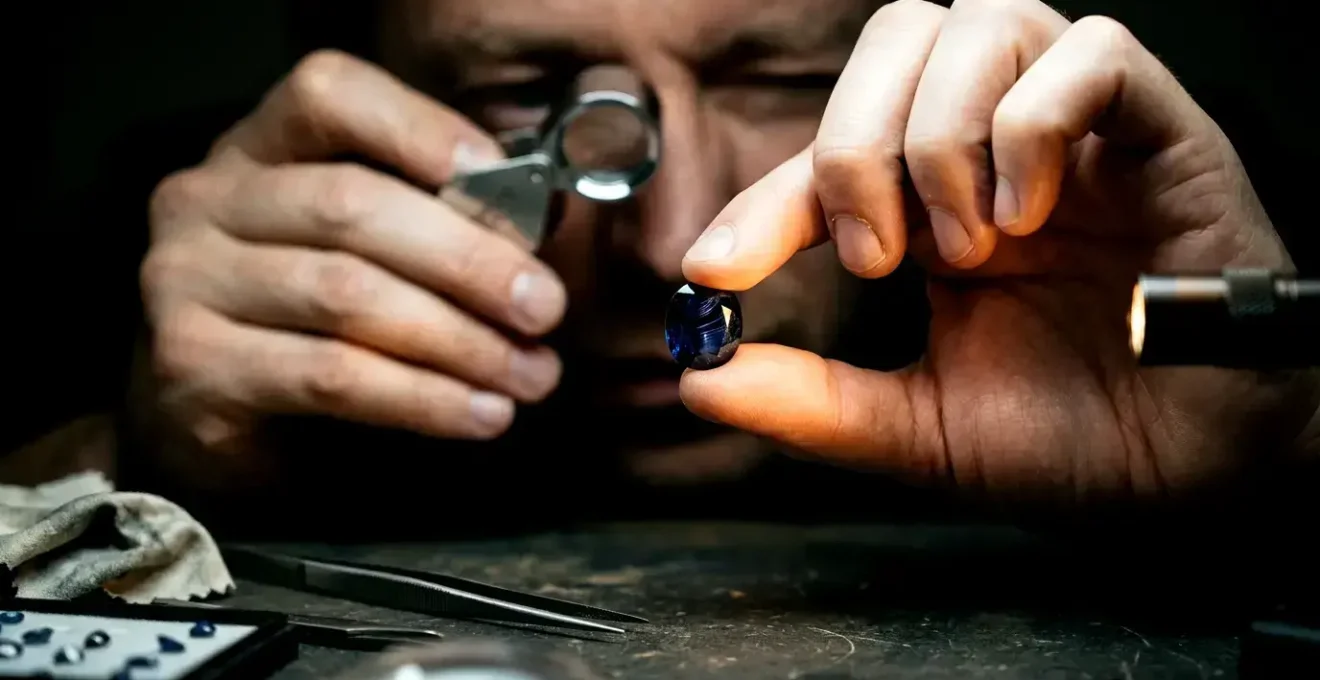
A sapphire can look perfectly transparent until a narrow beam of light reveals delicate lines running through its interior. Those lines may record changes in the crystal’s growth environment, indicate a particular laboratory synthesis method, or simply be surface marks left during polishing. Knowing the difference can prevent an expensive identification mistake.
Growth lines are evidence of crystal formation, not automatic proof of natural or synthetic origin. Their shape, orientation, relationship to inclusions and response to illumination must be considered together. Curved striae in corundum, for example, can strongly suggest flame-fusion synthesis, while angular zoning may be consistent with natural crystallisation. Neither observation should be interpreted without considering the gemstone species and other evidence.
For collectors examining loose stones with a loupe or microscope, the practical objective is to recognise meaningful clues, distinguish internal structures from surface defects and know when a professional laboratory examination is justified.
Growth lines: the essential identification clues
- Curved growth striae in ruby or sapphire can indicate flame-fusion synthesis, whereas natural corundum commonly exhibits angular zoning.
- Side lighting, transmitted illumination and careful focusing can reveal different features, but a home inspection cannot certify origin.
- Growth structures, inclusions, treatments and surface condition must be assessed separately before making a buying decision.
- Why Do Synthetic Growth Lines Often Look “Too Perfect” Compared With Natural Growth?
- How to Reveal Growth Lines Using Darkfield-Style Lighting With A £10 Torch Setup
- Visible Growth Lines vs “Clean” Look: Which Choice Ages Better in A Ring You Wear Weekly?
- The Polishing-Line Mistake That Makes People Think a Stone Has Growth Striae
- When Should You Check for Growth Lines: Before Payment or Only After You Receive the Stone?
- Why Do Some Crystals Show Sharp Growth Bands While Others Look “Smooth” Even Under Magnification?
- Why Aren’t Inclusions a Guaranteed Proof of Natural Origin Even When They Look Convincing?
- Which Inclusion Types Most Strongly Suggest a Stone Is Natural Rather Than Lab-Grown?
Why Do Synthetic Growth Lines Often Look “Too Perfect” Compared With Natural Growth?
Some synthetic gemstones display unusually consistent growth structures because their laboratory formation follows a controlled process. However, synthetic lines are not universally straight, evenly spaced or perfectly regular. The most useful distinction is often their geometry: flame-fusion synthetic corundum can exhibit curved striae, whereas natural ruby and sapphire typically show angular growth zoning related to their crystallographic structure.
Crystal growth depends on the availability of chemical components, temperature, pressure and the physical environment surrounding the developing crystal. Changes in these conditions can leave visible boundaries between successive growth stages.
In natural environments, crystals may grow through multiple episodes involving changing fluids, trace-element availability and geological conditions. These variations can produce colour zoning, inclusion layers and changes in internal growth structure.
Laboratory synthesis uses different mechanisms. Flame fusion forms material from a molten feed, while flux and hydrothermal methods crystallise material from chemically distinct growth environments. Each method can produce different microscopic characteristics.
According to GIA‘s examination of natural and laboratory gemstone growth processes, curved striae and curved colour banding are characteristic of flame-fusion synthetic gems, contrasting with the more angular growth zoning of natural corundum.
Three aspects deserve separate attention:
- Spacing: repeated intervals may reflect a growth process, but uniform spacing alone does not establish synthetic origin.
- Geometry: curved, angular and planar features have different significance depending on the mineral and synthesis method.
- Associated evidence: gas bubbles, mineral inclusions and chemical characteristics can strengthen or weaken an interpretation.
Flux-grown and hydrothermal synthetic gemstones can show complex structures that resemble natural features. Conversely, some natural crystals preserve remarkably orderly growth patterns. The simplistic rule that irregular means natural and regular means synthetic is therefore unreliable.
Origin matters commercially because natural and laboratory-grown stones are marketed as different products. A flame-fusion synthetic sapphire should not be priced as a natural sapphire merely because its colour and clarity appear comparable. The actual price difference depends on quality, size, treatment, provenance and the relevant market.
The next challenge is making these structures visible without confusing lighting artefacts with genuine internal features.
How to Reveal Growth Lines Using Darkfield-Style Lighting With A £10 Torch Setup
A basic torch, dark background and magnifying lens can help reveal certain internal gemstone features through oblique side illumination. The technique approximates one aspect of professional darkfield microscopy, but it does not reproduce laboratory optics. Darkfield-style lighting is particularly useful for inclusions, while diffused transmitted illumination may reveal colour zoning more effectively.
A modest home setup can be assembled around a small focused torch, a 10× jeweller’s loupe or phone macro camera, and a stable dark work surface. A £10 budget is an illustrative equipment target, not a validated cost for a complete gem-testing system.
Begin in a dim room with a loose, clean gemstone secured above a dark matte surface. Position the torch to one side of the stone rather than directing the beam into the viewing lens. Look from another angle so that scattered light from internal features becomes easier to distinguish against the darker background.
Professional gemmologists use several lighting configurations because no single arrangement reveals every characteristic. GIA’s technical overview of laboratory gemstone examination methods describes darkfield, brightfield, reflected, diffused and fibre-optic illumination as complementary techniques.
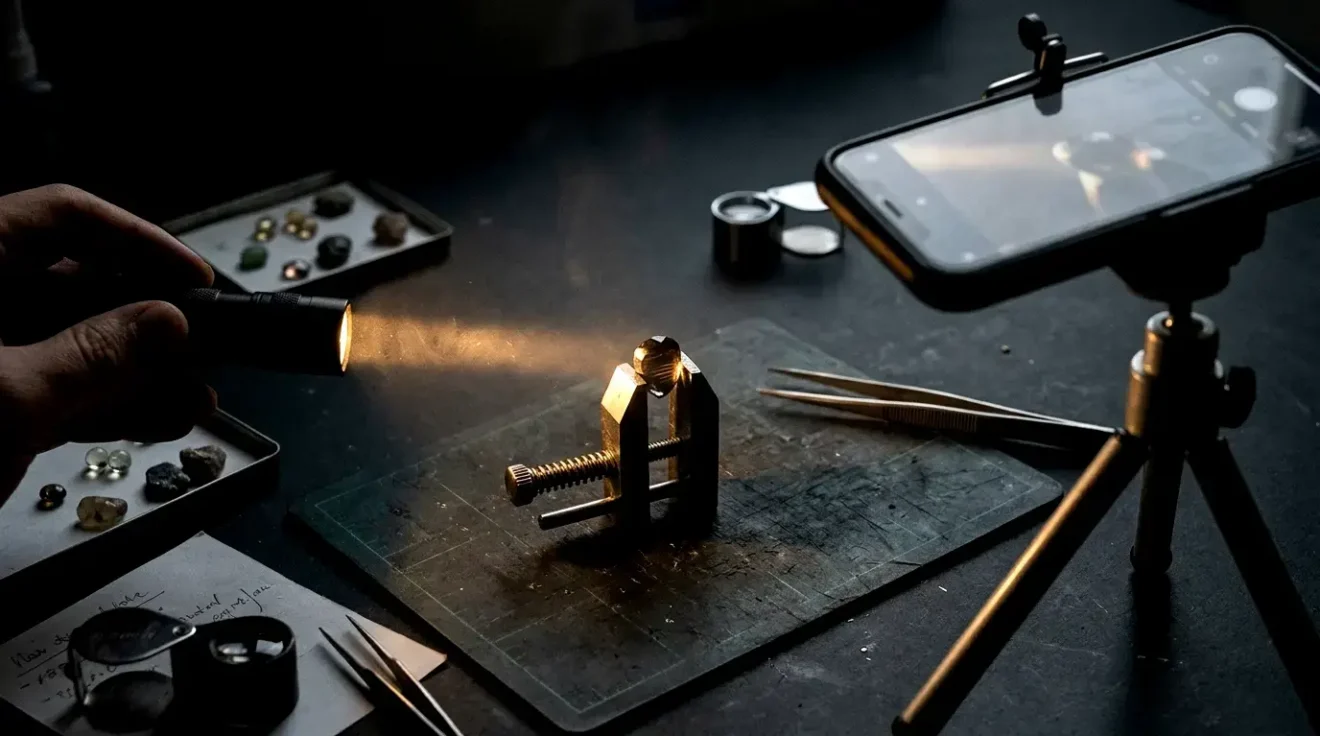
For a practical first examination, follow this sequence:
- Clean the stone gently using a method appropriate to its species and treatment status.
- Place it securely over a dark surface and examine it with a loupe.
- Introduce the torch beam from the side, avoiding direct glare into the viewing lens.
- Rotate the stone slowly while keeping the light position relatively stable.
- Switch to diffused transmitted light when searching specifically for colour zoning.
A focused, non-diffused beam may improve contrast for some features, although it is not a universal requirement. Light entering directly into the lens can obscure subtle structures. Likewise, looking only through the crown of a faceted stone may miss features visible through its pavilion.
Practice with specimens of known identity, ideally a documented synthetic corundum sample. Ordinary glass can help demonstrate reflections and bubbles, but it is not a reliable reference for crystalline growth striae.
Opaque stones, strongly included specimens and mounted gems may prevent meaningful examination. Seeing no lines is an inconclusive result, not evidence that the stone is natural, untreated or free from internal growth features.
Once a feature is visible, its location becomes important not only for identification but also for evaluating how the gemstone may perform in jewellery.
Visible Growth Lines vs “Clean” Look: Which Choice Ages Better in A Ring You Wear Weekly?
A gemstone with visible internal growth banding can remain suitable for regular wear because colour zoning and growth lines are not necessarily fractures or weaknesses. Durability depends more directly on mineral hardness, toughness, cleavage or parting, existing damage and treatments. Surface-reaching fractures deserve particular attention, whereas fully internal colour bands may primarily affect appearance and market preference.
A stone that looks visually clean is not automatically more durable. Clarity describes the visibility of internal features, while durability concerns the stone’s resistance to scratching, chipping, breaking and environmental damage.
For example, corundum is generally suitable for frequently worn rings because of its hardness and relatively good toughness. However, particular specimens can contain fractures, twinning-related parting or other weaknesses that require individual assessment.
Growth banding should not be confused with an open fissure. Internal colour zoning does not itself provide a pathway for dirt or moisture. Surface-reaching fractures, cavities and certain filled features can trap contamination or become more visible during wear.
Cutting and treatment further complicate the comparison. A gemstone may appear evenly coloured because of the orientation chosen by its cutter, natural colour distribution or treatment. Neither a shallow pavilion nor colour enhancement should be assumed simply because growth zoning is difficult to see.
Some treatments have care implications. Fracture-filled stones, for example, may require precautions around heat, chemicals or cleaning methods. These concerns relate to the filling material and treatment, not automatically to the original growth bands.
Before choosing between a visibly banded stone and a cleaner-looking alternative, compare four characteristics:
- Feature location: fully internal zoning versus surface-reaching openings.
- Structural condition: fractures, cleavage or parting that could affect durability.
- Treatment disclosure: whether enhancement creates additional care requirements.
- Price and appearance: whether the visible pattern offers an acceptable aesthetic trade-off.
A naturally banded sapphire may offer attractive value when its zoning is aesthetically acceptable and the stone is otherwise sound. However, no universal discount applies: price depends on the overall gemstone, not merely the presence of visible lines.
That distinction only works when the observed lines truly lie inside the crystal rather than on its polished surface.
The Polishing-Line Mistake That Makes People Think a Stone Has Growth Striae
Polishing lines are surface marks created during gemstone finishing, whereas growth striae are internal structures associated with crystallisation. Both can appear as fine repeated lines under magnification. The most reliable first step is to determine their depth by changing focus and viewing angle, rather than deciding from curvature or parallelism alone.
Polishing marks may become particularly noticeable when directional light reflects across a facet. Their appearance can change sharply as the stone tilts, because they interact with the surface reflection.
Internal striae behave differently: they remain associated with a position inside the gemstone and may become visible or disappear as the viewing geometry changes. However, an internal feature does not necessarily remain continuously visible through every facet or viewing angle.
GIA’s official terminology for diamond polishing features defines polish lines as parallel marks produced during polishing. The reference also distinguishes them from scratches, abrasion and other surface characteristics.
Although this terminology concerns diamond grading, the broader distinction between external finishing marks and internal crystal structures is useful when examining coloured stones.
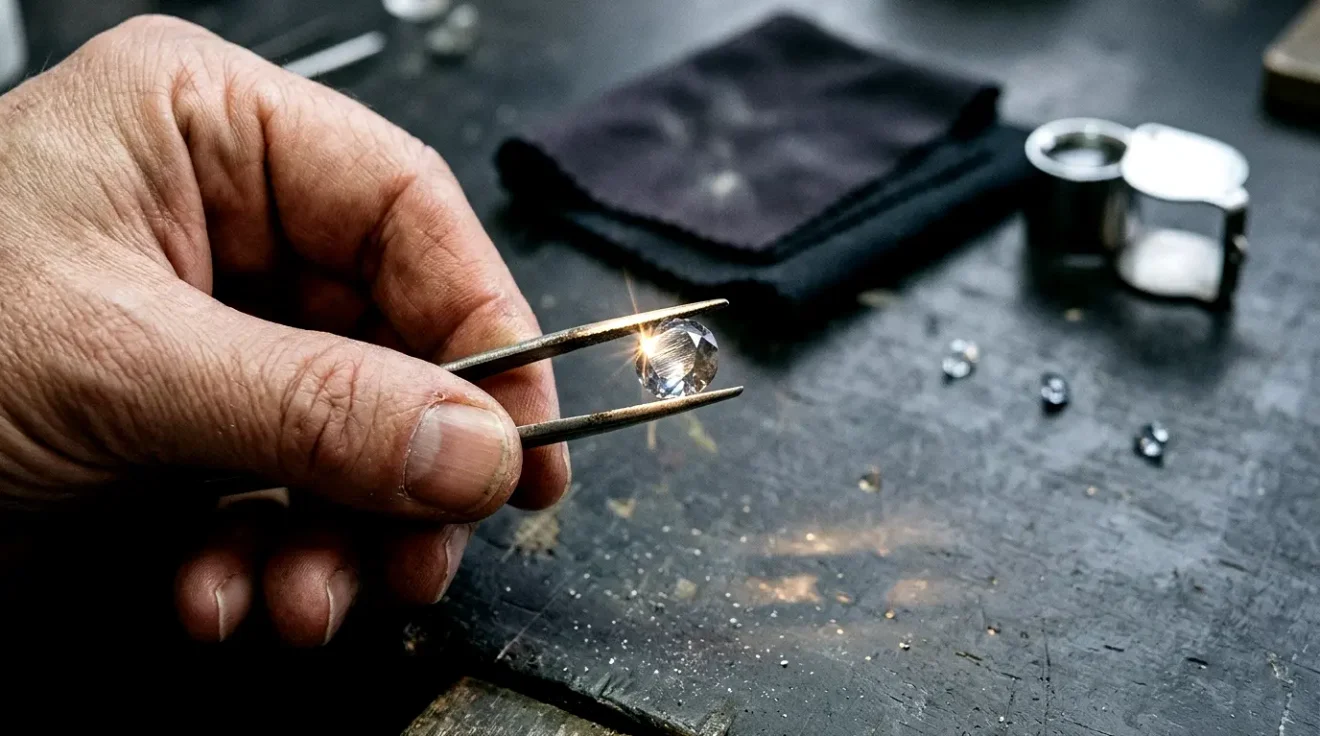
Rock the gemstone gently beneath the light while observing a suspected line. If the feature becomes prominent only when one facet reflects light, inspect that facet’s surface more closely. Then change the focal plane, if the optical equipment permits, to determine whether the feature lies below the surface.
Do not rely on the claim that polishing lines must always be straight or that growth striae must always curve. Scratches can be curved, and growth structures can be straight or angular. Multiple facets may also contain polishing marks in different directions.
The commercial consequences of confusion run in both directions. A buyer might interpret ordinary finishing marks as proof of unusual growth history, or reject a desirable gemstone because surface scratches resemble suspicious internal lines.
Older or repolished gemstones deserve the same careful surface inspection, although their age or repair history alone does not establish how many polishing marks they should contain.
Once the feature has been located and described, the remaining question is when that observation should influence a purchase.
When Should You Check for Growth Lines: Before Payment or Only After You Receive the Stone?
Inspect growth structures before payment whenever possible, then repeat the examination promptly after receiving the gemstone. The first inspection helps identify suspicious features and clarify the seller’s claims. The second provides an opportunity to examine the stone under better conditions while any applicable return or dispute period remains open.
For a loose ruby or sapphire, a torch and loupe may reveal conspicuous curved striae or other internal features. However, a brief shop inspection cannot reliably distinguish every natural, synthetic and treated gemstone.
Before purchasing, establish exactly what the seller is offering. Three descriptions should never be treated as interchangeable: a natural gemstone, a laboratory-grown gemstone of the same mineral species, and a simulant made from a different material.
Mounted stones introduce additional limitations because settings can obstruct the pavilion and prevent useful side illumination. A gemstone that appears clear when viewed from above may contain features visible only from another direction.
For a valuable purchase, request appropriate independent documentation and check whether its scope covers identity, origin determination and relevant treatments. A report identifying a mineral species does not necessarily answer every question about geographical origin or enhancement.
Five checks to document before committing to a gemstone
- Record the seller’s description: retain a screenshot or invoice specifying natural, synthetic or simulant status and disclosed treatments.
- Inspect the loose stone where possible: write down whether curved striae, angular zoning or other features were visible.
- Separate internal and surface marks: capture a focused image or note the observation as inconclusive if depth cannot be established.
- Verify supporting documentation: record the laboratory name, report identifier and precise conclusions stated.
- Confirm the return conditions: save the applicable deadline and arrange any necessary independent examination before it expires.
After delivery, compare the received gemstone with the listing, photographs and documentation. Record any discrepancies promptly. The ability to return or dispute a purchase depends on the seller’s terms and applicable consumer law, which vary between jurisdictions.
Independent laboratory testing becomes especially relevant when the stone carries a substantial natural-origin premium and the available observations are ambiguous. A disclosed, inexpensive synthetic gemstone may not justify the same testing expense.
Even with careful timing, identification remains difficult when a crystal shows little or no visible growth structure.
Why Do Some Crystals Show Sharp Growth Bands While Others Look “Smooth” Even Under Magnification?
Visible growth bands develop when successive crystal-growth stages produce detectable differences in colour, composition or inclusion distribution. A stone can appear smooth because those differences are too small to see, because its growth conditions produced little visible contrast, or because treatment altered its appearance. An absence of bands does not mean an absence of growth history.
Crystals incorporate chemical components as they form. Changes in the availability of trace elements, the surrounding fluid or melt, and other growth conditions can create variations between successive regions.
When these variations affect colour, they may become visible as colour zoning. When they involve inclusions, they may appear as layers of particles or aligned internal features rather than coloured bands.
Three common forms deserve distinction:
- Chemical colour zoning: variations in colouring components can produce bands or sectors in amethyst, tourmaline and other gemstones.
- Crystallographic zoning: angular colour boundaries in corundum can reflect the geometry of successive crystal-growth surfaces.
- Inclusion-defined growth: layers of microscopic particles or crystals may mark growth episodes without producing obvious colour changes.
Species also differ in the growth patterns collectors commonly encounter. The following comparisons are useful starting expectations, not rules that identify origin.
| Gemstone | Potential visible feature | Interpretation limit |
|---|---|---|
| Ruby and sapphire | Angular colour zoning, growth bands or internal striae | Growth geometry must be evaluated alongside synthesis-related features. |
| Amethyst | Angular or chevron-like colour zoning | Visible zoning does not independently establish natural origin. |
| Tourmaline | Colour zones or growth-related changes in hue | Colour distribution varies with composition and growth history. |
| Malachite | Conspicuous green concentric or layered banding | Banding describes its structure, not a universal authentication test. |
| Spinel and garnet | Sometimes little obvious colour banding | Apparent uniformity is not proof of natural or synthetic origin. |
Treatments can complicate these expectations. Heat may modify the appearance of natural colour zoning, while diffusion treatment can introduce colour concentrations related to the treated surface. Some diffusion-related patterns may become especially noticeable around facet junctions.
Such features should not automatically be mistaken for original growth zoning. The geometry of the colour, its distribution within the stone and the mineral’s known behaviour all matter.
Similarly, a stone that appears uniformly coloured under a loupe may reveal additional structure through a microscope, immersion examination or other professional techniques.
Growth structures become more informative when considered alongside inclusions, although inclusions create their own identification traps.
Why Aren’t Inclusions a Guaranteed Proof of Natural Origin Even When They Look Convincing?
Inclusions cannot guarantee natural origin because both geological and laboratory crystal-growth processes can produce internal crystals, cavities, fluid-related features and growth disturbances. Some inclusions are highly informative when correctly identified, but a generic feather, bubble or mineral-looking particle is not enough. Origin determination depends on the specific inclusion assemblage and its consistency with other evidence.
Natural gemstones may trap minerals, fluids or other materials as they crystallise. These features can preserve evidence of geological conditions and, in some cases, help specialists distinguish between different formation environments.
Laboratory-grown gemstones can also contain inclusions. Flux-grown and hydrothermal synthetic emeralds, for example, may display growth-related crystals and other internal features that require careful interpretation.
GIA’s illustrated comparison of natural, synthetic and treated emerald inclusions documents the range of features found in these different categories.
The important distinction is between recognising an inclusion and identifying what it actually is. A transparent crystal enclosed within an emerald may look convincing under a loupe, but its diagnostic significance depends on mineral identity, morphology and associated features.
Likewise, multiphase fluid inclusions occur in natural emeralds from several geological sources. Yet an observer cannot safely identify natural origin merely by noticing what appears to be a bubble inside a cavity.
Treatment creates another source of confusion. Emerald clarity enhancement commonly involves introducing oil or resin into surface-reaching fractures. The resulting optical effects and trapped bubbles can complicate observations without changing the stone’s original natural or synthetic status.
Cleanliness and origin are therefore independent purchasing criteria. A relatively inclusion-free synthetic emerald can look more transparent than an included natural emerald. Greater clarity does not make the synthetic stone natural, just as visible inclusions do not automatically make the natural stone more valuable.
Laboratory identification may combine microscopy with spectroscopy, fluorescence observations and chemical analysis. The appropriate techniques depend on the species and the identification question; no single instrument is universally decisive for every gemstone.
The strongest conclusions come from recognising specific combinations of features rather than assigning an origin to every inclusion individually.
Key takeaways before interpreting inclusions
- Identify the inclusion’s type and context, not merely its presence or visual complexity.
- Check whether the growth geometry and inclusion assemblage support the same explanation.
- Escalate contradictory or uncertain observations when the natural-origin claim materially affects the purchase price.
Which Inclusion Types Most Strongly Suggest a Stone Is Natural Rather Than Lab-Grown?
Specific mineral inclusions and well-characterised multiphase fluid inclusions can provide strong evidence of natural gemstone formation, especially when their identities and associations match a known geological environment. Their diagnostic value depends on precise identification, not appearance alone. Generic crystals, fractures and bubbles are much less reliable because comparable features can occur in synthetic or treated material.
Natural gemstones can preserve mineral assemblages formed during their geological history. In some cases, identifying a particular included mineral together with the host’s other characteristics provides evidence that is difficult to reconcile with a given laboratory growth method.
One documented example concerns natural emerald containing parisite. GIA’s illustrated emerald reference identifies a particular parisite-bearing specimen, together with supporting observations, as evidence confirming natural Colombian origin. That conclusion applies to the characterised specimen and evidence combination, not to every crystal inclusion in an emerald.
Multiphase inclusions are another important category. These may contain liquid, gas and sometimes additional solid material within a cavity. Their morphology and contents can reveal information about the environment in which the host crystal formed.
However, a multiphase-looking feature should not be treated as automatically diagnostic. Its significance depends on the actual phases, cavity geometry, associated structures and the gemstone being examined.
To evaluate a suspected natural-origin indicator, distinguish stronger evidence from features that are generally insufficient on their own.
| Observation | Potential significance | Important limitation |
|---|---|---|
| Identified mineral inclusion associated with a known geological assemblage | May strongly support natural formation | Requires reliable identification and contextual interpretation |
| Well-characterised multiphase fluid inclusion | Can support a geological growth interpretation | Generic bubble-containing cavities are not diagnostic |
| Curved striae with associated gas bubbles in corundum | Can strongly suggest flame-fusion synthesis | Species and feature identification must be confirmed |
| Generic feathers, fissures or small crystals | May describe clarity or growth history | Can occur in natural and synthetic gemstones |
| Angular colour zoning with mineral inclusions | May be consistent with natural corundum growth | Requires assessment against alternative growth and treatment explanations |
The most persuasive interpretation is internally consistent. Curved striae accompanied by features characteristic of flame-fusion growth form a coherent synthetic-origin hypothesis in corundum. Angular zoning with appropriate natural mineral inclusions may support a different interpretation.
Apparently contradictory observations warrant further investigation rather than an immediate verdict. For example, straight parallel zoning accompanied by convincing mineral inclusions does not automatically indicate flux-grown material. Natural gemstones can also exhibit orderly crystallographic zoning, and laboratory growth methods can produce complex inclusion assemblages.
Claims that particular inclusions require mutually incompatible formation temperatures must be supported by identification of the actual mineral phases and their geological context. Such conclusions cannot reliably be drawn from the apparent shape of tiny crystals under a handheld loupe.
For collectors, the objective is not to memorise a supposedly infallible list of natural inclusions. It is to recognise which observations justify closer examination, which are ambiguous and which require professional analytical confirmation.
For a gemstone carrying a significant natural-origin premium, document the observed structures, obtain the seller’s disclosures and seek an independent gemmological laboratory assessment when the evidence remains uncertain. A loupe can reveal the question; it cannot always provide the answer.
Can a natural sapphire contain perfectly straight growth lines?
Yes. Natural sapphire can exhibit straight or angular growth zoning associated with its crystallographic structure. Straightness or regular spacing alone does not prove synthetic origin. The geometry, mineral species and associated inclusions must be considered together.
Can growth lines be visible to the naked eye?
Yes. Strong colour zoning or conspicuous banding may be visible without magnification, particularly in some coloured gemstones. Subtle internal striae often require suitable lighting and magnification. Visibility depends on the stone’s transparency, cut, colour contrast and orientation.
Does heating remove natural gemstone growth lines?
Heat treatment can modify certain colour-related features, but it does not universally erase growth structures. Its effects depend on the gemstone species, original characteristics and treatment conditions. A smooth-looking stone cannot therefore be assumed to be heated, untreated, natural or synthetic.
Can a 10× loupe distinguish natural emerald from synthetic emerald?
A 10× loupe can reveal inclusions that raise useful questions, but many emerald identification features require greater magnification, controlled illumination or additional laboratory analysis. Synthetic and treated emeralds can contain complex internal features, so a loupe examination alone may remain inconclusive.
Should a gemstone be rejected if its growth lines are difficult to interpret?
Not necessarily. Unclear growth lines are common enough that they should be treated as an identification limitation rather than an automatic defect. The appropriate response depends on the stone’s claimed origin, value, documentation and return conditions. When origin significantly affects the price, independent testing may be justified before the purchase becomes final.