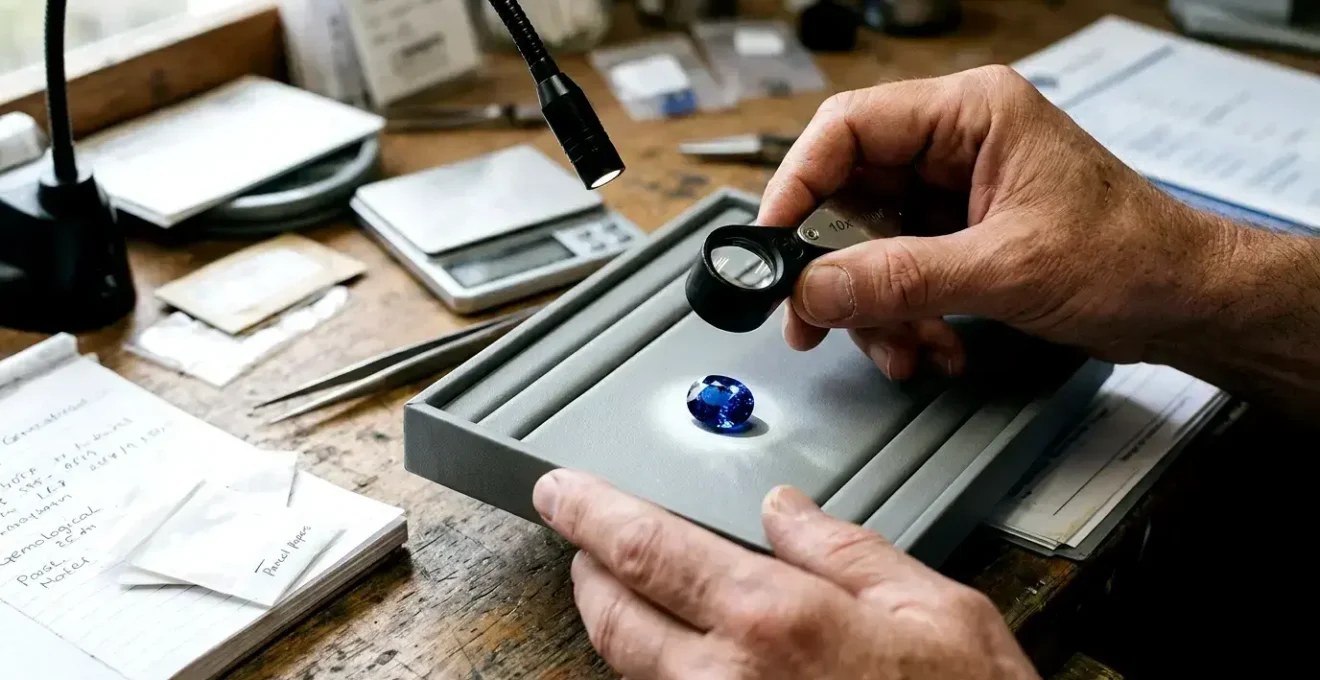
A sapphire can emerge from a furnace with richer blue colour and greater transparency while remaining the same natural gemstone it was before heating. A ruby can undergo a similar improvement. Neither necessarily becomes synthetic, artificial or fake simply because its appearance has changed.
Heat treatment is an established practice in the gemstone trade, particularly for ruby and sapphire. Yet the word « heated » can describe very different situations. Conventional heating without added colour-causing elements is not equivalent to diffusion treatment or fracture filling. Those distinctions affect what a buyer should pay, how a gem should be cared for and what independent testing can establish.
For buyers, the practical question is not whether every enhancement is unacceptable. It is whether the gemstone’s treatment has been properly identified, disclosed and reflected in its asking price. Understanding that difference helps prevent a common mistake: paying for documented rarity when the evidence supports only an ordinary treated gemstone.
Heat-treated gemstones: the buyer’s essentials
- Heating does not make a natural gem synthetic. Conventional heat treatment can permanently improve colour or clarity without changing ruby or sapphire’s mineral identity.
- Treatment type matters more than the word « heated ». Heating alone, diffusion, flux residues and glass filling require different value and care assessments.
- Documentation protects the purchase. Ask for written treatment disclosure and independent laboratory evidence before paying an unheated premium.
- Why Is Heat Treatment So Common in Sapphire and Ruby Without Being Considered « Fake »?
- How to Ask About Heat Treatment and Get a Straight Answer in Under 3 Minutes?
- Heated vs Unheated: Which Choice Makes More Sense if Your Budget Is Under £2,000?
- The Silence Trap: Assuming Untreated Because the Listing Doesn’t Mention Treatment
- When Should You Verify Treatment Status: Before Setting or Only Before Resale?
- How to Spot Heat-Treatment Clues in Corundum Using Only a Loupe and Side Lighting?
- When Is Advanced Testing Worth It for Corundum: Under £500, £2,000, or Only Higher?
- What Should You Assume About Any Corundum Stone Before You Even Ask the Seller Questions?
Why Is Heat Treatment So Common in Sapphire and Ruby Without Being Considered « Fake »?
Heat treatment is common because controlled heating can improve sapphire and ruby colour or transparency without changing their identity as natural corundum. The gemstone remains natural if it formed in the earth rather than a laboratory. Heating is therefore a treatment disclosure issue, not proof of imitation. However, conventional heating must be distinguished from treatments involving added materials.
Ruby and sapphire are varieties of corundum, a crystalline form of aluminium oxide. Their colours arise from trace elements and their interaction with the crystal structure. Heating can modify those colour-producing conditions and alter microscopic inclusions, creating a more desirable appearance.
Natural geological processes can also expose gemstones to heat, but deliberate furnace treatment is a separate commercial intervention. The distinction is historical and economic, not a transformation into a different mineral.
According to GIA‘s introduction to gemstone treatments, heating can influence gemstone colour and clarity, including the appearance of rutile silk in corundum. Conventional heat treatment is generally durable and permanent under normal handling conditions.
Three categories deserve separate attention:
- Unheated: a natural gemstone for which laboratory examination finds no indications of heating. This is an evidence-based finding, not an absolute reconstruction of its history.
- Conventionally heated: a natural gemstone improved through heating without an identified additional colour-causing diffusion treatment or substantial filling.
- Heated with additional treatment: a gemstone showing diffusion, flux-related residues, fracture filling or another process requiring specific disclosure and valuation.
Diffusion introduces elements into a gemstone during treatment. Glass filling places another material inside fractures or cavities. Neither should be represented as merely conventional heating.
The permanence of ordinary heating is reassuring for everyday wear, but it does not establish that every heated stone has identical durability. Intense treatment may increase brittleness, and glass-filled rubies can require different precautions around chemicals, heat and jewellery repairs.
The economic distinction is equally important. An attractive heated sapphire may be entirely genuine yet command less than a comparable fine-quality sapphire with independent evidence of no heating. That difference reflects rarity and market preferences rather than a loss of mineral authenticity.
The right question is therefore not simply whether the stone is real. It is whether its treatment has been described precisely enough to justify the asking price.
How to Ask About Heat Treatment and Get a Straight Answer in Under 3 Minutes?
Start by asking whether the gemstone has been heated, then immediately ask whether it has undergone diffusion, flux-assisted treatment or glass filling. Request the answers in writing and check whether an independent laboratory report supports them. A seller who only says « natural » has not answered the treatment question: natural origin and untreated condition are separate claims.
The conversation can be brief because each question addresses a distinct risk. Avoid asking only, « Is this a real sapphire? » A natural sapphire can be heated, diffused or fracture-filled while remaining natural corundum.
Use this sequence at the counter or in a written message:
- Identify conventional heating: « Has this stone been heat-treated, and is its treatment status confirmed or simply assumed? »
- Identify additional treatments: « Is it natural corundum without diffusion, glass filling, lead-glass composite construction or treatment-related residues? »
- Request independent evidence: « Which laboratory examined it, and can I review and verify the complete report before purchase? »
The sequence is a practical conversation framework, not a validated three-minute identification test. A quick answer can reveal a seller’s disclosure practices, but identifying treatment may require specialist laboratory work.
A professional response identifies what is known, what remains untested and which documents support the claim. An evasive response substitutes broad reassurance for a specific treatment description.
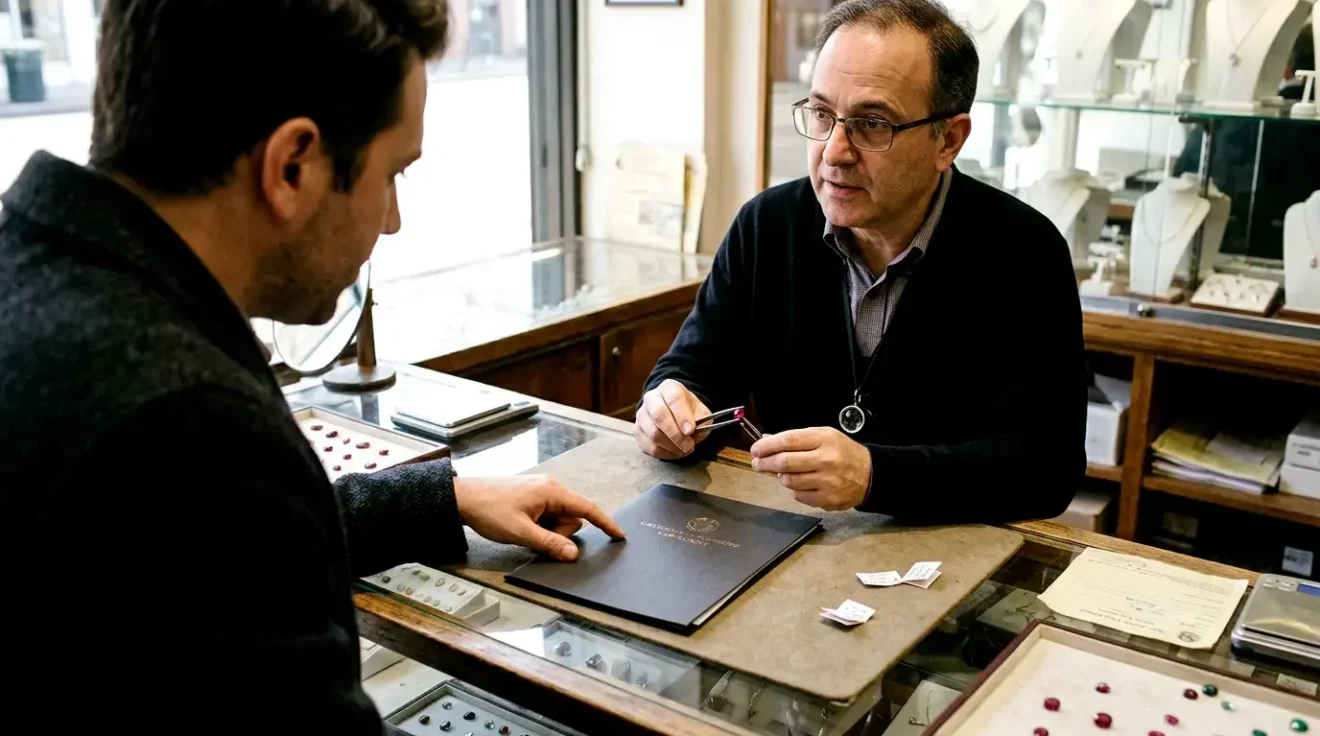
Independent reports are especially valuable when comparing gemstones advertised as unheated. For example, SSEF‘s sapphire laboratory report terminology distinguishes « indications of heating » from « no indications of heating ». Its reporting procedures also address detected diffusion, filling and treatment-related residues.
Those expressions matter. « No indications of heating » means the laboratory did not identify such indications in its examination. It is not an unconditional guarantee that the gemstone has never experienced artificial heating.
A seller-issued certificate, attractive photographs or an informal statement should not be treated as equivalent to independent analysis.
Five checks to complete before accepting a treatment claim
- Ask whether the gemstone is heated or unheated; retain the seller’s exact written response.
- Ask separately about diffusion, flux residues and fracture filling; obtain a written treatment breakdown.
- Request the complete independent laboratory report; save a readable copy.
- Check the report’s identification details and verification facility, where available; record the matching report reference.
- Confirm that the price, return conditions and invoice reflect the documented treatment; retain the final purchase record.
If the seller cannot establish that a gemstone is unheated, do not pay an unheated premium. Where substantial filling or diffusion is suspected but not adequately disclosed, declining the purchase is safer than relying on an optimistic interpretation.
Once the treatment claim is clear, the next decision is whether the rarity premium for an unheated gemstone is worth paying within the available budget.
Heated vs Unheated: Which Choice Makes More Sense if Your Budget Is Under £2,000?
For a personal jewellery purchase under £2,000, a well-cut conventionally heated sapphire or ruby can offer better visible quality for the money than a comparable unheated stone. Choose unheated when documented rarity matters more than size or appearance. Neither option is inherently superior, and £2,000 is a budgeting example rather than an established market threshold.
Unheated status can command a premium because desirable natural colour and clarity without detected thermal enhancement are commercially valued. But rarity does not replace the other factors that determine gemstone quality.
A poorly cut, heavily included unheated sapphire can look less appealing than a carefully selected heated sapphire. Conversely, a fine unheated stone with strong colour, balanced proportions and independent documentation may justify a significantly higher price.
The GIA’s sapphire buyer’s guide explains that independent confirmation of no evidence of heating can increase the rarity and value of fine-quality sapphire. It also distinguishes conventional heating from lattice diffusion, which generally carries a different market valuation.
Consider a hypothetical comparison involving two stones offered at similar prices. One is a larger, visually clean heated sapphire with a reliable treatment report. The other is smaller, shows more visible inclusions and has independent evidence of no heating. Their relative attractiveness depends on the buyer’s priorities, not on a universal price multiplier.
| Buying priority | Conventionally heated | Unheated |
|---|---|---|
| Visible appearance | May offer stronger colour, clarity or size within a fixed budget | May involve compromises in appearance or size at the same price |
| Rarity | Generally less valued for treatment rarity alone | Documented absence of heating may attract a premium |
| Everyday jewellery | Often a practical choice when properly identified | Also suitable when quality and setting are appropriate |
| Resale considerations | Requires accurate disclosure and realistic resale expectations | Laboratory evidence may support collector interest, without guaranteeing resale |
| Documentation | Especially useful for confirming the absence of additional treatments | Essential to substantiate a claimed unheated premium |
Unheated gemstones are not automatically easier to resell. Liquidity also depends on quality, demand, price, seller reputation and available documentation. No universal resale advantage can be calculated from treatment status alone.
Likewise, buying a gemstone should not be confused with buying a guaranteed appreciating investment. Retail margins, transaction costs and market preferences can affect eventual resale proceeds.
For jewellery intended primarily to be worn and enjoyed, paying for colour, cut and credible disclosure may be more sensible than stretching the budget to obtain an unsupported rarity claim.
The Silence Trap: Assuming Untreated Because the Listing Doesn’t Mention Treatment
A listing that does not mention gemstone treatment should be considered unverified, not untreated. Heating is an established commercial practice for sapphire and ruby, but silence does not establish which treatment, if any, occurred. Ask for explicit written disclosure and independent evidence before paying a premium based on an assumed unheated condition.
This trap commonly begins with ordinary listing language. A stone may be described as « natural », « genuine », « earth-mined » or « fine quality ». Those expressions address different characteristics and do not establish that a gemstone is free from treatment.
Absence of treatment information can have several explanations. The seller may not know the status, may never have commissioned testing or may be using a platform whose standard product fields omit treatment details. Deliberate concealment is another possibility, but silence alone cannot establish intent.
The commercial consequences are asymmetric. If a buyer pays a price appropriate to an ordinary heated stone and independent testing later finds no indications of heating, the discovery could increase its perceived desirability. If a buyer pays an unheated premium for a stone later identified as heated, the price assumption may prove costly.
However, neither outcome guarantees a profit or a specific loss. Overall quality, purchase price and actual resale conditions still matter.
The cautious approach is to avoid assigning any undocumented unheated premium. This is a valuation safeguard, not a scientific conclusion that every unreported stone has been heated.
Online marketplaces deserve particular attention because photographs rarely provide adequate evidence of treatment. Professional-looking imagery, confident descriptions and highly positive reviews do not establish what happened inside a gemstone before sale.
Compare the strength of the evidence rather than relying on the type of platform alone. A specialist dealer without an adequate report may offer less certainty than a marketplace seller supplying a verifiable independent report and clear return conditions.
Whenever treatment is material to the purchase, obtain clarification before committing funds. The timing becomes even more important when the gemstone will be mounted into jewellery.
When Should You Verify Treatment Status: Before Setting or Only Before Resale?
Verify treatment before setting when a gemstone represents a significant purchase, carries an unheated premium or may eventually be resold. Laboratory examination is often easier on a loose stone because its surfaces and internal features are more accessible. For inexpensive personal jewellery, postponing testing can be reasonable if the buyer accepts the resulting uncertainty.
Mounting a gemstone does not automatically prevent treatment identification. Laboratories can examine many mounted stones, although the setting may restrict observations, introduce additional handling requirements or limit certain conclusions.
Prongs, bezels and surrounding materials can obstruct the girdle, pavilion or surface-reaching fractures. Some identification procedures also depend on conditions that are more easily controlled before mounting.
This creates a practical reason to test early: the buyer can resolve material questions before paying for setting work and before return arrangements become more complicated.
It would nevertheless be misleading to claim that verification always costs the same before and after setting. Laboratory fees, examination options and potential removal or resetting costs depend on the stone, laboratory and jewellery construction.
Choose the timing according to the financial significance of uncertainty:
- Significant gemstone purchase: establish identity and treatment before setting, especially if the quoted price relies on unheated status.
- Potential heirloom or resale purchase: obtain suitable documentation early and keep it with the gemstone’s purchase records.
- Low-value personal jewellery: consider deferring independent testing where the cost is disproportionate and treatment status would not change the decision to keep the piece.
If testing is deferred, preserve the seller’s written statements, invoice, photographs and any existing report. Those documents establish what was represented at purchase, although they do not independently prove the treatment condition.
For a stone that might later be sold, uncertainty should be reflected in expectations. A future buyer may be unwilling to pay a documented-unheated premium without satisfactory laboratory evidence.
The next challenge is knowing what a buyer can reasonably observe without laboratory equipment—and, more importantly, what those observations cannot establish.
How to Spot Heat-Treatment Clues in Corundum Using Only a Loupe and Side Lighting?
A 10x loupe and focused side lighting may reveal altered inclusions, discoid expansion features or unusual internal characteristics in sapphire and ruby. These observations can justify further examination, but they cannot reliably establish treatment status. Some heating leaves little visible evidence, while naturally occurring features may resemble treatment clues. A loupe is a screening tool, not a laboratory substitute.
Begin with a clean gemstone and a single focused light source. Hold the stone securely with appropriate tweezers, bring the loupe close to the eye and adjust the gemstone’s position until internal structures come into focus.
Rotate the stone slowly rather than judging it from one face-up view. Look through the crown and, where accessible, from other angles to distinguish internal features from reflections, facet junctions and surface marks.
Two categories of observations deserve attention:
- Altered inclusions: partially dissolved rutile needles, commonly called silk, or discoid expansion features around inclusions may be associated with thermal treatment.
- Colour distribution: unusually abrupt or concentrated colour areas may warrant investigation, although colour zoning by itself is not a dependable indication of heating or diffusion.
The visible appearance of these features depends on their size, depth, orientation and the gemstone’s optical characteristics. Even when a feature appears suggestive, determining its origin requires expertise.
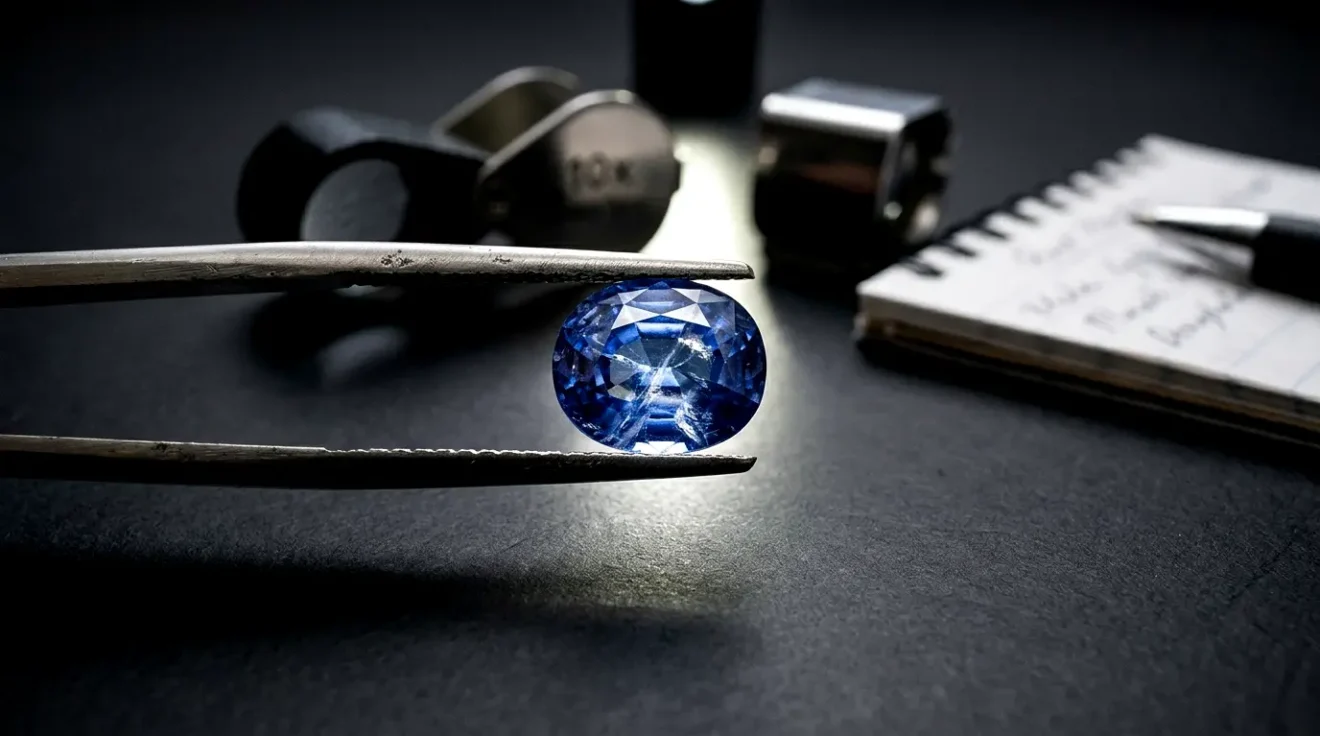
For particularly useful technical context, SSEF’s research on low-temperature corundum heating discusses the difficulty of identifying some treatments through microscopic evidence alone.
Its 2024 publication describes approximately 700–1000 °C as a range associated with low-temperature heating and explains that heating around 700–1200°C may leave only subtle or absent microscopic alterations. These are approximate technical ranges, not universal processing conditions.
This is why a clean-looking interior does not establish an unheated stone. Even professional microscopy may need to be supplemented by infrared spectroscopy and Raman micro-spectroscopy.
During an ordinary viewing, also note any conspicuous material in fractures, changes around the girdle, or differences in appearance between lighting conditions. Such observations may reveal quality or identification questions, but none is independently diagnostic of heat treatment.
A gemstone that looks vivid under a concentrated display lamp but dull under diffuse daylight may simply show lighting-dependent appearance. That deserves consideration when judging beauty, not an automatic accusation of undisclosed enhancement.
Where the treatment claim materially affects the price, professional testing remains the appropriate next step. Its economic value depends on the financial risk being investigated.
When Is Advanced Testing Worth It for Corundum: Under £500, £2,000, or Only Higher?
Advanced gemstone testing is worthwhile when the cost of uncertainty outweighs the cost of examination. A £500 purchase does not automatically justify a full report, nor does a £2,000 purchase automatically require geographic-origin analysis. The relevant factors are the treatment claim, the premium being paid, the seller’s reliability and whether the results could change the buying decision.
Testing should be matched to the question that needs answering. A buyer seeking confirmation that a gemstone is natural corundum and whether detectable treatments are present may not need the same service as a collector purchasing a stone priced around a prestigious geographic origin.
Reports also have different scopes. Identification, treatment analysis and geographic-origin determination are related but distinct services. Buyers should check which conclusions the selected report will actually provide.
Geographic-origin opinions can require advanced examination of microscopic characteristics, trace elements and spectroscopic information, supported by comparison with reference data. Such assessments are expert opinions rather than guarantees of an exact geological location.
There is no evidence-based universal financial threshold at which advanced testing becomes mandatory. A useful approach is to compare the potential overpayment associated with an incorrect claim against the actual laboratory quotation.
| Purchase situation | Practical testing approach | Principal risk |
|---|---|---|
| Under £500, ordinary personal jewellery | Consider seller disclosure, return rights and the proportionate cost of independent testing | Testing costs may be substantial relative to the purchase |
| Around £2,000, gemstone with a treatment-dependent premium | Seek independent identification and suitable treatment assessment before purchase | An unsupported unheated claim may materially affect value |
| Higher-value or collector-oriented purchase | Consider comprehensive treatment analysis and origin assessment when commercially relevant | Incorrect rarity or geographic-origin claims may affect the transaction |
| Any budget, suspected substantial filling or diffusion | Clarify the treatment with appropriate independent examination or decline the purchase | Misidentifying the treatment category may affect price and care |
Testing becomes particularly important when the seller explicitly charges for an unheated condition or a claimed geographic origin. Without appropriate evidence, the purchaser is accepting a price premium whose foundation remains uncertain.
For inexpensive purchases, buyers may instead prioritise a reputable seller, explicit written treatment statements and workable return conditions. These measures reduce commercial exposure but do not establish treatment status scientifically.
Insurance requirements should also be checked independently. An insurer may require a valuation or other documentation, which is not necessarily the same as a detailed gemmological treatment report.
A sensible testing decision begins even earlier, with realistic assumptions about what an unexamined ruby or sapphire can—and cannot—be presumed to be.
Key takeaways before evaluating any corundum stone
- Do not assign an unheated or premium-origin valuation without evidence supporting the claim.
- Separate natural mineral identity from treatment status, and conventional heating from additional enhancement processes.
- Match the strength of documentation to the size of the purchase, the potential premium and your intended use of the gemstone.
What Should You Assume About Any Corundum Stone Before You Even Ask the Seller Questions?
Before questioning a seller, assume that an undocumented ruby or sapphire has an unverified treatment history and geographic origin. For ordinary commercial blue sapphire and ruby, heating is a reasonable possibility to consider when evaluating price. This is a conservative purchasing assumption, not proof that a particular stone was treated or that every corundum variety follows the same market pattern.
The starting point matters because a gemstone’s description can appear more precise than the supporting evidence actually allows. A natural sapphire may be correctly identified as corundum even when its heat-treatment status remains unresolved.
Similarly, a seller may state a geographic origin that has not been independently assessed. Origins associated with premium market perceptions require appropriate supporting analysis when those claims materially affect the asking price.
Three baseline assumptions help separate known facts from commercial expectations:
- Treatment is unverified until adequately examined. Conventional heating is common in relevant market segments, but additional treatments cannot be ruled out merely because heating seems probable.
- Geographic origin is unverified unless supported. A country name in a listing is a seller claim until suitable evidence is available.
- The asking price is not proof of quality or rarity. Price may reflect a seller’s expectations, presentation or commercial costs rather than independently established characteristics.
These assumptions must remain flexible. Treatment patterns differ among colours, quality categories and market segments. A fine collector stone accompanied by a reputable laboratory report presents a different evidential situation from an inexpensive unexamined commercial stone.
It is also important to distinguish the laboratory’s findings from the seller’s description. The seller explains what is being offered; the report records what its examination supports, within the limits of the methods used.
Neither represents a universal minimum or maximum market price. Instead, their agreement—or disagreement—helps a buyer assess whether the requested price is defensible.
A report identifying natural sapphire with indications of heating does not make the stone fake. It establishes a relevant characteristic that can be considered alongside colour, clarity, cut, size and any other disclosed treatments.
Before buying, request the precise treatment description, review the available independent evidence and compare the asking price with the characteristics that can actually be substantiated. That process protects the decision without treating legitimate gemstone enhancement as inherently undesirable.
Can a heat-treated sapphire still be called a natural sapphire?
Yes. A sapphire that formed naturally remains natural corundum after conventional heat treatment. Natural origin and treatment status describe different characteristics. Accurate disclosure should still identify the treatment, and the term « natural » should not be used to imply « unheated ».
Will a heated ruby gradually lose its improved colour?
Conventional ruby heat treatment is generally considered durable and permanent under normal handling conditions. That does not mean the gemstone is immune to physical damage or extreme heat. Rubies containing glass filling or other additional treatments may require different precautions.
Does a laboratory report saying « no indications of heating » guarantee that a stone is unheated?
No. The expression means that the laboratory did not detect indications of heating during its examination. Some treatment processes, especially certain lower-temperature methods, may leave very subtle evidence. The finding is valuable expert evidence, but it should not be interpreted as absolute historical certainty.
Is diffusion treatment the same as ordinary heat treatment?
No. Conventional heat treatment changes appearance through heating, whereas lattice diffusion involves introducing chemical elements into the gemstone during treatment. The distinction affects disclosure and can significantly affect commercial valuation. A report should be examined for the specific treatment findings rather than relying on a generic « heated » description.
Can a heated sapphire be cleaned like an unheated sapphire?
A conventionally heated sapphire without additional filling generally does not require a special long-term cleaning regime solely because it was heated. However, ultrasonic cleaning, steam, temperature changes and jewellery repair procedures should be considered in light of the particular stone’s fractures, inclusions, setting and any other treatments. When treatment details are uncertain, seek professional cleaning advice.