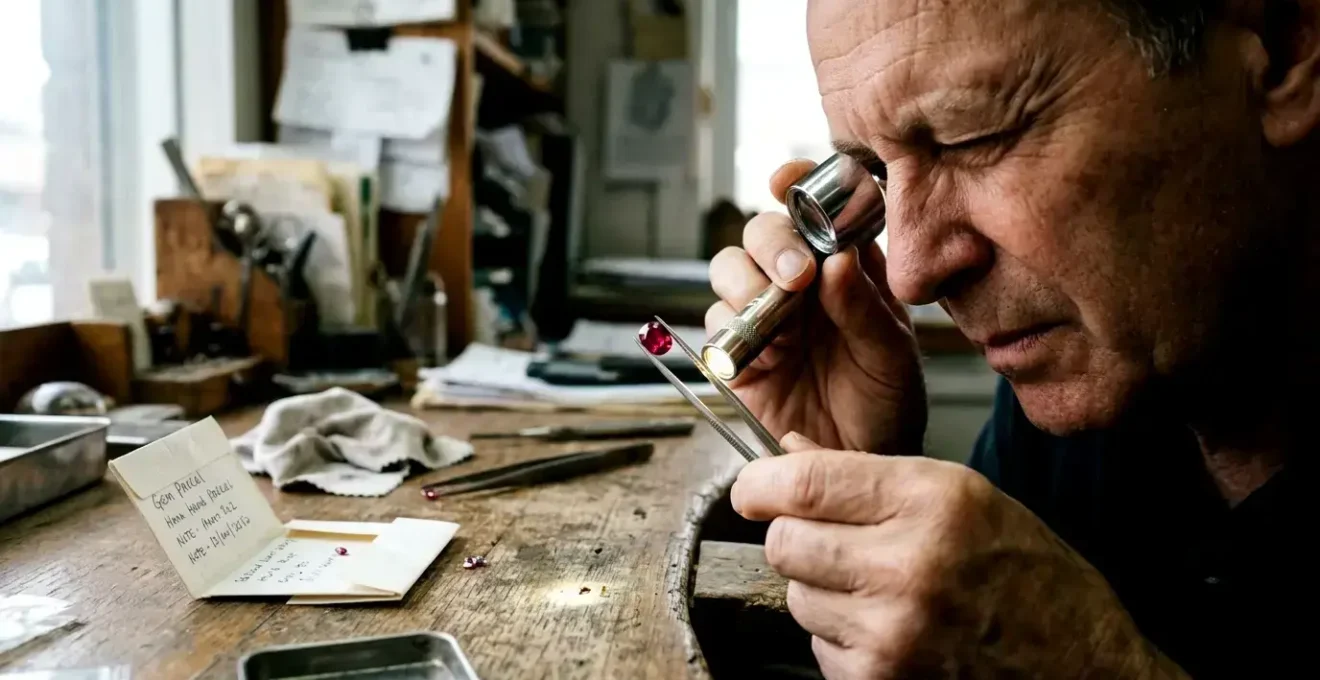
A gemstone can sparkle beautifully beneath a showroom spotlight and still have uneven facets, visible polishing marks, or vulnerable edges. Shine attracts attention, but it does not establish whether a stone has been finished carefully enough to justify its price.
A good polish produces smooth, consistent surfaces that reflect light cleanly. Equally important are the stone’s facet geometry, symmetry, material properties, and resistance to everyday wear. A highly polished gemstone can still chip, while a stone with minor microscopic polishing marks may look excellent without magnification.
For buyers comparing loose stones online or examining jewelry in person, the practical question is not whether every surface is flawless. It is whether visible finishing defects compromise appearance, create maintenance concerns, or make the asking price unreasonable.
A short inspection under different lighting conditions, followed by a closer look at facet junctions, can reveal problems that photographs and bright display lighting sometimes conceal.
What matters most when judging gemstone polish
- Look for consistent reflections, smooth facet surfaces, and clean junctions rather than relying on overall sparkle.
- Distinguish superficial polishing marks from chips, fractures, coatings, and material-related durability risks.
- Compare appearance at normal viewing distance and obtain a repair assessment before paying for a stone that may need repolishing.
- Why Can a Stone Look Shiny but Still Have a Poor Polish That Dulls in Weeks?
- How to Check Polish Quality in 2 Minutes Using Reflections and One Straight Edge
- Excellent Polish on a Smaller Stone vs Average Polish on a Larger Stone: Which Looks Better at Arm’s Length?
- The Buying Mistake: Ignoring Facet Junction Chips That Turn Into Big Damage Later
- When Should You Repolish a Stone: Before Setting, After Scratches Appear, or Only Before Resale?
- Why Does Your Everyday Ring Get Scratched in 2 Weeks Even If the Stone Feels Hard?
- Excellent Polish on a Smaller Stone vs Average Polish on a Larger Stone: Which Looks Better at Arm’s Length?
- Which ‘Semi-Precious’ Stones Are Actually Best for Daily Wear If You’re Clumsy or Busy?
Why Can a Stone Look Shiny but Still Have a Poor Polish That Dulls in Weeks?
A stone can appear shiny because its surface reflects strong lighting or because a coating enhances its appearance, even when the underlying finish is imperfect. Some treatments can wear or change with use, while softer materials may accumulate scratches. However, rapid dulling is not proof of poor polishing: the gemstone’s hardness, treatment, and wearing conditions also matter.
True mechanical polish results from progressively refining the stone’s surface until fine grinding marks are reduced sufficiently to produce a smooth, reflective finish. On a well-cut faceted gemstone, individual facets should display relatively even, mirror-like surfaces.
A bright reflection alone does not establish that quality. A facet can reflect a concentrated light source while retaining faint polishing lines, pits, or uneven texture.
According to GIA‘s research on colored gemstone cut quality, finishing craftsmanship includes the quality of facet polishing and junction formation. Remaining grinding marks, chipped edges, and distorted surfaces can affect a gemstone’s appearance and value.
The distinction between a poor finish and a treated surface is especially important.
A wax, resin, oil, or other enhancement may change how a gemstone looks. Some treatments are intended to improve color or clarity rather than conceal polishing defects. Their presence cannot reliably be established simply because a stone looks unusually glossy.
Likewise, a polished stone that becomes hazy after wear may have accumulated scratches, suffered treatment deterioration, or developed a residue from everyday products. These possibilities require different remedies.
For pricing purposes, inspect the underlying craftsmanship before assuming that a glossy appearance represents premium finishing. **A temporary surface effect and a durable mechanical polish are not equivalent.**
A reliable purchase assessment separates three questions: how the stone looks today, how its material is likely to wear, and whether any treatment needs special care. The next step is learning to examine those characteristics without specialized laboratory equipment.
How to Check Polish Quality in 2 Minutes Using Reflections and One Straight Edge
A two-minute inspection can reveal obvious polishing defects by comparing reflected light across facets, checking the surface under diffuse daylight, and examining large flat facets for visible irregularities. A straight edge may help assess an accessible, sufficiently large facet, but it is not a validated gemstone-grading method. Small stones and suspected structural defects require magnification or professional examination.
Begin with a clean stone and a stable light source. Dirt, fingerprints, and oils can create misleading haze.
A phone flashlight can provide concentrated illumination, although the light should be directed carefully to avoid glare that overwhelms surface detail.
Rotate the gemstone slowly and compare neighboring facets. Look for:
- Reflections that appear noticeably less defined on one facet than on comparable facets.
- Fine parallel lines that remain visible as the stone rotates.
- Small pits or irregular patches interrupting an otherwise smooth surface.
- Unexpected differences in surface texture between adjacent facets.
These signs are screening clues, not conclusive diagnoses. Internal inclusions, facet angles, reflections from the opposite side of a transparent stone, and the light source itself can complicate interpretation.
For a large, accessible flat facet, a clean, rigid straight edge can provide an additional visual reference. Avoid dragging metal across the gemstone or pressing against a fragile edge. A non-contact visual comparison is safer, especially for valuable stones.
A gap or rocking movement may suggest a geometry issue, but it does not by itself establish defective polish. This method is unsuitable for small, curved, mounted, or irregularly shaped surfaces.
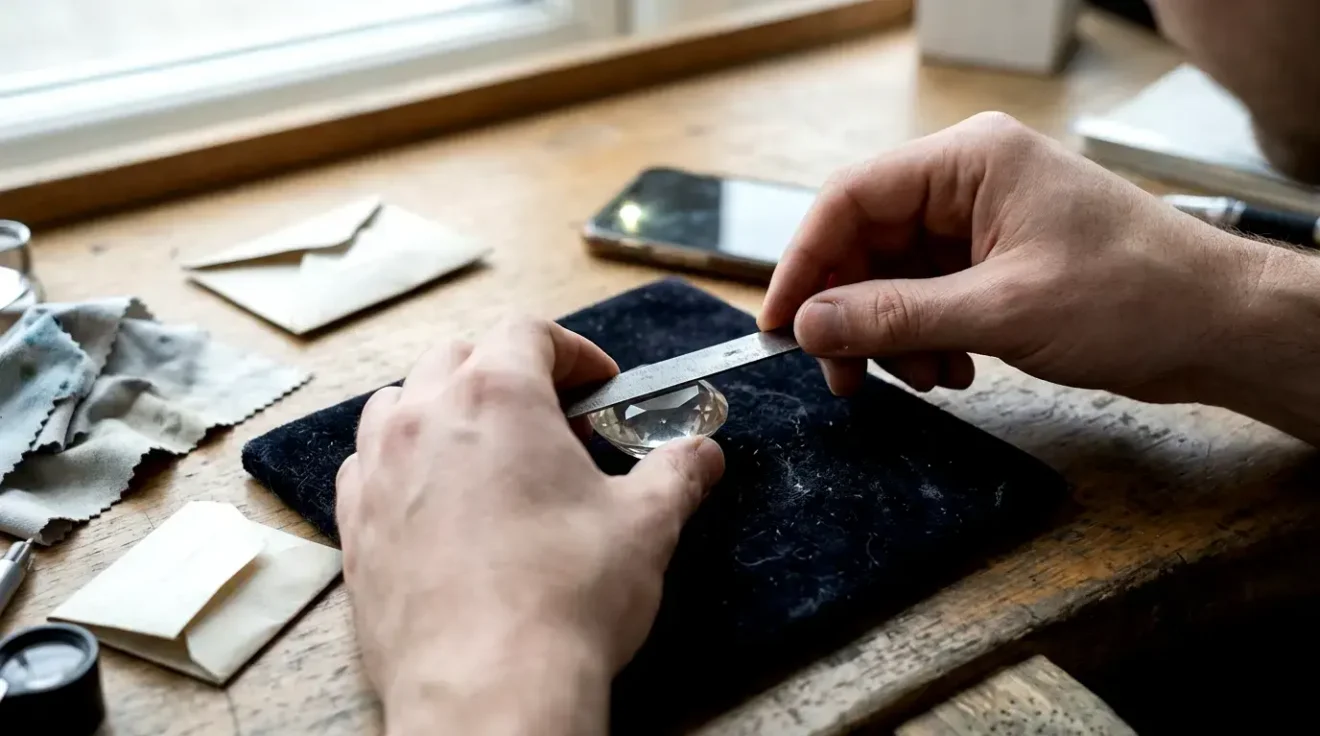
Finally, move the stone into diffuse daylight. Compare its surface appearance without the intense directional illumination commonly used in display cases.
A facet that appeared brilliant under spotlights may show haze or polishing lines more readily under another lighting arrangement. The reverse can also occur, so examine the stone from several angles.
Your five-step gemstone polish inspection checklist
- Clean the gemstone using a method appropriate to its material and treatment. Record whether visible haze remains.
- Rotate it beneath one concentrated light source. Identify any facet with unusually distorted or inconsistent reflections.
- Inspect the stone in diffuse daylight. Note which surface defects remain visible without intense illumination.
- Examine accessible facet edges with a 10x loupe. Record the locations of white abrasions, nicks, or chips.
- Compare your findings with the seller’s description and request a professional assessment if defects could affect value or repair costs. Keep a written list of unresolved concerns.
If several observations raise concerns, do not apply an automatic discount formula. Instead, request better photographs, independent inspection, or a written repair estimate before negotiating.
The inspection is most useful as a screening process. It can identify stones worth examining more closely, but it cannot replace professional grading or reliably distinguish every surface defect from an internal feature.
Excellent Polish on a Smaller Stone vs Average Polish on a Larger Stone: Which Looks Better at Arm’s Length?
A smaller gemstone with excellent polish can look more attractive than a larger stone with conspicuous surface haze, but the result is not universal. At arm’s length, color, transparency, cut proportions, lighting, and visible size may matter more than minor polishing differences. Choose the better-looking stone under comparable conditions rather than assuming that either size or polish always wins.
Polishing quality affects how cleanly facet surfaces reflect light. Obvious scratches, pits, or irregular textures can interfere with those reflections and make a stone appear less crisp.
However, a gemstone’s brilliance also depends on its overall cut, optical properties, and the direction of incoming light. Excellent polish cannot compensate for every proportion or symmetry problem.
For a fair comparison, place both stones in the same neutral lighting environment and view them at approximately the distance at which the finished jewelry will normally be seen.
Avoid comparing one stone beneath a bright spotlight and the other in shadow.
The most useful buying criteria are practical rather than purely technical.
| Buying priority | Smaller stone, excellent polish | Larger stone, average polish |
|---|---|---|
| Close-up appearance | May offer cleaner facet reflections | Minor finishing defects may be easier to notice |
| Arm’s-length appearance | Can look crisp but less prominent | May offer stronger size impact |
| Daily jewelry wear | Good initial finish, subject to material durability | Acceptable if defects are superficial and unobtrusive |
| Potential repair | May require less initial finishing work | Could need professional repolishing assessment |
| Resale considerations | Finish may support presentation | Size may remain attractive despite minor polish defects |
For a ring examined frequently at close range, visible surface quality deserves particular attention. For a pendant primarily viewed from a distance, a modest difference in polish may be less important than color and overall presence.
Resale value requires additional caution. There is no reliable universal rule that excellent polish preserves a particular percentage of value or that a larger stone with average polish must be repolished before resale.
**The premium for better finishing should remain proportionate to the stone’s overall value.**
If the difference cannot be seen under realistic viewing conditions, paying substantially more for microscopic perfection may offer little practical benefit. Visible chips at facet junctions, however, deserve a separate assessment.
The Buying Mistake: Ignoring Facet Junction Chips That Turn Into Big Damage Later
A small chip at a facet junction deserves attention because it may indicate previous impact damage or a vulnerable edge. Nevertheless, not every nick will grow into a larger fracture. The risk depends on the stone’s toughness, cleavage, geometry, setting, and exposure to knocks. Distinguishing harmless abrasion from deeper damage is essential before purchase.
Facet junctions are the lines where neighboring polished surfaces meet. Ideally, these intersections appear clean and well defined.
Under magnification, an abraded junction may instead resemble a fuzzy white line. A localized nick may look like a small notch, while a larger chip can interrupt the intended facet shape.
GIA’s diamond polish and symmetry terminology distinguishes scratches, pits, polish lines, abrasion, and nicks. Its definitions are particularly useful for describing what a buyer sees through a loupe, although the diamond grading system should not be applied unchanged to every colored gemstone.
Pay particular attention to the girdle, pointed corners, and exposed facet edges.
A thin girdle or sharp point may be vulnerable to impact, especially when the setting offers limited protection. A chip near these locations may also complicate recutting because removing the damage could require changing the gemstone’s outline or proportions.
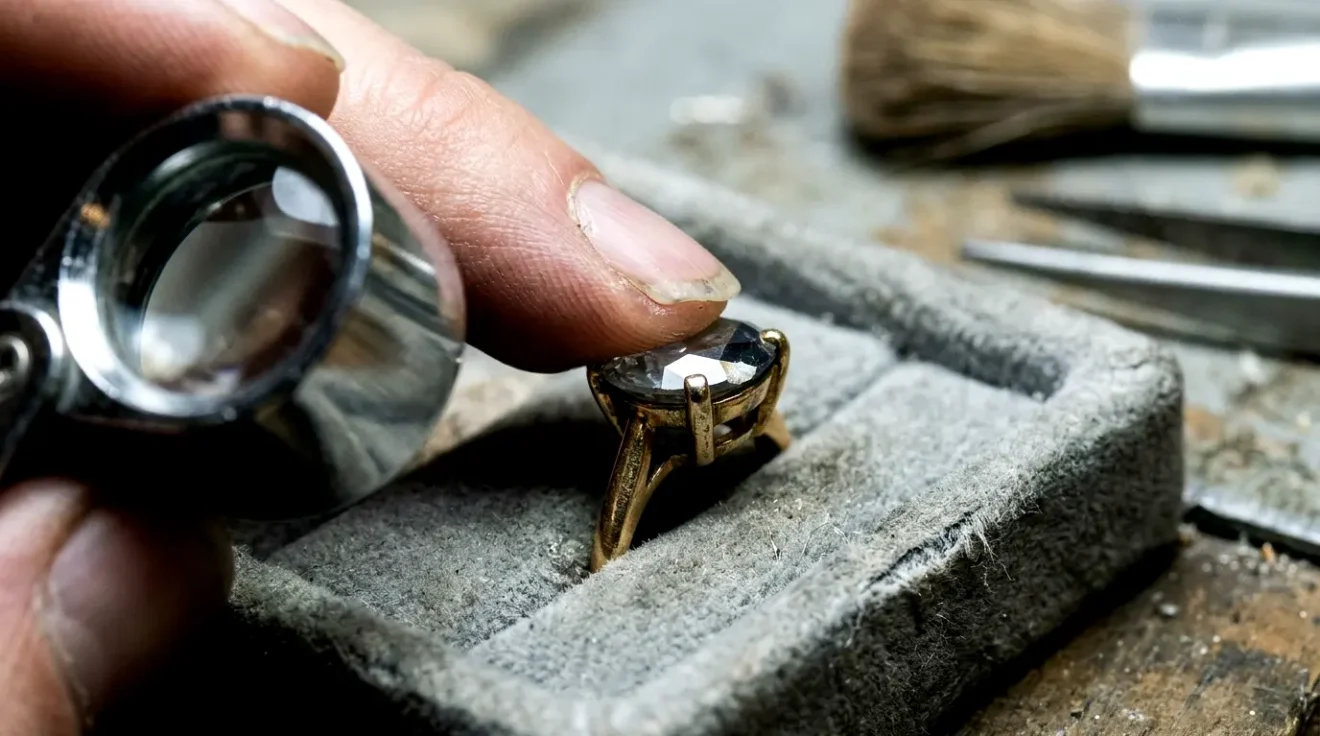
A fingernail may detect an obvious irregularity on an accessible edge, but it is not a reliable method for determining whether damage is superficial or structural. Avoid probing vulnerable areas or dragging a nail across delicate surfaces.
Use a loupe to document the location and appearance of a suspected defect. A professional can then determine whether it is an abrasion, a chip, a surface-reaching fracture, or a feature associated with the gemstone’s natural structure.
The distinction has direct financial consequences.
A superficial abrasion may be relatively straightforward to address, depending on the material. A deeper chip may require recutting, weight loss, or a revised setting. Some damage cannot be repaired economically.
For an unset gemstone, a repair assessment can be included in the purchase decision. For a mounted stone, removing and resetting it may introduce additional work and risk.
A visible defect is not automatically a reason to reject a gemstone, but uncertainty about its depth or repairability should affect the buying decision. That leads to the question of when corrective polishing is worthwhile.
When Should You Repolish a Stone: Before Setting, After Scratches Appear, or Only Before Resale?
Repolish a gemstone when visible surface damage materially affects its appearance and a qualified cutter confirms that correction is safe and economically reasonable. Before setting is often the most convenient time to address known defects. After ordinary wear, minor marks may not justify intervention. Before resale, repolishing makes sense only when the expected benefit outweighs its cost and risks.
Repolishing is not the same as cleaning. It involves removing or refining a portion of the gemstone’s surface to improve its finish.
The procedure may alter facet geometry, remove material, and potentially reduce weight. The extent depends on the original damage and the work required.
Consider three common situations.
| Timing | Potential benefit | Main consideration |
|---|---|---|
| Before setting | Access to the entire stone may simplify finishing | Additional upfront expense and possible weight loss |
| After visible wear | Restores appearance when suitable | Stone removal, treatment sensitivity, and repair risk |
| Before resale | May improve presentation to buyers | No guarantee of recovering the repair expense |
A gemstone with a few microscopic marks visible only through magnification does not necessarily need corrective work.
For ordinary jewelry, a more useful threshold is whether the scratches are apparent at normal viewing distance and materially reduce enjoyment of the stone.
Treatment history can change the decision.
Some gemstones contain fracture fillings or surface coatings that may be damaged by polishing, heat, or other workshop processes. A cutter should know the treatment status before undertaking repairs.
GIA’s reference on gemstone treatments explains that enhancements can influence appearance, durability, and care requirements. Certain coatings are vulnerable to scratching, particularly around facet edges.
Pearls, amber, opal, and other delicate materials require methods appropriate to their particular structure and composition. They should not automatically be subjected to procedures intended for conventional faceted gemstones.
**Repolishing is a material-removing intervention, not a cost-free reset.**
For an inexpensive stone, replacement may sometimes be more practical than specialist repair. For a valuable gemstone, preserving weight, original cutting character, and treatment integrity may be more important than eliminating every surface mark.
The best maintenance decision considers both visible damage and future wear. A stone that will return to demanding daily use may require a different strategy from one reserved for occasional occasions.
Why Does Your Everyday Ring Get Scratched in 2 Weeks Even If the Stone Feels Hard?
A ring can develop scratches quickly because gemstone hardness varies substantially, and everyday contact with abrasive particles or harder materials can damage a polished surface. Feeling hard to the touch does not establish scratch resistance. Two weeks is not a universal wear timeline: the outcome depends on the gemstone, its treatment, the environment, and how the ring is worn.
Gemstone durability involves more than resistance to scratching.
Hardness describes resistance to abrasion. Toughness concerns resistance to breaking or chipping, while stability describes how a material responds to environmental influences such as heat, chemicals, and light.
Quartz, a common mineral present in some sand and dust, has a Mohs hardness of Mohs hardness 7. It can scratch softer materials when sufficient contact and pressure occur.
That does not mean every gemstone below Mohs 7 will become visibly scratched within a fixed period. Abrasion depends on the particles involved, contact conditions, and frequency of exposure.
Rings are especially exposed because hands regularly contact desks, door handles, tools, bags, and other surfaces.
The same gemstone used in a pendant may experience fewer abrasive contacts, although its actual wear depends on the owner’s activities and jewelry design.
A highly polished surface cannot eliminate these material limitations. Even excellent initial craftsmanship will not make a relatively soft gemstone behave like a harder one.
Simple habits can reduce unnecessary wear:
- Remove rings before abrasive cleaning, manual work, or activities involving repeated impacts.
- Avoid exposing gemstones to chemicals or cleaning methods unsuitable for their composition or treatments.
- Store jewelry separately so harder stones and metal components do not rub against softer surfaces.
- Inspect exposed settings and edges periodically, especially after an impact.
Avoid assuming that frequent repolishing is routine maintenance for every gemstone. For some materials, repeated refinishing may be impractical or unnecessarily destructive.
Understanding wear helps buyers choose the right material and setting from the beginning. It also changes how size and polish should be compared in a real purchase.
Excellent Polish on a Smaller Stone vs Average Polish on a Larger Stone: Which Looks Better at Arm’s Length?
At arm’s length, the better-looking gemstone is the one that delivers the most pleasing combination of visible size, color, contrast, and clean reflections under the same lighting. Excellent polish may give a smaller stone a crisper appearance, but modest finishing differences can disappear at normal viewing distance. A direct side-by-side comparison is more reliable than judging photographs or labels alone.
For this comparison, concentrate on what the eye actually detects rather than what a loupe reveals.
Place the stones next to each other against a neutral background, using equivalent lighting and similar viewing angles. If possible, examine them both loose or in comparable temporary holders.
First, compare the overall visual impact. Which stone attracts attention without relying on a single bright reflection?
Next, look for surface haze, uneven reflections, or obvious polishing lines. Finally, assess whether the size difference remains meaningful once the stones are viewed from a realistic distance.
Larger facets can provide more surface area on which certain imperfections may be noticed, but visibility is not determined by size alone. Facet orientation, material transparency, lighting, and the type of defect also matter.
Consider a hypothetical buying scenario.
Hypothetical buyer comparison: two stones at similar budgets
Stone A is smaller, with clean reflections and no obvious surface defects. Stone B is noticeably larger but shows faint polishing lines under magnification and mild haze in some lighting.
At arm’s length, the buyer prefers Stone A’s crisp appearance in a ring. For a pendant intended to be viewed from farther away, Stone B’s greater visible size becomes more appealing. Before choosing Stone B, the buyer asks whether the haze is a finishing defect, whether repair is necessary, and whether the asking price reflects its condition.
Neither decision is automatically correct. The example illustrates why intended use matters more than a simplistic rule favoring either size or finish.
Resale expectations should remain conservative. A larger stone may command interest because of its material, color, and weight, while a smaller well-finished stone may appeal because of its craftsmanship. No fixed resale advantage follows from polish alone.
Once appearance and repair risk have been considered together, the remaining question is whether the gemstone’s material can withstand the wear expected of it.
Key takeaways before choosing a daily-wear stone
- A polished finish is only as practical as the material beneath it; scratch resistance, toughness, and stability must all be considered.
- Choose a setting that protects vulnerable edges and suits the activities during which the jewelry will be worn.
- For demanding everyday use, a modest durable stone with a sound finish may offer better long-term satisfaction than a larger, more delicate alternative.
Which ‘Semi-Precious’ Stones Are Actually Best for Daily Wear If You’re Clumsy or Busy?
For active wearers, quartz-family stones such as agate, jasper, and chalcedony can be practical choices, while certain garnets and other appropriately selected gemstones may also perform well. However, durability depends on scratch hardness, toughness, treatments, and setting design. The term ‘semi-precious’ is a commercial classification, not a reliable indication that a stone is suitable for everyday wear.
Start by separating appearance from physical performance.
A gemstone can be beautifully polished and relatively scratch-resistant yet remain vulnerable to cleavage or impact damage. Another may resist knocks reasonably well but accumulate surface abrasions during frequent contact.
GIA’s explanation of gemstone durability identifies three distinct properties: hardness, toughness, and stability. These should be evaluated together rather than relying exclusively on a Mohs hardness number.
| Gemstone or family | Potential advantage | Important limitation |
|---|---|---|
| Agate and chalcedony | Quartz-family materials with useful scratch resistance | Can still chip or fracture under impact |
| Jasper | Practical opaque quartz-family option | Surface finish and durability depend on material quality and construction |
| Garnet | Several varieties offer useful jewelry durability | Properties differ among garnet species; impacts remain a concern |
| Topaz | High scratch hardness | Distinct cleavage creates an important impact vulnerability |
| Opal | Distinctive optical appearance | Some varieties are sensitive to abrasion, impact, and environmental conditions |
| Amber, pearl, fluorite, and malachite | Attractive decorative and jewelry materials | Generally require more protection from scratches, impacts, or environmental exposure |
A stone’s suitability also depends on the setting.
A protective bezel can reduce exposure at certain edges, while an elevated design with exposed corners may be less forgiving of accidental knocks. The setting cannot eliminate the material’s underlying vulnerabilities.
For someone who regularly handles tools, exercises, cleans, or works with abrasive materials, removing a ring during those activities may matter more than choosing between two similarly durable gemstones.
Sunscreen, cosmetics, household cleaners, water exposure, and storage conditions should also be considered according to the specific material and any treatments.
Budget deserves equal attention. A modest stone with a sound polish, appropriate proportions, and a protective setting can be a more satisfying purchase than a larger gemstone that demands frequent caution.
There is little value in paying for an immaculate surface if the jewelry’s intended use will rapidly expose it to avoidable damage.
Choose the gemstone that suits your actual wearing habits, inspect its finish in neutral lighting, and ask the seller to clarify any treatments or visible defects. If repair might be necessary, obtain a qualified assessment before purchasing rather than assuming polishing can solve every problem.
Can a gemstone have excellent polish but poor symmetry?
Yes. Polish describes the quality of the finished surfaces, while symmetry concerns the arrangement and alignment of the stone’s features. A gemstone may have smooth, reflective facets but uneven proportions or poorly aligned junctions. Both characteristics should be evaluated independently.
Does a 10x loupe reveal every gemstone polishing defect?
No. A 10x loupe is useful for identifying many scratches, pits, polishing lines, and facet-edge abrasions, but some features require specialized lighting or greater magnification. It may also be difficult to distinguish a surface imperfection from an internal inclusion without professional examination.
Should you reject a gemstone because of microscopic polish lines?
Not automatically. Minor polishing lines that are invisible at normal viewing distance may have little practical effect on appearance. Their importance depends on the gemstone’s overall quality, price, intended use, and the expectations established by the seller.
Can polishing remove every scratch or chip from a gemstone?
No. Superficial scratches may be removable, but deeper chips can require substantial recutting or may be impossible to repair economically. Polishing removes material and may alter weight or proportions. Treatments, cleavage, and gemstone composition can further restrict what is safe.
Can online photographs prove that a gemstone has excellent polish?
Photographs can reveal obvious surface damage, but lighting, focus, reflections, and image processing may conceal finer defects. Request sharp close-ups from multiple angles, images in neutral lighting, and a clear description of visible polishing characteristics. For a valuable purchase, an independent examination provides greater confidence.