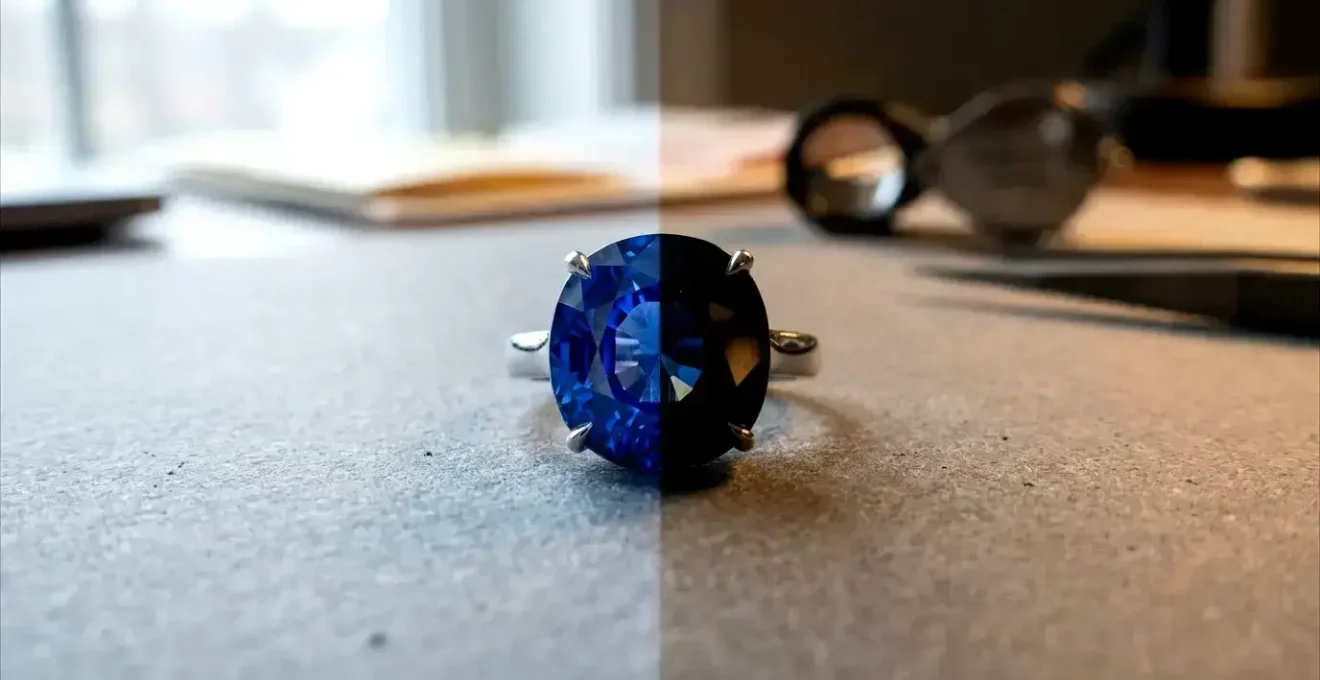
A deep blue sapphire can look richly saturated in daylight yet almost black across a dinner table. That change is not necessarily evidence of poor quality. It results from the interaction between the sapphire’s body colour, its internal light paths, its facet arrangement and the illumination available around it.
The important distinction is between a sapphire that looks dark but still returns lively blue flashes and one whose centre remains unresponsive under ordinary viewing conditions. Gem cutters call some of those unresponsive areas extinction, although absorption and reflections can create similar-looking darkness.
For buyers attracted to luxurious, midnight-blue sapphires, the solution is not automatically to choose a pale stone. It is to find a balance between saturation, tone and light return that works in the environments where the jewellery will actually be worn.
A short viewing under several light sources, combined with a careful examination of the cut, can reveal problems that attractive product photographs may conceal.
Deep blue sapphires: what matters before buying
- Darkness is not the same as saturation. Absorption, extinction, facet geometry and lighting all contribute to an inky appearance.
- Test the sapphire in diffuse daylight, warm indoor light and mixed everyday lighting. Judge how much visible blue survives, not simply how bright the stone becomes under a spotlight.
- Choose the stone that maintains pleasing colour and movement in your typical surroundings. A well-cut medium-tone sapphire may offer more everyday impact than a darker alternative.
- Why Do Some Deep Sapphires Look Almost Black Under Restaurant Lighting?
- How to Test a Deep Sapphire in 3 Lighting Setups During a 15-Minute Viewing?
- Brilliant Cut vs Step Cut: Which Makes a Deep Blue Sapphire Look Less “Dead”?
- The Cut-Proportion Mistake That Makes a Deep Sapphire Look Heavy and Unresponsive
- When Should You Choose a Lighter Blue Over a Deeper Blue to Get Better Daily Wear Impact?
- Why Do Gems “Change Colour” Between Indoor LEDs and North-Facing Daylight?
- Why Can Corundum Survive Daily Wear but Still Chip on One Bad Knock?
- What Should You Assume About Any Corundum Stone Before You Even Ask the Seller Questions?
Why Do Some Deep Sapphires Look Almost Black Under Restaurant Lighting?
Some deep blue sapphires look nearly black in restaurants because their strongly absorbing material receives relatively little usable light, while their cut may direct additional light away from the observer. Dim, warm illumination can make this effect more noticeable. The result may be a sapphire that retains blue flashes near certain facets but presents large dark areas face-up.
Imagine a sapphire as a coloured optical system rather than a simple blue object. Light enters through its crown, travels through the material, reflects or refracts at different facets and may eventually return toward the viewer. During that journey, the sapphire selectively absorbs wavelengths of light.
The longer the path through strongly absorbing material, the greater the potential loss of transmitted light. A deep-blue stone can therefore appear substantially darker than another sapphire with similar saturation but a more moderate tone or more favourable light paths.
Extinction is not another name for dark saturation. In gemmology, true extinction describes areas where light is internally reflected but does not return toward the observer through the crown. Absorption, windowing and reflections of the observer can also create dark-looking patterns.
These mechanisms are distinguished in GIA’s technical analysis of gemstone darkness and brightness, which explains how pavilion geometry and internal light paths influence a faceted gemstone’s appearance.
A sapphire can have strong, attractive colour saturation without becoming overwhelmingly dark. Saturation describes the intensity or purity of the perceived colour; tone describes its relative lightness or darkness. A cutter must also manage the optical consequences of facet angles and the thickness of material traversed by light.
Restaurant lighting adds another variable. A warm lamp generally provides a different spectral distribution from daylight, and some warm LEDs deliver relatively limited energy in the blue region. However, LED specifications vary considerably: neither warm colour temperature nor a low colour-rendering index alone predicts exactly how a particular sapphire will behave.
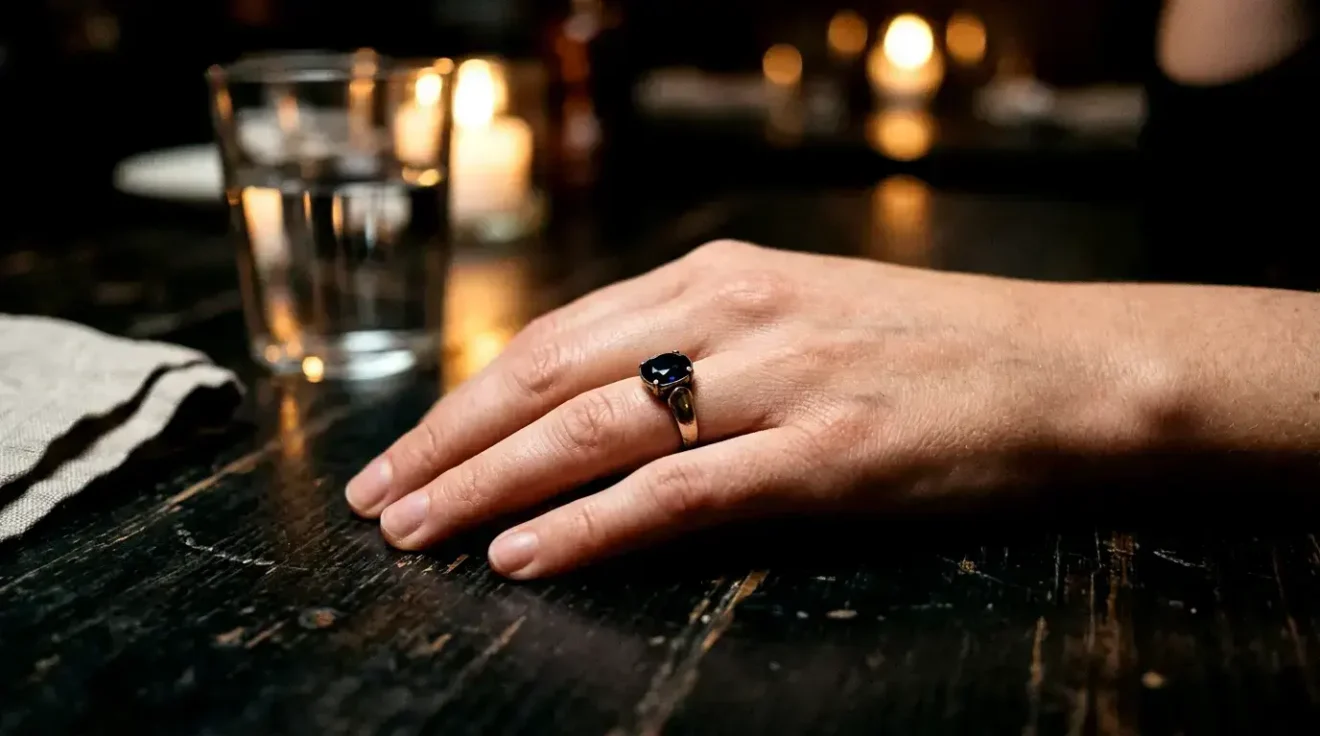
The stone and its lighting environment effectively form a contract: the gemstone cannot return blue light that is absent from the illumination reaching it. Even an exceptionally cut sapphire has optical limits under very dim conditions.
Photography can widen the gap between expectation and experience. Carefully diffused illumination, favourable backgrounds and deliberate camera positioning can show a sapphire at its most attractive. That does not establish that the seller is misleading anyone, but it means a studio image cannot predict every wearing environment.
The practical question is therefore not whether the sapphire ever looks dark, but whether enough recognisable blue and visual movement remain under the lighting conditions that matter to its owner. That is what a controlled viewing should establish.
How to Test a Deep Sapphire in 3 Lighting Setups During a 15-Minute Viewing?
Test a deep sapphire in three environments: diffuse daylight, warm indoor illumination and mixed everyday lighting. Examine its face-up colour, the size of its dark areas and how those areas change when the stone moves. A 15-minute viewing is a practical comparison exercise, not a standardised gemmological test or a substitute for professional evaluation.
Start with the sapphire clean and, ideally, loose or positioned so its crown and pavilion can be inspected. Compare it against another sapphire of similar shape if the seller has one available. Keeping the viewing distance and background reasonably consistent helps make differences easier to interpret.
Use the following procedure as a buyer’s practical screening method, rather than a laboratory grading protocol.
- Diffuse daylight — approximately five minutes. Stand beside a north-facing window or use overcast daylight without direct sun striking the stone. Observe whether the sapphire presents an identifiable blue centre, how evenly the colour is distributed and whether dark facets interrupt its brightness attractively or dominate its appearance.
- Warm indoor light — approximately five minutes. Move to an incandescent lamp or warm LED, preferably resembling lighting encountered at home or in restaurants. Avoid placing the sapphire directly beneath an unusually intense beam. Check whether the central blue disappears, whether only the edges remain coloured and whether movement restores visible flashes.
- Mixed retail or everyday lighting — approximately five minutes. Assess the stone under a combination of ambient and directional illumination, similar to an office, shop or naturally lit interior. Look for a comfortable balance of blue colour, contrast and movement rather than maximum brightness at a single viewing angle.
Under each light, perform a tilt-and-sweep check: rock the stone slowly from side to side and slightly forward and backward. Observe whether bright blue facets appear, whether black regions change shape or position and whether the central area remains persistently dark.
Movement is informative, but it is not a definitive diagnostic rule. A stationary dark region may arise from several interacting causes, while moving dark patterns do not prove that the cut is sound. Observer reflections, facet orientation and lighting geometry also affect the pattern.
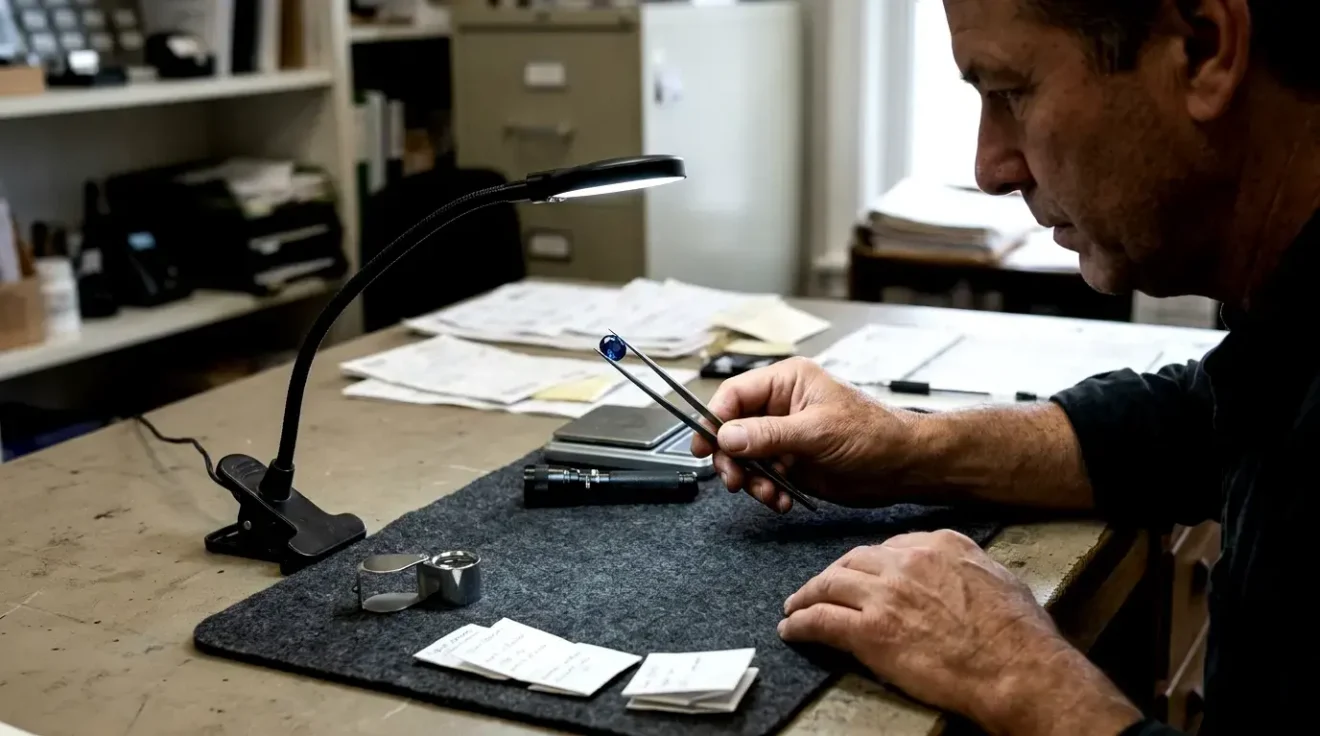
Give your eyes time to adapt when moving between bright and dim environments. Pupil size and visual adaptation can influence how dark a stone appears. Looking alternately with each eye may help identify whether an apparent difference is related to the viewing position or a reflection, although it is not an established grading technique.
Above all, do not evaluate a deep sapphire exclusively under a jeweller’s powerful overhead spotlight. Such lighting can create attractive facet flashes that will not necessarily appear in normal use.
Your five-action sapphire viewing checklist
- Photograph the sapphire face-up in diffuse daylight with a neutral background. Keep one reference image showing its natural blue appearance.
- Record its appearance under a warm indoor lamp. Note whether its centre stays blue, becomes dark blue or appears nearly black.
- Make a short video while tilting the stone under each light. Preserve a record of changing bright and dark facet patterns.
- Examine the sapphire from the side and request its dimensions. Save a side-profile photograph alongside the measurements.
- Write a one-sentence verdict for each lighting environment, then identify which appearance best matches the intended daily wearing conditions.
These records are especially valuable when comparing two stones on different days. They also help separate actual observations from the memory of an unusually flattering sales photograph.
If a stone retains its identity as a rich blue sapphire under ordinary illumination, the next issue is how its facet arrangement contributes to that performance.
Brilliant Cut vs Step Cut: Which Makes a Deep Blue Sapphire Look Less “Dead”?
Neither a brilliant cut nor a step cut automatically makes a deep blue sapphire look brighter. Brilliant-style facet arrangements can create numerous changing flashes, while step facets tend to produce broader reflections and quieter patterns. For a strongly absorbing sapphire, the best design depends on pavilion geometry, colour distribution and actual light return, not the cut label alone.
As a cutter, the first concern is how the facets direct light through the stone. A brilliant-style arrangement uses multiple angled facets to create changing patterns of bright and dark reflections. When appropriately proportioned, these can give a deep sapphire considerable visual movement.
A step cut uses rows of elongated facets that generally produce larger, more orderly flashes. This can emphasise broad areas of rich blue, which some buyers prefer for a restrained, architectural appearance. But if too much of the visible face remains dark, those broad areas may look comparatively inactive.
Importantly, the facet pattern is not the same as optical performance. A poorly proportioned brilliant-style pavilion can produce serious darkness or windowing. A thoughtfully cut step-faceted sapphire can provide attractive colour and contrast.
Many commercial sapphires also have mixed facet arrangements. GIA describes a common corundum configuration combining a crown with triangular or kite-shaped facets and a pavilion with parallel rectangular facets. Cutters may choose such arrangements to manage colour zoning, pleochroism, available rough and weight retention.
Windowing is another potential trade-off. When pavilion angles allow light to pass through rather than return through the crown, the viewer may see a pale or transparent-looking centre. In some settings, the background may even be visible through that area.
A window can make a dark sapphire appear lighter without providing desirable brilliance. The brighter-looking centre is not necessarily evidence of superior cutting.
For a buying decision, compare the two styles in the same lighting rather than relying on their names.
| Viewing criterion | Brilliant-style facets | Step facets |
|---|---|---|
| Typical visual character | Numerous changing reflections and flashes | Broader, more structured reflections |
| Deep-blue appearance | May break up dark areas with visible facet movement | May emphasise broad zones of saturated colour |
| Potential weakness | Poor geometry can still produce extinction or windowing | Large dark regions may remain visually prominent |
| Predominantly indoor wear | Worth considering when the stone demonstrates strong light return | Suitable if sufficient blue remains visible in ambient light |
| Daylight and formal occasions | Appealing for dynamic sparkle and contrast | Appealing for orderly flashes and a quieter appearance |
A modified mixed cut may offer an attractive compromise, but it is not inherently superior. The material’s absorption and the precise three-dimensional facet geometry determine whether that compromise succeeds.
The best-cut sapphire is the one whose proportions and facet arrangement serve the particular rough. That makes the stone’s overall depth the next characteristic worth examining.
The Cut-Proportion Mistake That Makes a Deep Sapphire Look Heavy and Unresponsive
Excessive depth can make a strongly coloured sapphire appear heavy and unresponsive because light may travel farther through absorbing material before emerging. Certain steep pavilion arrangements can also increase extinction. However, depth alone does not establish poor cutting: the relationships among pavilion angles, crown geometry, refractive index and body colour determine the final appearance.
Gem cutters often face a commercial compromise. Removing more rough may improve the finished stone’s face-up appearance but reduce its carat weight. Retaining additional material may preserve weight while producing a deeper pavilion and a smaller visible face relative to the stone’s mass.
In a dark sapphire, this compromise is particularly noticeable. A longer internal path can increase absorption, making the centre appear darker even when the colour itself is attractive.
Some stones show a visually active outer region surrounding a much darker centre. This may involve differences in facet return, absorption and extinction. A bright peripheral ring is not, by itself, proof that the pavilion is excessively deep.
Before examining the stone under another lamp, look at its side profile. A sapphire that appears unusually tall relative to its width deserves closer inspection, especially if its face-up appearance is already very dark.
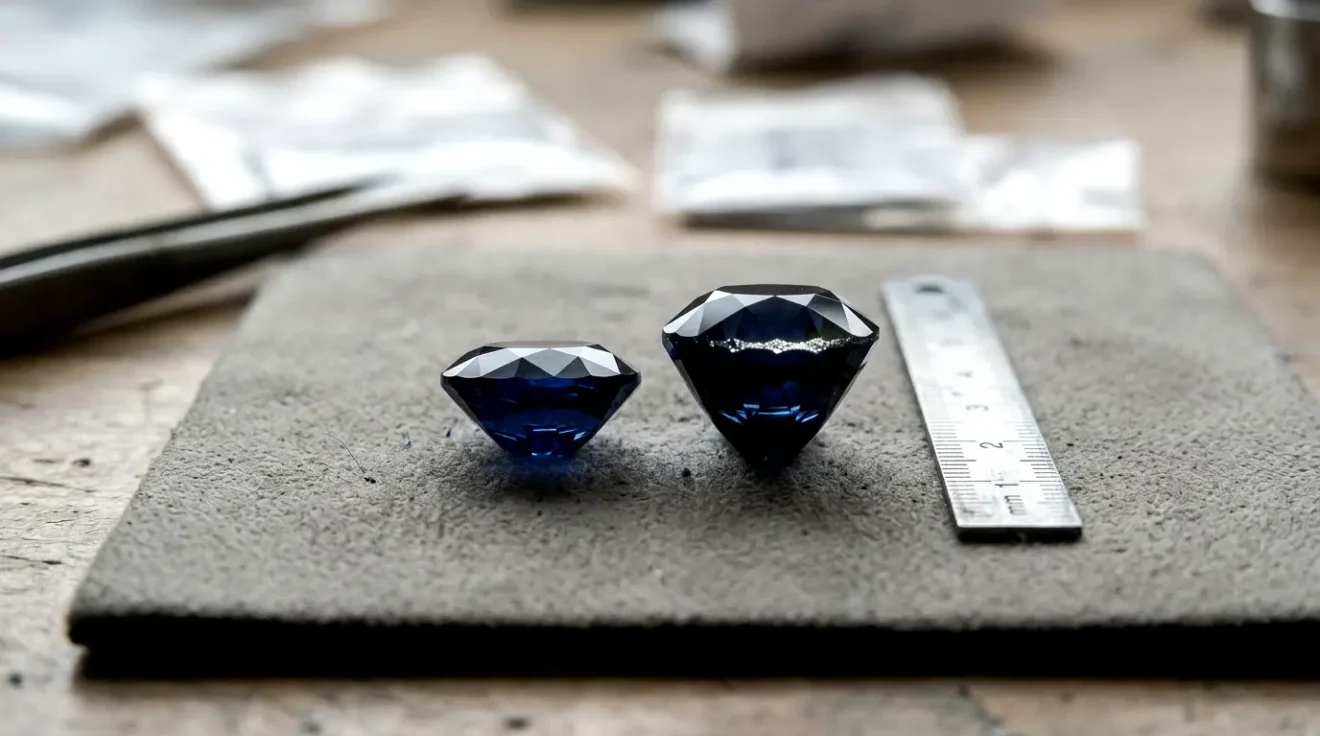
Ask for the length, width and total depth in millimetres. For a round stone, comparing depth with diameter is straightforward; for oval, cushion or other elongated shapes, the comparison must account for the outline and how the depth relates to both face-up dimensions.
There is no universally correct depth percentage for all sapphires. A measurement that suits one outline and facet arrangement may be inappropriate for another. Dimensions should therefore support visual evaluation rather than replace it.
A side-view photograph taken approximately at girdle level can be more revealing than another polished top-down image. It allows buyers to compare pavilion height, crown profile and the general distribution of material between stones of similar shape.
Also consider the intended setting. A deep pavilion can require additional mounting clearance, potentially affecting the ring’s height and design. Enclosed or shadowed mounting areas may alter how much light reaches the gemstone, although the outcome depends on the actual setting.
A useful comparison is between two hypothetical sapphires of similar outline and colour, one significantly deeper than the other. If the deeper stone shows a smaller face-up area and persistently dark centre, examine whether the apparent benefit of its retained weight compensates for its visual limitations.
Neither depth nor carat weight should override what the eyes consistently observe across different lighting environments.
Once proportion problems have been considered, the remaining choice is often about colour preference: whether the appeal of a very dark blue outweighs the everyday visibility of a somewhat lighter tone.
When Should You Choose a Lighter Blue Over a Deeper Blue to Get Better Daily Wear Impact?
Choose a medium-tone or moderately dark sapphire over a very deep blue when the lighter stone preserves stronger visible colour in the lighting where the jewellery will be worn most often. This matters particularly in offices, homes and evening environments. A darker sapphire can still be the better choice when it maintains pleasing blue flashes and matches the wearer’s aesthetic priorities.
Gemstone colour involves several characteristics. Tone describes relative lightness or darkness, while saturation describes colour intensity. A lighter tone is therefore not necessarily weakly saturated, and a darker sapphire is not automatically richer or more valuable.
According to GIA’s sapphire quality factors, highly valued blue sapphires generally display strong to vivid saturation alongside medium to medium-dark tone. Excessive darkness can reduce desirability even when the underlying colour is intense.
For daily wear, consider the amount of blue visible across an ordinary day, not only the depth of colour at its most flattering moment.
A hypothetical comparison makes the trade-off clear. Two sapphires of equal carat weight are presented together: one has very dark tone and striking colour under daylight, while the other has medium-dark tone and remains recognisably blue under ordinary indoor lighting. If the second stone consistently looks livelier during the wearer’s normal routine, its practical visual impact may be greater despite the first stone’s deeper colour.
The choice also depends on the jewellery design. A relatively small sapphire may have shorter internal light paths than a larger stone of similar geometry, but size alone does not determine brightness. Material absorption, cut and colour distribution remain important.
Metal colour and mounting style can influence perceived contrast. Yellow gold creates a different surrounding colour relationship from white metal, while a bezel frames the outline differently from prongs. The effect should be judged with the actual sapphire and proposed setting rather than predicted solely from metal colour.
| Buying consideration | Medium or medium-dark blue | Very deep blue |
|---|---|---|
| Indoor office or home use | Often worth prioritising for visible blue across changing light | Best assessed carefully for excessive darkness |
| Outdoor daylight use | Can look lively, bright and distinctly blue | May reveal impressive depth when sufficient light is available |
| Evening jewellery | May maintain better colour recognition in subdued lighting | Can provide a dramatic near-black aesthetic |
| Smaller jewellery designs | Useful when colour visibility is the priority | Potentially attractive, depending on actual absorption and cut |
| Overall buying priority | Consistent visible colour | Maximum depth of appearance without unacceptable loss of light return |
A very dark sapphire is not inherently a bad choice. Some buyers deliberately prefer the almost-black appearance of midnight-blue corundum, especially in understated formal jewellery. The concern arises when the darkness is an unexpected consequence rather than the intended aesthetic.
Price should be evaluated against the stone’s complete quality profile, including tone, saturation, clarity, cut, size and treatment disclosure. Colour depth alone cannot establish value.
The final decision becomes easier once the buyer understands why the same sapphire may appear to change not only in brightness but also in its apparent hue under different lamps.
Why Do Gems “Change Colour” Between Indoor LEDs and North-Facing Daylight?
Gems can appear to change colour between daylight and indoor LEDs because different light sources contain different proportions of wavelengths. A sapphire selectively absorbs and transmits light, so its apparent colour depends partly on the illumination reaching it. Most observed differences involve ordinary changes in hue, saturation or brightness rather than the special gemmological phenomenon called colour change.
North-facing daylight is often useful for evaluating gemstone colour because it can provide relatively even illumination without strong direct sunlight. Its spectrum, however, still varies with weather, time of day and surrounding reflections.
LED lighting is more variable. Different LEDs can produce similar-looking white light while distributing their energy differently across the visible spectrum. Two lamps described as warm white may consequently produce different appearances in the same blue sapphire.
The observer’s visual system adds another layer. Human colour perception adapts to surrounding illumination, so a gemstone’s apparent colour is influenced by both its optical behaviour and the viewing environment.
Ordinary colour shift and genuine colour change should not be confused. A sapphire becoming darker under a warm lamp does not automatically qualify as a colour-change sapphire.
Some sapphires exhibit a recognised colour-change effect, appearing blue to violet under daylight-equivalent illumination and violetish purple to reddish purple under incandescent light. The strength of this effect can vary between specimens.
Metamerism is relevant when materials or colour stimuli that appear to match under one illuminant no longer match under another. In casual gemstone descriptions, the term is sometimes used more broadly for illumination-dependent colour differences, but not every visible shift constitutes metamerism in its strict colour-science sense.
To investigate a sapphire’s behaviour, compare it under a daylight-equivalent lamp and a warm source while maintaining similar viewing geometry. Look separately for changes in apparent hue, saturation and overall darkness.
If the stone remains blue but becomes almost black, the principal issue may be reduced brightness or light return. If it changes distinctly from blue toward violet or purple, further gemmological assessment may be appropriate to determine whether it exhibits genuine colour change.
Neither outcome identifies the stone’s treatment history. Heating, diffusion and other treatments cannot reliably be diagnosed merely by observing a colour difference between two lamps.
Online photographs add uncertainty because camera white balance, background and screen rendering can affect apparent colour. GIA’s gemstone photography recommendations explain the importance of diffused lighting, background choice and consistent colour temperature when photographing gems.
The practical lesson is to match the viewing environment to the intended wearing environment. A sapphire whose beauty depends heavily on one carefully selected lamp may still be desirable, but that dependence should be understood before purchase.
Once colour performance is established, another purchasing concern deserves attention: the sapphire’s resistance to everyday wear and accidental impacts.
Why Can Corundum Survive Daily Wear but Still Chip on One Bad Knock?
Corundum survives everyday wear exceptionally well because it combines high scratch resistance with excellent toughness. Nevertheless, a concentrated impact can chip a vulnerable facet edge or damage an existing fracture. Hardness measures resistance to scratching, while toughness describes resistance to breaking. A sapphire’s durability therefore depends on more than its position on the Mohs scale.
Sapphire and ruby are both varieties of corundum. Corundum measures 9 on the Mohs hardness scale, making it highly resistant to scratches from many materials encountered in normal jewellery use.
GIA also describes corundum as having excellent toughness and no cleavage. This means sapphire is not inherently brittle or poorly suited to everyday rings. It does not mean that every facet junction or exposed edge is immune to damage.
9 on the Mohs scale
Corundum’s hardness indicates high resistance to scratching, not immunity to chips or fractures caused by impact.
Gemological Institute of America, sapphire care and durability guidance.
The girdle—the edge separating the crown from the pavilion—is an area worth inspecting. A very thin or exposed section may be more susceptible to localised damage if it receives a concentrated knock.
That does not establish a universal minimum safe girdle thickness. The risk depends on the stone’s geometry, existing internal features, type of impact and protection provided by the setting.
Inclusions deserve similarly careful interpretation. Many sapphires naturally contain them, and some fine inclusions can enhance appearance. However, an open fracture or structurally significant inclusion near an exposed edge may justify further examination.
A buyer should ask whether any visible feather, fracture or other potentially relevant feature reaches the surface or lies close to a vulnerable part of the stone. A qualified gemmologist can help assess the importance of such features.
For daily jewellery, a bezel or protective mounting can reduce exposure of certain edges. Well-designed prongs can also provide adequate protection while allowing more of the stone to remain visible. Neither setting type guarantees freedom from impact damage.
Treatment status affects care decisions too. Untreated and conventionally heat-treated sapphires are generally highly durable, while fracture-filled or otherwise treated material may require additional precautions, particularly during cleaning or repair.
Warm, soapy water is a broadly useful cleaning option, but any known filling, dyeing or cavity treatment should be discussed with the seller before ultrasonic cleaning, steam cleaning or repair work.
The essential distinction is between ordinary sapphire durability and the particular vulnerabilities of an individual specimen.
A buyer can address many of these concerns before the viewing appointment by establishing what is known, what is documented and what still needs to be checked.
Key takeaways before contacting the seller
- Ask for evidence rather than relying on descriptions such as “royal,” “midnight” or “premium” blue, which do not establish actual light performance.
- Separate optical quality from structural condition: a lively sapphire can still require a closer look at its girdle, inclusions and treatment status.
- Prepare to compare documented measurements and real-world lighting observations, not just carat weight and carefully lit photographs.
What Should You Assume About Any Corundum Stone Before You Even Ask the Seller Questions?
Before contacting a sapphire seller, assume that photographs show only selected viewing conditions, treatment information requires verification and the stone may contain internal features that are not obvious face-up. Do not assume that every sapphire is treated, flawed or poorly cut. Begin with documented facts, then ask targeted questions about treatment, proportions, girdle condition and everyday light performance.
The first expectation concerns treatment disclosure. Heat treatment is common in the sapphire trade and should not automatically disqualify a gemstone. However, a seller should be able to state what is known about treatments and distinguish confirmed information from assumptions.
Some treatments have greater implications than conventional heating. Diffusion treatment can affect colour distribution, sometimes concentrating colour near the surface. Fracture filling and other enhancements may create additional durability or care considerations.
A reputable laboratory report can support identification and treatment assessment, although the scope and certainty of conclusions depend on the examination and laboratory. A missing treatment disclosure should prompt further questions rather than an automatic conclusion that the sapphire has undergone a particular treatment.
Second, assume that sales photographs are selective representations. A product image may accurately show the sapphire under the conditions used to capture it while failing to communicate how the stone looks in a dim room.
Request a short video under diffuse daylight and a separate recording under ordinary indoor illumination. Ask that the sapphire be tilted slowly, with the light source and viewing conditions identified. Avoid interpreting differences between videos without considering camera exposure and white balance.
Third, assume that a face-up photograph cannot reveal every internal feature or aspect of the cut. Inclusions may exist outside the visible central area, and a mounting can conceal portions of the girdle or pavilion.
That does not mean every sapphire has dangerous inclusions. The useful question is whether any particular feature affects appearance, structural integrity or suitability for the proposed setting.
Fourth, request measurements and cutting information. Length, width, total depth, cut style and side-profile photographs provide a stronger starting point than carat weight alone.
A seller may use broad labels such as brilliant, step or mixed cut, but these categories do not replace an examination of actual facet geometry and light return.
The following pre-viewing questions focus on information that can change a purchase decision:
- Treatment: Is the sapphire natural or laboratory-grown? What treatments are disclosed, and is a relevant gemmological report available?
- Proportions: What are the exact length, width and depth measurements? Can the seller provide an eye-level side photograph?
- Cut: What facet arrangement is used, and can the stone be shown moving under diffuse and indoor light?
- Girdle and inclusions: Are there thin or damaged girdle areas, surface-reaching fractures or other features that deserve consideration during setting?
- Viewing and returns: Can the buyer inspect the stone under ordinary lighting before committing, and what return or inspection terms apply?
These questions serve different purposes. Treatment information supports an informed assessment of value and care. Measurements provide context for optical performance. Girdle and inclusion details help assess durability. Viewing conditions establish whether the sapphire’s appearance matches the buyer’s expectations.
Do not treat a seller’s inability to supply a precise cut classification as proof of poor quality, but be cautious if essential information is consistently unavailable or contradictory.
The most reliable purchasing decision combines documented information with direct visual observation. Neither a laboratory report nor an attractive photograph can independently establish whether a dark sapphire will look beautiful to a particular buyer under everyday lighting.
Before purchasing, request the treatment disclosure, dimensions, side-profile image and realistic lighting video, then examine the stone in the environments where it will be worn. Choose the sapphire whose visible colour and facet movement remain satisfying—not merely the one that looks deepest blue in a sales photograph.
Is a sapphire that looks black indoors necessarily poor quality?
No. A deep blue sapphire may look very dark because of its tone, absorption, cutting geometry and available light. Some darkness and contrast can create attractive visual depth. Concern is more justified when large areas remain unresponsive under normal viewing conditions or when the sapphire’s appearance differs substantially from what the buyer expected.
Can a dark blue sapphire become brighter after recutting?
Sometimes. Recutting can improve light return when the original facet geometry creates excessive extinction or windowing. However, it may reduce carat weight, alter the stone’s outline or fail to overcome strong absorption within the material. A skilled gem cutter should assess the individual stone before any improvement is promised.
Does a more expensive deep blue sapphire necessarily sparkle more?
No. Price depends on multiple attributes, including colour, clarity, size, cut and treatment status. Strong saturation and desirable tone can contribute substantially to value, but a higher price does not guarantee superior brilliance under indoor lighting. Optical performance should be assessed directly.
Can a sapphire’s jewellery setting make it look darker?
Yes, potentially. Mounting geometry can change the light reaching and surrounding the gemstone, while the metal and setting design can influence perceived contrast. The effect is not uniform across sapphires. A stone should ideally be evaluated in its intended setting or in a representative mounting before purchase.
Should a buyer avoid heat-treated sapphires when choosing an everyday ring?
Not automatically. Conventional heat treatment is common, and appropriately treated sapphires generally retain excellent everyday durability. Other treatments, including some forms of diffusion and fracture filling, may raise additional disclosure or care questions. Treatment type should be verified and considered alongside the sapphire’s appearance, value and intended use.