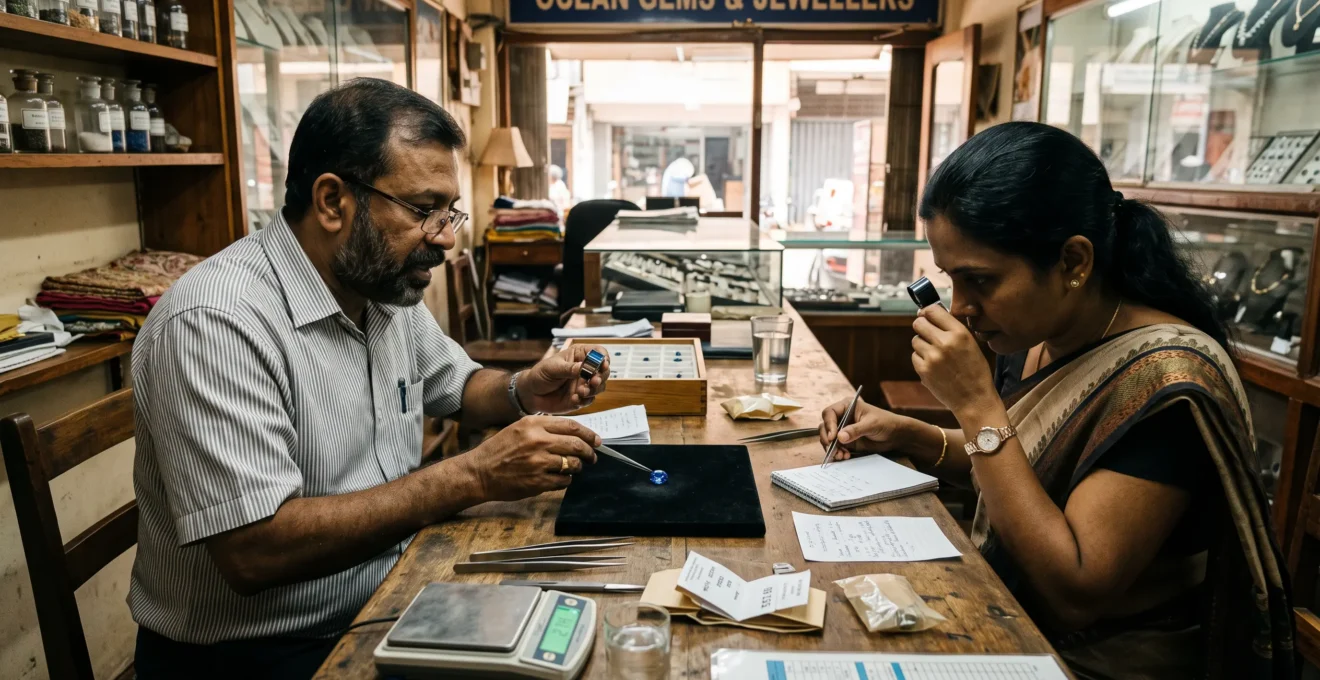
Two gemstone sellers can examine the same sapphire, agree that it is genuine, and still describe its quality very differently. One might emphasise its traditional precious-stone status. Another might focus on colour, inclusions, treatment or cutting. Their assessments may sound contradictory even when they address different questions.
The most dependable approach is to separate identification, durability, commercial quality and resale potential. Historical gemstone categories can explain market traditions, but they cannot establish whether an individual stone is authentic, suitable for everyday wear or fairly priced.
Modern gemmological testing offers stronger evidence about material identity and detectable treatments. Even so, a laboratory report does not necessarily assign a comprehensive quality grade or establish market value. Buyers must interpret its findings alongside observable characteristics and relevant market comparisons.
Understanding these distinctions makes it easier to challenge exaggerated descriptions, recognise meaningful documentation and decide when professional testing is worth the expense.
Gem classification: three rules for buyers
- Historical precious-stone labels describe tradition, not a universal scale of rarity, quality or value.
- Physical properties and independent laboratory findings are more useful for identification, care and treatment assessment.
- Compare documented characteristics and relevant market evidence before accepting a classification-based price premium.
- Why Can a “Semi-Precious” Stone Be Rarer Than a “Precious” One in Real Supply Chains?
- How to Place an Unknown Stone Into a Useful Category Using 4 Tests You Can Actually Do
- Historical “Cardinal” Ranking vs Modern Gemmology: Which Helps You Buy Smarter?
- The Pricing Trap: Paying a Premium for a Classification Label Instead of Verifiable Quality
- When Should You Classify First: Before Viewing, After Viewing, or After Lab Testing?
- Why Do Cardinal Gems Hold Resale Value Better Even When They’re Not the Prettiest Stone?
- The Documentation Mistake: Confusing a Shop Card With an Independent Corundum Report
- When a Seller Says “Cardinal Gem Quality,” What Should You Verify Before Paying a Premium?
Why Can a “Semi-Precious” Stone Be Rarer Than a “Precious” One in Real Supply Chains?
A gemstone traditionally called semi-precious can be rarer in a particular quality, size or commercial supply segment than a stone labelled precious. The historical distinction does not measure current availability. Fine examples of certain garnets, spinels and alexandrites may be difficult to source, while more ordinary examples of traditionally precious gemstones can be relatively accessible.
The traditional precious category generally refers to diamond, ruby, sapphire and emerald. Other gem materials have often been described as semi-precious, although that terminology does not reflect a consistent scientific or economic hierarchy.
The International Gem Society‘s explanation of gemstone classification highlights why the distinction can mislead buyers. Certain garnets, including demantoid, can command higher prices than some diamonds. That comparison demonstrates that category membership alone cannot determine value.
Consider fine tsavorite, alexandrite or top-quality spinel. Availability can become especially restricted when buyers demand a particular combination of size, colour, clarity and minimal treatment. However, these examples do not establish that every specimen is rarer than a mid-range sapphire. Supply comparisons require a defined grade, size range, geographic market and period.
Three characteristics need separate evaluation:
- Scarcity: how difficult it is to obtain a comparable specimen in the relevant market.
- Durability: how well the stone withstands scratching, impacts and environmental exposure.
- Liquidity: how readily an owner might find a buyer at an acceptable price.
A genuinely scarce stone may be fragile or unfamiliar to mainstream jewellery buyers. Conversely, a more widely traded gemstone may attract greater interest because dealers and consumers recognise its variety.
The supply-chain distinction matters. Established ruby, sapphire, emerald and diamond markets have recognised specialist dealers and established channels for evaluating and trading certain qualities. Less familiar collector stones may depend on narrower networks. These differences can influence resale opportunities without proving a universal liquidity advantage.
If sellers disagree about which stone ranks higher, ask whether they mean historical prestige, availability at a specified quality, physical performance or resale demand. A ranking becomes useful only after its underlying criterion is identified.
How to Place an Unknown Stone Into a Useful Category Using 4 Tests You Can Actually Do
Four non-destructive observations can help an ordinary buyer narrow the possibilities for an unidentified gemstone: examine its appearance under different lighting, compare its apparent weight with its size, inspect the stone and setting for existing wear, and look for optical effects such as facet doubling. None can reliably establish identity, treatment or geographic origin.
These checks are best treated as preliminary screening, not home certification. A convincing imitation can pass several observations, while a genuine gemstone can produce unexpected results because of its cut, inclusions or setting.
- Compare ordinary light with a flashlight. Observe the stone under diffuse daylight and a modest white light source. Look for changes in transparency, visible inclusions, colour distribution and unusual reflections. Lighting differences can reveal features worth investigating, but they cannot reliably distinguish natural from synthetic material. Avoid intense heat-producing light sources.
- Consider apparent weight relative to size. If a loose stone can be handled safely, note whether its heft seems consistent with its dimensions. Different gem materials have different densities, but visual estimates are highly unreliable. Cut proportions, settings and the absence of a verified reference make this a weak identification clue.
- Inspect existing wear rather than making scratches. Examine facet junctions, chips, surface abrasions and the condition of the mounting under magnification. Existing marks can raise questions about durability or previous use. Scratches on the surrounding metal do not establish gemstone hardness. Never scratch the stone or setting deliberately.
- Look for optical doubling. With a suitable loupe and viewing angle, some doubly refractive materials may show doubled facet edges or internal features. This behaviour can suggest an optical property, but its absence proves little. Orientation, optical characteristics and cut can conceal the effect.
These observations have different evidential strengths. Apparent colour and heft are particularly susceptible to misleading impressions. Existing wear may reveal condition without identifying the material. Optical effects can be informative, but interpreting them correctly often requires instruments and training.
Once the observations are complete, choose the next step according to the risk rather than attempting to name the stone with certainty.
| Observation | What it establishes | Sensible next step |
|---|---|---|
| No obvious warning signs; low-cost decorative purchase | Nothing conclusive about identity | Consider buying only if the price and return terms are acceptable without an identity guarantee |
| Appearance broadly matches the description; substantial asking price | Provisional consistency, not authentication | Request independent laboratory documentation |
| Visible damage or unexplained inconsistencies | A condition or description concern | Seek clarification and independent assessment, or decline |
| Seller refuses reasonable verification | Unresolved commercial risk | Walk away if the claim materially affects the price |
Professional gemmology uses measurements and analytical methods beyond these simple observations. An independent laboratory may examine optical properties, internal characteristics and other diagnostic evidence to establish material identity and report detectable treatments.
The purpose of home observation is to decide which claims need verification. It should never become an alternative classification system based on guesswork.
Historical “Cardinal” Ranking vs Modern Gemmology: Which Helps You Buy Smarter?
Modern gemmology is the more reliable framework for identifying a stone and understanding its physical characteristics. Historical cardinal classifications are useful mainly for interpreting established market terminology and some patterns of commercial recognition. Neither framework independently determines a fair purchase price, so the appropriate emphasis depends on whether the buyer prioritises jewellery wear, collecting or eventual resale.
The cardinal tradition reflects historical prestige and established trading conventions. It is not a laboratory grading standard. Modern gemmology instead investigates characteristics such as mineral identity, crystal structure, refractive behaviour and hardness.
For a buyer choosing jewellery, measured physical performance is particularly important. The GIA‘s explanation of gemstone durability beyond the Mohs scale distinguishes hardness, toughness and stability.
Hardness describes resistance to scratching. Toughness concerns resistance to breakage or chipping. Stability concerns responses to environmental conditions, including heat, light and chemicals. These properties are not interchangeable.
Corundum, the mineral family containing ruby and sapphire, has a Mohs hardness of 9. Diamond has a hardness of 10. Yet diamond’s exceptional scratch resistance does not make it immune to impact damage. A single hardness number therefore cannot describe complete suitability for daily wear.
| Buyer priority | Historical cardinal framework | Modern gemmological evidence |
|---|---|---|
| Recognising traditional market prestige | Provides useful cultural context | Does not measure prestige directly |
| Identifying a gemstone | Cannot establish identity | Provides diagnostic evidence |
| Choosing a daily-wear ring | Cannot predict complete durability | Supports evaluation of hardness, toughness and stability |
| Planning resale | May indicate established market familiarity | Helps substantiate identity and treatment disclosures |
| Determining a fair price | Insufficient alone | Necessary evidence for many comparisons, but not a valuation by itself |
Suppose a seller promotes an emerald because it belongs to the traditional precious category, while another recommends a different gem material for a frequently worn ring. The relevant disagreement may concern durability rather than status. Emerald’s treatment, inclusions and vulnerability to damage deserve consideration alongside its appearance.
Conversely, a physically durable non-cardinal gemstone does not automatically offer the same resale market as a recognised high-quality sapphire. Technical suitability and commercial demand answer different questions.
Ask each seller to identify the criterion behind their ranking. If one ranks by tradition and the other by durability, the apparent contradiction may disappear without either classification being universally correct.
The Pricing Trap: Paying a Premium for a Classification Label Instead of Verifiable Quality
A gemstone classification label can influence an asking price without demonstrating that the individual stone deserves a premium. Terms such as precious, cardinal quality, pigeon-blood or royal blue may evoke desirable characteristics, but their meaning and application can vary between sellers and reporting organisations. Buyers should compare documented stone characteristics rather than assume that attractive terminology establishes value.
Labels become especially influential when buyers cannot independently assess colour, clarity, treatments or cutting. A seller may present a descriptor as though it represents a universally accepted grade, even where no common market-wide standard applies.
Some specialist laboratories apply defined criteria to particular colour descriptions. That does not mean every dealer using the same expression follows identical criteria or has obtained a corresponding laboratory opinion.
For coloured gemstones, the GIA’s analysis of colored gemstone value factors identifies colour, colour uniformity, geographic origin, size, clarity, shape and cut quality as major considerations.
These factors are more informative than a broad category label, although their relative influence varies by gem variety and market segment. Treatment status can also materially affect comparisons and should be established separately.
Consider a hypothetical example: two sellers advertise the same ruby. One describes it as an exceptional cardinal gemstone, while the other supplies its weight, measurements, treatment findings and a detailed description of its appearance. The first description may sound more prestigious, but the second provides a stronger starting point for evaluating the asking price.
A practical comparison should control for the variables that most affect desirability:
- Gemstone identity and natural or synthetic status.
- Carat weight, dimensions and shape.
- Colour appearance, including tone, saturation and uniformity.
- Clarity, visible inclusions and cutting quality.
- Documented treatment status and relevant origin findings.
- Condition, seller terms and whether comparable prices are retail offers or completed transactions.
A laboratory identification report is not necessarily a graded price certificate. The buyer may still need a qualified independent valuation or relevant market evidence. Comparing advertised retail prices with wholesale or auction outcomes without adjustment can produce misleading conclusions.
There is no defensible universal percentage representing a cardinal-label premium. Without matched transactions, separating a price into precise label-driven and quality-driven monetary components would be speculative.
Resale creates an additional risk. A later buyer may value the gemstone using different criteria, and a marketing descriptor that helped secure the original sale may carry little weight without supporting evidence. The size of any resale discount cannot be assumed in advance.
A premium becomes more defensible when the underlying characteristics are verifiable and comparable market evidence supports the amount requested. A memorable label alone is not that evidence.
When Should You Classify First: Before Viewing, After Viewing, or After Lab Testing?
Classify gemstones provisionally before viewing, refine your assessment after examining the actual stone, and seek laboratory confirmation when identity or treatment uncertainty materially affects the purchase. This staged approach limits premature assumptions while avoiding unnecessary testing expenses. The final purchasing decision should reflect the quality of the available evidence, the asking price and the buyer’s intended use.
Each stage answers a different question and carries a different level of cost and uncertainty.
| Stage | Main purpose | Principal limitation |
|---|---|---|
| Before viewing | Define intended use, budget and plausible gemstone varieties | Seller descriptions may be incomplete or promotional |
| After viewing | Assess appearance, visible condition and documentation | Observation cannot conclusively establish identity or treatments |
| After laboratory testing | Confirm reported material identity and detectable treatments | Testing does not necessarily establish overall quality, price or future resale value |
Classifying too early creates anchoring risk. A buyer who decides that only a traditional precious gemstone is acceptable may dismiss a more suitable alternative before considering durability, care requirements or actual appearance.
Classifying too late creates a different inefficiency. Commissioning testing before deciding whether a stone is visually attractive, appropriately sized or within budget may consume resources without improving the shortlist.
The sensible sequence is therefore a funnel: identify plausible candidates, inspect and compare them, then verify consequential claims before making a commitment.
Laboratory testing deserves particular consideration when the gemstone is expensive relative to the cost of testing, the seller makes treatment or origin claims, existing documentation is inadequate, or the purchase is intended for collecting or resale.
The threshold is not universal. A modestly priced decorative purchase may justify a different level of investigation from a high-value untreated ruby. Even a genuine report cannot eliminate every commercial risk.
For jewellery worn frequently, classification should also include practical questions about the setting, exposure to impacts and suitable cleaning methods. The gem material alone does not determine how the finished piece should be cared for.
The objective is not to test every stone. It is to avoid paying for claims that remain unsupported at the point when they influence the price.
Why Do Cardinal Gems Hold Resale Value Better Even When They’re Not the Prettiest Stone?
Some traditionally cardinal gemstones may be easier to resell because established dealers, collectors and specialist auction channels recognise their categories. Market familiarity can make it easier to find potential buyers. However, cardinal status does not guarantee stronger resale value, and there is insufficient evidence for a universal rule that these stones outperform less familiar varieties.
Resale depends partly on liquidity: the ability to find a willing buyer within an acceptable period and at an acceptable price. A gemstone can be rare and visually impressive yet have a limited audience.
Established trading channels can reduce the difficulty of explaining a stone’s identity, typical quality characteristics and commercial appeal. Ruby, sapphire, emerald and diamond are familiar to many jewellery buyers, although demand varies substantially across qualities and price levels.
Less familiar gemstones may attract a narrower but knowledgeable collector audience. In some cases, that audience can place considerable value on exceptional specimens. Such outcomes do not prove a general trend of appreciation or a reliable resale advantage.
Consider a hypothetical comparison between an ordinary ruby and an unusually attractive spinel. The ruby’s familiar category might attract more initial enquiries, while the spinel’s individual quality could appeal strongly to specialist collectors. Without evidence about their treatments, asking prices and actual buyer demand, neither resale outcome can be predicted responsibly.
Appearance itself is not an objective universal ranking. Colour preferences, cut aesthetics and tolerance for inclusions differ among buyers and markets.
Documentation is especially important because a resale buyer may reassess the stone independently. Treatment findings, verified identity and condition can influence the willingness to transact. An unsupported claim of exceptional quality may not survive that scrutiny.
Liquidity should never be confused with price retention. A stone that sells quickly can still sell for substantially less than its original retail price. Transaction costs, dealer margins and market conditions can all affect the proceeds.
A buyer prioritising resale should investigate the market for the specific variety, size and quality rather than relying on historical prestige. The relevant question is whether comparable documented stones actually attract buyers.
The Documentation Mistake: Confusing a Shop Card With an Independent Corundum Report
A shop card and an independent corundum report serve different purposes. A shop card is commercial information supplied by the seller, while a recognised gemmological laboratory report records findings from an examination of the stone. When two sellers disagree about ruby or sapphire identity, treatment or origin, properly matched independent laboratory evidence carries substantially greater weight than unsupported sales descriptions.
Corundum includes ruby and sapphire. Both can be natural or synthetic, and treatment disclosures can matter considerably to a purchasing decision.
A shop card may list a variety, carat weight, colour description and price. These details can be useful for identifying the seller’s claims, but the card does not independently establish their accuracy. Its evidential strength depends on the information and documentation behind it.
The GIA’s official colored stone report documentation describes reports covering gemstone identity, natural or synthetic status and detectable treatments. Reported identifying details can include shape, cutting style, weight, measurements, colour and a photograph.
Geographic origin is a separate consideration. It is reported for applicable gemstones when the laboratory can determine it, and it should never be assumed merely because the stone is accompanied by a report.
Similarly, a report may not contain a standardised overall quality grade or retail valuation. A laboratory’s identification findings should not be interpreted as a guarantee of the seller’s asking price.
Before relying on any laboratory document, buyers should check its authenticity and its connection to the particular gemstone offered for sale.
Start with the issuing laboratory. Verify that it is an identifiable, appropriately qualified organisation operating independently of the transaction. Where the laboratory provides an official report-verification service, use that service rather than relying solely on a photograph supplied by the seller.
Next, compare the report’s identifying details with the stone. Weight, dimensions, shape and photographic features can help establish consistency. A laser inscription, where present and applicable, may provide another identifying reference. No single matching detail should be treated as conclusive if the remaining information conflicts.
Finally, read the treatment and origin findings exactly as written. A statement that no treatment was detected is not necessarily equivalent to a guarantee that no conceivable treatment exists. Analytical findings are limited by the methods and evidence available.
Report numbers and visual formatting should also be checked carefully because a document’s professional appearance alone cannot establish authenticity. If the laboratory cannot verify the document or the stone cannot be matched satisfactorily, the uncertainty remains unresolved.
Independent documentation does not make every seller description correct, but it gives buyers a stronger foundation for deciding which claims are substantiated and which still require clarification.
Key takeaways before committing to a purchase
- A category-based premium needs a clear explanation of what is being valued beyond the historical label.
- Documentation must match the individual gemstone and support the specific claims being made.
- Even verified identity and treatment findings leave price fairness and future resale value as separate questions.
When a Seller Says “Cardinal Gem Quality,” What Should You Verify Before Paying a Premium?
Before paying extra for a stone described as cardinal gem quality, verify its identity, treatment status, observable quality factors and price against suitable comparables. The expression itself is not a recognised universal gemmological grade. A premium should depend on evidence about the individual stone, not on a historical category presented as proof of exceptional quality.
The phrase combines two different ideas. Cardinal refers to historical gemstone prestige, while quality requires assessment of particular characteristics. Unless the seller explains the connection, the wording can create an impression of certification without establishing any measurable standard.
Begin by asking exactly what the seller means. Does the claim concern colour, clarity, rarity, treatment, origin, cut or simply traditional gemstone status? Each explanation calls for different evidence.
An independent laboratory report can substantiate identity and certain other findings. It may also describe measurable characteristics, but the buyer should not assume that every quality descriptor appears in the report or has been independently graded.
For example, a seller claiming an untreated ruby should provide appropriate treatment documentation. A claim of exceptional colour may require examination of the actual stone under suitable lighting and comparison with relevant market examples. A claimed geographic origin should be supported by an appropriate origin finding where one is available.
Price comparison must then address the actual specimen. Similar variety names are insufficient if the stones differ substantially in colour, size, clarity, treatment or cutting.
Five checks to complete before paying a classification premium
- Record the seller’s exact claims. Produce a written list separating gemstone identity, treatment, origin, colour descriptors and quality assertions.
- Verify independent documentation. Obtain the report reference, check it through the issuing laboratory where possible, and retain confirmation of the result.
- Match the report to the gemstone. Create a comparison record of weight, measurements, shape, photographs and any applicable inscription or distinctive identifying features.
- Build a comparable-stone shortlist. Record relevant documented examples, their quality characteristics, asking prices or transaction evidence, and differences that could affect comparability.
- Document the final decision. Write down the supported price rationale, unresolved claims, return terms and whether further verification is required before payment.
These checks also create a basis for negotiation. If the seller requests an additional premium for an unverified origin or loosely defined quality label, ask for supporting evidence or a price that does not depend on that assertion.
Not every quality factor will map to a single line in a laboratory report. Some require visual assessment, specialist expertise or market comparison. The aim is to match each material claim to an appropriate form of evidence, rather than demand that a laboratory document perform functions outside its scope.
Walking away is reasonable when consequential claims remain unsupported, documentation is inconsistent or the seller will not allow adequate verification. The decision does not require proving dishonesty; unresolved uncertainty can itself make a transaction unattractive.
Before agreeing to the final price, ask the seller for the independent findings and relevant comparisons supporting the premium. If those materials are unavailable, postpone the purchase or choose a stone whose description, documentation and price can be assessed with greater confidence.
Can two laboratories give different opinions about the same gemstone?
Yes. Differences can arise from reporting scope, available analytical methods or interpretation of complex evidence, particularly for some treatment and geographic-origin questions. Compare the exact findings rather than treating every difference as proof that one report is unreliable. An independent specialist review may be appropriate when the disagreement materially affects value.
Does a gemstone report prove that the asking price is fair?
No. An identification report can document material identity, detectable treatments and identifying characteristics, but it does not automatically provide a retail valuation. Price fairness requires comparison with relevant stones and consideration of condition, quality, market conditions and transaction terms.
Is a gemstone without a laboratory report necessarily suspicious?
No. Laboratory reports are not automatically necessary for every low-value or decorative gemstone purchase. The importance of testing increases when identity, treatment, origin or exceptional quality claims have a substantial influence on the price. Buyers should consider the cost of verification against the financial consequences of an incorrect description.
Can a synthetic ruby be classified as a real ruby?
A synthetic ruby is laboratory-grown corundum with the essential material characteristics of ruby, but it is not a natural ruby. Both the material identity and its natural or synthetic status matter. A description that omits the distinction can be misleading, especially when pricing assumes natural origin.
Should a UK buyer rely on a seller’s colour terminology?
Colour terminology can be useful descriptive information, but it should not be assumed to represent a universally applied grade. Ask whether the expression is the seller’s own description or a finding from a named laboratory, and check the precise wording. For expensive stones, examine the actual colour and compare appropriately documented examples before accepting a premium.