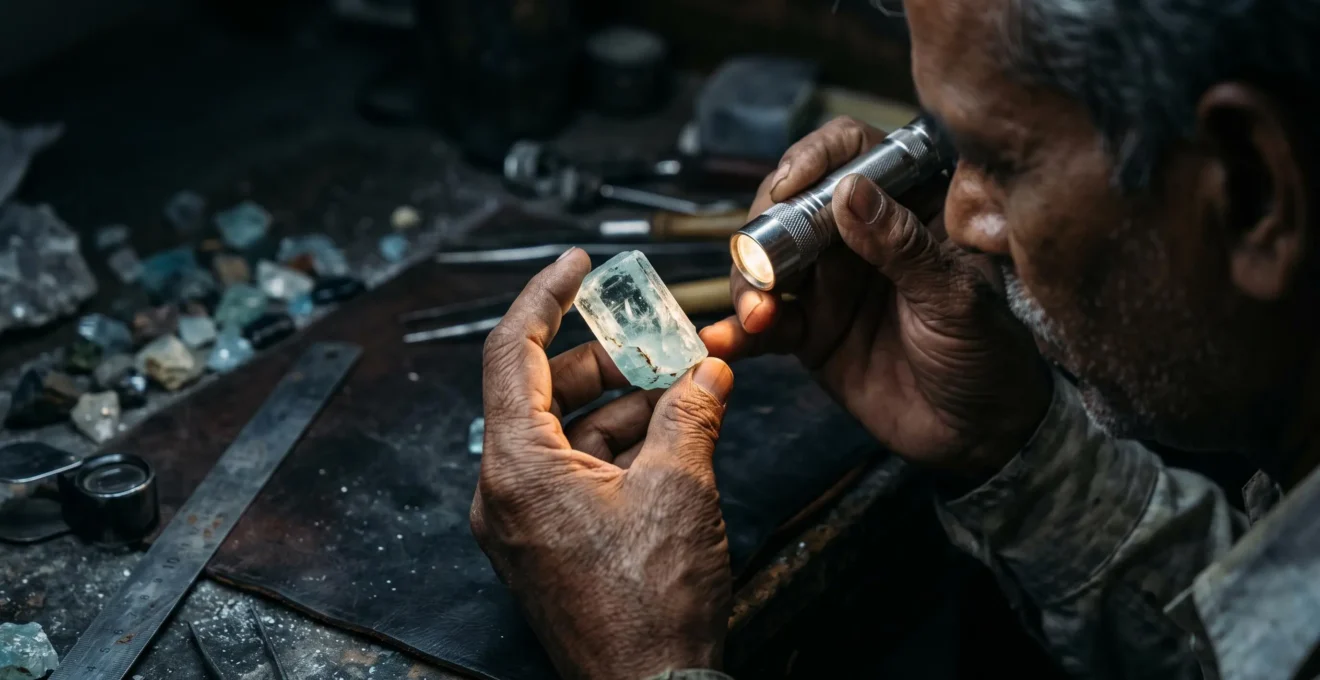
A beautiful aquamarine crystal can be a disappointing piece of cutting rough. Its blue may weaken when the stone is reduced to a smaller shape, an apparently clean interior may conceal a fracture, or the most attractive portion may disappear during preforming.
The practical test is to evaluate three things before cutting: blue colour in the intended viewing direction, usable clarity within the proposed gem outline, and realistic weight retention. A crystal does not need to be flawless, but its defects must be understood well enough to plan around them.
Aquamarine belongs to the beryl family. Its directional colour, characteristic inclusions and sometimes substantial crystal dimensions make it particularly important to assess the entire piece rather than judge a single attractive photograph.
For collectors and beginner cutters, the safest purchase is not automatically the deepest blue or largest crystal. It is the material whose likely finished appearance and losses can be estimated before money or specimen value is committed.
Quick assessment: Is this aquamarine worth cutting?
- Compare the blue from several directions. Crystal orientation and finished depth can change apparent saturation.
- Use grazing light and slow rotation to identify reflective fissures, then map their positions against the proposed cut.
- Estimate usable volume, not merely rough weight, and compare the potential gem with the intact crystal’s value.
- Why Is Aquamarine Often Pale, and What Makes the Blue Look Stronger in Larger Stones?
- How to Inspect an Aquamarine Crystal for Hidden Fractures Using One Torch and Slow Rotation?
- Clean Pale Aquamarine vs Included Deeper Aquamarine: Which Is the Better Buy Under £400?
- The Storage Mistake That Turns Tiny Aquamarine Fissures Into Visible Breaks Over a Month
- When Should You Cut an Aquamarine Crystal vs Keep It Intact for Long-Term Value?
- Why Do So Many Beryl Gems Have Surface-Reaching Fissures Even at High Prices?
- How to Estimate Cutting Yield From Rough Photos Using a 3-Step Volume Guess?
- Is This Rough Material Worth Cutting, or Will You Lose Half Your Weight Before You Even Reach Prepolish?
Why Is Aquamarine Often Pale, and What Makes the Blue Look Stronger in Larger Stones?
Aquamarine often appears pale because its natural blue colouring is relatively weak in many crystals. Larger finished stones can show stronger saturation because light travels through more coloured material. However, size alone does not determine the result: aquamarine is pleochroic, so the direction in which a cutter orients the gem also influences its visible blue.
According to GIA’s aquamarine quality factors, the gemstone can display near-colourless and stronger blue appearances in different crystal directions. GIA also observes that many faceted aquamarines need to exceed approximately five carats to show intense dark colour, although strongly coloured smaller stones occur.
For a cutter, this means that an attractive blue seen through the side of a rough crystal may not survive if the proposed table faces a less favourable direction. Aquamarine is commonly oriented with its table parallel to the crystal’s length to favour the stronger blue appearance.
To compare directions, place a crystal against a neutral background and inspect it under consistent illumination. View along its length, then through the sides, slowly changing the angle. A small torch can help reveal transparency and differences in apparent colour, although its beam colour and intensity can distort the comparison.
Do not assume that looking down the crystallographic c-axis reveals the richest blue. The relationship between optical directions and crystal orientation needs to be considered, particularly in a well-formed hexagonal crystal.
Finished proportions matter too. A deeper pavilion can increase the distance light travels inside the material, but an excessively deep or poorly proportioned design may sacrifice brightness, produce undesirable dark areas or retain weight inefficiently.
Step cuts can be attractive for aquamarine because they display broad areas of colour and clarity. Nevertheless, an emerald cut does not automatically intensify blue more effectively than every brilliant design. The result depends on the actual rough and the geometry chosen.
Consider a hypothetical pale crystal that appears distinctly blue through its longest side but nearly colourless when viewed end-on. Cutting a shallow gem in the weaker direction could produce a disappointing finished stone even if the rough initially looked promising.
The best colour decision is therefore made before the first saw cut. Once the promising orientation is identified, the next task is determining whether fractures leave enough clean material to use it.
How to Inspect an Aquamarine Crystal for Hidden Fractures Using One Torch and Slow Rotation?
Inspect aquamarine in a dim room using a small torch aimed across the crystal at a grazing angle. Rotate the stone slowly and watch for bright internal flashes, flat reflective surfaces or lines that extend to an exterior face. This screening method can reveal suspicious features, but a torch alone cannot reliably identify every inclusion or fracture.
Begin by cleaning loose dust from the crystal with a suitable soft cloth. Place it over a dark, non-scratching surface and use a narrow light beam. Avoid looking directly into the torch.
- Illuminate one side of the crystal at a shallow angle rather than shining straight through its centre.
- Rotate the crystal approximately 15–30 degrees at a time while keeping the lighting position reasonably consistent.
- Observe whether an internal line produces a sudden mirror-like reflection as its orientation changes.
- Inspect the opposite side and both ends to determine whether the feature appears continuous.
- Sketch suspicious features on a photograph or diagram before planning the preform.
Flat reflective flashes deserve attention because they can indicate fracture surfaces. However, their presence is not definitive proof that a fracture is open, unstable or surface-reaching.
Aquamarine may also contain elongated fluid inclusions and growth-related tubes. These can resemble fine rain inside the crystal. Unlike a broad fracture plane, a tube may appear as a narrow, continuous feature, sometimes with internal reflections of its own.
The distinction matters because a narrow inclusion outside the future table may have little effect on the finished gem, while a fracture crossing the intended pavilion can force a complete redesign.
Surface-reaching fissures deserve particular scrutiny. They may collect polishing residues or other substances, and existing fractures can complicate cutting, dopping and cleaning. Heat and mechanical stress should be managed carefully, although damage cannot be predicted from a torch reflection alone.
Five checks to document before cutting
- Photograph the crystal from its main viewing directions and save a labelled image set.
- Record which orientation shows the strongest blue and mark that direction on a working sketch.
- Rotate the crystal under grazing light and draw every suspicious reflective feature onto the sketch.
- Outline a proposed preform that avoids the most concerning features, producing a preliminary cutting diagram.
- Reinspect after marking the preform, recording any apparent change before proceeding with trimming or dopping.
A fine scribe or marking tool should not be pressed aggressively against fragile edges. The aim is to record the proposed shape, not test the strength of an existing crack.
Once the defects are mapped, a buying decision becomes more meaningful: the question is no longer whether the rough contains inclusions, but whether those inclusions compromise the gem that can realistically be cut.
Clean Pale Aquamarine vs Included Deeper Aquamarine: Which Is the Better Buy Under £400?
Under £400, clean pale aquamarine is generally the more predictable choice for a beginner seeking a transparent finished stone. Deeper-blue rough with moderate inclusions can be more appealing when its colour remains strong in the planned orientation and the defects can be excluded from the cut. Neither option is automatically better without inspecting the individual piece.
Price alone does not establish cutting grade. A £400 budget might cover a smaller transparent crystal, a larger specimen with limited clean zones, or a parcel with uncertain yield. There is no dependable market rule that material below this amount belongs to one particular quality category.
The comparison becomes clearer when the intended finished stone is defined before purchase.
| Buying criterion | Clean, pale rough | Deeper-blue, included rough |
|---|---|---|
| Primary attraction | Transparency and predictable appearance | Potentially stronger finished colour |
| Main cutting risk | Weak saturation after reducing size | Loss of usable volume around inclusions |
| Best suited to | Beginners prioritising a clean result | Cutters able to map defects accurately |
| Possible design approach | Preserve suitable depth and favourable orientation | Position inclusions outside critical optical areas |
| Purchase requirement | Verify blue from multiple directions | Verify colour and the precise inclusion layout |
When mapping inclusions, imagine the crown, pavilion and girdle inside the rough. A small inclusion close to material that will be removed during girdle shaping may be inconsequential. A similar inclusion projected beneath the centre of the table can be much more noticeable.
Position is not the only consideration. A fracture near the future girdle may still be a durability concern if it remains in the finished stone. Removing or securely avoiding a risky feature matters more than merely making it difficult to see.
Consider a hypothetical purchase: one crystal is uniformly pale and transparent, while another is noticeably bluer but contains a central reflective plane. If the second crystal must be divided into much smaller pieces to remove the fracture, its apparent colour advantage may not justify its price.
For resale, stronger colour can attract interest, but clarity, cutting quality, treatment disclosure and market demand also influence value. Pale eye-clean material is not guaranteed to sell more easily, and a saturated included gem is not guaranteed to command a premium.
Ask sellers for measurements, weight, photographs from multiple directions and an explicit description of fractures and treatments. If the material cannot be examined in person, a return policy and independent inspection become especially useful.
Buying the right rough is only part of protecting value. Once acquired, even a sound crystal should be stored in conditions that minimise avoidable physical and thermal stress.
The Storage Mistake That Turns Tiny Aquamarine Fissures Into Visible Breaks Over a Month
The storage mistake to avoid is exposing an already fissured aquamarine to abrupt temperature changes or physical contact with harder gemstones. Existing fractures may make the crystal more vulnerable to damage, but there is no established rule that a tiny fissure will become a visible break within one month. Storage conditions affect risk, not a predictable countdown.
Aquamarine has a Mohs hardness of 7.5–8, meaning it resists scratching relatively well. That number does not describe its resistance to fracture propagation.
As explained in GIA’s aquamarine care and cleaning recommendations, aquamarine should be protected from heat exposure. Ultrasonic and steam cleaning are generally suitable only when fractures and liquid inclusions are absent.
A cracked crystal left in a hot vehicle and then exposed to a much colder environment may experience thermal stress. The amount of risk depends on the crystal, its defects and the temperature conditions. A particular temperature threshold or one-month failure probability cannot be reliably assigned from appearance alone.
Freezing water inside an accessible fissure is another reason to avoid inappropriate storage conditions, although it should not be presented as a routinely documented cause of aquamarine breakage within weeks.
Contact damage is easier to prevent. Loose aquamarine stored against diamond or corundum can become scratched, and impacts against other stones can damage vulnerable edges or existing cracks.
A practical storage routine is straightforward:
- Keep each crystal in an individual soft pouch or padded compartment.
- Maintain a reasonably stable indoor temperature away from direct heating sources.
- Separate aquamarine from harder gemstones and heavy mineral specimens.
- Avoid ultrasonic and steam cleaning when fractures or liquid inclusions are present.
- Record existing fissures photographically if condition tracking or eventual resale matters.
For a fissured crystal, cautious cleaning with mild soapy water and a soft cloth is preferable to aggressive mechanical cleaning, provided the specimen’s condition permits it. Avoid sudden temperature changes during washing.
A monthly visual check can be a useful personal recordkeeping habit, not a scientifically prescribed inspection interval. Use similar lighting and camera angles to compare the same features. Apparent changes should be checked before assuming that a crack has grown.
Good storage preserves the option to cut later. That option can be especially valuable when the crystal itself may already be worth more as a mineral specimen than as potential gemstone rough.
When Should You Cut an Aquamarine Crystal vs Keep It Intact for Long-Term Value?
Cut an aquamarine crystal when its internal gem-quality material has a credible finished value that justifies sacrificing the specimen. Keep it intact when its complete termination, attractive crystal form, provenance or display quality may carry a meaningful collector premium. Cutting is irreversible, so uncertain value or limited cutting experience favours preservation until the comparison is clearer.
A complete terminated crystal can appeal to mineral collectors for reasons unrelated to faceting. Its geometry, surface features, colour distribution and aesthetic presentation may be important parts of its value.
Conversely, a broken crystal with an unattractive exterior but a large transparent interior may be more suitable for cutting. The important distinction is between specimen quality and usable gemstone quality.
Before committing, examine four questions:
- Is the crystal complete, naturally terminated and aesthetically attractive?
- Does it contain a sufficiently large transparent zone with useful blue saturation?
- Can that zone be removed without destroying a potentially valuable specimen unnecessarily?
- Are comparable specimen and finished-gem values available to support the decision?
A collector-grade crystal should not be cut simply because it is transparent. Equally, a damaged fragment should not be preserved indefinitely merely because it retains a recognisable hexagonal outline.
For a valuable or unusual specimen, independent opinions from a mineral specialist and an experienced cutter can help establish the alternatives. Both should examine the actual piece rather than rely on a single photograph.
One intermediate option is to polish a small test window on an already damaged or visually unimportant face. This may provide a clearer view into the interior without committing the entire crystal to faceting.
However, even a small window permanently alters the specimen. It can reduce collector appeal, particularly when natural faces and surface preservation are important. Test windows are therefore more appropriate for ordinary cutting rough than exceptional intact crystals.
Another option is to remove a previously broken or unattractive end for testing, provided the operation can be performed safely and the remaining crystal has no significant specimen premium.
Keeping a crystal intact also preserves future choices. Better equipment, improved cutting skill or additional information about the material may change the assessment later.
When cutting is justified, understanding how fractures formed helps distinguish ordinary geological features from damage that may compromise the finished gemstone.
Why Do So Many Beryl Gems Have Surface-Reaching Fissures Even at High Prices?
Beryl can contain natural fluid inclusions, healed fractures and open fissures formed during its geological history or introduced through later damage. High prices do not guarantee the absence of these features because colour, size, transparency and cutting quality also influence value. The critical distinction is whether a feature is healed, open, surface-reaching or positioned where it compromises the finished gem.
Beryl commonly forms in geological environments where crystals interact with mineral-rich fluids. Growth and later geological processes can leave internal structures that remain visible long after crystallisation.
Original research published in Gems & Gemology’s research on aquamarine from Pakistan examined six samples from the Shigar Valley. Researchers documented elongated fluid inclusions and fingerprint-like networks associated with healed fissure planes.
Laboratory observations from Shigar Valley aquamarine
In the 2018 investigation, six Pakistani aquamarine samples underwent gemological examination supported by analytical techniques.
Researchers identified two-phase and three-phase inclusions, elongated fluid inclusions aligned with the crystallographic c-axis, and fingerprint-like structures associated with healed fissures. These observations document internal growth and healing features but do not establish that every visible feature reaches the surface.
A healed fracture is not equivalent to an open crack. During geological healing, material may be redeposited within an earlier fracture, leaving a visible inclusion pattern without necessarily leaving an open pathway to the exterior.
Mining and extraction can introduce additional damage. Mechanical impacts during removal, handling or transport may create fresh fractures, but it would be misleading to attribute every fissure in a particular deposit to hammer extraction without evidence about the individual specimen.
For buyers, fracture position is more useful than a simple yes-or-no inclusion label. A small healed feature away from the main viewing area may have limited visual impact. A large open fissure extending through the crown or girdle can create both appearance and durability concerns.
Treatment disclosure also matters. Surface-reaching fractures can provide pathways for filling materials, although fracture filling in aquamarine is described by GIA as rare. A high-priced fissured stone should not automatically be assumed to have been treated.
Ask whether any clarity enhancement has been performed. Under magnification, some filled fractures may show diagnostic optical effects, but identifying a treatment reliably can require professional gemological testing.
Once these features have been identified, the next challenge is estimating how much material remains available for a finished stone, particularly when purchasing from photographs.
How to Estimate Cutting Yield From Rough Photos Using a 3-Step Volume Guess?
Estimate cutting yield from photographs by first approximating the crystal’s overall dimensions, then subtracting visibly unusable regions, and finally considering how much additional material the intended gem shape will require removing. The result should be a broad planning range, not a precise finished-weight prediction. Photographs cannot reliably reveal every internal defect or optical constraint.
The first requirement is a trustworthy scale. Ask the seller to photograph the rough beside a millimetre ruler and provide its actual weight and three principal dimensions. A coin can help when its size is known, but a ruler is usually clearer for international purchases.
Perspective matters: an object photographed close to a wide-angle lens may look disproportionately large. Ideally, obtain views from the front, side and end, with the scale positioned near the same plane as the crystal.
The three-step method is a practical screening exercise rather than a validated gemological yield formula.
- Construct a bounding volume. Imagine the smallest practical rectangular box enclosing the crystal. Multiply its length, width and depth to obtain an approximate bounding-box volume.
- Identify usable material. Mentally remove empty corners, irregular projections, damaged ends and zones intersected by significant fractures. Sketch the largest plausible clean region rather than treating the entire box as solid aquamarine.
- Allow for faceting losses. Compare the remaining region with the intended finished shape, allowing for pavilion depth, crown formation, orientation and preforming. Express the result as uncertain rather than applying a universal retention percentage.
A simple hypothetical example illustrates the method. Suppose the bounding box measures 20 × 10 × 8 mm, giving 1,600 mm³. This is only the volume of the enclosing box, not the volume of the irregular crystal or the usable cutting region.
If the actual usable portion is substantially smaller because of tapered ends or a central fissure, multiplying the bounding-box volume directly by beryl density would greatly overstate the possible finished weight.
As a reasonableness check, compare the seller’s stated rough weight with its dimensions. The Pakistani aquamarine samples examined in the GIA study had measured specific gravities of 2.60–2.72. Those values describe the investigated samples and should not be treated as an exhaustive density range for all aquamarine.
For an approximate mass calculation, volume in cubic centimetres multiplied by specific gravity gives mass in grams. Since 1,000 mm³ equals 1 cm³, the hypothetical 1,600 mm³ bounding box represents 1.6 cm³. It must still be adjusted for the crystal’s actual shape and void space before comparing it with the measured mass.
One central fracture can remove a large part of the feasible cutting outline, while numerous shallow surface imperfections may disappear during preforming. This is why inclusion position can influence yield more than inclusion count.
Remote buyers should request additional photographs whenever the estimate depends on a feature that is not clearly visible. If the seller cannot provide suitable evidence, the uncertainty belongs in the purchase decision.
The resulting estimate is only useful when paired with a realistic cutting plan and a comparison of the finished stone’s potential value against the alternatives.
Key takeaways before making the cut
- A favourable blue orientation is necessary, but insufficient if the usable region is crossed by a serious fracture.
- Calculate expected losses around the actual intended shape, not from a universal rough-to-finished percentage.
- Compare the potential gem, cutting costs and intact specimen value before sacrificing the crystal.
Is This Rough Material Worth Cutting, or Will You Lose Half Your Weight Before You Even Reach Prepolish?
Rough aquamarine is worth cutting when its colour, clarity and usable dimensions support a finished gemstone whose value or personal usefulness justifies the loss of material. Losing half the original weight is possible, but not a universal rule or a reliable prepolish forecast. The actual result depends on the rough’s geometry, fractures, orientation, design and cutter’s execution.
The first decision is whether the rough passes three basic tests. Does it show sufficient blue in a feasible cutting orientation? Can major fractures be excluded from the finished outline? Is enough clean material available to produce the desired shape with workable proportions?
If any answer is clearly negative, the proposed cut may need to change or be abandoned.
Cutting style influences the calculation. A round design carved from elongated prismatic rough can require considerable removal, whereas a rectangular or elongated design may follow the original crystal geometry more efficiently. This is a possibility, not a rule that emerald cuts always retain more weight than ovals or rounds.
GIA’s analysis of colored gemstone value factors explains the relationship between rough quality, finished proportions, colour, clarity and craftsmanship. Maximising retained mass is not necessarily the same as maximising the finished gem’s value.
A heavy stone with poor optical performance may be less desirable than a lighter, well-proportioned result. Likewise, preserving extra weight by leaving a dangerous fracture in the finished gem may be a poor compromise.
For an economic decision, compare the realistic value of the finished gemstone with the intact rough’s current value and the cost of cutting. Include potential recutting or breakage losses, and distinguish an actual resale offer from an optimistic retail asking price.
Hypothetical cutting decision
Imagine two aquamarine crystals of similar rough weight. Crystal A has an elongated transparent region with favourable blue orientation. Crystal B appears bluer from one angle but contains a central fracture that divides its usable interior.
Crystal A may support one well-proportioned gem, while Crystal B might require two smaller stones or extensive trimming. Without measured weights, cutting designs and market quotations, neither crystal can be assigned a reliable yield or profit figure. The example demonstrates why visible colour alone is insufficient.
Beginners should also account for execution risk. Orientation, sawing, dopping, pavilion alignment and polishing all introduce opportunities for error. An expensive aquamarine crystal is a poor choice for learning the complete sequence for the first time.
Practice on inexpensive, expendable material first. Low-grade quartz can help develop handling and faceting skills, although its behaviour differs from aquamarine. Synthetic corundum may also be used for practice, but its greater hardness changes the cutting and polishing experience.
Keeping the rough intact, selling it as a specimen or asking an experienced lapidary for a cutting assessment are all legitimate alternatives. A decision not to cut is not necessarily a missed opportunity.
Before the first cut, record the intended colour orientation, draw the preform, estimate likely losses and obtain a realistic assessment of the finished result. Proceed only when those observations support the decision; otherwise, preserve the crystal until better evidence or experience is available.
Can a pale aquamarine crystal become dark blue after cutting?
Cutting orientation and finished proportions can strengthen the apparent blue, particularly when light travels through a greater depth of material. However, faceting cannot create saturation that the material does not possess. Some pale crystals will remain pale regardless of the design.
Does a visible inclusion mean aquamarine is unsuitable for faceting?
No. The type, size and position of the inclusion matter. A small feature outside the intended finished outline may be removed during cutting. A central fracture or an open fissure crossing the girdle can be more consequential. Professional inspection is advisable when the feature is uncertain.
Can a phone torch replace a gemological microscope?
A phone torch can help screen rough for obvious internal reflections and colour differences, but it cannot reliably distinguish all fluid inclusions, healed fractures and open cracks. Magnification, controlled illumination and professional examination provide more dependable information for valuable material.
Is heat-treated aquamarine necessarily lower quality?
Not necessarily. Treatment status is one factor in assessing a gemstone, alongside colour, clarity, cutting and disclosure. Ask the seller whether the material has been treated and avoid assuming that colour alone proves natural or treated status. Laboratory assessment may be needed when treatment identification matters.
Should a beginner buy aquamarine rough without seeing it in person?
Remote purchasing is possible, but it increases uncertainty. Request accurate weight and dimensions, photographs from multiple directions, transmitted-light views and clear disclosure of fractures and treatments. For costly rough, favour independent examination or a suitable return arrangement rather than relying on one attractive sales image.