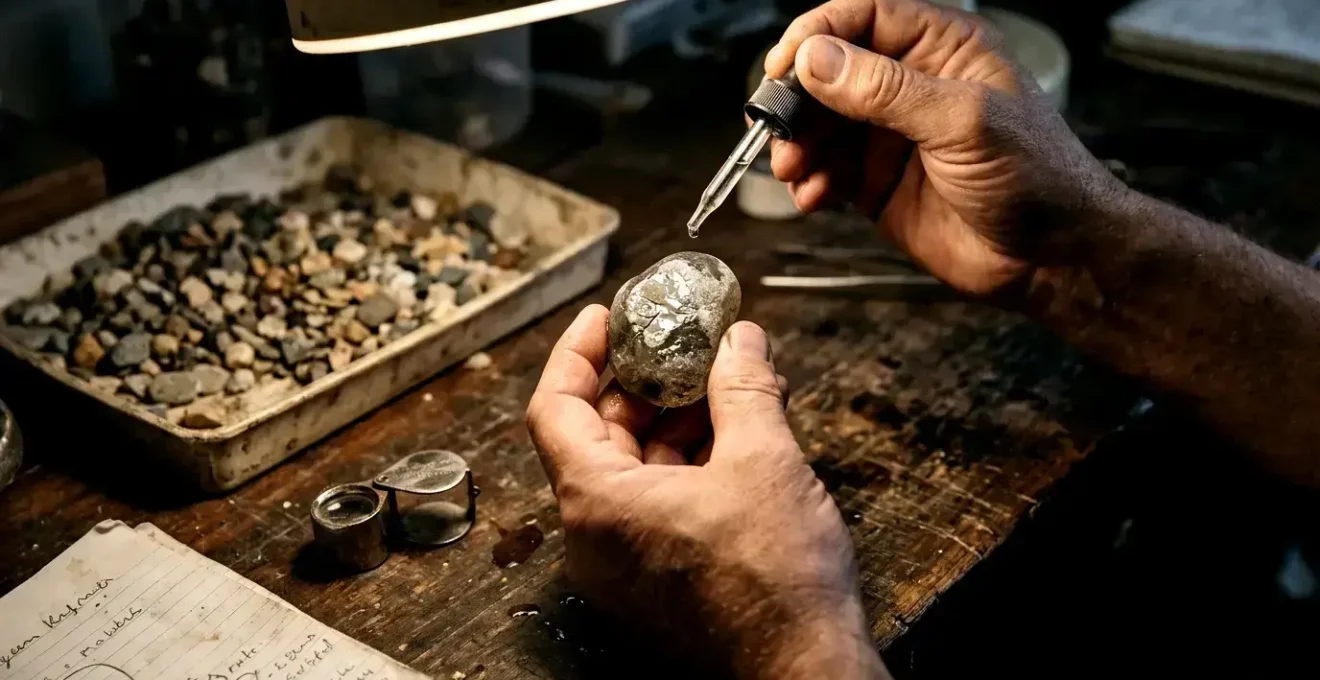
An alluvial deposit changes a gemstone’s surface through erosion, transport, abrasion and weathering. Sharp edges may become rounded, exposed crystal faces can lose their original texture, and impacts may leave small chips or fractures. The resulting pebble can appear smooth and durable, even when its interior contains features that make cutting difficult.
For collectors buying stones described as « river found, » these changes are useful evidence—but not proof of origin. Mechanical tumbling can imitate several effects of natural transport, while some genuinely alluvial crystals retain recognizable faces and edges. Neither perfect rounding nor a frosted surface independently establishes a river history.
The more reliable approach is to examine several signals together: wear distribution, internal transparency, mineral associations, original crystal geometry and documented collecting context. Each reveals something different about the stone’s journey. Understanding where those signals agree—and where they contradict one another—helps separate geological evidence from an attractive sales description.
Reading the Surface of an Alluvial Gemstone
- River transport changes both shape and survival: abrasion rounds exposed areas, while breakage can eliminate weaker, heavily fractured material.
- Surface wear is not an origin certificate: compare abrasion, texture, rounding and residues before accepting a river-found claim.
- Buying decisions depend on what remains hidden: inspect internal features and request collection documentation before paying an origin premium.
- Why Do River-Worn Gems Hide Internal Cracks Better Than Freshly Broken Rough?
- How to Tell Natural Alluvial Wear From Artificial Tumbling Using 4 Surface Clues
- Alluvial Pebbles vs Primary Vein Rough: Which Is Better if You Want Predictable Cutting?
- The Pricing Trap: Paying a Premium for “River Found” Without Any Verifiable Indicators
- When Should You Record Location and Context for Alluvial Finds So They Still Matter Later?
- Primary Rock Deposit vs Alluvial Deposit: Which Origin Tends to Give Better Crystal Shape?
- Pegmatite vs Hydrothermal Vein: Which Origin Fits Your Quartz Cluster More Often?
- Which Formation Process Produced Your Mineral, Based on 5 Visible Clues You Can Check at Home?
Why Do River-Worn Gems Hide Internal Cracks Better Than Freshly Broken Rough?
River-worn gems can conceal internal cracks because their abraded surfaces scatter light, making fractures harder to distinguish. Transport also preferentially breaks some heavily fractured crystals, leaving a naturally selected population of more resistant material. These are separate effects: a surviving pebble may be structurally sound, but its smooth outline does not establish internal freedom from fractures.
During erosion and water transport, gemstone fragments encounter other sediment particles and undergo repeated mechanical impacts. Pre-existing fractures can provide pathways for breakage, especially where a mineral’s cleavage or internal weaknesses favour separation. Pieces that fracture may become smaller or disappear from the recoverable gem-sized fraction.
The GIA research on gemstones recovered from sedimentary rocks describes this natural sorting process, including the removal of fractured or less durable crystals during transport. It does not imply that every surviving alluvial gem is internally flawless.
Natural selection and surface concealment must not be confused. A pebble can survive transport because it is relatively resistant while still containing healed fractures, inclusions or internal stress features. Its external condition may simply prevent those structures from being seen clearly.
A freshly broken crystal may expose transparent surfaces through which internal discontinuities are readily visible. A water-worn specimen can instead have a frosted exterior produced by fine abrasion or etching. This irregular surface scatters incoming light, reducing the visibility of features beneath it.
For a practical examination, begin with a clean, dry stone under directional light. Rotate it slowly and look for fine lines crossing the surface or following old impact points. Where the material is suitable, a small amount of clean water may temporarily improve optical contact and help reveal features beneath a rough exterior. Water is preferable to oil for an initial non-invasive check: oil can leave residue, enter open fractures or complicate subsequent examination.
The method has limits. A fracture may remain invisible because it is too deep, poorly oriented or obscured by inclusions. Magnification and suitable transmitted lighting can provide additional information. GIA’s research on gemstone inclusions explains how internal mineral features, fluid inclusions and healed fractures can inform gemological identification and geological interpretation.
For cutting, the relevant question is not whether the pebble survived a river. It is whether the intended cutting volume contains fractures likely to open during sawing or shaping. An opaque or heavily frosted exterior increases uncertainty, but no general rule establishes that alluvial rough must yield less usable material than comparable primary rough.
A river may eliminate some weak fragments, yet surviving stones still require individual examination. The next challenge is establishing whether their apparent transport wear is natural at all.
How to Tell Natural Alluvial Wear From Artificial Tumbling Using 4 Surface Clues
Natural alluvial wear and artificial tumbling can look remarkably similar because both involve repeated contact between stones and abrasive particles. Four useful clues are abrasion distribution, surface texture, edge-rounding geometry and residual coatings. None is conclusive alone; their value comes from identifying a coherent pattern consistent with the stone’s claimed transport history.
A tumbling machine can reproduce substantial mechanical rounding without a natural river journey. It may also use different abrasives, polishing compounds and processing stages to produce surfaces ranging from dull to highly polished. Therefore, the distinction is not simply matte versus glossy.
The following comparison identifies tendencies worth inspecting rather than inflexible diagnostic rules.
| Surface clue | Possible natural alluvial wear | Possible artificial tumbling |
|---|---|---|
| 1. Abrasion distribution | Exposed edges and protrusions may show stronger wear; sheltered recesses can retain older textures. | Repeated barrel contact can produce broadly distributed wear, although recessed areas may also remain protected. |
| 2. Surface texture | Matte, frosted, pitted or locally polished areas may coexist, depending on mineral and environment. | Fine polishing can produce an even gloss; coarse or incomplete tumbling may leave a matte surface. |
| 3. Edge geometry | Rounding may vary according to original shape, impact history and local exposure. | Processed batches may show similar rounding, but individual shapes can remain irregular. |
| 4. Residual material | Iron-oxide staining, mineral coatings or attached matrix may survive in protected areas. | Cleaning and polishing often remove deposits; coatings or staining can also be retained or introduced artificially. |
Look for relationships between the clues. A pebble with rounded protrusions, sheltered pits and mineral deposits trapped within those pits presents a more coherent weathering history than a uniformly glossy stone accompanied only by a seller’s account.
However, an irregular matte surface does not establish alluvial origin, and a polished appearance does not disprove it. Natural pebbles may acquire substantial polish under particular sediment conditions, while artificial tumbling may stop before any final polishing stage.
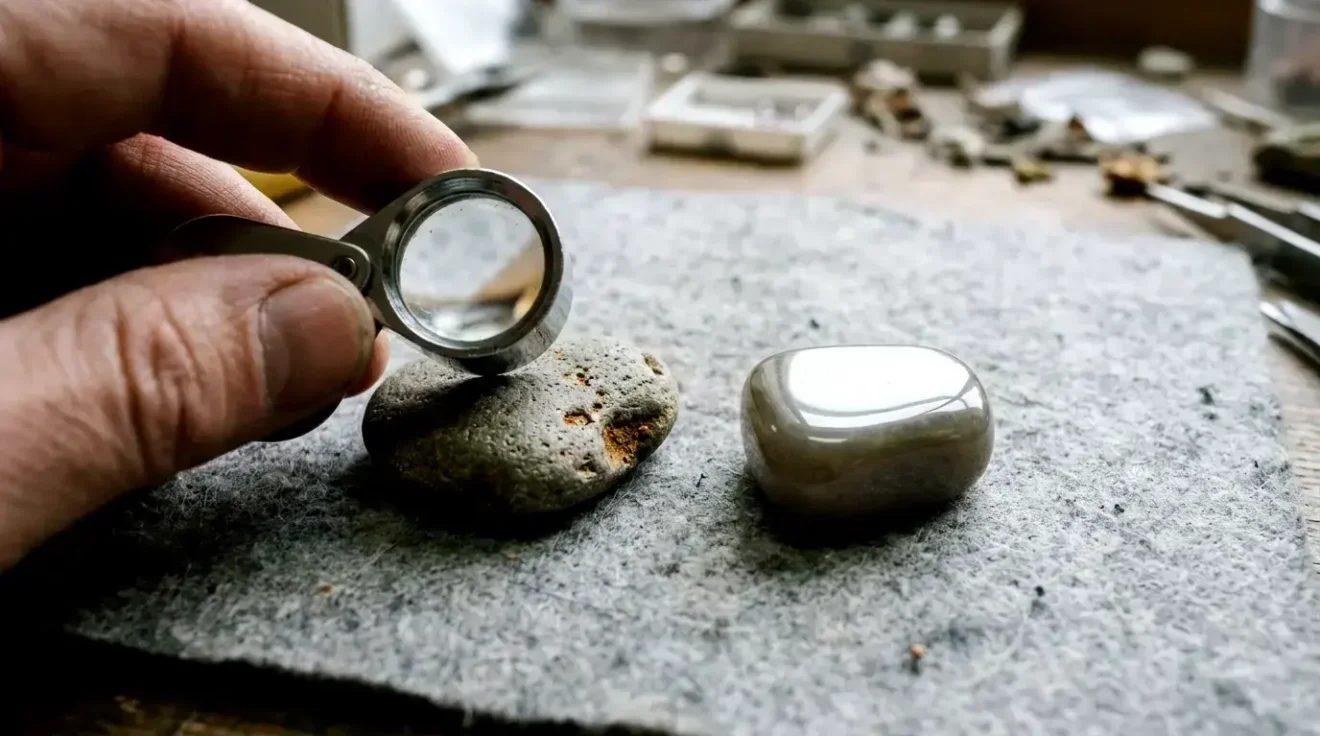
Under a loupe, inspect transitions between exposed and sheltered surfaces. Old coatings within recesses may be more informative than superficial staining over the entire specimen. Also examine fractures and cavities for abrasive residue or signs of recent polishing.
The geological distinction extends beyond surface mechanics. Natural alluvial history can include chemical weathering, changing sediment conditions and multiple episodes of transport or burial. Artificial tumbling imitates part of that mechanical history but does not independently reproduce the original geological setting.
Even deliberate staining and sophisticated finishing can make surface inspection ambiguous. Internal inclusions, mineral identification and reliable collection records become more important when a seller asks for additional payment based on natural origin.
A plausible worn surface is only the beginning of evaluation. Once the purchase also involves cutting potential, the hidden geometry of the stone matters at least as much as its exterior.
Alluvial Pebbles vs Primary Vein Rough: Which Is Better if You Want Predictable Cutting?
Primary vein rough can be easier to orient for cutting when recognizable crystal faces, terminations and internal features remain visible. Alluvial pebbles often reveal less about their original growth geometry, but transport may already have removed fragile protrusions. Predictability depends on the individual stone’s transparency, fractures, mineral properties and intended cut—not simply its deposit type.
Fresh primary rough may preserve geometric features that help a cutter understand crystallographic orientation. Depending on the mineral, these can inform decisions about cleavage, optical behaviour and the direction of a planned cut. However, a crystal with sharp faces may still contain substantial fractures or unusable inclusions.
An alluvial pebble presents a different problem. Its external outline has been modified by transport, so original faces and terminations may be missing. The cutter must rely more heavily on the remaining silhouette, transparency, internal features and visible impact damage.
The comparison becomes more useful when the buyer examines each material according to the information it can actually provide.
| Assessment | Primary vein rough | Alluvial pebble |
|---|---|---|
| External geometry | Inspect crystal faces, growth direction and terminations. | Assess rounded form, remaining volume and irregular projections. |
| Internal visibility | Use accessible transparent faces to examine inclusions and fractures. | Use suitable transmitted light or accessible windows to inspect the interior. |
| Damage indicators | Check broken terminations, exposed fractures and separation planes. | Check old impact points, surface cracks and chipped areas. |
| Cutting uncertainty | Visible growth structure may assist orientation, but internal damage remains possible. | Transport may have removed weak portions, while abrasion may conceal useful information. |
A compact, barrel-shaped alluvial pebble can sometimes offer an advantageous starting shape because there are fewer protruding pieces to remove. Yet rounded geometry alone does not predict a particular finished weight or cutting yield. Its apparent compactness may be offset by fractures or inclusions that are invisible from outside.
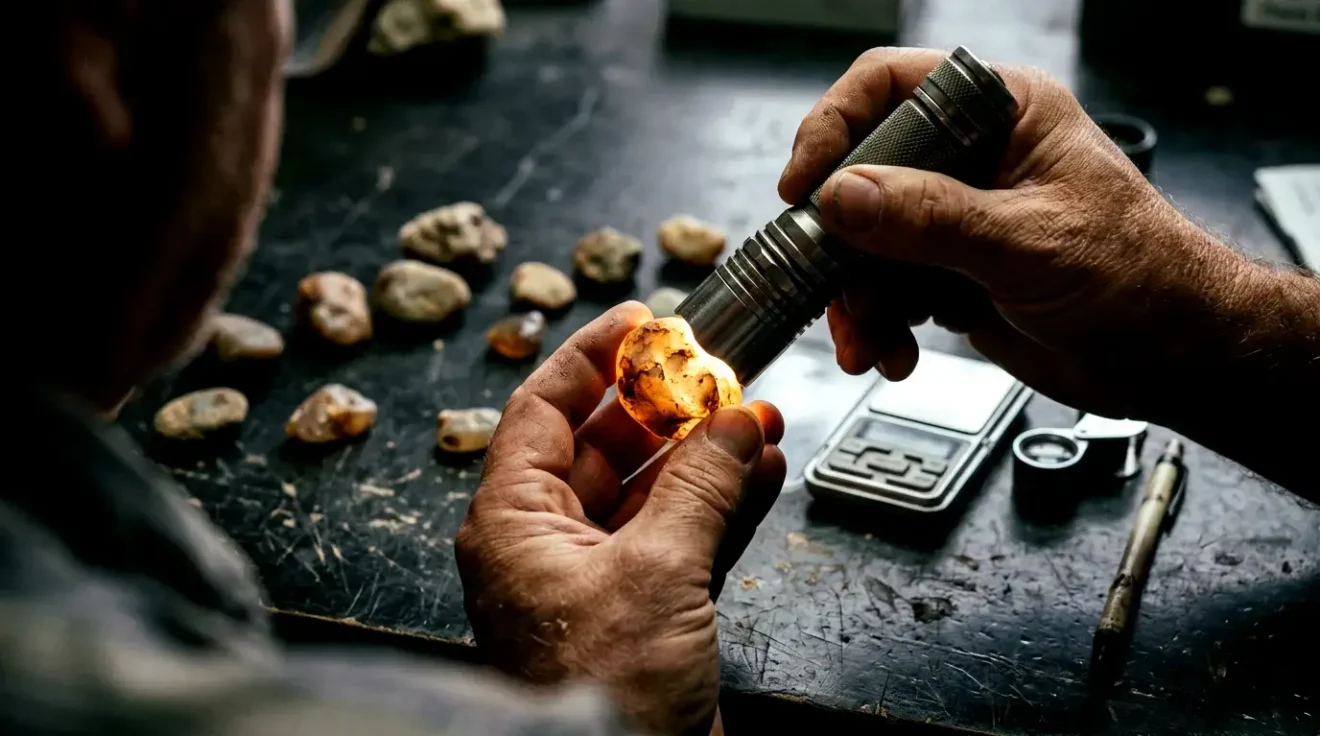
Windowing involves directing light through an accessible area of rough to examine its interior. A strong, controlled light source may reveal fractures, clouds or inclusions in sufficiently translucent material. It provides less useful information for opaque stones or where rough surface scattering prevents effective transmission.
Mineral species also matters. Cleavage, optical characteristics and internal structure differ substantially among gem materials. A comparison between two pieces of rough is only meaningful when these differences—and the intended finished shapes—are taken into account.
Alluvial material trades some geological information for possible natural pre-screening. Primary rough may preserve more information about formation and orientation while leaving greater responsibility for evaluating structurally weak regions to the buyer.
Neither category deserves a blanket yield premium. A cutting estimate requires examining the actual specimen, ideally with appropriate lighting and professional assessment when the financial stakes justify it.
This distinction becomes especially important when a seller charges extra for the story of natural river recovery rather than demonstrable material quality.
The Pricing Trap: Paying a Premium for “River Found” Without Any Verifiable Indicators
The phrase « river found » can add perceived value to a gemstone without providing independently verifiable evidence of its origin. A naturally worn pebble may be attractive or historically interesting, but artificial tumbling can imitate transport wear. Any premium attributed specifically to provenance should therefore depend on credible documentation and consistent physical evidence, not the description alone.
The appeal is understandable. Alluvial gemstone deposits are associated with natural concentration, sedimentary sorting and the possibility of finding resistant gem material in river gravels. These associations can make a stone seem more desirable than visually similar unidentified rough.
Yet a sales description is not a geological record. A polished pebble does not establish where it was collected, what sediment hosted it or whether a dealer received it in the same condition in which it was found.
Evidence can be assessed in three practical tiers:
- Documented context: locality information, collection records, original extraction photographs and details of the surrounding sediment. These offer the strongest contextual support when they can be linked reliably to the individual stone.
- Consistent physical evidence: wear distribution, residual coatings, mineral associations and other observable characteristics compatible with natural transport. These support plausibility but do not independently verify locality.
- Unverifiable narrative: a river name, regional reputation or collection story without supporting records. This should not be treated as authenticated provenance.
The distinction also protects the buyer’s understanding of material quality. If a machine-rounded stone is mistaken for naturally transported rough, the buyer may incorrectly assume that it has undergone the same natural sorting and breakage history as a genuine placer specimen.
Such an assumption is particularly risky when estimating cutting performance. An artificial exterior can conceal a very different geological and mechanical history from that suggested by the marketing description.
Ask the seller concrete questions before accepting an origin premium. What type of gravel hosted the stone? Were other minerals present? Was the specimen recovered from surface sediment or a particular gravel layer? Is there an original collecting photograph or a documented chain of custody?
These questions are useful because they request evidence rather than merely repeating the claimed location. A reseller may not personally know every field detail, so incomplete answers do not automatically imply deception. They do, however, limit the strength of the provenance claim.
For pricing, distinguish the value of the gemstone itself—its species, appearance, condition and suitability for its intended purpose—from any additional amount requested for an asserted origin. When provenance cannot be substantiated, the latter should remain unverified rather than be converted into an assumed fact.
Documentation is easiest to evaluate when it was recorded during collection. Once a stone has passed through several hands, recovering that original information can become difficult or impossible.
When Should You Record Location and Context for Alluvial Finds So They Still Matter Later?
Record an alluvial gemstone’s location and sedimentary context at the time of discovery, ideally before removing it from the gravel. The stone may remain recognizable for years, but its precise association with sediment layers, neighbouring minerals and the collection site can be lost immediately. Contemporary field records preserve information that surface examination cannot reliably reconstruct later.
Alluvial deposits are not uniform piles of pebbles. Individual sediment layers may reflect different transport conditions, depositional episodes or concentrations of heavy minerals. Recording where a specimen occurred can therefore preserve information about its geological setting.
Formal geological documentation principles reinforce this approach. The IMA-CNMNC guidelines on the natural geological origin of minerals recommend documenting locality, geological mode of occurrence, specimen characteristics and associated minerals. Those recommendations concern scientific assessment of mineral origin; they are not a universal commercial gemstone authentication standard.
For an ordinary collector, a compact field record can capture much of the relevant context without sophisticated equipment.
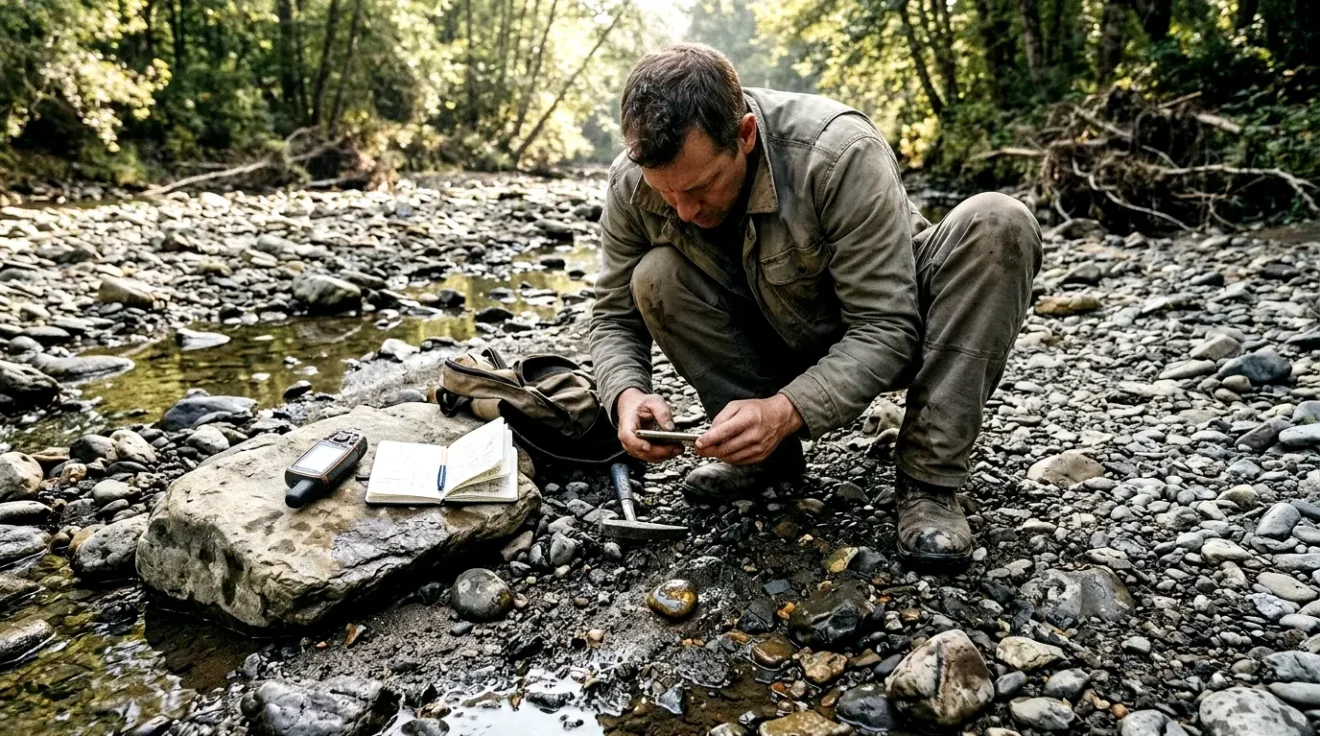
Five Actions to Preserve an Alluvial Gemstone’s Field Record
- Photograph the specimen in place before disturbing the sediment. Save an original image showing its position relative to nearby gravel.
- Record the collecting date and the precise locality, using GPS coordinates or a detailed locality description. Create a dated location entry.
- Describe the sediment layer, including observable gravel size, sorting and any relevant layering. Write a short field description.
- Photograph surrounding sediment and record any associated minerals that can be reasonably identified. Save an annotated context image or mineral list.
- Assign the specimen a unique reference and connect it to its photographs, notes and measurements. Produce a labelled specimen record that can accompany the stone.
Each element contributes differently. Locality records establish where collection was reported. Sediment descriptions preserve depositional context. Associated minerals may help researchers investigate possible geological sources, although a mineral association alone seldom identifies a unique source rock.
Photographs provide an additional check. A clear image taken before removal can show whether the specimen’s exterior is consistent with its documented setting. However, photographs can be misidentified or separated from their original specimen, so a continuous and coherent record remains important.
Documentation should also reflect legal and environmental responsibilities. Mineral-collection rules vary by jurisdiction, land ownership and protected-area status. Recording a location does not establish permission to collect there.
Exact coordinates may be useful in private scientific or collection records without being appropriate for public distribution. Sensitive sites, private land and vulnerable collecting areas can require restricted disclosure.
Preserving context strengthens future interpretations, but the stone’s remaining crystal shape also contains evidence about whether it originated in primary rock or was subsequently transported.
Primary Rock Deposit vs Alluvial Deposit: Which Origin Tends to Give Better Crystal Shape?
Primary deposits generally preserve recognizable crystal shapes better than alluvial deposits because crystals can remain close to their original growth environment. River transport may chip terminations, abrade faces and round exposed corners. Resistant minerals can nevertheless retain distinctive crystal geometry after transport, so crystal shape provides useful evidence of wear rather than an absolute test of deposit type.
A crystal growing in a cavity or other suitable geological environment may develop well-defined faces and terminations. If it remains protected, those features can survive until collection. Once erosion releases the crystal, mechanical transport exposes protruding parts to additional damage.
The general progression can be described as three observational stages:
- Little visible abrasion: recognizable growth faces and sharp terminations remain largely intact.
- Partial abrasion: corners or terminations are worn while much of the original crystal habit remains identifiable.
- Extensive abrasion: original growth geometry is difficult to recognize beneath a rounded or irregular pebble outline.
This progression is not a calibrated transport-distance scale. A stone moved a relatively short distance through energetic, coarse sediment may be more damaged than one transported farther under gentler conditions. Mineral hardness, cleavage, grain size, sediment load and repeated burial or reworking all affect the result.
Diamond, corundum, garnet and zircon can preserve recognizable features under some transport conditions, although each has different mechanical properties and potential weaknesses. Even resistant minerals are not immune to chipping or fracture.
For collectors, the most useful question is whether original growth geometry and later surface modification can be distinguished. A crystal with recognizable faces but abraded edges may preserve evidence of both primary formation and subsequent sedimentary transport.
Conversely, pristine terminations on a stone described as alluvial deserve closer examination, not immediate rejection. A specimen could have undergone limited transport, remained protected in sediment or been recovered near its source.
Crystal shape is a history clue, not a geographic certificate. The best interpretation combines morphology with surface wear, internal characteristics and collection context.
Recognizing what transport has removed is valuable, but understanding what the original growth environment produced can explain the inclusions, matrix and structures that remain.
Pegmatite vs Hydrothermal Vein: Which Origin Fits Your Quartz Cluster More Often?
Neither pegmatite nor hydrothermal vein formation is universally the more common origin for a quartz cluster. Pegmatites can produce exceptionally coarse crystals within granitic rocks and cavities, while hydrothermal veins form as mineral-bearing fluids precipitate quartz in fractures and open spaces. Matrix minerals, growth textures and geological context provide more reliable clues than crystal size alone.
Granitic pegmatites form through complex late-stage magmatic processes involving hydrous or volatile-rich residual melts and fluids. They are commonly characterized by very coarse mineral grains, often including quartz, feldspar and mica. Some contain cavities in which well-formed crystals develop.
The GIA’s research on granitic pegmatites describes these mineral associations and the formation of large crystals within pegmatitic environments. However, these characteristics do not make every large quartz crystal pegmatitic.
Hydrothermal veins form where aqueous fluids circulate through fractures or cavities and precipitate minerals under suitable chemical and physical conditions. Quartz may grow inward from cavity walls, creating recognizable arrangements such as comb-like growth or drusy surfaces composed of numerous small crystals.
Specimen-level clues can help distinguish the possibilities:
| Observed feature | Pegmatitic possibility | Hydrothermal possibility |
|---|---|---|
| Associated minerals | Feldspar, mica and sometimes tourmaline may support a granitic pegmatite association. | Vein-associated minerals and altered wall rock may support precipitation from hydrothermal fluids. |
| Crystal arrangement | Very coarse intergrown minerals or cavity-grown crystals may be present. | Comb growth, drusy linings or crystals growing inward from fracture walls may be present. |
| Internal features | Growth zoning and inclusions may record complex crystallization histories. | Growth banding and fluid inclusions may preserve aspects of fluid-related formation. |
| Remaining matrix | Coarse quartz-feldspar-mica associations can provide useful context. | Vein material and adjacent host-rock fragments may preserve the setting. |
These features overlap. Fluid inclusions are not exclusive to hydrothermal veins, and pegmatites can contain open cavities lined with well-formed crystals. Without geological context, a quartz cluster’s appearance may support several plausible interpretations.
Market frequency is equally uncertain. Different mining regions, supply chains and collecting practices can favour one type of specimen over another. No universal proportion of commercially available quartz clusters can be inferred from these formation descriptions.
The comparison matters for alluvial material because both geological settings can supply quartz to secondary sediment deposits. Once the quartz has been detached and abraded, external evidence of its former matrix may disappear.
Internal inclusions, surviving attached minerals and documented source geology can sometimes help reconstruct that primary history. A rounded quartz pebble alone rarely establishes whether it originated in a pegmatite or hydrothermal vein.
The most useful conclusion is methodological: identify primary growth evidence separately from later transport wear, then combine both when evaluating an unfamiliar specimen.
Key Takeaways Before Your Next Gemstone Inspection
- Separate the mineral’s original formation environment from the processes that later modified its exterior.
- Give greater interpretive weight to preserved crystal geometry, internal structures and credible context than to surface polish alone.
- When observations conflict, document the uncertainty instead of assigning a precise geological origin.
Which Formation Process Produced Your Mineral, Based on 5 Visible Clues You Can Check at Home?
Five observable clues can help narrow a mineral’s likely geological history: crystal shape, associated matrix, surface texture, internal features and overall geometry. Together, they may distinguish original crystallization from later sedimentary transport. However, a mineral can preserve evidence of several processes, so the goal is a reasoned interpretation rather than a definitive origin certificate.
Begin with a clean specimen, good directional lighting and a loupe if available. Avoid aggressive cleaning or polishing before examination, since these treatments may remove exactly the surface evidence being assessed.
The following five clues provide a repeatable inspection framework:
- Crystal shape and terminations: identify intact faces, sharp corners, recognisable growth geometry or rounded remnants. Preserved habit can indicate original crystallization, while damaged edges may suggest subsequent mechanical wear.
- Host rock and matrix: inspect attached feldspar, mica, vein material or other associated minerals. Their presence may help identify the geological environment, but an isolated stone may have lost its original matrix.
- Surface texture: distinguish flat growth faces, irregular fracture surfaces, fine abrasion, pitting and drusy crystal growth. More than one texture can occur on the same specimen.
- Inclusions and growth structures: use suitable light to look for visible internal minerals, bands, healed fractures or other discontinuities. Some features require magnification or specialist instruments to interpret reliably.
- Overall mass and geometry: assess whether the shape is consistent with intact crystal growth, mechanical breakage, transport rounding or a combination of these processes.
The observations should not be added up as though each clue carried equal diagnostic weight. Original crystal faces and internal growth features may preserve information about formation even after superficial abrasion has altered the exterior.
For example, consider a hypothetical quartz specimen with recognisable hexagonal faces, worn corners and a residual piece of coarse feldspar-rich matrix. The visible faces and matrix might support a primary crystallization history, while the rounded corners suggest subsequent damage or transport. The evidence does not necessarily indicate a single uninterrupted process.
Now consider a different hypothetical pebble with a uniformly polished exterior, no attached matrix and little internal transparency. Its surface might be compatible with natural wear, artificial tumbling or both. Without additional evidence, a more precise origin assignment would be unjustified.
This approach is especially useful for evaluating seller claims. If a description identifies a particular river or geological formation, ask which visible characteristics support that interpretation and what independent contextual evidence exists.
Escalate the examination when observations remain contradictory, when treatment is suspected or when geological origin materially affects the price. A qualified gemologist can investigate internal characteristics and treatments, while geological documentation may be necessary to support collection provenance. Professional testing does not automatically establish the precise river from which a specimen was recovered.
For the next potential purchase, record the five observations, photograph any contradictory details and request source documentation before accepting an origin-based premium. A well-supported conclusion may be simply that the stone is consistent with alluvial transport, while its precise history remains unverified.
Can a genuine alluvial gemstone have sharp edges?
Yes. Sharp edges can survive when transport has been limited, the mineral is resistant, or parts of the crystal were protected from abrasion. Sharp morphology alone does not exclude alluvial recovery. The interpretation depends on the mineral, surrounding wear, sedimentary setting and documented collection history.
Does a frosted gemstone surface always indicate river transport?
No. Frosting can result from several surface-modification processes, including mechanical abrasion, chemical alteration and artificial treatment. Natural transport can produce frosted surfaces, but a matte exterior is not specific to river environments. Its diagnostic value increases when considered alongside edge wear, surface deposits and provenance records.
Can a gemological laboratory certify that a pebble came from a particular river?
Laboratories may identify gemstone species, investigate treatments and examine inclusions that provide geological or geographical clues. However, the precise river where an individual pebble was collected generally cannot be established from its worn surface alone. Reliable collecting records and documented custody may be necessary to substantiate that level of provenance.
Should mineral coatings be removed before examining an alluvial stone?
Not automatically. Coatings, staining and particles retained in recesses may preserve useful evidence about the specimen’s history. Photograph the stone before cleaning and avoid chemicals or abrasive methods that could damage the mineral or erase relevant features. Suitable cleaning methods depend on the gemstone’s identity and condition.
Can an alluvial gemstone contain synthetic material or undergo treatment after recovery?
A genuinely collected alluvial gemstone can be cut, polished or treated after recovery. Separately, a synthetic or artificially processed stone may be marketed with a misleading natural-origin story. Geological provenance, natural-versus-synthetic identity and treatment disclosure are different questions. Each may require its own evidence and examination.