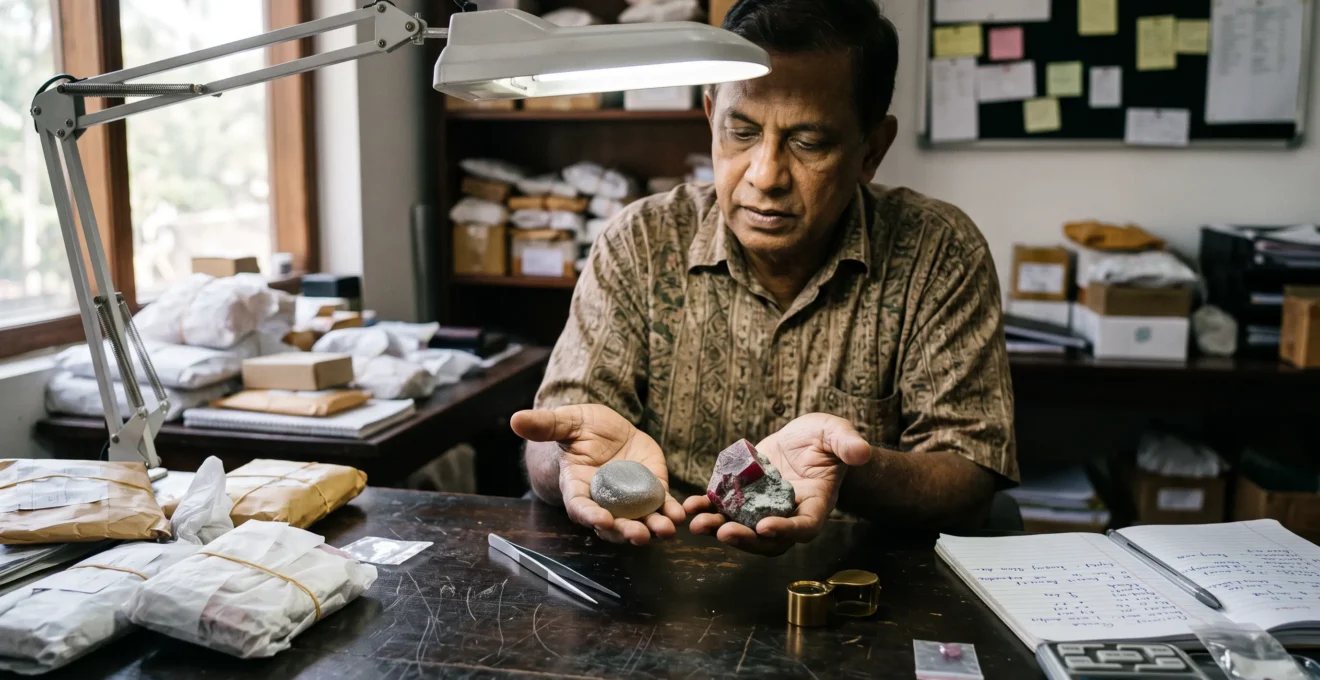
Some gemstone deposits produce remarkable transparent crystals. Others yield large stones crossed by needles, mineral inclusions or healed fractures. The difference begins with geological conditions, but identifying a deposit as primary, hydrothermal, pegmatitic or alluvial does not automatically tell you which outcome to expect.
Primary deposits preserve gemstones near their original formation environment. Alluvial deposits concentrate material released by erosion and transported through sediments. The former can retain complete crystal shapes; the latter may contain naturally sorted, water-worn stones. Neither category guarantees larger, cleaner or more valuable gems.
For collectors, the useful question is not simply which deposit has the best reputation. It is whether the claimed source makes the gemstone’s size, clarity, surface condition and treatment history geologically plausible. That distinction matters when comparing rough stones, evaluating an origin-labelled sapphire or deciding whether a prestigious locality justifies additional verification.
Understanding these patterns also helps distinguish a deposit’s geological potential from its current commercial supply—and a plausible origin description from an origin that has actually been tested.
Gemstone deposit differences at a glance
- Clarity depends on growth history: fluid chemistry, mineral impurities, cooling and later fracturing matter more than a simple primary-versus-alluvial label.
- Large does not mean clean: a crystal may grow to considerable size while preserving inclusions, zoning or structural damage.
- Origin claims need separate verification: laboratory analysis can support geographic attribution, while documented custody is needed to assess a stone’s supply-chain history.
- Why Do Some Deposits Produce « Clean » Gems While Others Almost Always Include Silk and Crystals?
- How to Evaluate a Deposit Claim From a Listing Description Without Getting Fooled
- Primary Rock Deposit vs Alluvial Deposit: Which Origin Tends to Give Better Crystal Shape?
- The Ethical Sourcing Mistake: Trusting a Famous Deposit Name Without Any Chain Evidence
- When Should You Research the Deposit: Before You Browse, After Shortlisting, or Only Before Paying?
- Why Does Geological Environment Decide Whether Gems Grow Large or Stay Tiny and Included?
- Alluvial Pebbles vs Primary Vein Rough: Which Is Better if You Want Predictable Cutting?
- What Does an Alluvial Deposit Do to a Gem’s Surface, and How Can You Read Those Clues?
Why Do Some Deposits Produce « Clean » Gems While Others Almost Always Include Silk and Crystals?
Deposits produce different clarity patterns because gemstones crystallize under different chemical, thermal and structural conditions. Some crystals grow in relatively stable environments with few trapped foreign minerals, while others develop inclusions during crystallization, cooling or later geological events. Slow growth alone does not guarantee transparency, and visible inclusions do not necessarily indicate defective material.
A gemstone records successive stages of its geological history. During growth, it may enclose neighboring minerals or small fluid-filled cavities. Changes in the surrounding fluid chemistry can alter growth patterns, while subsequent fracturing may introduce additional fluids. Cooling can also create inclusions that were not present as separate crystals during the original growth stage.
According to GIA’s scientific article on gemstone inclusions, inclusions may comprise mineral crystals, fluid cavities and structures produced by processes such as exsolution. These different formation mechanisms explain why microscopic features need geological interpretation rather than simple counting.
Rutile silk in sapphire is a useful example. Fine rutile needles can form when titanium-bearing components become less soluble within corundum as it cools. Such needles are not necessarily evidence that the crystal grew rapidly or trapped foreign crystals during its initial formation.
Emeralds illustrate a different inclusion history. Crystals associated with hydrothermal environments may preserve fluid inclusions and neighboring minerals. Colombian emeralds, for example, can contain carbonate minerals, while certain marble-hosted rubies from Mogok may contain calcite. These associations are geological clues, not exclusive identifiers of either locality.
The distinction between primary and secondary features matters when assessing clarity:
- Growth inclusions: minerals or fluids incorporated as the host gemstone crystallized.
- Exsolution features: microscopic phases that develop during later changes in temperature or chemical equilibrium.
- Secondary inclusions: material introduced through fractures or other changes after initial crystal growth.
A deposit can therefore yield eye-clean gems alongside heavily included specimens. Differences in local growth conditions, crystal position and later geological damage can create substantial variation even within the same mining area.
Treatment expectations also depend on the actual inclusion and fracture profile. Heating may modify inclusions in corundum, while emerald fissures may be filled to improve their appearance. However, a deposit’s general reputation for included material is not sufficient evidence that a particular gemstone has been treated.
The practical rule is to examine the individual stone and its treatment disclosure first, then use the claimed deposit to interpret what those observations might mean.
How to Evaluate a Deposit Claim From a Listing Description Without Getting Fooled
A credible deposit claim identifies the gemstone, states the claimed geographic origin clearly and provides evidence appropriate to the stone’s value. A famous mine name, attractive inclusion pattern or seller’s guarantee is not equivalent to laboratory verification. Even a recognized laboratory may be unable to determine origin conclusively when geological evidence overlaps between deposits.
Consider a listing describing a blue sapphire as Kashmir material because it displays fine silk and a soft appearance. Those characteristics may be consistent with certain Kashmir sapphires, but they are not exclusive to that origin.
Plausibility and proof are different questions. A photograph can suggest that a stone deserves closer examination. It cannot establish the entire combination of microscopic, chemical and spectroscopic characteristics needed for a defensible geographic-origin opinion.
GIA’s review of gemstone geographic-origin determination describes how laboratories combine gemological observations with analytical techniques, including trace-element analysis and spectroscopy. The review also explains why overlapping characteristics can prevent a definitive geographic attribution.
For a collector, this changes how a listing should be read.
| Listing statement | What it establishes | Appropriate next step |
|---|---|---|
| « Origin guaranteed » | A seller’s assertion without identified supporting evidence | Request the basis of the guarantee and its written terms |
| « Typical Kashmir silk » | A proposed visual or microscopic resemblance | Ask whether independent origin testing supports the claim |
| « Mogok ruby with certificate » | A claim that documentation exists | Identify the laboratory and inspect the complete report |
| « New deposit discovery » | A commercial or geological claim requiring substantiation | Request locality information and independently verifiable evidence |
| « Origin inconclusive » | Insufficient evidence for a confident attribution | Evaluate the stone without assuming a premium origin |
Several warning signs deserve particular attention: an unusually low asking price for a supposedly exceptional origin, a description that changes when questioned, or an unfamiliar discovery used to explain features inconsistent with published deposit references.
None of these automatically proves deception. They indicate that the buyer should avoid relying on the origin label until the discrepancy is resolved.
A useful cross-check compares the stone’s color, transparency, inclusion characteristics and documented treatments against reliable reference material for the claimed locality. An obvious mismatch should prompt a request for further examination rather than an immediate assumption of fraud.
Five checks before accepting a gemstone deposit claim
- Copy the seller’s exact origin wording into a purchase note; retain a dated screenshot of the listing.
- Request the complete laboratory report, including laboratory name and report number; retain a readable copy.
- Check the report’s details against the physical stone and the issuing laboratory’s available verification service; record any discrepancy.
- Compare the disclosed inclusions, color and treatments with documented deposit characteristics; write down unresolved questions.
- Obtain written confirmation of the claimed origin, treatment status and return conditions before payment; save the seller’s response.
A convincing listing should allow the buyer to separate what the seller believes, what a laboratory has concluded and what remains unverified. That distinction becomes especially important when comparing primary and alluvial material.
Primary Rock Deposit vs Alluvial Deposit: Which Origin Tends to Give Better Crystal Shape?
Primary deposits generally offer the better opportunity to recover crystals with recognizable natural growth faces because the stones remain near their formation environment. Alluvial deposits contain material released from rock and affected by transport, abrasion and natural sorting. However, better preserved crystal shape does not necessarily produce better cutting yield or a cleaner finished gemstone.
A primary deposit contains gemstone crystals within or close to their original geological host. Depending on the formation environment, crystals may preserve terminations, growth faces and structural relationships with the surrounding rock.
For mineral collectors, these features can be highly desirable. An intact crystal attached to its natural matrix may have specimen value independent of its suitability for faceting.
For cutters, preservation introduces a different calculation. A crystal that looks geometrically promising can contain fractures, color zoning or stressed areas near the matrix contact. Its external shape may therefore overstate how much sound material can be recovered.
An alluvial deposit, by contrast, is a secondary concentration of minerals transported and deposited by moving water. Weathering releases crystals from their host rock, after which transport can round edges, remove projecting features and break weaker material.
The surviving stones may no longer show their original crystal habit clearly. Their rounded shapes can nevertheless make them attractive candidates for cutting when examination reveals sufficiently sound interiors.
The geological mechanism is described in GIA’s article on gemstones recovered from sedimentary rocks. Weathering, transport and sedimentary concentration help explain why durable gem minerals accumulate in placer deposits and why fractured material may be reduced during transport.
Natural sorting is selective, not perfect. An alluvial pebble can retain internal fractures, while a primary crystal can contain exceptionally clean and well-proportioned material.
| Characteristic | Primary deposit | Alluvial deposit |
|---|---|---|
| Original crystal faces | May remain intact | Often worn or obscured |
| Host-rock attachment | May be present | Generally absent from transported pebbles |
| Surface condition | May preserve growth features and fresh fractures | May show abrasion and rounding |
| Internal integrity | Requires examination | Requires examination despite natural sorting |
| Potential advantage | Preserved geometry or mineral specimen value | Durable, naturally concentrated cutting material |
The buyer’s priority determines which advantage matters. A specimen collector may prefer preserved crystal faces, while someone purchasing rough for a particular faceted design may value a manageable internal fracture pattern more highly.
Crystal shape describes how material has been preserved and transported. It does not establish geographic provenance, ethical sourcing or the likely quality of every stone within a deposit.
The Ethical Sourcing Mistake: Trusting a Famous Deposit Name Without Any Chain Evidence
A prestigious deposit name is not evidence of responsible sourcing. Geographic-origin testing can support an opinion about where a gemstone formed, but it does not reconstruct every transaction between extraction and sale. Ethical provenance requires appropriate documentation of the supply chain, with particular attention to gaps, intermediaries and unsupported claims about mining conditions.
Names such as Mogok, Kashmir and Ceylon carry commercial significance because buyers associate them with particular gemstone histories or characteristics. Yet a familiar label on an invoice does not independently prove that the stone came from a particular mine, remained segregated from other material or passed through responsible commercial channels.
Trade parcels may be consolidated, split, recut and resold. Each additional transaction creates an opportunity for documentation to become incomplete or disconnected from the individual stone.
Geological origin and chain of custody answer different questions. An origin report concerns the stone’s gemological characteristics and a laboratory’s geographic attribution. Custody documentation concerns who handled the material and how it moved through the market.
The European Commission’s explanation of mineral supply-chain due diligence describes chain of custody as the documentary record of successive custodians. It also explains the broader purpose of identifying and managing risks across mineral supply chains.
For colored gemstone buyers, useful supporting records may include:
- A mine or producing-area declaration identifying the claimed extraction source.
- Dealer invoices that link the material to specific transactions.
- Applicable export and import documents associated with the relevant shipment.
- Consistent stone identifiers, photographs or parcel references across successive records.
- Independent laboratory reports supporting gem identification, treatment status and, when possible, geographic origin.
No individual document automatically proves the entire history. An invoice repeats information supplied during a transaction; an origin report addresses geological attribution rather than the conduct of every business involved.
The distinction also matters legally. The European Union’s Regulation (EU) 2017/821 concerns qualifying importers of specified minerals—tin, tantalum, tungsten and gold—not a universal due-diligence obligation covering every colored gemstone. Other sourcing, disclosure, customs and trading requirements depend on the jurisdiction and transaction.
Collectors should therefore avoid assuming that the existence of conflict-mineral legislation proves that a ruby or sapphire falls within its specific regulatory scope.
The practical risk extends beyond formal compliance. Without adequate traceability, a buyer may be unable to substantiate claims about mining conditions, responsible trading or the identity of the extraction source when later reselling or documenting a collection.
A proportional standard helps. Inexpensive mixed rough may have limited available provenance, making explicit disclosure of uncertainty appropriate. A valuable gem marketed at a premium because of its alleged mine or ethically verified supply chain warrants substantially stronger supporting evidence.
Origin reputation can guide geological expectations, but responsible purchasing depends on the evidence attached to the particular stone and transaction. That evidence is easier to evaluate when research begins before the final payment decision.
When Should You Research the Deposit: Before You Browse, After Shortlisting, or Only Before Paying?
Research gemstone deposits at three stages: learn broad geological patterns before browsing, investigate specific locality claims after shortlisting, and complete stone-level verification before committing to payment. Each stage answers a different question. Early research prevents unrealistic expectations, comparison research identifies inconsistencies, and final verification addresses the evidence supporting the actual purchase.
Waiting until checkout to investigate a deposit is inefficient because the buyer may already have selected a stone based on a compelling origin story. Conversely, trying to master every mining locality before browsing can turn a straightforward purchase into an unnecessary research project.
A staged method balances effort against purchasing risk.
| Stage | Research focus | Decision supported |
|---|---|---|
| Before browsing | Deposit types, inclusion mechanisms, treatments and rough morphology | Recognize implausible generalizations |
| After shortlisting | Claimed locality, comparable material, inclusion profiles and seller documentation | Determine whether the stone deserves further consideration |
| Before paying | Individual examination, laboratory findings, disclosures and transaction terms | Decide whether the remaining uncertainty is acceptable |
Before browsing, the aim is to understand broad relationships rather than memorize locality names. Knowing that alluvial transport rounds crystals, for example, makes it easier to question descriptions that confuse pristine growth faces with water-worn surfaces.
After shortlisting, research becomes more specific. A collector comparing two origin-labelled sapphires should examine the relevant published deposit characteristics and establish which reported properties are genuinely diagnostic—and which occur in multiple localities.
At this stage, the buyer can also request additional photographs, microscopy observations or a treatment disclosure. Doing so before a transaction becomes urgent preserves the option to reconsider.
Before paying, the focus shifts from geological probability to stone-specific evidence. A laboratory report should be assessed for what it actually states, including qualifications or inconclusive findings. The buyer must also decide whether any remaining uncertainty is compatible with the price and intended use.
Several situations justify moving immediately to deeper verification:
- The origin name appears to account for a substantial part of the asking price.
- Photographs or disclosed treatments seem inconsistent with the seller’s explanation.
- The seller describes a rare locality but cannot identify the supporting evidence.
- Documentation is promised only after payment.
- The seller refuses reasonable requests for clarification or changes the origin description.
This method is particularly important for collectors who rely on locality labels to organize collections. A plausible origin should not be silently converted into an established fact within acquisition records.
There is also a limit to what deposit research can achieve. Geological environments are variable, deposits can share characteristics and individual stones may not contain sufficient evidence for geographic attribution.
Once the source claim has been evaluated, the next question is whether the gemstone’s physical size and clarity are consistent with the growth conditions proposed for its deposit.
Why Does Geological Environment Decide Whether Gems Grow Large or Stay Tiny and Included?
Gemstone size depends on crystal-growth space, the availability of suitable chemical components and the conditions maintained during formation. Large crystals can develop where growth continues under favorable circumstances, but size does not guarantee clarity. Mineral impurities, fluid inclusions, growth interruptions and subsequent geological damage can affect crystals regardless of their dimensions.
Crystal growth begins when the physical and chemical environment permits a mineral to crystallize. The eventual size reflects the interaction of several factors, including available material, the number of competing crystals and the duration over which growth remains possible.
Fluid-rich environments may support the movement of elements needed for crystallization. In some pegmatitic systems, relatively large crystals can form where chemical conditions and available space favor continued growth. Hydrothermal systems can also produce significant crystals when suitable conditions persist.
However, neither environment guarantees clean material. Crystals may incorporate inclusions or fluids as they grow, while later cooling or deformation can introduce additional internal features.
Large crystal growth and high transparency are separate outcomes. The geological conditions allowing a mineral to become large need not eliminate the processes that produce inclusions.
Repeated fracturing, changes in fluid chemistry or competing mineral growth can interrupt crystal development. Such disturbances may lead to complex internal structures, although no universal rule allows crystal dimensions to be predicted from geological disturbance alone.
For buyers, it helps to distinguish three observations:
- Crystal size: the dimensions of the original mineral specimen or rough.
- Usable clean volume: the portion that can potentially yield a transparent faceted gemstone.
- Finished size: the remaining material after the cutter removes unsuitable portions and establishes proportions.
A large rough crystal with numerous fractures may offer less useful cutting material than a smaller specimen with a favorable internal structure. Conversely, a large crystal with substantial clear zones may provide several cutting possibilities even if other regions are included.
These differences also help explain market segmentation. Material containing conspicuous inclusions may be suitable for cabochons, especially when its internal features create desirable optical effects. Other rough may be considered for treatments intended to improve appearance, where such treatments are technically appropriate and properly disclosed.
It would nevertheless be inaccurate to infer treatment solely from crystal size or deposit type.
Large, transparent, untreated gems can be particularly desirable when their combination of characteristics is uncommon within the relevant gemstone market. The extent of any price premium depends on the species, quality, treatment status, documented origin and prevailing demand—not on a universal geological pricing formula.
Supply stability introduces another distinction. A historically productive deposit may change as mining reaches different zones, economics shift or extraction becomes more difficult. Earlier reports of exceptional crystals do not establish the dimensions or clarity of material being produced today.
Without recent production records, a collector should not assume that a famous locality continues to supply the same size and quality distribution as in its best-documented historical periods.
Geological growth conditions define what a deposit can produce; inspection determines what a particular crystal actually offers. This becomes especially important when the intention is to commission a cut from rough material.
Alluvial Pebbles vs Primary Vein Rough: Which Is Better if You Want Predictable Cutting?
Alluvial pebbles can offer a practical advantage for cutting because natural transport may have removed some fractured material before recovery. Primary vein rough may preserve more favorable crystal geometry and potentially useful volume. Neither guarantees a predictable result: cutting reliability depends on internal fractures, color distribution, shape and the quality of pre-cut examination.
Predictability should be defined before comparing specimens. For a lapidary, it usually concerns the likelihood that the planned stone can be produced without unexpected fractures, unacceptable color changes or excessive loss of usable weight.
These concerns overlap but should not be treated as identical.
A piece of rough can have a sound interior yet an inconvenient shape. Another can offer excellent geometric possibilities but contain fractures that compromise the intended design. A third may be structurally sound but display color zoning that becomes undesirable after orientation and cutting.
Alluvial sorting offers a conditional advantage. During transport, less durable and heavily fractured fragments may break apart. Surviving pebbles can therefore represent material that has already endured some mechanical selection.
However, water transport does not inspect gemstones according to lapidary standards. A surviving pebble may still contain internal fractures, healed features or color zoning. Its rounded exterior may also require substantial material removal to achieve a particular faceted outline.
Primary vein rough presents the opposite opportunity. Preserved crystal faces can help the cutter identify crystallographic orientation and plan how to use the available geometry. Yet matrix contacts, internal stress and concealed fractures may complicate that plan.
For this reason, the skill and assessment methods of the cutter matter alongside geological origin.
| Priority | Alluvial pebble | Primary vein rough |
|---|---|---|
| Reduced fracture surprises | May benefit from natural sorting; inspection remains necessary | Depends on internal condition and matrix-related damage |
| Maximum usable geometry | Rounded shape may limit some layouts | Preserved faces may support advantageous planning |
| Color consistency | Must be examined individually | Must be examined individually |
| Custom-cut potential | Useful when interior and dimensions suit the design | Useful when geometry and internal integrity support the design |
| Calibrated finished stones | Deposit effect is mostly indirect | Deposit effect is mostly indirect |
A hypothetical example illustrates the trade-off. Suppose a buyer is choosing between a rounded pebble and a sharply formed primary crystal of the same rough weight. The primary crystal might offer an attractive outline for a larger finished design, but a fracture near its attachment zone could reduce the usable volume. The pebble might require more shaping yet contain fewer problematic fractures.
Without internal examination, neither stone can be assigned a reliable cutting yield simply from its deposit category.
Collectors purchasing finished, calibrated gems experience these distinctions indirectly. By the time a stone reaches that market, the cutter has already made decisions about recovery, orientation, proportion and which rough was commercially suitable.
Collectors commissioning custom cuts have more direct exposure. They should request the cutter’s assessment of fractures, proposed orientation and realistic outcome rather than relying on a general promise that alluvial or primary material cuts better.
No universal comparative yield percentage is established by the supplied geological evidence. Any numerical recovery estimate should therefore be specific to the examined rough and intended cutting design.
A useful next step is to examine the rough surface itself, particularly when an alluvial origin is claimed. Surface wear can reveal part of the stone’s transport history, even though it cannot settle every question about its interior.
Key takeaways before inspecting an alluvial gemstone
- Separate the stone’s visible exterior from its internal structure; the two may record different kinds of damage.
- Judge transport-related wear as geological evidence, not as an automatic quality grade.
- Use surface observations to refine questions about cutting risk and source claims, rather than treating them as geographic proof.
What Does an Alluvial Deposit Do to a Gem’s Surface, and How Can You Read Those Clues?
Alluvial transport can abrade gemstone surfaces, round crystal edges and obscure original growth faces. Frosted or pitted textures may develop through mechanical wear and weathering. These features help assess whether a stone’s surface is consistent with transport, but they cannot independently prove a particular deposit or establish whether its interior is free of fractures.
Water transports minerals through sediment, where they may collide with other particles or experience repeated contact with gravel and rock. The resulting mechanical wear depends on the gemstone’s properties and the conditions of transport.
A water-worn gemstone may retain its general crystalline shape while losing sharp edges and small projecting features. Greater transport exposure can contribute to heavier abrasion, but distance alone does not determine how much wear a particular stone displays.
Water energy, sediment composition, mineral durability and previous weathering also influence the final appearance.
Several features are worth examining:
- Rounded edges: corners and crystal terminations may have been worn away.
- Frosted surfaces: fine-scale abrasion or weathering may reduce surface transparency.
- Pits and irregularities: these may reflect weathering, mechanical damage or other geological processes.
- Worn growth faces: original crystal geometry may survive only as a partial outline.
- Surface scratches: visible marks should be considered in context, because handling and later processing can also alter the exterior.
The most important buying distinction is between superficial wear and fractures extending into the interior. A pebble can have an unattractive, abraded surface while preserving useful transparent material beneath it. Another can appear similarly worn but contain cracks that limit its cutting potential.
To assess that difference, inspect the stone under suitable lighting and magnification. Diffused or transmitted light may reveal internal structures where the material is sufficiently transparent. When appropriate for the mineral and its condition, immersion examination can help reduce surface reflections and make some internal features easier to observe.
For a collector examining rough remotely, photographs under both reflected and transmitted light can provide different information. Surface-focused images show abrasion and shape; suitable backlighting may reveal zoning and some internal structures. Neither replaces a professional examination when significant value is involved.
Surface observations also help test a seller’s geological description. Rounded, abraded material is consistent with certain alluvial histories. A stone described as heavily water-worn but displaying exceptionally fresh, undamaged crystal faces deserves clarification.
That apparent inconsistency is not conclusive. A gemstone may experience limited transport, may come from sediment close to its primary source, or may preserve parts of its original shape. Some material described commercially as alluvial may also have a more complicated recovery history than the label suggests.
The same caution applies when estimating cutting yield. Surface abrasion has already removed some original crystal material, but it does not mean that all subsequent cutting losses have been accounted for.
A rounded pebble must still be oriented, shaped and polished. Internal inclusions, color zoning and the intended finished proportions can all influence the amount of rough removed.
When comparing primary and alluvial rough of equal stated weight, ask whether each stone has been examined internally and whether a proposed cutting layout exists. The weight alone does not indicate which one will produce the larger finished gemstone.
Price comparisons should reflect the observable condition of each specimen, the information available about its interior and the uncertainty surrounding potential yield. A worn exterior may be compatible with valuable material, but natural sorting is not a guarantee against hidden damage.
Before buying origin-labelled rough, request photographs that reveal the surface and interior, confirm the disclosed treatments and obtain a qualified examination when the value warrants it. Record what the deposit evidence suggests—and what remains unknown—so the purchase rests on the particular stone rather than the reputation of its source.
Can a gemstone’s inclusions identify its exact mine?
Usually not on their own. Certain inclusions are associated with geological environments, but similar features can occur in gemstones from different locations. Laboratory geographic-origin determination may combine microscopy, chemical analysis and spectroscopy. Even with these methods, a precise attribution can remain inconclusive, and a broad geographic opinion does not necessarily identify an individual mine.
Does an eye-clean gemstone become less credible when its claimed deposit is known for inclusions?
No. A deposit with a reputation for included stones can also produce unusually transparent specimens. Eye-clean appearance describes what is visible under normal viewing conditions, not the absence of all microscopic inclusions. Exceptional clarity may justify closer examination when a significant origin premium is involved, but it does not automatically contradict the claimed source.
Does a laboratory origin report prove that a gemstone was ethically mined?
No. Geographic-origin reports evaluate gemological evidence concerning where a gemstone formed. Ethical sourcing requires separate information about extraction conditions, custody, trading practices and relevant supply-chain risks. A laboratory origin opinion and documented chain of custody can complement each other, but neither should be represented as proof of something it does not examine.
Can an alluvial gemstone still contain serious internal fractures?
Yes. Natural transport can break down some weak or heavily fractured material, but surviving gemstones may still contain internal damage. A rounded or frosted pebble should be examined for fractures and other structural features before cutting. Natural sorting is a geological tendency, not a guarantee of usable cutting material.
Can a famous gemstone deposit guarantee a steady supply of large, clean stones?
No. Historical discoveries demonstrate what a deposit has produced, not necessarily what current mining can deliver. Production may change with mining location, available resources, extraction conditions and commercial circumstances. Claims about present-day availability or consistent size and clarity require current deposit-specific evidence rather than reputation alone.