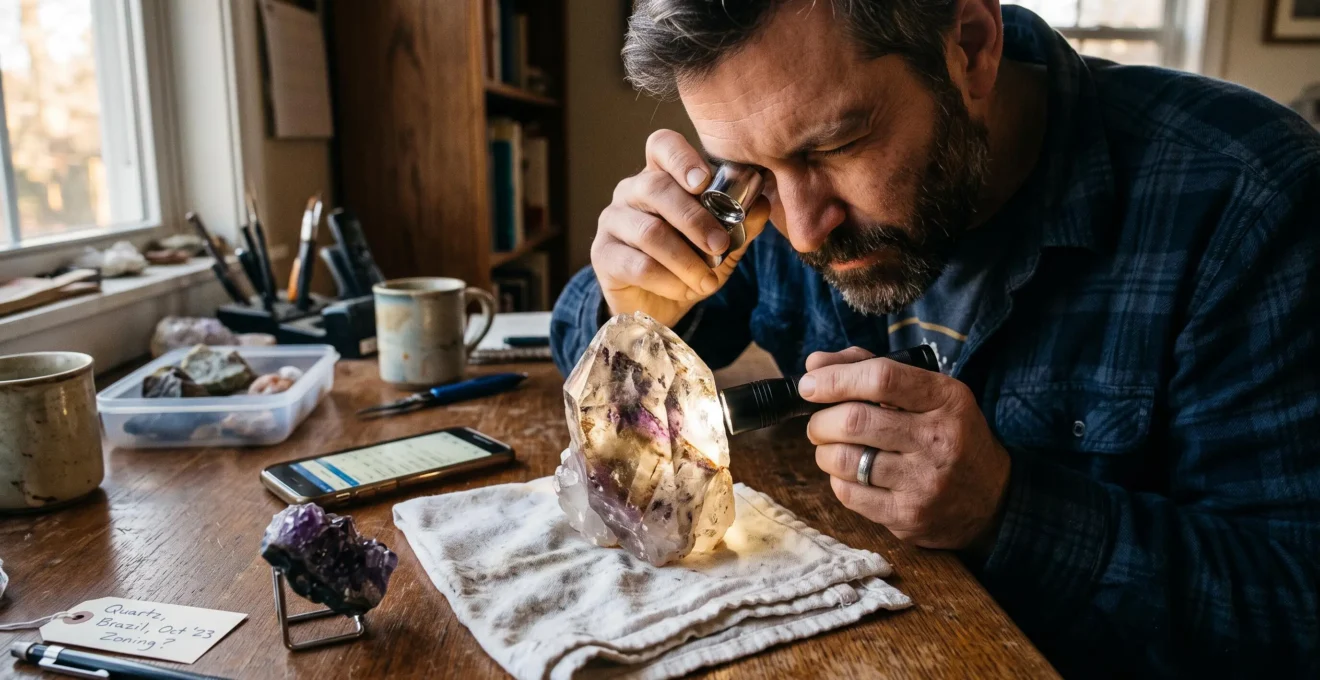
A quartz cluster with perfectly pointed crystals and a rounded pebble of the same mineral may have very different geological histories. One could have grown into an open cavity from mineral-rich fluids; the other might have crystallised within an igneous rock, then been broken, transported and worn smooth. The mineral name alone does not tell the whole story.
Fortunately, five visible clues can help reconstruct how a specimen formed: internal growth zoning, crystal shape, the arrangement of crystals in a cluster, inclusions, and neighbouring minerals or matrix. A phone torch, a jeweller’s loupe and a little patience are enough to begin investigating.
The aim is not to identify a precise mine or establish a laboratory-grade verdict. It is to distinguish plausible magmatic, pegmatitic, hydrothermal and metamorphic origins while recognising when later weathering, damage or treatment has altered the evidence. The most reliable interpretation comes from combining several observations rather than trusting one attractive feature.
Mineral formation: the essential clues
- Look inside first: angular colour zoning, internal phantoms and inclusion patterns can preserve evidence of crystal growth.
- Examine the outside: crystal habit, attachment surfaces and cluster orientation help distinguish growth in rock from growth in open spaces.
- Check the neighbours: associated minerals and original geological context often provide stronger evidence than crystal size or colour alone.
- Why Do Some Crystals Show Sharp Growth Bands While Others Look « Smooth » Even Under Magnification?
- How to Infer Hydrothermal vs Magmatic Growth From Crystal Shape Using a 3-Step Check?
- Pegmatite vs Hydrothermal Vein: Which Origin Fits Your Quartz Cluster More Often?
- The Beginner Error of Confusing Iron Staining With Primary Growth Features
- When Should You Photograph and Measure a Specimen During Prep So You Don’t Lose Key Formation Clues?
- Why Does Geological Environment Decide Whether Gems Grow Large or Stay Tiny and Included?
- Why Are Fluid Inclusions Common in Hydrothermal Gems, and When Are They a Red Flag?
- Which Geological Environment Most Likely Produced Your Gem, Based on Its Most Common « Neighbours »?
Why Do Some Crystals Show Sharp Growth Bands While Others Look « Smooth » Even Under Magnification?
Sharp growth bands develop when a crystal’s growing environment changes, sometimes altering the concentration of colouring elements or the arrangement of internal defects. Crystals that appear uniformly coloured may have grown under comparatively consistent conditions, or their original zoning may be too subtle to see. Some have also undergone later alteration or recrystallisation. Visible bands are evidence of variation, not an automatic identification of origin.
Imagine a crystal growing in a mineral-bearing fluid. As the surrounding chemistry changes, newly deposited material may differ slightly from earlier layers. These differences can create straight, angular or hourglass-shaped zones that preserve successive growth stages. Comparable zoning can occur during crystallisation from melts, so the pattern must be interpreted alongside the mineral species and geological setting.
Begin with a simple examination. Place a translucent specimen against a soft light source, such as a phone torch, and rotate it slowly. Look for boundaries that appear to run through the crystal rather than across its surface. A 10× jeweller’s loupe may reveal additional detail, although many internal structures require specialised microscopy.
Band geometry can also matter when investigating whether a gemstone is natural or laboratory-grown. The Gemological Institute of America‘s comparison of natural and laboratory gemstone growth explains that flame-fusion synthetic ruby and sapphire commonly show curved growth striae or colour bands. Natural corundum generally exhibits more angular zoning.
This distinction is especially relevant to corundum produced by the flame-fusion method. It is not a universal rule for quartz, beryl or every synthetic gemstone. Laboratory-grown crystals can reproduce features that resemble natural growth, and an apparently smooth interior does not establish authenticity.
Record whether zoning is straight, angular, curved, irregular or absent. Note whether the boundaries follow the crystal’s geometry. Avoid turning a single band into a geological verdict.
Once the internal structure has been examined, the next useful evidence lies on the crystal’s outer faces and attachment surfaces.
How to Infer Hydrothermal vs Magmatic Growth From Crystal Shape Using a 3-Step Check?
Crystal shape can suggest whether a mineral grew from a cooling melt or from mineral-rich fluids, but it rarely distinguishes those environments on its own. A well-formed crystal may develop in either setting. The more informative combination is crystal habit, surface details and evidence of attachment, particularly whether the specimen grew freely into an open space or was surrounded by other minerals.
Magmatic crystals form during the cooling and crystallisation of molten rock. Their shapes depend on the mineral’s internal structure, available space, cooling history and competition with neighbouring crystals. Some develop clear crystal faces; others become irregular where growth is restricted.
Hydrothermal minerals crystallise from fluids carrying dissolved components. Where a fracture or cavity provides open space, crystals can grow with distinct terminations. A cavity lined with small, projecting crystals is commonly described as drusy.
Use the following three-step examination to collect evidence rather than force an immediate answer.
- Inspect the overall habit. Look for blocky forms, elongated prisms, skeletal outlines or irregular intergrowths. Record the shape without assuming that elongation means hydrothermal growth or that blockiness means magmatic growth.
- Study faces and edges. With a loupe and oblique light, look for growth striations, sharp terminations, dissolution marks and broken surfaces. Distinguish original faces from damage wherever possible.
- Examine the base. Look for an attachment point, surrounding host rock, a cavity lining or minerals intergrown with the specimen. This context may be more informative than the visible termination.
A quartz crystal projecting from a fracture wall is consistent with growth into an open space. Quartz embedded among feldspar and mica in a coarse-grained rock suggests a different setting. Yet both situations can produce sharply formed crystals.
Later dissolution can modify faces, twinning can complicate geometry, and breakage can remove original terminations. A detached crystal without matrix is particularly difficult to interpret confidently.
Shape becomes a stronger hint when its growth relationship to the surrounding rock is preserved. Without that context, it remains a descriptive observation requiring corroboration.
For quartz clusters, the next question is whether their arrangement and companion minerals favour a pegmatite or a hydrothermal vein.
Pegmatite vs Hydrothermal Vein: Which Origin Fits Your Quartz Cluster More Often?
A quartz cluster is more suggestive of pegmatitic origin when it remains associated with coarse feldspar, mica and other characteristic pegmatite minerals. A cluster attached to a fracture surface, with crystals growing into an open space alongside calcite or sulphides, may favour a hydrothermal vein. Neither crystal size nor orientation alone proves either origin, because both settings can produce large, well-formed quartz.
Pegmatites are exceptionally coarse-grained igneous rocks, often associated with granitic systems. Their mineral assemblages and internal zoning can preserve the history of crystallisation. The USGS geological report on pegmatite deposits in Idaho documents quartz, feldspar and mica as principal constituents, with minerals such as tourmaline and beryl occurring in some deposits.
Hydrothermal veins form when mineral-bearing fluids move through fractures and deposit minerals. Crystals growing into open fractures may produce comb-like arrangements, with elongated crystals projecting away from the fracture walls.
The comparison below gives useful starting points, not universal identification rules.
| Observation | Pegmatitic setting | Hydrothermal vein |
|---|---|---|
| Typical surrounding material | Coarse quartz, feldspar and mica | Fracture-filling quartz with variable host rock |
| Possible companion minerals | Tourmaline, beryl and other pegmatite minerals | Calcite, pyrite and other sulphides |
| Crystal arrangement | Intergrown masses or crystals in pockets | May show aligned, comb-like growth into fractures |
| Crystal size | Can be very large | Can also be large |
| Most useful surviving evidence | Original coarse-grained matrix and mineral associations | Fracture geometry, attachment surfaces and vein minerals |
Start by checking whether several crystals share a common growth direction. If they point into a preserved fracture opening, a vein interpretation becomes more plausible. If quartz is intergrown with coarse feldspar and mica, investigate a pegmatitic setting.
Next, examine the size distribution and any layered growth. Small secondary crystals covering larger ones, including so-called cactus quartz textures, can record later mineral deposition. These textures do not independently identify a pegmatite or vein.
Finally, inspect the matrix. A cluster sold without its original host rock may have lost the most useful evidence. A reliable locality record can therefore be more valuable than a particularly attractive crystal habit.
Hydrothermal fluids may also operate during or after pegmatite formation. Consequently, one specimen can preserve more than one stage of mineral growth. Fluid inclusions can occur in quartz from different environments, and their abundance alone is not a reliable separator.
Even a promising interpretation can be undermined if later surface staining is mistaken for a feature formed inside the crystal.
The Beginner Error of Confusing Iron Staining With Primary Growth Features
Reddish, orange, yellow or brown material on a crystal may be iron-rich staining deposited after its original growth rather than evidence of the conditions in which it crystallised. Primary growth features, by contrast, develop during crystal formation. The key distinction is where the feature sits and how it relates to the crystal, not simply its colour.
Iron-bearing minerals such as hematite and goethite can produce conspicuous colours on mineral surfaces and within fractures. Some deposits form during later weathering or fluid circulation. Iron-bearing particles can also be incorporated during crystal growth, so it would be incorrect to classify every reddish feature as secondary staining.
Begin with a careful visual examination. Surface coatings may follow exposed faces, pits and cracks. Internal colour zones can follow crystallographic growth boundaries, while phantoms may preserve outlines of earlier crystal surfaces beneath later transparent growth.
A phantom is particularly interesting because it can show where a crystal temporarily stopped growing or acquired a layer of foreign material before further growth enclosed that layer. Unlike a simple external coating, the outline remains within the specimen.
Do not scrape an unfamiliar specimen to test whether a colour is superficial. Scraping can damage crystal faces, and neither wiping nor ordinary household cleaning reliably identifies the material.
A misleading orange fracture in quartz
In a documented gemmological examination, researchers found a quartz specimen with a fracture filled with orange and yellow resin designed to imitate natural iron oxide staining.
Microscopic observations revealed features of the manufactured filling, including incomplete filling and trapped gas bubbles. The case demonstrates that colour within a fracture is not sufficient evidence of either natural iron oxides or a particular formation history.
The case is described in GIA’s case study of manufactured inclusions in gemstones. It is a useful reminder that treatments and artificial features can imitate natural geological textures.
Iron-rich surface coatings may indicate that a specimen experienced later alteration, potentially including weathering near the surface. But their presence alone cannot establish how deep the crystal originally formed or whether its initial environment was magmatic or hydrothermal.
Because cleaning can remove coatings and associated minerals, the safest next step is to document the specimen in its present condition.
When Should You Photograph and Measure a Specimen During Prep So You Don’t Lose Key Formation Clues?
Photograph and measure a mineral specimen before its first cleaning, cutting, tumbling or chemical treatment. The unaltered specimen may retain delicate crystal surfaces, matrix contacts, associated minerals and staining that reveal its geological history. Once these features are removed, photographs and locality notes may become the only surviving record of how the crystal was attached or what surrounded it.
Begin with an overall photograph showing the entire specimen against a neutral background. Include a ruler for scale and take views from several directions. Photograph the underside and any broken surfaces, not just the most attractive crystal faces.
Use side lighting to make face striations, terminations and surface textures easier to see. For translucent specimens, a phone torch behind the crystal may help reveal colour zoning or larger inclusions. These photographs are observational records, not substitutes for microscopy.
Preparation methods can remove different types of evidence. Acid treatments may dissolve calcite associated with quartz. Tumbling can round sharp edges and erase fine surface details. Heating can modify inclusions or create fractures, depending on the mineral and conditions. Even vigorous brushing may detach delicate drusy crystals.
If the specimen was collected directly from a rock exposure, record its original position and orientation. Note whether crystals pointed into a cavity or were embedded in solid rock. If it was purchased, retain the seller’s locality information, but distinguish a documented locality from an unverified label.
Five actions to preserve your specimen’s formation evidence
- Photograph the entire uncleaned specimen from at least three angles; save an overview image set.
- Photograph crystal terminations and surfaces under side lighting; save a close-up showing visible growth features.
- Backlight translucent areas and record any visible zones or inclusions; save a labelled internal-feature photograph.
- Measure the specimen and photograph its attachment base with a ruler; create a dimensions and matrix record.
- Record locality, known host rock, associated minerals and any planned preparation; attach a dated specimen label or digital note.
A brief photographic record can also prevent later confusion between a naturally weathered surface and damage caused during preparation. If water immersion is considered to reduce reflections, first establish that the specimen and its associated minerals are water-safe; some minerals are soluble or fragile.
With those details preserved, crystal size and clarity can be considered as additional, though less decisive, clues about the growth environment.
Why Does Geological Environment Decide Whether Gems Grow Large or Stay Tiny and Included?
Geological environment influences crystal size because minerals need suitable chemistry, time, space and a continuing supply of their constituent elements to grow. Pegmatites and some hydrothermal cavities can produce unusually large crystals where favourable conditions persist. Rapid crystallisation or restricted growth space may produce smaller crystals, but size and clarity are not reliable measures of growth speed by themselves.
In a cooling magma, minerals crystallise as conditions change. If many crystals form close together, their growth may be restricted by neighbouring grains. In certain pegmatitic environments, the combination of chemical composition, volatile-rich residual material and favourable growth conditions permits exceptionally coarse crystals.
Hydrothermal cavities offer another route to large crystals. Mineral-bearing fluids can deposit material onto growing crystal faces over successive episodes. Where space remains available, crystals may develop prominent terminations and substantial dimensions.
Inclusions complicate the picture. A crystal may trap tiny mineral particles, fluid or melt during growth. Later fracturing and healing can introduce additional inclusion patterns. A specimen that appears cloudy may contain many microscopic inclusions, internal fractures or other features that cannot be distinguished reliably with the unaided eye.
Consider two hypothetical quartz specimens. One is a large, transparent crystal with a clean termination. The other is a small, cloudy crystal attached to a dense cluster. It would be tempting to assign the first to slow pegmatitic growth and the second to rapid hydrothermal growth. Yet both could have formed within different parts of a hydrothermal system.
Similarly, large crystals may contain abundant inclusions, while small crystals may be exceptionally clear. Growth rates can vary within a single pocket, and inclusion abundance depends on more than growth speed.
The useful question is therefore not simply whether a gemstone is large or eye-clean. Ask whether its size and clarity fit the growth relationships already suggested by its matrix, zoning and crystal arrangement.
Some of the most informative details are microscopic pockets of trapped material, particularly when they preserve evidence of fluids involved in mineral formation.
Why Are Fluid Inclusions Common in Hydrothermal Gems, and When Are They a Red Flag?
Fluid inclusions occur in many hydrothermal gemstones because crystals grow from mineral-bearing fluids and can trap tiny portions of those fluids as they develop. Some inclusions contain liquid and a gas bubble, while others preserve more complex mixtures. Their presence can support an interpretation involving fluid activity, but fluid inclusions alone do not prove natural hydrothermal origin or establish whether a gemstone has been treated.
As a crystal grows, small irregularities or changes at its growth surfaces may enclose fluid. After trapping, changes in temperature and pressure can affect the inclusion’s internal phases. A liquid-filled cavity may therefore contain a visible bubble when examined under suitable magnification.
Occasionally, a relatively large, fluid-filled cavity may show a moving bubble as the specimen is gently repositioned. Such specimens are sometimes described as enhydro quartz. Do not heat or shake a specimen to make a bubble move; inclusions and their host crystals can be damaged.
The relationship between inclusions and crystal structure is more informative than their mere presence. Inclusions associated with growth zones may record conditions during crystal formation. Trails of inclusions crossing earlier growth structures can indicate later fracturing and healing.
However, a fingerprint-like pattern does not automatically prove a particular origin. Natural gemstones, laboratory-grown materials and treated stones can display overlapping microscopic features.
Research documented in the USGS study of hydrothermal quartz and fluid inclusions identified multiple generations of quartz and characterised fluid-inclusion assemblages in the Stibnite-Yellow Pine district of Idaho. The researchers used specialised methods, including microthermometry and Raman spectroscopy, to investigate these histories.
This illustrates why professional examination can reveal geological events that ordinary visual inspection cannot separate.
Potential warning signs in a gemstone include conspicuous surface-reaching fractures, unusual material along fractures, or internal features that appear inconsistent with the claimed identity. These observations justify closer examination, not an immediate conclusion that a stone has been filled, heated or manufactured.
Laboratory-grown hydrothermal gems may contain fluid-related inclusions, while treatments can create or modify fracture features. A professional gemmological assessment may be needed to distinguish these possibilities.
The strongest final interpretation emerges when these internal observations are compared with the minerals and rock that originally surrounded the specimen.
Key takeaways before identifying your specimen’s origin
- A preserved matrix can outweigh a striking crystal shape because it records the geological setting in which minerals grew together.
- Several compatible clues provide a stronger interpretation than one feature, especially when later growth or alteration may have occurred.
- If the original host rock and locality are missing, record uncertainty rather than assigning an origin from appearance alone.
Which Geological Environment Most Likely Produced Your Gem, Based on Its Most Common « Neighbours »?
The minerals surrounding a gemstone often provide the strongest accessible clue to its formation environment. Quartz intergrown with coarse feldspar and mica may indicate a pegmatite; quartz associated with calcite and sulphides in a fracture may indicate a hydrothermal vein; and garnet or corundum within a schistose metamorphic rock may suggest metamorphic growth. The full mineral assemblage and its geological relationships matter more than any single neighbour.
Minerals form under particular combinations of temperature, pressure, chemistry and fluid availability. Different geological environments therefore produce characteristic, although overlapping, mineral associations.
For example, feldspar, quartz and mica commonly occur together in granitic and pegmatitic rocks. Calcite and sulphide minerals may accompany hydrothermal quartz. Garnet may develop during metamorphism as existing rocks respond to changing temperature and pressure.
The matrix also reveals how minerals relate to one another. A crystal enclosed by metamorphic foliation tells a different story from a crystal projecting into an open fracture, even when the two specimens share a similar shape.
If the matrix has been removed, look for remnants attached to the base, impressions left by neighbouring crystals, and surviving contact surfaces. These may retain clues to former mineral associations. Photographs taken before cleaning can be especially valuable.
The following table brings together the five main clues. It provides a framework for judging which origin is more plausible, rather than a definitive identification key.
| Clue | What to observe | What it may reveal |
|---|---|---|
| 1. Growth zoning | Angular bands, phantoms or changes in internal colour | Changes during crystal growth, without uniquely identifying the environment |
| 2. Crystal shape | Habit, terminations, striations and attachment points | Growth conditions and possible open-space crystallisation |
| 3. Cluster structure | Crystal alignment, intergrowth and cavity relationships | Possible vein growth, pocket growth or multiple crystallisation episodes |
| 4. Inclusions | Fluid pockets, mineral inclusions and cross-cutting trails | Trapped growth materials or later geological events |
| 5. Neighbouring minerals | Feldspar, mica, calcite, sulphides or metamorphic matrix | Evidence supporting pegmatitic, hydrothermal or metamorphic settings |
To reach a provisional conclusion, first identify the strongest contextual clue: a preserved rock matrix, an original fracture surface or a credible collecting locality. Then compare the other observations with that interpretation.
If a quartz cluster has coarse feldspar and mica attached, a pegmatitic origin is reasonable to investigate. If it preserves aligned growth into a fracture alongside calcite and sulphides, a hydrothermal-vein interpretation may be stronger. If the specimen sits within a foliated metamorphic rock, investigate whether its growth is related to metamorphism.
Confidence should increase when several independent observations agree. It should decrease when evidence is missing, contradictory or potentially altered by cleaning, weathering, cutting or treatment. A single specimen may also record successive geological events rather than one simple formation process.
Where the evidence remains ambiguous, reliable locality information, examination of the host rock or professional mineralogical analysis is the appropriate next step. An origin story should reflect the evidence actually available.
Choose one specimen from your collection, photograph its five clues and write a short origin hypothesis identifying both the supporting evidence and what remains uncertain. Preserve that record with the specimen label; it will make future comparisons and expert identification considerably more useful.
Can you identify a mineral’s geological origin without knowing where it was found?
Sometimes you can identify a plausible formation environment from crystal relationships, matrix and associated minerals. However, a precise origin or locality usually cannot be established from appearance alone. Detached, cleaned or polished specimens are particularly difficult because important contextual evidence may be missing.
Does a perfectly shaped crystal mean it formed slowly?
No. Well-developed crystal faces reflect the mineral’s crystal structure and the conditions under which it grew, including available space and competition with neighbouring crystals. Growth rate is only one influence. Both magmatic and hydrothermal environments can produce sharply formed crystals.
Can a crystal record more than one geological formation event?
Yes. A crystal may preserve successive growth zones, later mineral overgrowths, dissolution surfaces, healed fractures or secondary inclusions. These features can represent different stages in its history. Distinguishing them accurately may require microscopic or laboratory examination.
Is a jeweller’s loupe enough to identify natural versus synthetic gemstones?
A loupe can reveal useful features, but it is not sufficient for reliable identification in every case. Natural and laboratory-grown gemstones may share similar zoning and inclusions. Some synthetic growth methods produce particularly recognisable patterns, while other distinctions require professional gemmological instruments.
What should you do if a specimen has already been cleaned and its matrix removed?
Inspect the remaining attachment surface, look for small matrix remnants or impressions, and preserve any original photographs, labels or collecting records. Record the five visible clues that remain, but avoid reconstructing missing evidence from assumptions. A documented locality or comparison with verified specimens may help narrow the possibilities.