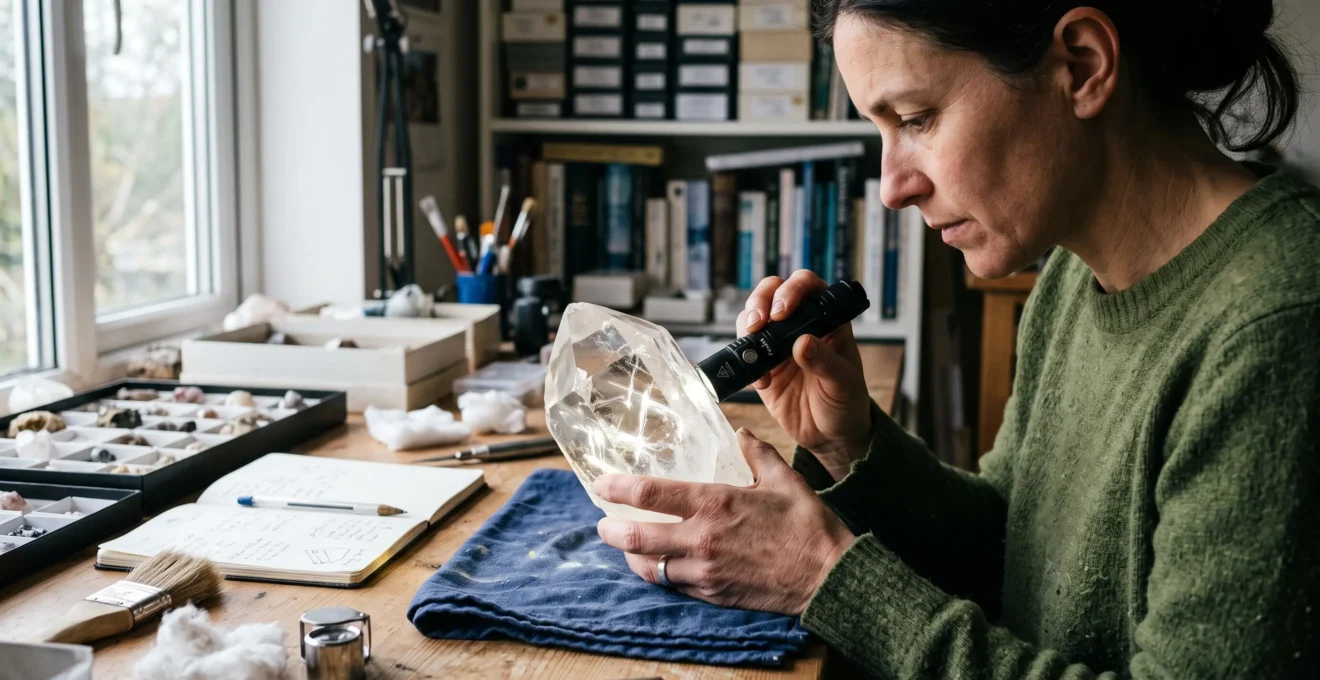
A crystal may form more than 2,000 megapascals (MPa) underground and still chip when dropped onto a kitchen worktop. Another specimen may withstand years of ordinary handling despite growing in a comparatively low-pressure environment. The difference is not simply how much pressure either crystal experienced during formation.
Formation pressure determines which mineral structures can develop and remain stable, but it does not directly measure a specimen’s resistance to breaking. Once a crystal reaches the surface, its behaviour depends on atomic bonding, cleavage, existing fractures, crystal shape, mineral associations and the forces applied to it.
For collectors and beginning lapidaries, that distinction matters more than an impressive geological origin. A dense garnet embedded in metamorphic rock, an exposed quartz cluster and a transparent topaz crystal present different handling problems even when all three look perfectly solid.
The practical aim is to recognise those problems before cleaning, shipping, cutting or setting a specimen, rather than discovering a hidden weakness when the damage has already occurred.
Crystal durability: three rules worth remembering
- Hardness is not toughness: a mineral that resists scratching may still split along a cleavage plane.
- High formation pressure is not a durability rating: mineral species, crystal structure and existing damage matter more for everyday handling.
- Inspect before applying force: identify the mineral, look for fractures and vulnerable projections, then choose cleaning, packaging and setting methods accordingly.
- Why Does Your Crystal Crack During Cleaning Even If It “Looks Solid”?
- How to Spot Pressure-Formed Toughness Clues in 60 Seconds When Buying a Specimen?
- High-Pressure Metamorphic vs Low-Pressure Hydrothermal Crystals: Which Typically Handle Shipping Better?
- The One Handling Mistake That Snaps Cleavable Minerals After a 10-Minute Car Journey
- In What Order Should You Cut, Preform, and Set a Fragile Crystal to Avoid a Last-Minute Break?
- Which Formation Process Produced Your Mineral, Based on 5 Visible Clues You Can Check at Home?
- Why Do Some Crystals Show Sharp Growth Bands While Others Look “Smooth” Even Under Magnification?
- Why Are Most Gem Minerals Silicates, and Why Does That Matter for What You’ll Find at Shows?
Why Does Your Crystal Crack During Cleaning Even If It “Looks Solid”?
A crystal can crack during gentle cleaning because its surface hardness says little about its resistance to fracture. Hidden cleavage planes, pre-existing cracks and temperature-sensitive inclusions can concentrate stress when a specimen is brushed, knocked or exposed to sudden temperature changes. Identifying the mineral and its vulnerabilities is more reliable than judging strength by appearance.
Hardness measures resistance to scratching; toughness concerns resistance to breaking and chipping. These properties are not interchangeable. The Gemological Institute of America explains this distinction in GIA’s explanation of gemstone hardness and toughness, which also identifies stability as a separate component of gemstone durability.
Consider diamond. Its Mohs hardness of 10 makes it exceptionally resistant to scratching, yet its crystallographic cleavage creates directions along which it can split. GIA reports comparative diamond toughness values of approximately 5,000 erg/cm² along cleavage directions and more than 8,000 erg/cm² in a stronger direction. These are orientation-dependent values, not a universal breaking-pressure threshold.
By contrast, nephrite’s interlocking microstructure contributes to exceptional toughness despite its lower scratch hardness. Its durability illustrates why internal structure matters more than a single Mohs number.
Many brittle minerals contain planes of comparatively weak atomic bonding. An existing crack can also concentrate stress at its tip, allowing a small applied force to extend the fracture. Grain boundaries in aggregates, and local stresses around inclusions, introduce additional variables.
A sudden temperature difference introduces another risk. Placing a cold specimen directly into warm water can create uneven expansion, particularly where different minerals, inclusions or fractures occur together. This does not mean all metamorphic crystals are thermally unstable: their individual histories and material properties determine the risk.
Before cleaning a transparent or translucent specimen, hold a small light near its edge and observe it from several directions. Reflective internal surfaces, cloudy fracture-like features or abrupt changes in transparency may justify closer examination. A torch cannot reliably identify every cleavage plane or microscopic crack, and a healed fracture is not automatically an active weakness.
Use a conservative cleaning decision based on mineral identity:
- Known cleavage or visible damage: avoid scrubbing, ultrasonic cleaning and abrupt temperature changes; consider dry dust removal first.
- Mineral confirmed water-safe: use water at a stable temperature and a soft brush only where the specimen’s condition permits.
- Unknown or potentially water-sensitive mineral: postpone wet cleaning until its chemical stability and associated minerals are identified.
A specimen’s safest cleaning method begins with its mineral properties, not its apparent solidity. The same principle applies when deciding whether a crystal is worth buying.
How to Spot Pressure-Formed Toughness Clues in 60 Seconds When Buying a Specimen?
A 60-second inspection can reveal obvious handling risks, although it cannot establish a crystal’s formation pressure or measure its toughness. Check the crystal’s overall shape, examine its faces for growth features, and shine light through accessible edges to look for internal discontinuities. Combine those observations with the mineral’s known cleavage and the seller’s provenance information.
Begin with the specimen’s habit: its characteristic three-dimensional growth form. A compact crystal or massive aggregate may have fewer exposed projections than a slender needle, thin plate or fragile cluster. That can reduce some mechanical risks, but it does not prove that the compact specimen formed under greater pressure or has stronger atomic bonding.
A practical inspection follows three short steps:
- Observe the silhouette. Look for unsupported points, narrow connections, thin plates and crystals projecting beyond their matrix. These are locations where accidental contact can apply damaging leverage.
- Check the faces. Use oblique light to reveal growth striations, chips, uneven surfaces or possible repairs. Growth lines provide morphological information but are not automatically fractures.
- Inspect accessible edges. Shine a phone light through translucent areas and rotate the specimen gently. Note reflective planes, inclusions or fracture-like patterns without assuming their precise identity.
The Australian Museum‘s mineral properties reference distinguishes crystal habit, cleavage and tenacity as separate characteristics. That distinction prevents a common error: treating an elongated habit, sharp growth lines or high transparency as a direct measure of toughness.
A compact garnet in rock may be easier to handle than a delicate projecting crystal simply because less material is exposed. Conversely, a compact specimen with a significant internal fracture may be less dependable than an intact slender crystal. Geometry and existing defects must be assessed alongside mineral identity.
Ask the seller where the specimen was found, whether it came from a vein, cavity or metamorphic host rock, and how it was extracted. Careful hand extraction and blasting may expose specimens to different damage mechanisms, although extraction method alone cannot establish their present condition. Ask directly about glue, reconstructed points and stabilisation treatments.
Some crystals contain healed fractures formed during their geological history. Such features can contain fluid inclusions and reveal earlier episodes of damage and mineral growth. Their presence does not necessarily imply that the specimen is mechanically unsafe today.
When the species, provenance and condition are uncertain, treat the crystal as fragile until better evidence becomes available. This is especially valuable when the specimen must survive shipping.
High-Pressure Metamorphic vs Low-Pressure Hydrothermal Crystals: Which Typically Handle Shipping Better?
Neither high-pressure metamorphic nor lower-pressure hydrothermal crystals consistently handle shipping better. Metamorphic specimens may occur in compact, supportive rock, while hydrothermal specimens may form exposed clusters on fragile matrices. However, both environments produce minerals with widely varying cleavage and fracture behaviour. Shipping risk depends primarily on specimen geometry, existing damage and packaging.
Metamorphic minerals form as rocks respond to changes in pressure, temperature and chemical conditions. Hydrothermal minerals crystallise from fluids circulating through fractures, cavities and other geological environments. Hydrothermal activity is not necessarily low-pressure: some hydrothermal systems operate at substantial depths and pressures.
Consider a garnet enclosed within a dense metamorphic rock. Its host may support much of the crystal, leaving relatively little material exposed to contact. Compare that with a cluster of long quartz crystals attached to a narrow base. Even though quartz lacks cleavage, unsupported projections can snap when subjected to bending or impact.
The reverse situation is equally possible. A metamorphic specimen may contain fissures, weakened grain boundaries or vulnerable crystal projections, whereas a robust hydrothermal quartz crystal may travel without damage when suitably protected.
The useful distinction is therefore practical rather than geological.
| Handling criterion | Compact specimen or dense matrix | Exposed cluster or delicate matrix |
|---|---|---|
| Primary concern | Impacts, internal fractures and movement inside the container | Bending, contact with projections and matrix breakage |
| Supporting material | Rock may provide protection when structurally sound | Porous or thin matrix may offer limited support |
| Packaging approach | Restrain the specimen with cushioning that prevents movement | Support the base and keep projections clear of packaging surfaces |
| Inspection priority | Hidden fractures and existing damage | Attachment points, unsupported tips and loose crystals |
| Geological limitation | Compactness does not establish high-pressure origin | Delicate geometry does not establish low-pressure origin |
For a solid loose crystal, use a separate padded container that limits movement without exerting damaging pressure. For a fragile cluster, support the specimen at mechanically suitable points, usually involving its stable base or matrix. A custom cavity or mount can keep vulnerable projections away from the box walls. Do not suspend a heavy specimen by a fragile crystal or attachment.
Vibration is relevant because repeated movement can create contact, rubbing or small impacts. Yet no general evidence establishes that metamorphic minerals tolerate a particular duration of vibration better than hydrothermal minerals. Existing flaws and packaging geometry remain more useful predictors.
Some minerals require additional precautions unrelated to toughness. Halite is water-soluble, while moisture-sensitive minerals or unstable mineral associations may deteriorate under unsuitable storage conditions. Individual zeolite species also require identification rather than a blanket assumption that all respond identically to humidity.
Once a specimen is restrained appropriately, the remaining concern is how its crystal structure responds to unintended contact. Cleavable minerals deserve particular attention during even short journeys.
The One Handling Mistake That Snaps Cleavable Minerals After a 10-Minute Car Journey
The critical mistake is allowing a cleavable crystal to move freely inside a rigid container. During a car journey, the specimen can strike the walls or other contents, applying localised forces to vulnerable directions. A short trip is not automatically damaging, and vibration alone does not guarantee fracture, but poorly restrained crystals face an avoidable risk.
Cleavage occurs because certain crystallographic planes separate more readily than others. Calcite, fluorite, topaz and spodumene have well-known cleavage properties, although their cleavage orientations and relative ease of separation differ.
A rigid plastic box might appear protective. However, if a crystal can slide or bounce inside it, road irregularities may cause contact between the specimen and its surroundings. A small impact near a pre-existing crack or cleavage plane can initiate breakage without a dramatic collision.
Repeated contact can also cause progressive chipping or damage. It would be misleading, however, to claim that a specific ten-minute journey necessarily produces measurable fatigue along cleavage planes: the provided geological sources do not establish such a time-dependent failure threshold.
The practical solution is restraint without excessive compression. Position the crystal in suitable cushioning, eliminate empty space that permits movement, and keep separate specimens from touching one another. Fine projections should not bear the weight of the surrounding padding.
Orienting an identifiable cleavage plane away from likely contact points can be sensible, but simply placing that plane diagonally to a box wall does not guarantee protection. What matters is preventing damaging forces from acting on the crystal, particularly at vulnerable edges and projections.
Quartz and garnet lack cleavage, so cleavage-related splitting is not their main concern. Both can still fracture under impact, especially where inclusions, cracks or thin projections are present. They should not be transported loose merely because they lack recognised cleavage planes.
Five checks before transporting a fragile crystal
- Identify the mineral: record the species and its known cleavage behaviour on a specimen label.
- Inspect existing damage: photograph any visible cracks, chips or repaired areas before packing.
- Support vulnerable geometry: make a simple sketch showing which faces or matrix areas can safely contact cushioning.
- Secure the specimen: close its individually padded container and confirm that gentle handling produces no detectable internal movement.
- Check after arrival: compare the specimen with the original photograph and record any newly visible damage.
Packaging prevents many avoidable accidents, but cutting and setting introduce forces that cushioning cannot remove. Those operations need a different kind of planning.
In What Order Should You Cut, Preform, and Set a Fragile Crystal to Avoid a Last-Minute Break?
For a fragile crystal, establish the mineral’s identity, fracture condition and cleavage orientation before selecting a final cutting design. Orient the rough material, preform it cautiously, cut and polish with controlled pressure, then select a setting compatible with its vulnerabilities. Designing the setting first can create unnecessary mechanical risks during the final stage.
The starting point is a careful examination of the rough. Identify visible fractures, inclusions, cleavage directions and potential areas of internal weakness. For a valuable specimen, a qualified gemmologist or experienced lapidary may be needed to assess features that cannot be resolved with basic tools.
A practical working sequence is:
- Examine and document the rough. Record its species, dimensions, inclusions and visible damage, including photographs from several orientations.
- Plan the orientation. Consider cleavage, usable material, intended shape and the locations that will experience cutting or setting pressure.
- Preform conservatively. Remove material gradually, maintain suitable support and avoid forcing thin edges against abrasive equipment.
- Complete cutting and polishing. Use techniques appropriate to the specific mineral, controlling pressure and temperature while watching for new damage.
- Select and complete the setting. Position the finished stone so exposed edges and pressure-sensitive areas receive suitable protection.
Topaz has pronounced basal cleavage, while spodumene varieties such as kunzite also have cleavage that demands care. Their orientation during cutting and the forces applied during setting can influence breakage risk.
Prong settings concentrate holding forces at particular contact points. A poorly positioned or over-tightened prong may therefore damage a vulnerable gemstone. A bezel setting can protect the perimeter and distribute contact over a broader area when correctly designed, but it still introduces stress during fabrication and tightening. A bezel is not automatically safer if it applies excessive force.
Round, oval and cushion designs generally avoid the exposed sharp corners associated with pointed shapes. For some brittle or cleavable materials, this can reduce handling and setting vulnerabilities. However, an apparently protective outline cannot compensate for an unfavourable cleavage orientation or an internal fracture.
There is also a yield trade-off. Aligning the rough to minimise risk may produce a smaller finished stone than orienting it solely for maximum carat weight. For an inexperienced cutter, preserving a sound gemstone is often more useful than recovering the last possible fraction of material.
Before transferring a specimen to a lapidary, provide labelled photographs showing known cleavage directions and suspicious features. Those records create a practical reference when choosing the preform and discussing where setting pressure should be applied.
Good cutting decisions also depend on recognising how the mineral developed. Its shape, host rock and associated minerals can provide useful geological clues before the first abrasive touches the surface.
Which Formation Process Produced Your Mineral, Based on 5 Visible Clues You Can Check at Home?
Five observations can help narrow down a mineral’s possible formation environment: crystal habit, growth markings, host rock, surface texture and associated minerals. None is definitive on its own. Combining several observations with a reliable species identification can support a geological hypothesis, which should then be checked against documented occurrences and formation environments.
Crystal habit is the first clue. Metamorphic garnets commonly occur as relatively equidimensional crystals within rock, while quartz can develop elongated prisms in open cavities and veins. Yet the same mineral may form in several environments, and unusual habits do not prove unusual formation pressures.
Growth striations provide a second clue. Parallel lines on crystal faces may reflect changes in growth conditions, crystallographic development or repeated additions of material. Their direction and appearance can help distinguish particular crystal forms, but cannot independently establish pressure or temperature.
The remaining clues place the crystal in geological context:
- Host rock: schist or gneiss can support a metamorphic interpretation, while mineral-lined cavities or veins may suggest fluid-assisted growth. The rock must be correctly identified.
- Surface texture: well-developed faces may indicate growth into available space, whereas granular intergrowths or recrystallised textures can reflect different histories. Weathering and damage may later alter the surface.
- Mineral association: accompanying minerals may reveal a shared geological environment, provided the association is natural rather than an assembled or repaired specimen.
As an explicitly hypothetical example, consider a garnet embedded in a foliated rock with other metamorphic minerals. The host texture and mineral association together would support a metamorphic origin more strongly than garnet shape alone. An isolated loose garnet, without provenance or host-rock evidence, would permit fewer conclusions.
By comparison, quartz projecting into an open cavity with other vein minerals may support hydrothermal growth. However, quartz also occurs in igneous and metamorphic rocks, so crystal shape alone cannot establish its history.
The Open University‘s introduction to minerals and rocks describes mineral structures, geological formation processes and high-pressure mineral occurrences. One example is stishovite, a high-pressure form of silica stable at pressures above approximately 7.5 gigapascals (GPa) under the conditions discussed.
2,000 MPa = 2 GPa
This is a pressure magnitude, not a crystal toughness rating. Pressure stability in the Earth’s interior cannot be converted into an individual specimen’s resistance to impact or cleaning.
Geological context: The Open University’s mineralogy course.
High-pressure stability and surface durability describe different properties. A mineral structure may be stable under extreme geological conditions without being mechanically resistant to impact after extraction and cooling.
For a home assessment, combine at least two independent clues and compare them with a documented mineral occurrence using a reference such as Mindat or a museum collection record. If provenance is absent, retain alternative explanations instead of assigning an exact pressure or depth.
These observations become more informative when combined with features inside the crystal. Growth zoning can preserve part of the specimen’s history, although it also has important interpretive limits.
Why Do Some Crystals Show Sharp Growth Bands While Others Look “Smooth” Even Under Magnification?
Visible growth bands form when differences in chemistry, impurities or growth conditions become recorded in successive crystal zones. A crystal without obvious bands may have grown under comparatively uniform conditions, may contain subtle zoning that requires specialised examination, or may have undergone later changes. Band visibility alone does not establish growth speed or mechanical strength.
During crystallisation, the surrounding melt or fluid can change in composition, temperature or other conditions. Trace elements and defects may become incorporated differently as growth proceeds, producing zones with contrasting colour, fluorescence or inclusion patterns.
Amethyst provides familiar examples of visible colour zoning. Some specimens contain sharply defined purple regions, while others appear relatively uniform. These differences can reveal variations in growth conditions, but sharp regular bands do not automatically mean the crystal grew slowly or under stable conditions.
Growth features also require careful classification. Surface striations are not identical to internal colour zoning, and neither is necessarily a fracture. A visible boundary between two growth zones may represent a compositional change without being mechanically weak.
To inspect a specimen at home, first use a small light at a shallow angle across its exterior faces. This can reveal surface markings and variations in texture. Then, for transparent or translucent crystals, place the light behind the specimen to examine internal colour zoning and inclusions.
Rotate the specimen carefully and distinguish features that change with viewing angle from those that remain fixed within the crystal. Note whether a line appears to terminate at an inclusion, coincide with a fracture-like surface or extend through successive regions of colour.
GIA’s scientific discussion of gemstone inclusions, described in its 2022 publication, explains that fractures can develop after crystallisation and may later heal in the presence of fluids. Small fluid inclusions can remain along those healed zones, preserving evidence of the crystal’s geological history.
However, a healed fracture is not automatically dangerous. Its mechanical significance depends on the actual material and condition, and internal appearances observed with a torch are not sufficient for a definitive assessment.
A smooth-looking crystal may contain microscopic inclusions or deformation features invisible under ordinary magnification. Conversely, obvious growth zoning may be structurally sound. Growth bands provide clues about formation, not a direct durability score.
Formation history becomes especially useful when combined with mineral chemistry. At a mineral show, recognising the dominant chemical families helps narrow down what a specimen might be and which properties deserve closer inspection.
Key takeaways before buying a gem mineral
- Use chemical family to narrow identification, but check the individual species for cleavage and stability.
- Do not equate geological abundance with the proportion, quality or price of specimens offered at a particular show.
- When deciding between attractive specimens, prioritise verified identity, existing damage and intended use over appearance alone.
Why Are Most Gem Minerals Silicates, and Why Does That Matter for What You’ll Find at Shows?
Many familiar gem minerals are silicates because silicate minerals dominate the Earth’s crust and occur across numerous geological environments. Quartz, feldspars, garnets, topaz and zircon all belong to this broad family. Their abundance helps explain their importance to collectors, but it does not mean most stones at every gem show are silicates or that silicates share similar toughness.
Silicate minerals are constructed around silicon-oxygen tetrahedra, commonly represented as SiO4 structural units. Depending on the mineral, these units occur as isolated groups, chains, sheets or three-dimensional frameworks, with other elements linking or occupying positions within the structure.
The Open University describes silicates as making up more than 90% of the Earth’s crust. Feldspars alone account for approximately 60% in the crustal composition discussed. These figures concern geological abundance, not the proportion of commercial gem-quality stones or mineral-show inventory.
Silicate structures differ substantially in mechanical behaviour. Garnet and quartz lack crystallographic cleavage, whereas topaz, feldspars and spodumene possess characteristic cleavage directions. All can fracture, but they do so under different conditions.
The distinction matters when handling specimens at a show. A quartz point may need protection against impact at its termination; a feldspar specimen may require extra attention to cleavage; and a garnet cluster may have weak attachments or fractured matrix even though the individual garnets lack cleavage.
Common non-silicate gem materials also include corundum, an oxide; calcite, a carbonate; and apatite, a phosphate. Their properties vary considerably. Corundum is highly scratch-resistant, calcite has pronounced cleavage, and apatite can be vulnerable to scratching and impact.
Non-silicate gems are not universally rarer, more expensive or less durable than silicates. Availability and price depend on species, quality, locality, market demand and specimen condition. A mineral fair may also specialise in particular materials, making its inventory unrepresentative of the Earth’s mineral proportions.
A useful shopping comparison begins with species rather than family alone.
| Mineral | Chemical family | Main handling consideration |
|---|---|---|
| Quartz | Silicate | No cleavage; protect projecting points and pre-existing fractures |
| Garnet | Silicate | No cleavage; assess cracks and matrix attachments |
| Topaz | Silicate | Pronounced basal cleavage; avoid concentrated forces |
| Feldspar | Silicate | Cleavage directions and existing damage require attention |
| Corundum | Oxide | High scratch hardness does not eliminate fracture risk |
| Calcite | Carbonate | Pronounced cleavage and sensitivity to inappropriate chemical cleaning |
| Apatite | Phosphate | Protect against scratching, chipping and impacts |
Combining the chemical family with the species, host rock, habit and visible condition provides a more dependable starting point than any single characteristic. A specimen’s formation environment can refine that assessment, but it cannot replace direct evidence of its mechanical vulnerabilities.
At the next mineral show, select one specimen and document its species, chemical family, cleavage, visible damage and intended use before purchasing. That short record provides a defensible basis for deciding how to clean, transport or set it without assuming that geological pressure guarantees strength.
Does a crystal become stronger after forming at 2,000 MPa?
Not necessarily. A formation pressure of 2,000 MPa, equivalent to 2 GPa, influences which mineral structures can form or remain stable under particular geological conditions. It does not establish the specimen’s resistance to scratching, cleavage or impact after extraction. Mineral structure, defects, orientation and applied forces determine its mechanical response.
Can a crystal without cleavage still break?
Yes. Quartz and garnet lack characteristic crystallographic cleavage, but both can fracture. Existing cracks, inclusions, exposed points and strong localised impacts can cause breakage. The absence of cleavage removes one type of preferred splitting direction; it does not make a mineral unbreakable.
Can a phone flashlight prove that a crystal has no hidden fractures?
No. A phone flashlight can reveal some reflective surfaces, colour zones and inclusions in sufficiently translucent material. Very small fractures, unfavourably oriented features or discontinuities inside opaque crystals may remain invisible. Important specimens may require professional examination using appropriate magnification and illumination.
Is a healed fracture as dangerous as an open crack?
Not automatically. A healed fracture records an earlier break that underwent some degree of mineral sealing or regrowth. Its present mechanical significance depends on the extent and characteristics of that healing and the surrounding crystal. Visual evidence of healing alone cannot establish how much force the specimen will withstand.
Should collectors avoid ultrasonic cleaners for every crystal?
No single cleaning rule applies to every mineral specimen. Ultrasonic cleaning can be unsuitable for cleavable, fractured, treated, porous or otherwise sensitive materials. If the mineral identity, internal condition or associated matrix is uncertain, avoid ultrasonic cleaning and choose a more conservative method appropriate to the confirmed material.