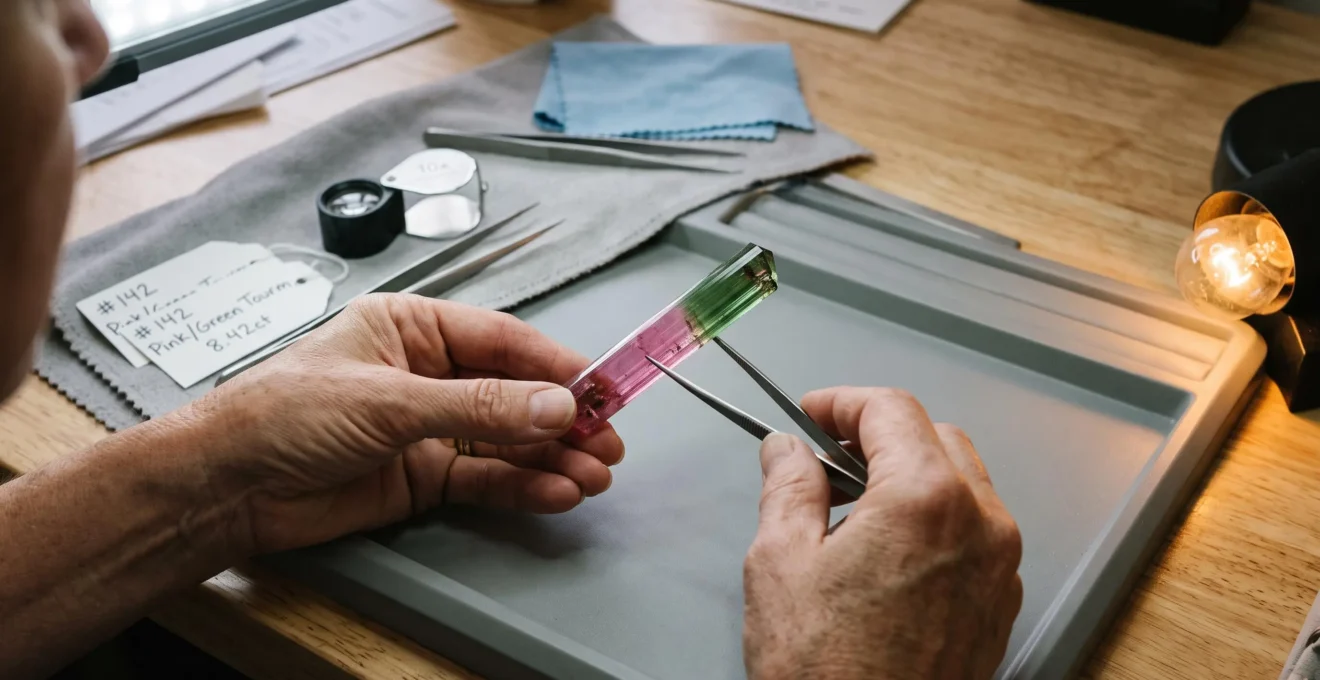
Medium-toned green and blue-green tourmalines are often the most practical visual choices for everyday rings. They can offer recognisable colour without the near-black appearance of overly dark stones or the faintness of poorly saturated material. A well-selected pink tourmaline can perform equally well visually, provided its treatment history and colour stability are understood.
Colour alone, however, does not determine durability. Tourmaline measures 7–7.5 Mohs on the Mohs hardness scale, yet its resistance to chipping is only fair. A beautiful stone with an exposed edge or a surface-reaching fracture can therefore become a disappointing daily-wear choice, whatever its colour.
The real buying decision combines tone, saturation, cutting orientation, treatment disclosure and setting protection. These factors also explain why a tourmaline that looks electric under a jeweller’s spotlight may appear muted in an ordinary room. Choosing the right individual stone matters far more than relying on a variety name or a seller’s photograph.
Tourmaline for everyday wear: the essentials
- Best visual starting point: medium-toned, well-saturated green, blue-green or pink tourmaline, checked under more than one light source.
- Best durability strategy: sound girdle edges, no problematic surface-reaching fractures and a setting that protects vulnerable areas.
- Best treatment approach: documented untreated or heat-treated material offers clearer stability expectations than tourmaline with an uncertain irradiation or filling history.
- Why Does Tourmaline Vary So Much in Colour Even Within the Same Crystal?
- How to Choose Tourmaline for a Ring Using 4 Checks That Predict Chipping Risk
- Watermelon Tourmaline vs Solid-Colour Tourmaline: Which Looks Better in a Small Setting?
- The Disclosure Mistake: Buying Ultra-Vivid Tourmaline Without Asking One Key Treatment Question
- When Should You Photograph Tourmaline to Capture True Colour: Before Setting or After?
- Emerald-Look Tourmaline vs Peridot: Which Gives a Cleaner Green in Daylight for Under £300?
- Spinel vs Garnet: Which Is the Better Choice for a Ring You’ll Wear 300+ Days a Year?
- Which ‘Semi-Precious’ Stones Are Actually Best for Daily Wear If You’re Clumsy or Busy?
Why Does Tourmaline Vary So Much in Colour Even Within the Same Crystal?
Tourmaline varies in colour because its chemical composition can change as a crystal grows. Elements such as iron, manganese, copper and chromium influence the colours produced, while their distribution can create distinct zones within one crystal. Strong pleochroism adds another variable: the same material may look lighter, darker or differently coloured depending on the viewing direction.
Tourmaline belongs to a complex mineral group rather than representing one chemically uniform gemstone. Small differences in composition can produce greens, blues, pinks, reds and combinations of several colours. During crystal growth, changing chemical conditions may create layers or regions with different appearances.
These zones do not always follow the same geometry. Some run along the crystal’s length, while others develop across it. Watermelon tourmaline commonly displays a pink centre surrounded by green material, particularly when viewed in an appropriately oriented slice.
According to GIA’s tourmaline quality factors, both colour zoning and strong pleochroism influence how cutters orient finished stones. Cutting can deliberately favour a direction that produces a lighter or darker face-up appearance.
Cutting orientation changes perceived colour, not the underlying chemical identity of the stone. A gem that appears strongly saturated face-up can reveal less attractive tones when tilted. This is why two stones from the same crystal can look surprisingly different without either having been treated.
For a practical comparison, inspect a candidate under diffuse daylight and a warm incandescent source. Rotate it gently and view it from at least two orientations. Look for areas that become excessively dark, unexpectedly pale or visually uneven.
Colour depth also affects how easily inclusions are noticed. A richly coloured tourmaline may conceal liquid inclusions that would be obvious in a lighter stone. Conversely, visible uniformity is not proof of treatment: naturally uniform tourmalines exist.
Once colour has been assessed from several directions, the next priority is physical integrity. An attractive face-up colour cannot compensate for a vulnerable edge in a ring intended for frequent wear.
How to Choose Tourmaline for a Ring Using 4 Checks That Predict Chipping Risk
Four checks help identify a tourmaline that may be vulnerable to chipping: inspect the girdle, examine points and corners, assess how the setting protects the stone, and identify inclusions or fractures reaching its edges. These checks cannot predict an exact failure rate, but they reveal weaknesses that a hardness rating alone will miss.
Tourmaline has a Mohs hardness of 7–7.5, which provides useful resistance to everyday scratching. Its toughness is a different matter. The Gemological Institute of America classifies it as fair, meaning that resistance to breaking and chipping deserves specific attention.
The distinction matters because hardness measures scratch resistance, not survival after impact. The GIA’s explanation of gemstone durability beyond Mohs hardness separates hardness, toughness and environmental stability as three different properties.
Use the following four-point inspection before committing to a ring stone:
- Inspect the girdle at 10× magnification. Look for existing chips, abraded facet junctions and unusually thin areas. Ask the jeweller to explain anything suspicious before the stone is mounted.
- Examine the culet, corners and pointed ends. Pear and marquise cuts require particular attention at their points. Rectangular cuts with sharp corners can also expose vulnerable areas unless their settings provide protection.
- Assess the setting against actual impact exposure. A well-designed bezel, partial bezel or protective prong arrangement can shield edges. Tourmaline does not need to be treated as though it has the perfect basal cleavage of topaz; its fair toughness and possible fractures are sufficient reasons for protection.
- Check inclusions near the girdle. Liquid inclusions and internal feathers are not automatically disqualifying, but a fracture reaching a vulnerable edge deserves closer professional assessment.
Of these checks, the condition of the girdle is particularly useful during a pre-setting inspection. Existing edge damage can become a starting point for further damage after an impact, although there is no reliable universal figure showing how frequently this occurs.
A round or oval tourmaline with adequate girdle thickness can be a practical choice because it avoids sharp points. That is a design preference, not a guarantee: a poorly proportioned oval may still be more vulnerable than a carefully protected rectangular stone.
For someone working at a desk, incidental contact with hard surfaces may be the primary concern. A person handling equipment, lifting objects or regularly working with their hands faces different risks. Removing the ring during impact-prone activities can be more valuable than choosing a marginally harder gemstone.
Five checks to complete before buying a tourmaline ring
- Request an inspection of the girdle and visible facet edges under 10× magnification; obtain written confirmation of any observed chips or their absence.
- Examine the stone under diffuse daylight and warm indoor lighting; keep two comparable photographs showing its appearance.
- Ask whether any fractures or inclusions reach the girdle; retain the seller’s written description of their condition.
- Confirm which edges and corners the proposed setting will protect; obtain a photograph or drawing of the mounting design.
- Request written treatment information and any available independent gemological report; retain the documents with the purchase receipt.
A ring stone should be judged for both optical appeal and physical condition. That becomes especially important when colour zoning influences the shape and size of the gem.
Watermelon Tourmaline vs Solid-Colour Tourmaline: Which Looks Better in a Small Setting?
Solid-colour tourmaline is usually the easier choice for a small everyday ring because its colour remains visually recognisable across a limited face-up area. Watermelon tourmaline can be more distinctive, but a small setting may not display enough of its pink and green zones. The result depends heavily on crystal orientation, cutting and the amount of light reaching the gem.
Watermelon tourmaline combines contrasting colour regions within one stone. Its appeal comes from seeing those regions together, particularly when the boundary between them is attractive and clearly presented.
The geometry becomes challenging at small sizes. If the colour boundary occupies only a narrow part of the finished gem, one colour may dominate. Some watermelon crystals show radial zoning, with a pink centre and green outer region, while others exhibit different arrangements. Consequently, no single cut shape is universally best.
A suitable rectangular or other deliberately oriented cut can sometimes give the colour transition more room. A round or oval can also display zoning successfully when the original crystal permits it. The decisive factor is the actual face-up result, not the cut name.
For a small ring, a solid medium-toned green or blue-green stone often offers greater visual consistency. It can remain recognisably coloured without requiring the viewer to distinguish two separate zones.
Watermelon stones may appear less balanced when a mounting shades one part of the gem. A pink area that looked lively under strong display lighting may become relatively faint beside a darker green region. A solid-colour stone can also darken in a restrictive setting, but it does not have the additional challenge of maintaining a visible colour boundary.
| Buying consideration | Watermelon tourmaline | Solid-colour tourmaline |
|---|---|---|
| Small everyday ring | Depends on clearly visible zoning | Usually easier to assess at a glance |
| Visual character | Contrasting colour regions | One dominant hue |
| Cut orientation | Critical for displaying the transition | Important for tone and pleochroism |
| Setting choice | Requires attention to light reaching both zones | Requires attention to overall colour depth |
| Replacement after damage | Matching a distinctive pattern can be difficult | A close visual match may be easier to find |
| Best practical use | Larger or carefully planned statement pieces | Compact rings intended for frequent wear |
A sharp, well-positioned transition may add desirability to an individual bicolour gemstone. Nevertheless, there is no universal pricing rule: size, clarity, colour quality and the actual pattern all influence the assessment.
Replacement is another consideration. If a distinctive watermelon stone is damaged, reproducing its particular colour arrangement may be difficult. A buyer who values a precise matching appearance should discuss repair and replacement expectations before purchase.
Neither variety is inherently tougher because of its colour arrangement. The next distinction concerns how that colour originated and whether it has been modified.
The Disclosure Mistake: Buying Ultra-Vivid Tourmaline Without Asking One Key Treatment Question
Before purchasing unusually vivid tourmaline, ask: “Has this stone been heated, irradiated or coated, and can you document its treatment history?” Also ask whether any fractures have been filled. Colour intensity alone cannot establish whether a gem is untreated, while certain enhancements can affect care requirements, colour stability or value.
Tourmaline’s natural colour range is remarkably broad. A vivid blue-green or intense pink stone is not automatically treated, just as a softer-coloured stone is not automatically untreated. Appearance provides a reason to investigate, not a diagnosis.
Heating and irradiation are especially relevant. Heat treatment can modify the colour of some tourmalines, including lightening overly dark material. GIA describes colour changes produced by heat treatment as stable, although excessive subsequent heat can still damage the gemstone or alter its appearance.
Irradiation may create or intensify pink and red colours. Unlike colour changes resulting from heating, irradiation-induced colour can sometimes fade through exposure to heat or bright light. That does not mean every pink or red tourmaline will fade.
These distinctions are explained in GIA’s tourmaline care and cleaning guide, which also confirms that tourmaline is generally stable under normal light exposure.
Copper-bearing tourmalines require particular care in buying descriptions. Strongly saturated blue-to-green stones may be marketed as Paraíba-type material, but colour alone does not verify copper content, geographical origin or treatment status. Fine copper-bearing tourmalines occur in Brazil, Mozambique and Nigeria, and origin may have significant commercial implications.
Fracture filling and surface coatings raise different concerns. Materials used to conceal fractures or modify appearance can introduce additional sensitivity to heat, chemicals or cleaning procedures. However, these treatments should not be assumed to be common in every tourmaline variety, and their presence cannot be reliably determined from ordinary product photographs.
For any tourmaline, avoid ultrasonic and steam cleaning. GIA recommends warm, soapy water instead. This precaution applies generally, even when no filling or coating has been identified.
For buyers in the United States, the Federal Trade Commission‘s Jewelry Guides establish treatment-disclosure expectations when an enhancement is non-permanent, requires special care or significantly affects value. The FTC guidance on gemstone treatment disclosures explains these conditions.
United Kingdom buyers should also request clear written descriptions, but US guidance should not be mistaken for UK legislation. Across English-speaking markets, the practical rule remains the same: a listing that says nothing about treatment has not established that a gemstone is untreated.
If a seller cannot explain the treatment history of an expensive stone, an independent gemological report may be appropriate. Even then, some enhancements can be difficult to identify conclusively, so the report’s precise wording matters.
Once treatment information has been recorded, photography provides another useful safeguard: it preserves evidence of how the actual stone looked before its setting changed the viewing conditions.
When Should You Photograph Tourmaline to Capture True Colour: Before Setting or After?
Photograph tourmaline both before and after setting. The loose-stone image records its appearance before the mounting influences incoming light, while the finished-ring image documents the colour the wearer will actually see. Use consistent lighting, camera settings and colour references so differences between the photographs are meaningful rather than caused by photography itself.
For the initial record, place the loose stone on a neutral background under diffuse daylight or a controlled daylight-balanced light source. Avoid harsh direct sunlight, strong reflections and automatic image processing that exaggerates saturation.
Direct sunlight does not inherently bleach an untreated tourmaline during a brief photograph. The concern is that intense illumination, glare and camera exposure choices can produce an unrepresentative image.
Photograph the stone face-up and, where useful, at an angle that reveals its zoning or pleochroism. Include a neutral grey reference card so a photographer or gemologist can compare the colour under more consistent conditions.
Record the date and connect the images to the stone’s purchase documentation or gemological report number. A dated photograph cannot prove that the stone was untreated, but it can help establish the documented appearance of that particular gem.
The second photograph should show the completed ring under similar lighting. Metal colour, the amount of exposed pavilion and the mounting’s geometry can all influence the apparent colour.
Yellow gold can create a warmer overall impression, while white metals may produce a cooler visual context. These are perceptual effects rather than permanent chemical changes to the tourmaline.
A closed-back setting can reduce the light entering through the pavilion, making some dark or strongly zoned stones appear darker when worn. The effect is a property of the mounting and illumination, not evidence that the stone itself has faded.
Comparing the two photographic records helps reveal whether the setting preserves the intended face-up appearance. If the difference is substantial, inspect the ring in person before accepting it, rather than assuming the discrepancy can be corrected through editing.
These records also have practical value for insurance and replacement discussions. Tourmalines can vary considerably in hue, saturation and zoning, so carat weight and a general colour description may be insufficient to identify a close visual replacement.
Photographs should supplement, not replace, a suitable valuation or gemological document. Lighting and camera reproduction are never perfectly objective, and an image alone cannot establish treatment history.
With an accurate record of appearance, buyers can compare neighbouring green gemstone options more fairly, including alternatives that may offer greater size or clarity within a limited budget.
Emerald-Look Tourmaline vs Peridot: Which Gives a Cleaner Green in Daylight for Under £300?
For a budget under £300, green tourmaline is worth prioritising when the goal is a deeper, less yellow green, particularly if a slightly smaller stone is acceptable. Peridot is an attractive alternative for buyers who prefer a lively yellow-green and may want a larger, cleaner-looking gem. Neither species guarantees a particular colour appearance or size at that price.
The expression “emerald-look” describes a visual preference rather than a gemological variety. A green tourmaline may approach the cooler appearance associated with some emeralds, especially when its hue has a blue-green component. Other green tourmalines lean towards olive, yellow or brown.
Peridot’s characteristic yellow-green appearance is associated with iron in its composition. Its colour can look especially appealing under daylight, but the perceived balance between green and yellow depends on the actual stone and the illumination.
It would be misleading to claim that all peridot becomes flat under warm indoor lighting or that every green tourmaline maintains an identical hue under changing conditions. Compare candidates under the lighting in which the jewellery will be worn most often.
Budget affects the decision. Peridot is generally available in eye-clean material and can offer an appealing combination of size and clarity within a 300 £ budget. Fine, strongly saturated green tourmaline may involve a compromise in size, clarity or both at the same spending limit.
The £300 threshold should be treated as a shopping budget, not as a verified market price boundary. Carat weight, cut quality, treatment information and whether the amount includes a completed ring setting all change what can reasonably be purchased.
| Criterion | Green tourmaline | Peridot |
|---|---|---|
| Typical colour direction | Green, sometimes blue-green or olive | Distinctive yellow-green |
| Mohs hardness | 7–7.5 | 6.5–7 |
| Clarity and size at a modest budget | May require a compromise for stronger colour | Often offers good clarity and size |
| Common treatment consideration | Heating may modify colour | Typically sold untreated |
| Practical ring concern | Chipping and exposed edges | Abrasion, chipping and setting protection |
| Best visual preference | Deeper or cooler green | Fresh yellow-green |
Tourmaline’s greater hardness offers some advantage against scratching, but that does not establish that every tourmaline is tougher than peridot under impact. Individual stone condition, internal features and mounting design remain important.
Peridot’s usual lack of colour enhancement can appeal to buyers who want a straightforward natural-colour purchase. Tourmaline buyers should ask whether heating or another treatment has been applied rather than presuming a green stone is untreated.
If the ring is expected to be worn almost continuously, it is useful to compare both stones with gemstone families selected for stronger overall durability rather than colour alone.
Spinel vs Garnet: Which Is the Better Choice for a Ring You’ll Wear 300+ Days a Year?
Spinel is generally the stronger starting choice for a ring worn more than 300 days a year because it combines Mohs hardness of 8 with the absence of cleavage. Garnet can also perform well, but its hardness varies by variety. For either gemstone, secure mounting, freedom from significant fractures and realistic protection from impacts matter more than a simple promise of durability.
Spinel offers an attractive combination of properties for everyday jewellery, with 8 Mohs hardness improving resistance to scratching compared with tourmaline, while its lack of cleavage removes one possible structural weakness.
That does not make spinel unbreakable. Any faceted gemstone can chip under an unfortunate impact, particularly when a vulnerable edge or point is exposed.
Garnet refers to a group of minerals rather than one uniform gemstone. Different garnet varieties have different hardness values, commonly spanning approximately 6.5–7.5, and they vary substantially in appearance.
Almandine and pyrope are familiar red garnets, often available at accessible prices. Their darker tones can become visually dense in low lighting, especially if the stone is deep or heavily saturated.
Tsavorite offers a distinctively vivid green alternative, while demantoid is also prized for its green colour and optical character. Fine examples of these varieties can command considerably higher prices than more common red garnets.
Both spinel and garnet are frequently sold without the colour treatments that buyers must investigate in certain tourmalines. This makes them worth considering when documented natural colour is a priority. However, no gemstone species should be treated as universally untreated without checking the individual purchase.
For intensive ring use, three questions provide a useful hierarchy:
- Can the stone tolerate foreseeable knocks? Assess overall toughness, existing fractures and the extent to which vulnerable edges are protected.
- How will its surface resist abrasion? Use hardness as a relative guide, while remembering that everyday contact conditions vary.
- Will the colour remain visually attractive? Compare medium and dark tones under realistic indoor lighting, not just display spotlights.
Spinel performs particularly well as a balanced starting point, although the condition and design of a specific garnet ring may make it preferable to a poorly mounted spinel.
Against this benchmark, tourmaline offers colour diversity but asks more of the setting and the wearer. A carefully selected, protected tourmaline can still be a reasonable daily-wear ring for someone whose activities are relatively gentle.
The broader lesson is that jewellery durability cannot be reduced to one mineral property. The full range of commonly described semi-precious gemstones reveals why some attractive options are better reserved for occasional wear.
Key considerations before choosing an everyday gemstone
- A gemstone’s resistance to breakage and its mounting deserve separate attention from its scratch-resistance rating.
- A naturally attractive, moderately saturated colour can be more useful than an unusually dark or difficult-to-document appearance.
- Frequent wear favours a combination of appropriate material, protected geometry and realistic habits rather than one supposedly indestructible gemstone.
Which ‘Semi-Precious’ Stones Are Actually Best for Daily Wear If You’re Clumsy or Busy?
For someone prone to knocking rings against hard surfaces, spinel is among the more practical choices within the commonly labelled semi-precious gemstones. Garnet and aquamarine can also be considered, depending on variety and setting. Tourmaline is workable with sensible protection, while topaz and tanzanite deserve greater caution because hardness alone does not overcome their vulnerability to cleavage or fracture.
The expression “semi-precious” is commercially familiar but does not describe a scientifically consistent durability category. It brings together gemstones with very different resistance to scratching, impact and environmental exposure.
A meaningful comparison therefore needs at least two dimensions: surface hardness and toughness. Stability under heat, light and cleaning conditions forms a third consideration, particularly where treatment has modified the stone.
Mohs hardness values provide a useful starting point but cannot be converted into a numerical probability of damage. The scale is not linear, and two stones with similar hardness may behave quite differently under impact.
| Gemstone | Mohs hardness | Impact-related consideration | Daily-wear judgement |
|---|---|---|---|
| Spinel | 8 | No cleavage; chips remain possible | Strong general candidate with a secure setting |
| Garnet | Approximately 6.5–7.5 | Generally no cleavage; properties vary by variety | Reasonable candidate with suitable protection |
| Aquamarine | 7.5–8 | Cleavage and edge damage require consideration | Possible with careful cutting and setting |
| Tourmaline | 7–7.5 | Fair toughness; vulnerable to some impacts | Practical with protected edges and sensible wear |
| Quartz family | 7 | Generally no cleavage; chips and abrasion still possible | Reasonable for many uses, with precautions |
| Peridot | 6.5–7 | Requires care against abrasion and impacts | More suitable for moderate exposure |
| Topaz | 8 | Perfect cleavage can create a serious impact vulnerability | Choose protective designs and avoid hard knocks |
| Tanzanite | 6–7 | Cleavage and fracture vulnerability | Better suited to occasional ring wear |
This is a qualitative comparison, not a measured ranking of failure rates. It also assumes properly identified material without severe pre-existing damage or treatments that require special care.
Topaz demonstrates why hardness figures can mislead. Despite its Mohs hardness of 8, its perfect cleavage means that a sufficiently unfortunate impact in a vulnerable direction can cause serious damage.
Tanzanite presents another caution. Its attractive violet-blue colour does not compensate for its relatively modest hardness and fracture vulnerability in a ring subjected to frequent knocks.
Protective mounting design can substantially improve a sensible choice. A bezel or partial bezel may shield vulnerable edges, while appropriately designed V-shaped prongs can protect pointed cuts. A halo may offer some additional shielding in certain designs, but it is not automatically protective if the centre stone remains exposed.
For selected vulnerable gemstones, a cabochon with a rounded, protected profile can remove sharp faceted corners. Whether that makes a particular ring safer depends on the gem’s material, cut proportions and mounting; it is not a universal solution.
Daily habits are equally relevant. Remove rings before weight training, heavy gardening, DIY work, moving furniture or handling equipment likely to strike the gemstone. These specific precautions are more useful than vague advice to be careful all the time.
Over extended wear, less scratch-resistant stones may accumulate fine surface marks. Professional repolishing can sometimes restore appearance, but it removes material and cannot reverse every form of damage. A damaged setting or fractured stone requires an individual jeweller’s assessment.
For tourmaline specifically, the sensible target remains a medium-toned, attractively saturated stone with a documented treatment history and protected edges. Green and blue-green are convenient starting points for buyers who want distinct colour without excessive darkness. A comparable pink stone can be equally suitable if its colour origin and stability are understood.
Untreated and heat-treated tourmalines generally offer reassuring colour-stability expectations under ordinary conditions. Irradiated material requires more careful disclosure because some induced colours may fade under heat or bright light. Nevertheless, vividness itself is not evidence of instability, and a very dark stone is primarily a visual-selection problem rather than proof of poor durability.
The most useful next step is to shortlist two or three actual stones, compare their colour under daylight and indoor lighting, request written treatment information, and ask a jeweller to assess each proposed mounting. That comparison is more reliable than buying solely by colour name, hardness number or promotional photography.
Does sunlight permanently fade natural green tourmaline?
Tourmaline is generally stable under normal light exposure, and natural green tourmaline should not be assumed to fade simply because it is worn outdoors. Excessive heat remains a concern. Certain irradiation-induced colours can fade after exposure to heat or bright light, so documented treatment history is important when assessing a particular stone.
Can an unusually dark tourmaline be made to look lighter without treatment?
Sometimes, cutting orientation and setting design can improve the apparent lightness of a dark tourmaline. Strong pleochroism means different viewing directions can produce different colour depths. However, cutting cannot guarantee an attractive result from material that absorbs excessive light, and changing an existing cut may involve substantial weight loss.
Is a laboratory report necessary for every tourmaline ring?
Not necessarily. For a modestly priced stone, a clear seller description, written treatment disclosure and competent inspection may be proportionate. An independent gemological report becomes more valuable for expensive specimens, disputed treatments, significant origin claims or stones marketed as copper-bearing Paraíba-type tourmaline. Report scope and any limitations should be checked carefully.
Does yellow gold make pale tourmaline look more saturated?
Yellow gold may make the overall appearance warmer through reflections and visual contrast, but it does not change the gemstone’s intrinsic saturation. A pale tourmaline may still appear pale after setting. Evaluate the actual stone against the intended metal and under ordinary lighting before approving the finished design.
How should a tourmaline ring be cleaned after frequent wear?
Use warm, soapy water and gentle cleaning methods, then rinse appropriately and dry with a soft cloth. Avoid ultrasonic and steam cleaners, as recommended by GIA. If the stone has fractures, uncertain treatments or a damaged mounting, ask a qualified jeweller to inspect it before cleaning. Avoid sudden temperature changes and excessive heat.