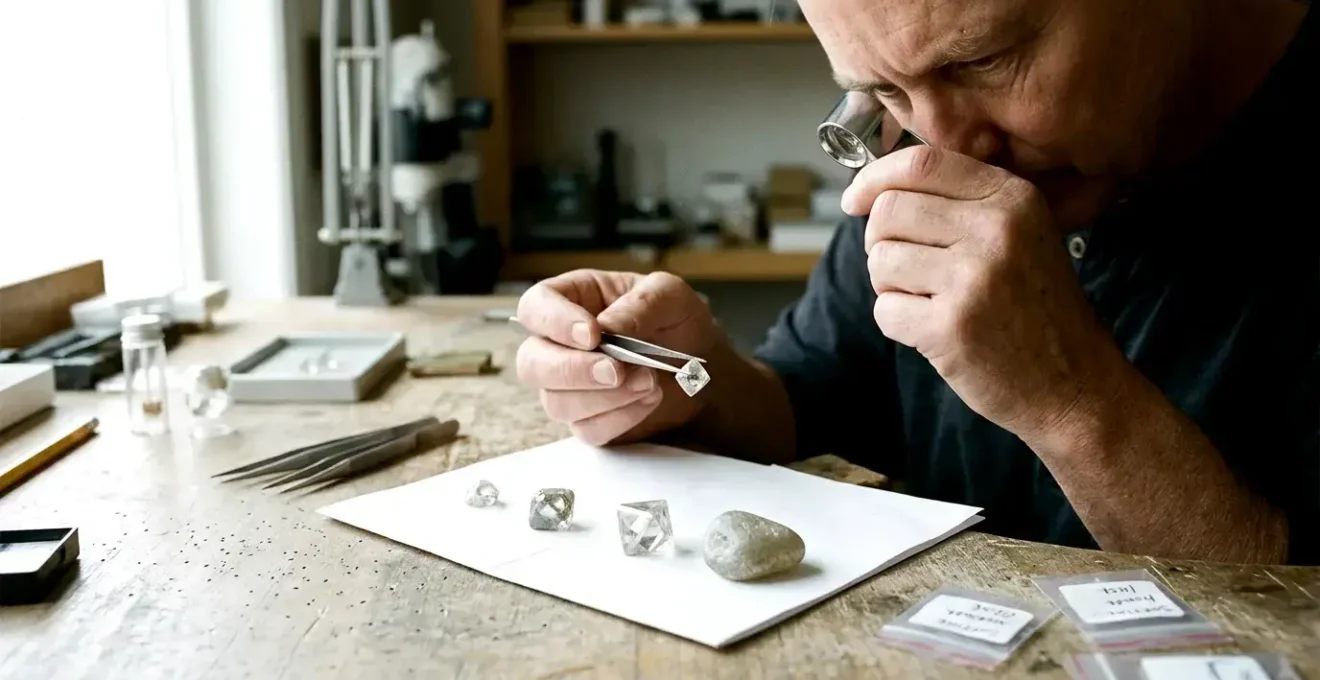
A diamond can spend an immense geological history deep inside Earth, survive an explosive journey through a volcanic pipe, and arrive at the surface with much of its original crystal shape preserved. Another diamond from a similar environment may emerge rounded, chemically etched, or fractured. The difference is not simply whether one crystal is stronger than the other.
Volcanic transport exposes gems to several competing forces: rapid movement can limit chemical destruction, while reactive magma, pressure changes, mechanical impacts, and pre-existing weaknesses can damage a crystal before it reaches the surface. Kimberlite, the volcanic rock responsible for transporting many natural diamonds, makes this contrast particularly clear.
For collectors, these processes matter because a rough gemstone’s outline, surface texture, and inclusions may preserve clues about its geological history. Those clues can make an origin claim more plausible, but they cannot automatically establish a particular mine, internal clarity, or market value.
Understanding the journey helps separate useful geological evidence from attractive stories attached to stones.
Volcanic pipes and rough gemstones: the essentials
- Rapid ascent improves survival opportunities. Kimberlite can carry diamonds upward before chemical dissolution becomes extensive, although the journey may still damage them.
- Surface appearance needs interpretation. Rounded edges can result from chemical resorption inside magma, river abrasion, or a combination of processes.
- Origin is not a quality grade. Host-rock descriptions and mine provenance provide context, but individual gemstone characteristics and supporting documentation remain essential.
- Why Does Fast Volcanic Transport Sometimes Preserve Crystals Better Than Slow Ascent?
- How to Tell if a ‘Volcanic Pipe Origin’ Claim Is Informative or Just Storytelling?
- Kimberlite vs Lamproite: Which Term Should You Care About as a Buyer, and Why?
- The Rarity Mistake: Assuming ‘Volcanic Pipe’ Automatically Means Scarce or Valuable
- When Should You Learn Volcanic Pipe Basics: Before Buying, After Your First Specimen, or Never?
- Why Do Some Deposits Produce ‘Clean’ Gems While Others Almost Always Include Silk and Crystals?
- Pegmatite Environment vs Metamorphic Belt: Which Origin Claim Fits Beryl More Often?
- Which Geological Environment Most Likely Produced Your Gem, Based on Its Most Common ‘Neighbours’?
Why Does Fast Volcanic Transport Sometimes Preserve Crystals Better Than Slow Ascent?
Fast volcanic transport can preserve crystals because it reduces the time they spend exposed to conditions that may dissolve or chemically modify them. In diamond-bearing kimberlite, rapid ascent can end before the magma destroys the diamonds it carries. However, speed cannot eliminate chemical reactions or mechanical damage, so quickly transported rough may still arrive rounded or broken.
Imagine an elevator carrying fragile cargo through a hostile environment. The shorter the trip, the less time the cargo spends exposed to the surroundings. Kimberlite behaves somewhat like that elevator, transporting diamonds that formed deep within Earth long before the magma incorporated them.
According to the GIA research article on diamond dissolution, published in 2020, some kimberlite eruptions can transport mantle material through approximately 150–200 kilometres in less than ten hours to around two days, based on the research cited by its authors.
150–200 km
Approximate transport distance for mantle material in the kimberlite ascent scenarios discussed by GIA. Reported travel times range from less than ten hours to approximately two days; these are not universal values for every eruption.
Gemological Institute of America, Gems & Gemology, Spring 2020, discussing Russell et al. (2019).
The important distinction is that diamond is not chemically indifferent to kimberlite magma. Kimberlite can be sufficiently oxidizing to dissolve diamond surfaces. The presence and chemistry of fluids containing water and carbon dioxide also influence how that dissolution proceeds.
Rapid transport therefore changes the balance between survival and destruction. It does not make the transporting magma harmless.
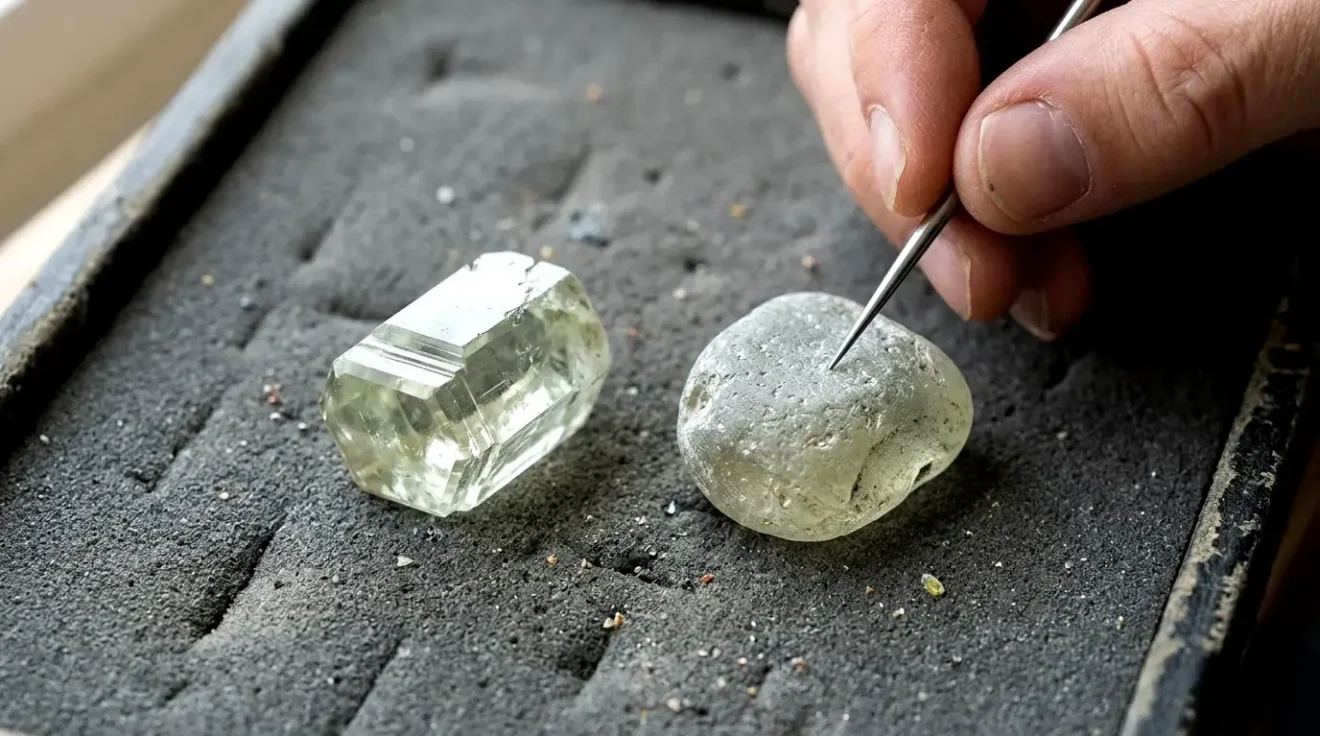
A diamond that originally possessed sharply defined crystal faces can develop curved surfaces through chemical resorption. Consequently, a rounded rough diamond is not necessarily a river-worn diamond. The rounding may have begun during volcanic ascent, before the stone ever encountered a stream.
Different gem species respond differently to their transporting environments. For example, sapphire and garnet crystals carried as fragments within volcanic rocks may exhibit reaction or alteration features under suitable chemical and thermal conditions. The specific response depends on the mineral and magma; diamond behaviour cannot simply be applied to every volcanic gemstone.
Mechanical survival is another question. Diamond’s exceptional resistance to scratching does not make it immune to cleavage-related breakage. Existing fractures, internal weaknesses, and violent collisions during transport can contribute to broken rough even when ascent is rapid.
For buyers, external morphology is therefore a record of possible processes, not a guaranteed clarity forecast. Rounded surfaces, sharp edges, and visible fractures deserve attention, but none alone establishes the stone’s internal condition or potential cutting yield.
The next challenge is determining whether a seller’s geological explanation actually helps interpret the gemstone being offered.
How to Tell if a ‘Volcanic Pipe Origin’ Claim Is Informative or Just Storytelling?
A volcanic-pipe origin claim is informative when it identifies a plausible geological setting, provides verifiable details, and explains what those details mean for the stone. It becomes storytelling when a seller relies on dramatic language without a specific deposit, credible provenance, or a connection to observable characteristics. Geological plausibility and documented mine origin are separate questions.
A description such as « born in the fires of Earth » may sound compelling, but it identifies neither a source rock nor a mining location. By contrast, stating that a diamond was recovered from a documented kimberlite deposit gives a buyer a specific claim that can be investigated.
Three different statements often get blurred together:
- Geological origin: the formation environment or geological system associated with the gemstone.
- Host rock: the material containing or transporting the crystal, such as kimberlite or lamproite.
- Geographic provenance: the particular mine, deposit, or country from which the stone was recovered.
These distinctions matter especially for diamonds. Research reviewed by GIA indicates that diamonds from different deposits can have overlapping physical and chemical characteristics. As a result, an individual diamond’s appearance does not ordinarily provide definitive proof of its geographic source.
The GIA study of diamond geographic-origin verification explains why provenance information preserved from the time of mining is essential for establishing where a diamond was recovered.
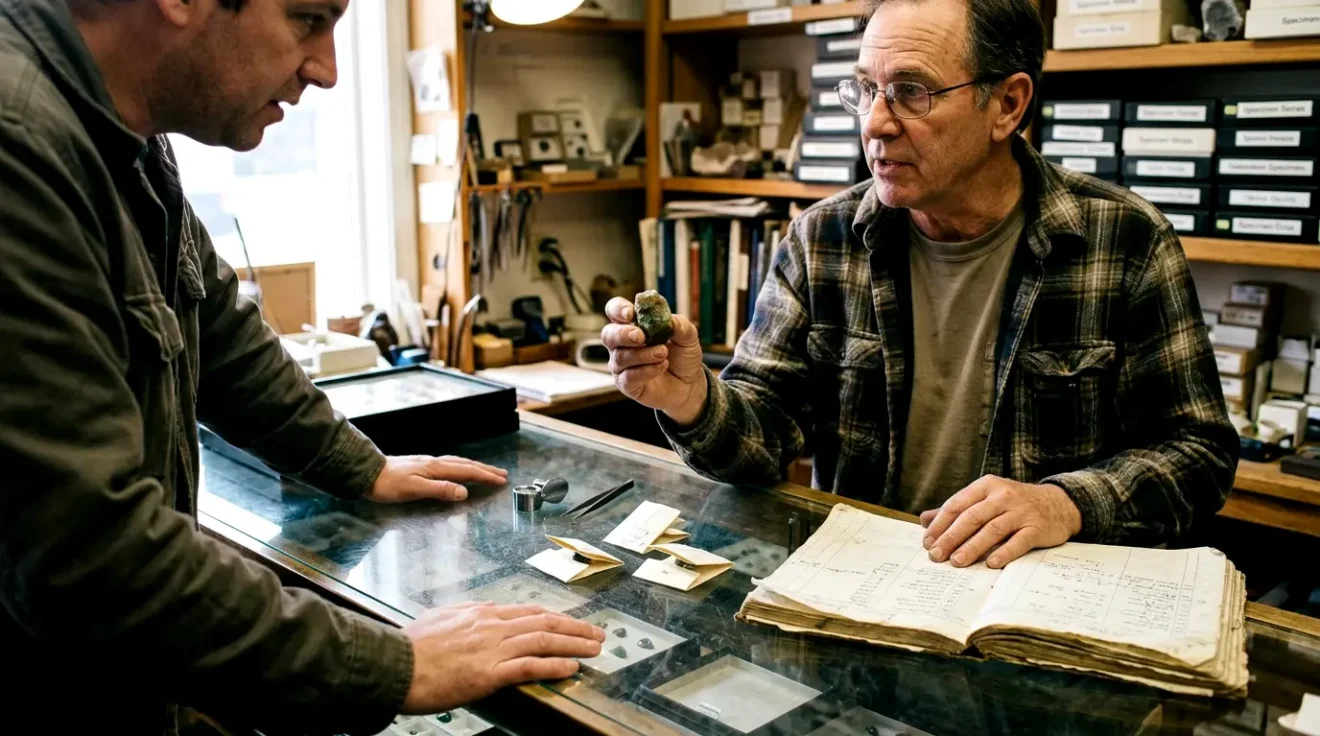
Consider two hypothetical listings. One advertises an unspecified « rare volcanic diamond » at a premium. Another identifies its claimed deposit, states whether the evidence consists of seller records or documented mine-to-market traceability, and describes its visible surface characteristics without promising a superior grade.
The second listing offers more information, even if its claims still require independent scrutiny. The first relies primarily on atmosphere.
Five checks before accepting a volcanic-origin claim
- Identify the species. Record the gemstone’s claimed mineral identity and any supporting identification report.
- Request the geological setting. Write down the named host rock or deposit and check whether the gem species is plausibly associated with it.
- Separate origin from provenance. Record whether the seller is claiming a rock type, a mine, a country, or all three.
- Ask for supporting evidence. Keep a copy of the available mining records, traceability information, or seller documentation, clearly noting anything missing.
- Connect the claim to the specimen. Note which observable features or documented supply characteristics the seller says the origin explains, and whether the explanation can be evaluated.
One particularly useful question is: « What does this origin tell me about this specific stone’s inclusions, shape, or durability? »
A knowledgeable seller may explain that origin provides only limited insight into those features. That honest limitation is more informative than an unsupported certainty.
Once the claim is specific enough to evaluate, terms such as kimberlite and lamproite become useful geological descriptions rather than unexplained labels.
Kimberlite vs Lamproite: Which Term Should You Care About as a Buyer, and Why?
Kimberlite and lamproite are volcanic rock types capable of transporting diamonds to Earth’s surface, but neither is a diamond quality grade. Kimberlite is the dominant natural diamond delivery system, while diamond-bearing lamproite occurrences are less common. Buyers should care about the distinction mainly when it clarifies a deposit’s geology, production history, or documented source.
Diamonds form at depth before being incorporated into the magmas that carry them upward. The volcanic material acts as a transporter, not the original creator of the crystal.
Kimberlite is generally silica-poor, magnesium-rich, and commonly contains abundant olivine. Lamproite has a different mineralogical composition, including enrichment in potassium and magnesium. Both can incorporate diamonds originating much deeper within Earth.
The GIA overview of kimberlite and lamproite geology describes these differences and emphasizes the geological role of the transporting rocks.
Although kimberlite pipes are frequently illustrated as downward-tapering volcanic conduits, not every kimberlite occurrence has that shape. Kimberlite also occurs in geological bodies such as dikes and sills.
The comparison is more useful when placed in context:
| Criterion | Kimberlite | Lamproite |
|---|---|---|
| Diamond transport | Dominant volcanic delivery system for natural diamonds | Less common diamond-bearing volcanic system |
| Typical geological description | Silica-poor, magnesium-rich rock, commonly containing olivine | Distinctive potassium- and magnesium-rich volcanic rock |
| Deposit context | Can occur in pipes, dikes, and sills | Can form different volcanic bodies and deposit settings |
| Buyer relevance | Helps describe the source geology and mining context | Helps identify a different source geology and production history |
| Quality guarantee | None | None |
Australia’s Argyle mine provides a recognizable lamproite example. The mine, which closed in 2020, became particularly associated with pink diamonds while also producing many brown diamonds. Its geological identity and production history contribute to the context in which Argyle-origin diamonds are discussed.
However, the fact that Argyle was associated with pink diamonds does not mean a pink diamond can be assigned to Argyle simply because of its color. Reliable provenance still requires appropriate evidence.
For a buyer considering two diamonds, the host-rock label cannot replace assessment of color, clarity, cut potential, and weight. Nor does it establish that one rough crystal will have fewer fractures or inclusions than another.
The practical rule is straightforward: geological terminology earns its place when it explains the deposit or a documented supply story. Without that connection, it should not support a quality premium on its own.
Understanding the transport rock also helps prevent a related purchasing error: assuming that a geologically unusual source necessarily produces commercially rare gemstones.
The Rarity Mistake: Assuming ‘Volcanic Pipe’ Automatically Means Scarce or Valuable
A gemstone does not become scarce or valuable simply because it came from a volcanic pipe. The geological rarity of a particular rock formation is different from the market scarcity of the material it produces. A productive deposit can supply substantial quantities, while an exceptional stone from a secondary deposit may be much harder to replace.
Many geological events are uncommon without producing commercially scarce specimens. A diamond-bearing kimberlite is a specialized geological setting, but the existence of such a setting says little about the quantity, quality, or market availability of diamonds recovered from it.
Furthermore, not every kimberlite body contains economically recoverable diamonds. Identifying the right type of volcanic rock is not equivalent to discovering a profitable diamond deposit.
Once production begins, market availability depends on several additional factors: the quantity recovered, the characteristics of the stones, the duration of mining, sorting practices, and demand for the resulting material.
These variables help explain why deposit rarity and gemstone scarcity cannot be treated as interchangeable.
Consider a hypothetical comparison. Deposit A is an established volcanic source that has supplied a particular category of rough for many years. Deposit B is a small secondary deposit from which only limited quantities of an unusual material are offered.
There is no sound basis for declaring material from Deposit A more valuable merely because its original host was volcanic. The available supply and the characteristics of the individual specimens must be considered.
Nor does alluvial origin make a stone inferior. An alluvial diamond may have originated in kimberlite, subsequently been released by erosion, and then been transported into river sediments. Its current deposit records a later stage of its geological journey.
At the individual-stone level, buyers should assess the characteristics relevant to their purpose. For polished diamonds, these commonly include the four Cs: cut, color, clarity, and carat weight. Rough collectors may also care about morphology, visible surface features, fractures, and the quality of the documentation.
A seller claiming a rarity premium should be able to distinguish three separate propositions:
- The geological source is unusual.
- The specific gem material is difficult to obtain.
- The individual specimen has qualities that justify its asking price.
Only the first proposition concerns geological occurrence alone. The others require evidence relevant to supply, desirability, and the actual stone.
For example, documented production history may help establish a deposit’s importance, but it cannot automatically establish the present market scarcity of an individual gem category.
Ask how much comparable material actually reaches buyers, whether the claimed scarcity is documented, and what makes this particular specimen distinct.
Buyers do not need advanced volcanology to recognize this distinction. A small amount of targeted geological knowledge is often enough to improve purchasing decisions.
When Should You Learn Volcanic Pipe Basics: Before Buying, After Your First Specimen, or Never?
Learn the essentials before buying any gemstone whose volcanic origin affects its description or price. Deeper geological study becomes more useful after acquiring specimens, comparing deposits, or evaluating rough. The goal is not to master volcanology before a purchase, but to understand enough to recognize meaningful origin information and avoid unsupported claims.
For a first purchase, three questions provide a practical starting point. What mineral is being offered? Is the claimed volcanic setting plausible for that mineral? Does the claim help explain anything verifiable about the specimen?
A beginner buying a polished diamond does not necessarily need detailed knowledge of kimberlite mineral chemistry. Reliable identification, appropriate grading information, and clear documentation are generally more immediately useful.
A collector buying rough diamonds has different needs. Crystal form, surface resorption, visible breakage, and possible secondary transport can influence how the specimen is understood and evaluated.
Learning can therefore proceed in stages:
| Stage | Useful knowledge | Practical outcome |
|---|---|---|
| Before the first purchase | Gem species, plausible host rocks, origin versus provenance | Recognize unsupported geological claims |
| After acquiring a specimen | Crystal morphology, inclusions, visible surface alteration | Describe the specimen more accurately |
| When comparing sellers | Deposit geology, documentation, production context | Compare claims consistently |
| When collecting rough seriously | Resorption, cleavage, transport histories, companion minerals | Make more informed specimen assessments |
The appropriate depth of study also depends on how strongly geological origin affects the asking price. A rock name used as background information may warrant only a quick check. A substantial premium attributed to a particular volcanic source deserves closer scrutiny.
There are costs at both extremes. Ignoring geological basics can leave buyers unable to question exaggerated claims. Spending excessive time studying every volcanic classification, meanwhile, may add little value to an otherwise straightforward purchase.
Increase your geological knowledge when it changes a real decision: choosing between two sources, assessing a rough crystal, interpreting an inclusion, or evaluating provenance documentation.
One particularly valuable next subject is inclusions, because they connect geological formation conditions with features collectors can sometimes observe directly.
Why Do Some Deposits Produce ‘Clean’ Gems While Others Almost Always Include Silk and Crystals?
Deposits produce different inclusion patterns because gemstones form and evolve under different chemical, thermal, and geological conditions. Some crystals trap other minerals or fluids during growth, while certain inclusions develop later as the crystal cools. These features can reveal aspects of formation history, but a deposit’s geology does not guarantee a particular clarity grade for every stone.
An inclusion is not simply a defect introduced after a gem forms. It may be part of the crystal’s growth history, capturing evidence of the surrounding environment or changes within the host crystal.
Common examples include enclosed mineral crystals, fluid-filled cavities, and microscopic needles. Their origins are not identical, so they should not be interpreted as though they all record the same event.
In sapphire, fine rutile needles commonly referred to as silk can develop through processes associated with the crystal’s chemistry and cooling. In some stones, appropriately oriented inclusions can produce asterism, the star-like optical effect valued in star sapphires.
Emeralds can contain mineral inclusions reflecting their geological setting. Mica inclusions, for example, may occur in emeralds associated with mica-rich schists, while certain carbonate inclusions occur in Colombian hydrothermal material.
The GIA article on inclusions in gemstones examines how these internal features assist gem identification and geological interpretation.
Importantly, inclusions are clues rather than automatic proof of origin. Similar features can occur in different deposits, and the presence of a natural-looking inclusion does not independently establish that a stone is untreated.
For collectors, the relevant question is not always whether a stone is completely clean. It is whether its inclusions are consistent with its identity, visually acceptable for the intended use, and compatible with the expected durability of the specimen.
Consider the distinction between fine internal silk and an open fracture. Silk may influence appearance or create a desirable optical effect. A surface-reaching fracture, however, can raise separate questions about structural integrity, especially when the stone will be cut, set, or regularly handled.
Included gemstones may also hold collector interest because of their characteristic appearance, geological associations, or unusual optical effects. That interest should not be confused with a universal price advantage for included material.
A deposit associated with distinctive inclusions may therefore produce highly desirable specimens without every crystal from that deposit sharing the same clarity or market value.
Beryl provides a useful extension of this reasoning, particularly when comparing pegmatite-related material with emeralds from metamorphic or hydrothermal environments.
Pegmatite Environment vs Metamorphic Belt: Which Origin Claim Fits Beryl More Often?
Neither pegmatite nor metamorphic belt is the correct origin for every beryl. Beryl occurs in several geological environments, and the likely setting depends partly on the variety being examined. Pegmatites are important sources of some beryl varieties, while many emerald deposits involve metamorphic, metasomatic, or hydrothermal processes. Inclusions and associated minerals provide useful checks, not definitive proof.
Beryl is a mineral family that includes emerald, aquamarine, and other gem varieties. Its members share a mineral identity but do not all grow under identical geological conditions.
Pegmatites can provide environments in which large beryl crystals develop. Some deposits yield attractive gem-quality material, but it would be misleading to assume that every pegmatite-hosted beryl crystal is large, transparent, or inclusion-free.
Emerald formation often requires geological conditions that bring together elements not always concentrated in the same rock. Interactions involving different rock compositions and chemically active fluids can help create suitable environments.
In certain metamorphic settings, emerald occurs in association with mica-rich rocks. Elsewhere, emerald deposits have hydrothermal histories that differ from this setting.
That variety matters when a seller describes an emerald as simply « metamorphic » or « pegmatite-origin. » The label may be meaningful, but a broad geological category is rarely a complete explanation of an individual stone.
Observations can be cross-checked against the proposed environment:
- Mineral associations: Do the accompanying minerals fit the proposed formation setting?
- Crystal growth characteristics: Does the specimen’s habit make sense within the claimed geological context?
- Inclusion evidence: Are the observed inclusions compatible with what is known about the material?
- Provenance records: Does any documentation connect the actual specimen to the claimed deposit?
A mismatch can justify additional questions, but it should not automatically lead to an accusation of misrepresentation. Deposits can be geologically complex, and individual crystals do not always exhibit every feature commonly associated with their surroundings.
Clarity expectations also need restraint. A buyer should not assume that pegmatite beryl must be cleaner than metamorphic beryl, or that every emerald from a particular environment must contain a specific inclusion pattern.
For pricing and collecting purposes, the geological setting is most useful when it helps establish realistic expectations and supports a coherent account of the specimen.
This approach applies well beyond beryl: the minerals found alongside a gemstone may provide another independent clue to the environment in which it formed or was transported.
Key takeaways before examining companion minerals
- Keep formation, volcanic transport, and later sedimentary deposition separate when interpreting a gemstone’s history.
- Compare several consistent clues instead of allowing one attractive inclusion or surface feature to decide origin.
- Treat the minerals accompanying a gem as geological context, then look for documentation before accepting a specific mine attribution.
Which Geological Environment Most Likely Produced Your Gem, Based on Its Most Common ‘Neighbours’?
A gemstone’s accompanying minerals can help identify its geological environment because particular mineral associations develop under particular formation conditions. Garnets, tourmalines, feldspars, and other minerals may narrow the possibilities when found in relevant geological context. However, companion minerals are indicators rather than definitive evidence, especially when specimens have been separated, transported, or commercially mixed.
Minerals do not form in isolation from their surroundings. Their presence reflects the availability of particular chemical elements, as well as the pressure, temperature, fluids, and geological processes involved.
This makes associated minerals useful evidence. In a pegmatite setting, for instance, an assemblage involving beryl, tourmaline, and feldspar may support a pegmatite interpretation. In other settings, different minerals can suggest different formation histories.
The method becomes particularly interesting for diamonds because their geological journey separates original formation from volcanic transport.
Kimberlite can contain minerals incorporated from the mantle, including certain garnets. Chromium-bearing pyrope garnets are among the indicator minerals used in diamond exploration. Their occurrence in a suitable geological context can help geologists investigate whether diamond-related mantle material may be present.
Yet an indicator mineral does not prove that a particular rock contains diamonds. Nor does a garnet associated with a specimen establish a diamond’s exact mine of origin.
Collectors can still use the association method without conducting a full laboratory investigation. The first step is to ask what other minerals are documented from the claimed source and whether those associations make geological sense.
Imagine a hypothetical rough specimen offered with its original matrix. If the seller claims a pegmatite origin and the specimen contains a plausible pegmatite mineral assemblage, that relationship supports the description more strongly than an unsupported label alone.
Now imagine an isolated gemstone sold with several unrelated loose mineral specimens. Merely displaying those minerals together does not establish that they occurred together naturally. Geological association requires evidence that the materials actually shared a relevant deposit or rock context.
For volcanic-pipe diamonds, an additional distinction is essential: a mineral found in kimberlite may record the magma’s mantle source or transport history, rather than the exact conditions in which a particular diamond originally crystallized.
A practical interpretation combines three categories of evidence: the gemstone’s own characteristics, the documented geological associations of the claimed deposit, and whatever reliable provenance records are available.
These categories are complementary, not interchangeable. Consistency can strengthen a hypothesis, while documentary gaps may prevent a confident attribution even when the geological story seems plausible.
When examining your next rough gemstone, begin with its mineral identity, describe its visible features, and ask which parts of its claimed geological history can actually be supported. Use those observations to choose the next useful question for the seller or gemologist, rather than letting an origin story make the purchasing decision.
Do diamonds form inside volcanic pipes?
Diamonds generally form deep within Earth before kimberlite or lamproite magma transports them toward the surface. The volcanic system is primarily a delivery mechanism, not the environment that originally created the diamond crystal.
Can a diamond survive a volcanic eruption without visible damage?
Yes. Rapid volcanic transport can allow diamonds to retain recognizable crystal morphology. However, chemical resorption may modify their surfaces, and mechanical impacts can produce fractures or breakage. An apparently intact surface also does not guarantee an internally flawless stone.
Does a rounded rough diamond necessarily come from a river deposit?
No. Rounded surfaces may develop through chemical resorption while the diamond is carried in kimberlite. Later river transport can cause additional abrasion and percussion marks. Surface appearance must therefore be interpreted in context.
Can a laboratory identify the exact mine of any diamond from its inclusions?
No universal analytical method has been demonstrated that can independently establish the exact geographic origin of an arbitrary individual diamond. Inclusions and other characteristics may provide useful evidence, but reliable mine attribution generally depends on provenance information preserved through the supply chain. This distinction is particularly important for untraceable stones.
Is a gemstone found with its original host rock more trustworthy than a loose specimen?
An authentic and documented host-rock association can provide useful geological context that a loose specimen lacks. However, the association must be genuine, and even a convincing matrix does not independently establish a specific mine or geographic provenance. Supporting records remain valuable.