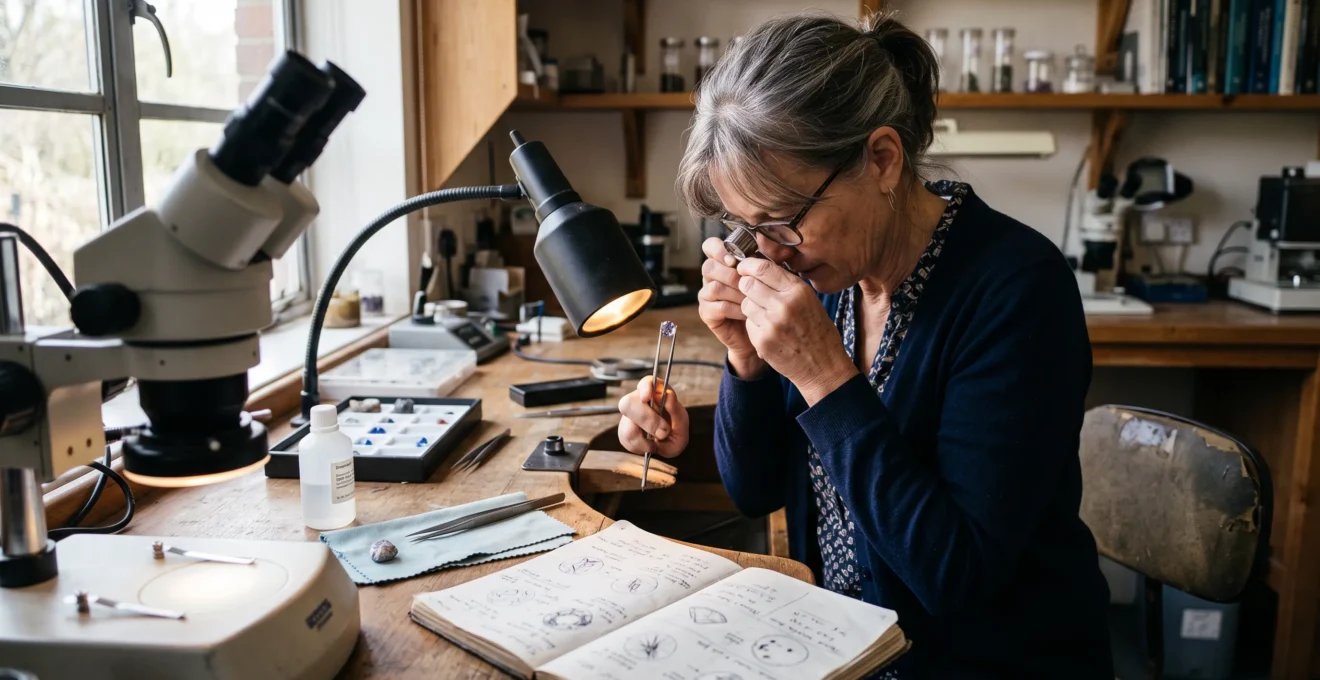
A gemstone containing tiny crystals, fluid-filled cavities or delicate internal fractures may seem unmistakably natural. Yet laboratory-grown stones can develop surprisingly similar features. Some synthetic gems even contain fingerprint-like inclusions that resemble geological evidence, while natural stones may display characteristics altered by heating or fracture filling.
The strongest evidence of natural origin is not the presence of inclusions but the relationship between their mineral identity, shape, distribution and growth environment. An identifiable mineral inclusion consistent with a gemstone’s geological formation can be persuasive. A gas bubble, isolated fracture or apparent fingerprint is usually much less informative without additional context.
For collectors, the practical challenge is to separate three questions: What is the feature? What does it reveal about the stone’s formation? Does it create a durability concern? A 10x loupe can provide useful preliminary answers, although some distinctions require professional microscopy or laboratory instruments.
These distinctions matter before purchasing, mounting, cleaning or valuing a gemstone. An inclusion can support an origin assessment and simultaneously expose a vulnerability that affects how the stone should be handled.
Gemstone inclusions: the essential distinctions
- Look for diagnostic combinations. Mineral inclusions consistent with natural geological growth can be stronger evidence than isolated bubbles, fractures or fingerprints. No single inclusion type proves natural origin across all gemstone species.
- Use a 10x loupe to classify, not certify. Examine crystals, fluid features, growth structures and fractures under changing illumination before drawing conclusions.
- Assess durability separately from origin. Surface-reaching fractures, vulnerable girdle areas and filling treatments may affect setting, cleaning and repair decisions regardless of whether a stone is natural or synthetic.
- Why Aren’t Inclusions a Guaranteed Proof of Natural Origin Even When They Look Convincing?
- How to Classify Inclusions Into 4 Useful Types Using Only a 10x Loupe?
- Included Stone in Prongs vs Bezel: Which Setting Choice Reduces Breakage Risk More?
- The Misdiagnosis That Makes Surface Damage Look Like « Natural Inclusions » Under a Loupe
- When Should You Pay for Microscopy: Only After You See a Suspicious Inclusion?
- Why Are Fluid Inclusions Common in Hydrothermal Gems, and When Are They a Red Flag?
- Hydrothermal Vein vs Pegmatite Pocket: Which Source More Often Produces Clean Tourmaline?
- Why Do Hydrothermal Vein Gems So Often Show Colour Zoning and Fluid Inclusions?
Why Aren’t Inclusions a Guaranteed Proof of Natural Origin Even When They Look Convincing?
Inclusions cannot guarantee natural origin because laboratory crystal-growth processes can produce internal crystals, trapped substances, growth patterns and fracture-like features. Some closely resemble inclusions in naturally formed gemstones. Their identification value depends on the gemstone species, the growth process and the relationship between multiple characteristics, not simply on whether the stone contains visible imperfections.
Natural crystals grow in geological environments where surrounding minerals, changing chemical conditions and trapped fluids can leave recognizable internal records. Laboratory production also involves physical growth conditions capable of leaving comparable records. The resulting features may look natural even when their causes are different.
According to GIA’s technical review of laboratory gemstone growth, flame-fusion, flux and hydrothermal synthesis can produce distinctive internal features. However, their diagnostic significance differs considerably.
For example, curved striae or curved colour bands can indicate flame-fusion synthetic ruby or sapphire. Flux-grown gemstones may contain flux-filled fingerprints that resemble naturally occurring, fluid-filled healed fractures. Hydrothermal synthetic emeralds may display characteristic growth structures and nailhead-like inclusions.
These examples demonstrate why inclusion morphology must be evaluated alongside the stone’s identity and growth architecture.
| Observed feature | Possible interpretation | Diagnostic limitation |
|---|---|---|
| Identifiable mineral crystal | May support natural geological formation when the mineral association is consistent with the host | The mineral must be identified and interpreted in context |
| Angular growth zoning | Can support natural growth in particular gemstone species | Angular patterns are not universally exclusive to natural gemstones |
| Curved striae | Characteristic of certain flame-fusion synthetic corundum | Must not be confused with other growth structures or polishing features |
| Fingerprint-like inclusion | May represent natural fluid-filled healing, synthetic flux or treatment-related residues | Appearance alone may be inconclusive |
| Gas or fluid bubble | Shows that a substance was trapped during formation or another process | Bubbles occur in multiple materials and cannot establish origin alone |
| Seed-related structure | Can support identification of particular synthetic growth processes | Seed remnants may be absent or removed during cutting |
Treatments introduce a further complication. A natural ruby subjected to heat treatment may contain flux residues within healed fractures. Such features can resemble the inclusions of flux-grown synthetic gemstones. Glass-filled fractures and cavities may also change the appearance of an originally natural stone.
Therefore, a suspicious feature may indicate synthesis, treatment or an ordinary geological event. These possibilities should remain separate until enough evidence supports one interpretation.
The most defensible assessment is cumulative: identify the host gemstone, describe each feature, evaluate whether the features form a consistent growth pattern, and check whether treatment could explain any contradictory evidence.
Once that distinction is established, a loupe becomes useful as a structured observation tool rather than a shortcut to an unsupported natural-origin claim.
How to Classify Inclusions Into 4 Useful Types Using Only a 10x Loupe?
A practical 10x loupe examination can organize visible gemstone features into four working categories: mineral crystals, fluid-related inclusions, growth structures and fracture-type features. This classification helps collectors describe what they see, identify potential durability problems and decide whether professional testing is needed. It does not independently establish natural or laboratory-grown origin.
Begin with a clean stone, a stable light source and a properly focused 10x loupe. Observe the stone through several facets rather than relying on the face-up view. Where accessible, use different illumination arrangements to see how a feature responds.
The examination principles described in GIA’s gemstone laboratory examination procedures distinguish darkfield lighting, transmitted brightfield lighting and reflected illumination. Each reveals different information.
| Category | What to look for at 10x | What it may suggest |
|---|---|---|
| 1. Crystal or mineral inclusions | Distinct internal bodies with defined outlines, faces or contrasting appearance | Potential geological evidence if their identity and association with the host are established |
| 2. Fluid and fingerprint-like inclusions | Cavities, reflective droplets, apparent bubbles or branching networks | Possible fluid entrapment, fracture healing, flux residues or another growth-related process |
| 3. Growth structures | Colour zoning, repeated lines or bands following apparent growth directions | Evidence of changing growth conditions; some patterns are associated with particular natural or synthetic processes |
| 4. Fractures, feathers and cavities | Veil-like breaks, reflective planes, openings or irregular gaps | Potential durability concerns, with limited origin significance unless their context is established |
This is a field classification for organizing observations, not an official universal gemological identification system. Some inclusions fit more than one descriptive category.
Darkfield illumination can emphasize internal inclusions against a darker background. Transmitted brightfield lighting can help reveal colour zoning, while reflected light is particularly useful for examining scratches, pits and other surface characteristics. A handheld loupe and ordinary lamp will not fully reproduce a gemological microscope’s controlled lighting, but changing illumination can still expose important differences.
Rotate the stone slowly and note whether the observed feature remains visibly beneath a facet or appears attached to the surface. Where possible, examine its apparent depth, location relative to the girdle and orientation toward exposed points.
These observations also matter mechanically. A mineral inclusion enclosed within an otherwise intact crystal does not necessarily create the same concern as a fracture reaching the girdle. A cavity at a vulnerable edge or a fissure extending toward a setting contact point deserves separate attention.
A five-step 10x loupe inspection checklist
- Clean the gemstone using a method appropriate to its known material and treatment status; record that the surface was examined without visible loose contamination.
- Inspect the stone under reflected light; produce a short note identifying visible scratches, chips or surface openings.
- Change the lighting and rotate the gemstone; record every significant internal feature under one of the four working categories.
- Sketch the stone’s outline and mark each feature’s apparent position, including any relationship to the girdle, culet or exposed corners.
- Photograph or describe any feature that cannot be confidently classified; produce a concise question for an independent gemologist rather than assigning an unsupported origin.
A fingerprint-like network that remains ambiguous at 10x should be recorded as such. Describing a feature accurately is more useful than forcing it into a natural or synthetic category.
The next step is to distinguish evidence relevant to origin from structural weaknesses that might affect how the gemstone can safely be mounted.
Included Stone in Prongs vs Bezel: Which Setting Choice Reduces Breakage Risk More?
A bezel often provides better protection against external impacts at vulnerable gemstone edges, while prongs leave more of the stone exposed and concentrate contact at individual seating points. However, neither setting is automatically safer for an included gem. The appropriate choice depends on fracture location, gemstone toughness, setting pressure and whether existing weaknesses can tolerate mounting.
Prong settings secure a gemstone through several localized contacts. If a surface-reaching fracture lies beneath a prong seat, the stone may be vulnerable during setting or subsequent impact. Exposed corners and thin girdle areas can also require additional protection.
Bezel settings surround part or all of the gemstone’s perimeter. Their protective coverage may reduce direct exposure of vulnerable edges during wear, but forming a bezel still involves mechanical contact. An already fractured girdle should not be assumed safe merely because a bezel distributes coverage around it.
GIA’s discussion of gemstone durability identifies hardness, toughness and stability as distinct properties. Hardness concerns scratch resistance, while toughness concerns resistance to breaking or chipping. A stone can resist abrasion yet remain vulnerable to damage at fractures or exposed points.
Before selecting a setting, the jeweler should know whether any feathers reach the surface, whether cavities occur near proposed contact points and whether a fracture extends toward a vulnerable tip or culet. A stone with substantial structural damage may need professional evaluation before either mounting method is attempted.
| Consideration | Prong setting | Bezel setting |
|---|---|---|
| External edge protection | More exposed perimeter, depending on design | Greater perimeter coverage |
| Setting contact | Localized pressure at prong seats | Contact around the covered rim during installation |
| Fracture at girdle | Particularly concerning beneath a prong contact | Requires assessment before rim pressure is applied |
| Access for later inspection | More of the perimeter may remain visible | Covered areas may be harder to examine |
| Potential suitability | Depends on contact placement and exposed points | May improve impact protection when safely installed |
There is also a diagnostic trade-off. A bezel can conceal the very girdle features that an examiner might want to reassess. That may complicate later visual documentation for resale, insurance discussions or identification work, although it does not necessarily prevent professional testing.
For a valuable stone, documenting significant inclusions before mounting is a sensible precaution. Photographs and a written condition assessment can preserve information about areas that the setting will subsequently obscure.
Repairs create further considerations. Heat applied during nearby jewelry work can be problematic for certain included or fracture-filled gemstones. The relevant risk depends on the material, its treatment and its condition, not simply on whether the stone formed naturally or hydrothermally.
A setting should therefore be selected only after surface damage and internal fractures have been distinguished, because confusing the two can compromise both origin assessment and structural decisions.
The Misdiagnosis That Makes Surface Damage Look Like « Natural Inclusions » Under a Loupe
The most common misdiagnosis is treating damage or contamination on a gemstone’s surface as evidence of natural crystal formation. Abrasions, chips, polishing marks, filled cavities and debris can resemble internal inclusions under a loupe. Their location, response to changing light and relationship to facet surfaces help distinguish external condition from genuine internal features.
A small nick at a facet junction may look like a natural cavity. Scratches can appear as linear growth structures, while residue caught in an opening may resemble a contrasting mineral inclusion. On softer or frequently worn stones, repeated surface marks can form patterns that appear deceptively organized.
Fractures add ambiguity because an internal fissure can intersect the surface. A feather visible through the crown may represent a genuine internal break, even though part of it is externally accessible. The correct classification may therefore include both internal structure and surface-reaching damage.
Reflected illumination helps reveal surface relief and facet wear. Internal features may become more apparent with illumination passing through or entering the stone from different directions.
Changing the viewing angle can also provide qualitative depth clues. If an apparent inclusion shifts relative to a facet boundary as the stone rotates, it may lie beneath the surface. However, optical refraction, facet reflections and complex internal geometry can make this judgment unreliable at 10x.
Surface position is not proof of geological origin. A cavity may be natural, damage-related or treatment-related. A filled fracture can belong to a natural gemstone while revealing an enhancement that needs separate disclosure.
Consider a hypothetical collector examining a transparent green gemstone. Under one lighting angle, a pale line looks like an internal growth feature. Under reflected light, it becomes apparent that the line follows a worn facet junction. The appropriate observation is surface abrasion, not a confirmed natural growth structure.
The financial consequences operate in both directions. Mistaking damage for natural inclusions may cause a buyer to overestimate the stone’s significance or underestimate its condition problems. Conversely, assuming that all visible imperfections are damage may lead to an unsupported dismissal of genuine internal features.
Cleaning matters, but cleaning itself can introduce risk. GIA’s guidance on gemstone durability and care cautions that some fracture-filling treatments can be affected by heat or chemicals, and that ultrasonic cleaning can damage certain treated emeralds.
When treatment status is uncertain, avoid using aggressive cleaning as a diagnostic experiment. A gentle, material-appropriate approach, or a professional inspection, is preferable to exposing a potentially fragile gemstone to ultrasonic or steam cleaning.
Once surface effects have been separated from internal features, the remaining question is whether those observations are sufficient or whether professional microscopy could materially change the assessment.
When Should You Pay for Microscopy: Only After You See a Suspicious Inclusion?
Professional microscopy is justified when its findings could affect a purchase, valuation, setting decision or origin assessment. A suspicious inclusion is one useful trigger, but not the only reason to seek examination. Apparently clean stones can also require laboratory identification, particularly when natural and synthetic material may be visually indistinguishable at 10x.
The first decision is whether the unresolved question is important enough to affect the next action. A collector documenting an inexpensive specimen may need only a careful loupe record. A buyer considering a valuable emerald with uncertain origin or treatment status faces a different level of uncertainty.
Microscopy becomes especially relevant when an observation suggests a feature that cannot be resolved with a handheld loupe.
- Possible flux residues: a fingerprint-like inclusion may require closer examination to evaluate its structure and context.
- Unusual growth banding: a suspected synthetic growth pattern may need controlled illumination or additional testing.
- Ambiguous fluid inclusions: internal geometry and associated features may be more informative than the apparent presence of bubbles.
- Surface-reaching fractures: greater detail can help an examiner assess their apparent extent before mounting or repair.
- No visible diagnostic features: a clean stone may still require laboratory examination when origin matters commercially.
Professional gemological microscopes provide adjustable magnification and specialized lighting that reveal details often inaccessible at 10x. Transmitted light, darkfield techniques, reflected illumination and fiber-optic lighting can expose different aspects of an inclusion.
Immersion techniques may help clarify internal growth patterns in suitable gemstones. Yet greater magnification does not automatically make an ambiguous feature diagnostic.
For instance, a natural fluid-filled fingerprint and a synthetic flux-filled fingerprint may remain difficult to distinguish by appearance alone. Mineral identification and associated growth features can be more revealing than magnification of the fingerprint itself.
GIA’s laboratory procedures also describe the use of analytical methods beyond microscopy, including Raman spectroscopy and fluorescence-based techniques where appropriate. These methods may be necessary when internal observation cannot resolve identity, origin or treatment.
The choice between a basic microscopic examination and a formal laboratory report should reflect the question being asked. For a high-value purchase or seller dispute, a report from a reputable independent gemological laboratory may provide more useful documented findings than an informal opinion.
In some cases, photographs supplied to an experienced independent gemologist can help determine whether further examination is warranted. Such a review cannot replace direct instrumental testing when the relevant features remain unresolved.
There is no evidence-based universal fee threshold that makes microscopy worthwhile. The relevant factors are the stone’s potential value, the cost of an incorrect assumption, the intended use and the likelihood that additional examination will change the decision.
This principle is particularly important for hydrothermal gemstones, whose fluid inclusions may appear consistent with natural geological formation while also occurring in laboratory-grown crystals.
Why Are Fluid Inclusions Common in Hydrothermal Gems, and When Are They a Red Flag?
Fluid inclusions are common in many hydrothermally formed gemstones because crystal growth takes place in water-rich environments capable of trapping small quantities of fluid. Both natural hydrothermal growth and laboratory hydrothermal synthesis can produce such features. Fluid inclusions become concerning when their geometry and associated growth structures suggest a particular synthetic process rather than natural formation.
In natural hydrothermal environments, mineral-bearing fluids move through fractures, veins and other geological openings. As conditions change, dissolved components may crystallize. Some fluid can become enclosed within the growing crystal or trapped as fractures heal.
Laboratory hydrothermal synthesis uses controlled aqueous environments, typically involving elevated pressure and temperature gradients, to grow crystals. Because the medium is fluid-rich, synthetic material may also contain fluid-related features.
The mere presence of liquid or a visible bubble therefore does not distinguish natural hydrothermal formation from laboratory growth.
Fluid inclusions can contain more than one phase, such as liquid and gas. Some natural tourmaline inclusions may include liquid, gas and solid components. However, phase count alone is not a universal natural-origin test because interpretation depends on the host mineral and its growth history.
In hydrothermal synthetic emeralds, characteristic structures may include chevron graining, nailhead-like features and, occasionally, evidence associated with the seed material used during growth. Such observations can support synthetic identification when correctly interpreted.
A possible seed-plate remnant is particularly relevant because it relates to the controlled growth arrangement. However, these remnants are often removed during cutting, so their absence is not evidence of natural origin.
Repeated banding closely associated with a growth structure may also deserve professional investigation. The examiner must establish whether the pattern matches an identified synthetic technique rather than assuming that straight or regular inclusions are inherently artificial.
Similarly, chips or cracks visible near a gemstone’s table are primarily condition observations. Without additional diagnostic features, their position does not establish hydrothermal synthesis.
Curved striae must be interpreted with care. They are characteristic of certain flame-fusion synthetic corundum, but should not be treated as an interchangeable description of hydrothermal synthetic emerald growth. Different synthesis technologies leave different evidence.
Fluid inclusions may also affect durability, especially when heating can produce internal pressure or aggravate existing fractures. Nevertheless, the supplied evidence does not establish that hydrothermal synthetic gems as a class are more fragile than naturally formed gems.
Before repair, cleaning or setting, identify the gemstone material, evaluate any surface-reaching fractures and investigate possible treatments. Those factors provide a better basis for care decisions than the general presence of hydrothermal inclusions.
The same caution applies when comparing gemstones from different geological environments: inclusion abundance may vary, but apparent cleanliness is not a reliable origin certificate.
Hydrothermal Vein vs Pegmatite Pocket: Which Source More Often Produces Clean Tourmaline?
There is no sufficiently supported general rule showing that pegmatite-pocket tourmaline is consistently cleaner than hydrothermal-vein tourmaline. Both geological environments can produce variations in growth conditions and inclusion development. Most gem-quality lithium-rich elbaite tourmaline discussed in gemological research is associated with granitic pegmatites, and clarity alone cannot identify the geological source.
Pegmatites are coarse-grained igneous bodies that can provide environments favorable to the growth of relatively large crystals. Their evolution involves changing melt and fluid conditions, so tourmaline formed within them may preserve mineral inclusions, growth tubes and fluid-related features.
A crystal grown in a pegmatite pocket can be comparatively clean, visibly included or contain several distinct internal structures. A slow or favorable growth environment does not guarantee the absence of inclusions.
Hydrothermal veins, by contrast, form through the movement and deposition of material from mineral-bearing fluids. Changing temperature, pressure and chemistry can influence crystal growth and the trapping of fluids.
These geological differences are useful for interpreting possible formation mechanisms, but they do not support a universal ranking of tourmaline clarity without comparative data from well-characterized deposits.
In GIA’s research summary on tourmaline inclusions, the documented features include mineral crystals, fluid inclusions, growth tubes and colour zoning. Mineral associations may offer clues about the environment in which a tourmaline crystal formed.
For example, the summarized research identifies lepidolite, feldspar, zircon and pyrochlore among inclusions associated with pegmatitic elbaite tourmalines. Graphite and apatite are discussed in connection with tourmalines from metamorphic settings.
These associations may help an experienced gemologist investigate geological history, but a visible inclusion should not be assigned a mineral identity from shape alone.
Another misleading assumption is that a tourmaline appearing unusually clean must have been grown in a laboratory. The GIA research summary reports no laboratory-grown counterpart in the gem market it describes. This does not imply that laboratory synthesis of tourmaline minerals is physically impossible, but it directly undermines claims that commercially widespread hydrothermal synthetic tourmaline explains exceptionally clean tourmaline gemstones.
For a collector, this changes the investigative priority. If a supposedly synthetic tourmaline is offered for sale, confirming the material’s actual mineral identity is more useful than assuming that its clarity proves a hydrothermal manufacturing process.
Growth-tube orientation, colour zoning and mineral inclusion distribution can be documented as clues. None of these observations, individually, establishes a unique pegmatite-versus-hydrothermal-vein origin.
The most informative next step is to examine why changes in mineral-bearing fluids produce zoning and inclusions together, then connect those observations to the wider natural-versus-synthetic assessment.
Key takeaways before interpreting growth patterns
- Assess colour zoning and fluid inclusions together: both may reflect changing growth conditions, but neither proves natural origin independently.
- Distinguish growth technologies: curved flame-fusion striae and hydrothermal chevron structures must not be treated as equivalent synthetic signatures.
- Request views through different facets before purchase, because cutting orientation can make internal zoning more or less apparent.
Why Do Hydrothermal Vein Gems So Often Show Colour Zoning and Fluid Inclusions?
Hydrothermal vein gemstones can display colour zoning and fluid inclusions because their growth environment changes over time. Variations in fluid chemistry, temperature and pressure may alter how colouring elements enter the crystal, while fluid entrapment can occur during growth or fracture healing. These features reflect related geological processes, although neither is exclusive to natural hydrothermal formation.
In a hydrothermal vein, mineral-bearing fluids circulate through geological openings. Crystals can grow as dissolved components become incorporated into solid mineral structures under suitable conditions.
If the composition of the fluid changes during growth, different crystal regions may incorporate different concentrations of colouring elements. This can produce visible variations in colour.
Changes in growth conditions can also influence crystal morphology and internal structure. Fluid trapped within a developing crystal or within healing fractures may remain preserved as inclusions.
The resulting gemstone can therefore contain both colour zoning and fluid inclusions, even though the features may have formed at different moments in its history.
Colour zoning is particularly useful when examined as a three-dimensional growth record rather than a simple visual pattern. In some natural gemstone species, angular colour boundaries following crystallographic growth directions can support natural formation.
However, angular zoning is not universally diagnostic. The correct interpretation depends on the mineral and the available comparison with known natural and synthetic growth structures.
Similarly, curved colour striae are associated with certain flame-fusion synthetic corundum. They should not be generalized to every laboratory-grown gemstone or assumed to represent hydrothermal synthesis.
Hydrothermal synthetic emeralds may display chevron-like graining and other characteristic structures. Such patterns must be evaluated according to the synthesis method and the gemstone species.
Concentric zoning is not a universal signature of hydrothermal synthesis. A visually organized pattern may arise from different growth histories, and no single shape establishes origin across all gemstones.
Cutting adds another interpretive challenge. A faceted gemstone is an oriented section through a larger crystal. Depending on the cutting direction, colour bands may appear prominent, subdued or difficult to see.
Cutters can use orientation to influence the finished stone’s appearance, including how colour is presented face-up. As a result, a lack of obvious zoning through the table does not establish that the original crystal grew uniformly.
A buyer examining an unfamiliar stone can request views through the crown, pavilion and side facets where accessible. Changes in lighting and orientation may reveal internal patterns otherwise hidden in ordinary viewing.
The most useful collector-level assessment combines the entire sequence of observations:
- Confirm, as far as available evidence permits, the gemstone’s stated mineral identity.
- Separate external wear and treatment-related features from internal inclusions.
- Classify visible crystals, fluid features, growth structures and fractures.
- Evaluate whether the combined features are consistent with known natural or synthetic growth processes for that specific material.
- Identify durability concerns and seek professional examination when unresolved findings could affect the purchase, mounting or care decision.
This approach does not turn a loupe into a laboratory. Instead, it produces a defensible record that an experienced gemologist can interpret and, when necessary, supplement with microscopy or analytical testing.
Before buying or setting a gemstone whose natural origin matters, document the visible evidence and obtain independent gemological identification when the combined observations remain uncertain. The goal is not to find an imperfection that proves a story, but to establish whether the stone’s internal features genuinely support that story.
Can a gemstone be completely eye-clean and still be natural?
Yes. Natural gemstones can have few or no inclusions visible to the unaided eye. Some natural and hydrothermal synthetic quartz crystals may both show very few visible internal features. Clarity alone cannot establish whether a gemstone is natural or laboratory-grown.
Are mineral inclusions stronger evidence of natural origin than gas bubbles?
Identifiable mineral inclusions that are consistent with the host gemstone’s geological formation can provide stronger evidence than an isolated gas bubble. However, the mineral must be correctly identified and its association interpreted in context. Bubbles are generally less specific because trapped gas or fluid-related features can occur in different natural and synthetic materials.
Can a naturally formed gemstone contain inclusions associated with synthetic growth?
Yes. Certain treatment processes can create features resembling synthetic growth-related inclusions. For example, flux residues may occur in fractures of heat-treated natural ruby and resemble some features observed in flux-grown synthetic gemstones. Such cases require careful separation of geological origin from treatment history.
Does a fracture-filled gemstone count as natural?
A naturally formed gemstone remains natural in origin after fracture filling, but its treatment status is a separate material fact. Filling can change the appearance of fractures and may introduce additional care restrictions. Both origin and treatment should be evaluated when considering identification, value and durability.
Can a gemological report identify natural versus laboratory-grown origin without visible inclusions?
In many cases, a qualified gemological laboratory can use physical characteristics, growth structures and analytical instruments beyond ordinary magnification to investigate origin. The available methods and certainty depend on the gemstone species and the particular identification challenge. An absence of visible inclusions does not automatically prevent laboratory identification.