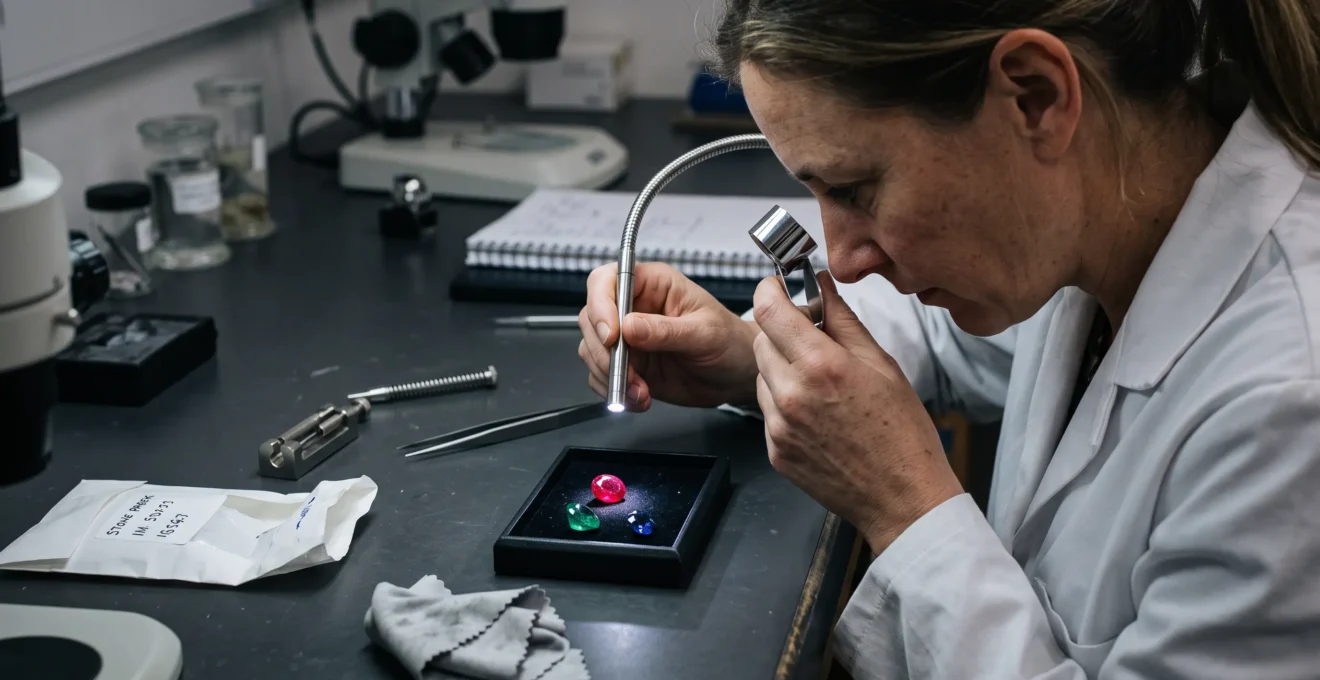
Chromium can make a ruby red and an emerald green. Iron and titanium can interact to produce blue sapphire, while some striking gemstone colours arise from processes that are not explained by the presence of a single trace element. These differences matter whenever a seller uses chemical composition to explain exceptional colour, justify a premium or claim a particular geographic origin.
Trace-element analysis can reveal important information about a gemstone. It can identify elements associated with colour-producing mechanisms, contribute to treatment investigations and help laboratories compare stones with reference material from known deposits. Yet an elemental reading does not automatically identify the dominant cause of colour, establish whether a stone has been treated or prove where it was mined.
For collectors interpreting laboratory notes, the essential distinction is between what a chemical measurement establishes and what an interpretation adds. Understanding that boundary makes it easier to question sales claims, interpret qualified origin opinions and decide whether additional testing will provide useful evidence.
Trace elements, colour and origin: the essentials
- A trace element’s effect on colour depends on the host mineral, its chemical state and interactions with other defects or elements.
- Geographic origin assessments combine several kinds of evidence. No single trace-element concentration reliably proves a country of origin.
- Testing is most valuable when the selected method can answer a specific question about colour, treatment or origin that matters to a purchasing decision.
- Why Can the Same Trace Element Create Different Colours in Two Different Minerals?
- How to Question a « Trace Element » Claim Without Sounding Confrontational in Messages?
- Trace Elements or Treatment Effects: Which Is More Likely Behind That Extra-Vivid Colour?
- The Origin-Claim Mistake: Treating One Trace Element as a Location Fingerprint
- The Overclaim Mistake: Using Chemical Composition to « Prove » a Country of Origin
- Why Is Origin Assessment Often « Most Likely » Rather Than Certain Even With Modern Testing?
- Is an Origin Assessment Worth Paying For, or Are You Funding a Story With No Resale Power?
- When Does Trace-Element Testing Make Sense: £80 Screening or Only for High-Value Stones?
Why Can the Same Trace Element Create Different Colours in Two Different Minerals?
The same trace element can produce different colours because its optical behaviour depends on the crystal structure surrounding it. Chromium commonly contributes red to ruby and green to emerald, even though both minerals contain chromium ions. The surrounding atomic environment changes which wavelengths of visible light are absorbed, so identifying the element alone cannot predict the gemstone’s colour.
Ruby belongs to the corundum mineral family, whereas emerald is the green variety of beryl. In both, chromium can act as a chromophore, a colour-producing component. However, the arrangement of neighbouring atoms differs between the two host minerals. That environment changes the electronic energy levels associated with chromium and, consequently, its absorption of visible light.
The distinction extends beyond chromium. Blue sapphire provides an important example of colour arising from an interaction between elements rather than from one isolated impurity. Electron transfer involving Fe²⁺ and Ti⁴⁺ creates absorption that contributes to blue coloration.
Research published in Gems & Gemology, described in GIA’s quantitative research on colour in corundum, identifies six major colour-producing chromophores in natural corundum: Cr³⁺, h•-Cr³⁺, Fe³⁺, h•-Fe³⁺, Fe²⁺-Ti⁴⁺ and V³⁺. These include mechanisms involving charge compensation and trapped holes, not simply isolated metallic impurities.
Colour centres add another complication. Defects within a crystal can influence light absorption, sometimes through changes in electronic charge states. A chemical analysis that lists elemental concentrations may therefore omit part of the explanation for the colour actually observed.
For a collector, the first useful distinction is between an active colour-producing component and an incidental impurity. An element may be present at a measurable concentration without making a substantial contribution to the visible colour of that particular gemstone.
A sensible interpretation begins with four questions:
- Which mineral species is being examined?
- Which colour mechanism is associated with the detected element in that mineral?
- Is the element present in a relevant chemical or electronic state?
- Could another chromophore, defect or interaction better explain the observed colour?
The concentration matters too, but it is not the whole explanation. Colour depends on absorption characteristics, the combination of chromophores and the distance light travels through the material. Two stones with related chemistry can consequently appear different because of their chromophore balance and optical properties.
Once this distinction is understood, the next question becomes practical: what evidence should a seller provide when attributing a gemstone’s colour to a particular element?
How to Question a « Trace Element » Claim Without Sounding Confrontational in Messages?
The most effective way to question a trace-element claim is to ask how it was established rather than suggest that the seller is mistaken. Request the element’s name, the analytical technique, the reported concentration and any supporting laboratory documentation. Specific, neutral questions allow a legitimate claim to be clarified without turning an ordinary purchasing discussion into a dispute.
Suppose a seller describes a vivid gemstone as having an unusually high chromium content. That statement contains several uncertainties. Was chromium measured, or inferred from colour? Was the measurement qualitative or quantitative? Is the concentration unusual for that mineral, or merely an ordinary feature of its chemistry?
A non-confrontational reply could read:
« That’s interesting. Could you let me know which laboratory measured the chromium content and whether the result appears on the report? »
If a concentration is provided, a useful follow-up is:
« Would you be able to share the analytical method and the reported concentration? I’m trying to understand how the chemistry relates to the colour. »
For an origin-related claim, the wording can remain equally neutral:
« Does the laboratory interpret this elemental profile as supporting an origin, or is that interpretation separate from the report? »
These questions distinguish three levels of evidence: a seller’s description, an actual analytical result and a laboratory’s interpretation of that result.
Five checks before accepting a trace-element claim
- Identify the claimed element. Record its name and the precise property it supposedly explains. Deliverable: a one-sentence statement of the claim.
- Request the analytical method. Ask whether testing involved EDXRF, LA-ICP-MS or another technique. Deliverable: the named method and testing laboratory, if available.
- Obtain the reported result. Request the concentration, units and relevant report extract. Deliverable: a copy of the numerical or qualitative finding.
- Check the interpretation. Compare the proposed colour mechanism with the mineral species and distinguish chemistry from treatment or origin opinions. Deliverable: a note identifying what the measurement actually supports.
- Confirm the sales wording. Ask the seller to distinguish verified results from interpretations or assumptions. Deliverable: a written description consistent with the evidence provided.
Written communication is particularly useful because the explanation can be revisited later. A clear message creates a record of what was represented without requiring the buyer to challenge the seller’s expertise.
It also provides a natural opportunity to request missing context. A laboratory report may contain a genuine elemental result while offering no opinion about the claimed colour mechanism or geographic origin.
Even a fully documented chemical result can leave an important question unanswered: whether the observed colour reflects the stone’s original formation or a subsequent treatment.
Trace Elements or Treatment Effects: Which Is More Likely Behind That Extra-Vivid Colour?
Exceptional colour intensity cannot, by itself, establish whether a gemstone’s appearance is natural or treatment-enhanced. Trace elements can produce vivid colour during crystal formation, but heating, diffusion and irradiation may also alter colour. The appropriate conclusion depends on the gemstone species, internal features and laboratory findings, not simply on how saturated the stone appears.
Heat treatment may change the electronic or structural conditions responsible for light absorption. Irradiation can create or modify colour centres, sometimes followed by heating. Diffusion treatment can introduce certain elements into a gemstone at elevated temperatures, changing its colour-producing chemistry.
Fracture filling requires a different interpretation. Glass or other filling materials generally improve the visibility of fractures and apparent transparency rather than directly changing the intrinsic colour of the surrounding crystal.
GIA’s introduction to gemstone treatments explains these enhancement categories and why professional identification matters. Importantly, treatment methods vary in their effects, durability and detectability.
For diffusion-treated gemstones, colour concentrated near the surface or facet junctions may provide a useful clue. However, surface-related colour is not universal proof of diffusion. Treatment penetration varies, and natural growth zoning may also create uneven colour distributions.
Other observations may justify further investigation: unusual zoning patterns, suspicious surface-related features under magnification or inconsistencies between a seller’s treatment declaration and the available documentation. None should be interpreted in isolation.
A particularly important distinction concerns when an element entered the crystal. An element incorporated during natural growth may also be detectable after introduction through a treatment process. A basic chemical reading can identify its presence without establishing the history of its incorporation.
For example, beryllium diffusion in corundum requires suitably sensitive analysis. Conventional EDXRF cannot detect beryllium, whereas methods such as LA-ICP-MS may be used to investigate its presence and distribution.
A practical assessment follows this sequence:
- Document the observed colour, saturation and zoning.
- Determine whether known natural colour mechanisms plausibly explain the appearance.
- Examine the stone for features associated with relevant treatments.
- Check the laboratory report for treatment conclusions and limitations.
- Request further testing if the unresolved question materially affects the purchase.
Absence of visible treatment indicators is not equivalent to confirmation of an untreated stone. Some enhancements require specialist equipment and interpretation.
Once colour and treatment have been considered separately, trace-element chemistry can be examined for another possible purpose: evaluating a claimed mining origin.
The Origin-Claim Mistake: Treating One Trace Element as a Location Fingerprint
A single trace element cannot reliably identify the deposit where a gemstone was mined. Chromium, vanadium, iron and other elements occur in gemstones from multiple geographic sources, while concentrations may vary within one deposit. Their presence can contribute to an origin assessment, but treating one elemental measurement as a unique location fingerprint confuses a chemical characteristic with geographic proof.
Consider an emerald described as originating from a particular country because its chromium or vanadium concentration matches an expected profile. The chemistry may be compatible with that source, but compatibility does not establish exclusivity.
Deposits formed under related geological conditions may produce gemstones with overlapping elemental characteristics. Conversely, different areas of a single deposit can produce stones with differing compositions and inclusion assemblages.
Consequently, an elemental concentration that appears characteristic of one source may also occur elsewhere. A laboratory must determine whether the full combination of observed properties can meaningfully distinguish competing possibilities.
Credible geographic origin assessments can incorporate:
- Microscopic inclusions: internal minerals, fluids and other features that may reflect the environment of gemstone formation.
- Growth characteristics: structural or zoning patterns potentially associated with particular geological conditions.
- Spectroscopy: absorption and other measurable properties related to the gemstone’s composition and structure.
- Trace-element suites: the combined patterns of several measured elements rather than a single concentration.
- Reference comparisons: observations evaluated against documented gemstones from known sources.
No category is automatically decisive. Some inclusion features occur in multiple deposits, and some chemically similar gemstones may come from different countries.
The commercial consequence of ignoring this limitation can be substantial. A location claim may influence the asking price even when the underlying evidence supports only a broad chemical resemblance.
Hypothetical example: a premium based on vanadium
A collector is offered an emerald at a premium because the seller says its vanadium concentration proves a prestigious geographic origin. The seller provides an elemental reading but no independent origin opinion.
The measurement supports the presence of vanadium, assuming the analysis is reliable. It does not establish the mine or country. Before accepting the premium, the collector requests a laboratory origin assessment and asks whether the price remains justified if the result is inconclusive.
If a gemstone is subsequently submitted to another laboratory and receives a different origin opinion, a previously confident sales description may become difficult to defend. Depending on the applicable contract and jurisdiction, inaccurate representations could also raise disputes over the transaction.
The next distinction is subtler: even when several chemical measurements are used, laboratory interpretation is still not the same as proof of a country of origin.
The Overclaim Mistake: Using Chemical Composition to « Prove » a Country of Origin
Chemical composition can support a gemstone origin assessment, but it cannot ordinarily prove a country of origin by itself. Laboratories compare combinations of chemical, microscopic and spectroscopic characteristics with reference gemstones of documented provenance. Their conclusions are comparative interpretations whose strength depends on the stone’s features, the available reference material and the extent to which different sources can be distinguished.
This distinction is central to GIA’s review of gemstone origin determination methods. The review describes how traditional gemmological observations and advanced analytical techniques contribute to geographic origin assessment.
Rather than searching for a single universal country-identifying marker, laboratories examine how well the evidence agrees with documented reference stones. A chemical profile may support one proposed origin more strongly than another, but the significance of that match depends on the alternatives represented in the reference collection.
This is a form of evidence-based classification under uncertainty. It does not necessarily involve a published numerical probability, and a laboratory’s opinion should not be translated into an unsupported percentage of certainty.
Reference coverage matters. A well-documented collection may include gemstones from different deposits, geological environments and production periods. However, no collection can be assumed to capture every source or the full natural variation of every deposit.
Claims become misleading when sales language removes those limitations.
| Sales statement | What the evidence may support | What should be checked |
|---|---|---|
| « The chromium level proves the country. » | Chromium may be compatible with gemstones from that country. | Whether other origins have comparable chemistry and whether additional evidence was evaluated. |
| « The laboratory confirmed this origin. » | The laboratory may have issued a geographic origin opinion. | The original report wording, laboratory identity and any qualifications. |
| « All tests point to the same mine. » | Several observations may support a geographic interpretation. | Whether the report actually identifies a mine or only a country, region or inconclusive result. |
The word provenance also deserves care. Laboratory geographic origin assessment is not equivalent to a documented chain of ownership or mining records. A stone may have a credible laboratory origin opinion without an independently verified transaction history connecting it to a particular mine.
Before accepting a geographic claim, compare the exact sales statement with the report. Check the issuing laboratory, the gemstone identity, the stated conclusion and whether the interpretation is explicitly conditional.
If a report does not assess origin, an elemental analysis attached to it should not be presented as though it does.
That distinction becomes especially important when modern instruments produce detailed measurements but laboratories still cannot reach a definitive geographic conclusion.
Why Is Origin Assessment Often « Most Likely » Rather Than Certain Even With Modern Testing?
Origin assessments often remain qualified because gemstones from different deposits can share chemical and microscopic characteristics. Advanced testing improves the evidence available, but it cannot always separate overlapping geological populations. When a stone is compatible with several possible sources, a laboratory may express a qualified opinion or decline to assign an origin rather than present uncertain evidence as certainty.
Modern techniques can identify elements at very low concentrations, examine absorption features and reveal characteristics invisible to an unaided observer. Their precision, however, does not remove geological overlap.
Two different deposits may produce gemstones with similar elemental profiles because their formation environments share relevant characteristics. A single deposit may also contain enough natural variation that not every stone resembles a typical reference specimen.
Reference collections introduce another limitation. They depend on access to reliably documented stones, the diversity of samples collected and the range of deposits represented. New mining activity or newly studied material may expand the set of plausible comparisons.
These challenges explain why laboratories may use language such as « characteristics consistent with » a stated origin or provide an inconclusive assessment. Such wording is illustrative; the exact terminology and reporting conventions differ between laboratories.
A qualified conclusion is not evidence of poor testing. It can indicate that the laboratory has recognised the limits of the available information rather than overstated what the measurements establish.
What happens when two laboratories disagree?
The first step is to compare the scope of their reports. One may have provided a geographic origin opinion while another performed identification and treatment testing only. If both assessed origin, examine whether the conclusions are contradictory or merely expressed at different levels of specificity.
Differences in reference collections, analytical procedures, interpretation criteria and the gemstone’s particular features can contribute to different outcomes. Disagreement does not automatically show that one laboratory is incompetent.
Where the distinction matters financially, a collector can request clarification of the assessment basis, confirm that the reports concern the same gemstone and consider an additional opinion from a suitably qualified laboratory.
Yet another report is not guaranteed to resolve the uncertainty. If the stone’s characteristics genuinely overlap between possible sources, further analysis may still be inconclusive.
The commercial question is whether an opinion with acknowledged limitations can justify the additional cost of testing or support a meaningful resale premium.
Is an Origin Assessment Worth Paying For, or Are You Funding a Story With No Resale Power?
A geographic origin assessment is worth paying for when credible origin information could materially affect a gemstone’s price, buyer confidence or resale prospects. This is especially relevant for selected rubies, sapphires and emeralds from origins that command recognised premiums. For stones whose buyers chiefly value appearance and quality, an additional origin report may provide information without creating significant commercial value.
The distinction is between information value and market value. A collector may personally appreciate knowing a stone’s likely geographic source, even when future buyers would not pay more for that information.
For commercially sensitive gemstones, an independent origin opinion may help a prospective buyer evaluate a claim associated with an established premium. However, the report does not create the underlying quality of the gemstone or guarantee the premium will be realised.
GIA’s analysis of coloured gemstone value factors explains how geographic origin can influence the value of certain coloured gemstones, including the importance attached to Kashmir sapphires.
Colour, clarity, cut, size and other quality characteristics still matter. A claimed prestigious origin does not automatically make a gemstone more desirable than every comparable stone from elsewhere.
Before commissioning an assessment, consider the following decision grid.
| Decision factor | Stronger case for testing | Weaker case for testing |
|---|---|---|
| Gemstone value | A material purchase or resale decision depends on the origin claim. | The testing expense is substantial relative to the stone’s value. |
| Gemstone category | Ruby, sapphire or emerald with an origin-sensitive market. | A variety for which buyers rarely distinguish prices by geographic source. |
| Buyer expectations | Potential buyers request independent origin documentation. | Buyers principally assess appearance, quality and treatment status. |
| Purpose | Resale, insurance discussions or a disputed premium makes documented evidence important. | Personal enjoyment is the main objective and geographic attribution would not change the decision. |
| Possible outcome | The buyer accepts that the result may support, contradict or fail to resolve the proposed origin. | The purchase only makes financial sense if the laboratory confirms a preferred origin. |
A report’s effect on marketability is asymmetric. A well-supported prestigious origin may strengthen an existing value argument. An inconclusive or commercially less desirable result may leave the expected premium unsupported.
This does not mean an inconclusive report necessarily reduces the stone’s intrinsic value. It means that buyers cannot safely assume they will recover an origin-related premium that remains unverified.
For a hypothetical purchase, consider two otherwise comparable sapphires. One carries a substantial asking-price premium attributed to geographic origin; the other is priced mainly for its observable quality. An independent origin assessment may be more useful for the first stone because a specific price assumption depends on its outcome.
Testing also has limits beyond laboratory uncertainty. An origin report is not a valuation certificate, a guarantee of future demand or proof of an unbroken chain of provenance.
Before paying, establish whether the intended buyer market recognises the reported origin and whether the expected commercial benefit justifies the uncertainty and cost. The remaining decision is which level of analysis can answer the question efficiently.
Key takeaways before commissioning a test
- Define the specific uncertainty that would change the purchasing or resale decision; an elemental reading and an origin opinion answer different questions.
- Consider the financial exposure associated with an incorrect assumption, not simply the gemstone’s asking price.
- Confirm the analytical method, reporting scope and possibility of an inconclusive result before committing to the expense.
When Does Trace-Element Testing Make Sense: £80 Screening or Only for High-Value Stones?
Trace-element testing makes sense when the information it can reliably provide is worth more than the cost of obtaining it. Basic elemental screening may be appropriate for preliminary composition questions, while more sensitive quantitative analysis may be justified for significant treatment or origin concerns. An £80 screening quotation should therefore be evaluated against the method and its capabilities, not treated as a universal testing price or a guarantee of useful conclusions.
The first question is not how much analysis the laboratory can perform. It is what decision the analysis needs to support.
For a relatively inexpensive gemstone, identifying whether certain heavier elements are present may be sufficient for an initial investigation. In another case, an elementally plausible stone may still require specialised treatment testing or comparative geographic origin assessment.
Energy-dispersive X-ray fluorescence, commonly abbreviated EDXRF, can provide useful elemental information without requiring the same type of sampling as laser-ablation methods. Its sensitivity and detection limits, however, depend on the elements and analytical setup.
Laser ablation inductively coupled plasma mass spectrometry, or LA-ICP-MS, can measure trace elements at lower concentrations and is useful for investigations requiring greater sensitivity. It involves microscopic removal of sample material and should not be assumed to be appropriate or necessary for every gemstone.
Crucially, neither technique automatically produces a geographic origin conclusion. Measurements still require interpretation, often together with microscopic observations, spectroscopy and reference comparisons.
The distinction becomes particularly important for suspected beryllium diffusion. A conventional EDXRF measurement cannot detect beryllium, so an inexpensive screening result showing no relevant anomaly cannot rule out that treatment.
To choose an appropriate service, compare the question with the capabilities of each testing level.
| Testing level | Appropriate question | Important limitation |
|---|---|---|
| Basic elemental screening | Are certain detectable elements present, and what preliminary compositional information can be obtained? | May lack the sensitivity, precision or coverage required for specific treatment and origin questions. |
| Advanced trace-element analysis | What are the concentrations of relevant trace elements, including those requiring greater analytical sensitivity? | Elemental measurements alone may not establish treatment history or origin. |
| Comprehensive laboratory assessment | What do the combined gemmological observations and analytical findings support about identification, treatment or geographic origin? | Conclusions depend on the tests performed, the stone’s properties and the available comparative evidence; origin may remain inconclusive. |
There is no universal value threshold above which advanced testing becomes worthwhile. A relatively modest stone may warrant investigation if a disputed treatment claim is central to the purchase. Conversely, an expensive gemstone may not need further analysis when the relevant uncertainty has already been adequately addressed.
A useful spending rule is to estimate the consequence of being wrong. If a buyer would make the same decision regardless of the result, testing may add knowledge without changing the transaction. If the result could materially affect the price, acceptance or resale strategy, additional analysis may be justified.
Before accepting a quotation, request written confirmation of the techniques used, the questions the laboratory can address, whether sampling is involved and what the final report will contain.
For the next gemstone under consideration, write down the specific claim that matters, identify what evidence already exists and request the least costly laboratory service capable of addressing the remaining uncertainty. A useful test should improve the decision, not simply make the stone’s story more elaborate.
Can a gemstone contain chromium without chromium being its main colour-producing element?
Yes. Detecting chromium establishes its presence within the analytical method’s capabilities, but not necessarily its dominant contribution to colour. Other chromophores, interactions and crystal defects may have a greater optical effect. The mineral species, relevant absorption mechanisms and the full available measurements must be considered.
Does a certificate listing trace elements also certify geographic origin?
No. An elemental analysis and a geographic origin assessment are different services. A report listing concentrations does not establish origin unless the laboratory has actually performed and reported an appropriate origin assessment. The wording and scope of the original document should be checked.
Can EDXRF testing rule out beryllium diffusion in sapphire?
Conventional EDXRF cannot detect beryllium, so it cannot by itself rule out beryllium diffusion. A laboratory may use more sensitive techniques, including LA-ICP-MS, together with relevant gemmological observations to investigate the treatment.
Does disagreement between origin laboratories mean a gemstone is misrepresented?
Not necessarily. Different reference collections, analytical approaches and interpretations can produce different opinions, especially when gemstones from possible sources have overlapping characteristics. Compare the complete reports and their qualifications before deciding whether a seller’s representation exceeds the evidence.
Is an inconclusive origin report useless for a collector?
No. An inconclusive origin opinion can establish that the available evidence does not reliably distinguish the proposed sources. That is useful when evaluating an unsupported price premium. The same report may also contain valid identification and treatment findings, depending on the services performed, even though no geographic origin has been assigned.