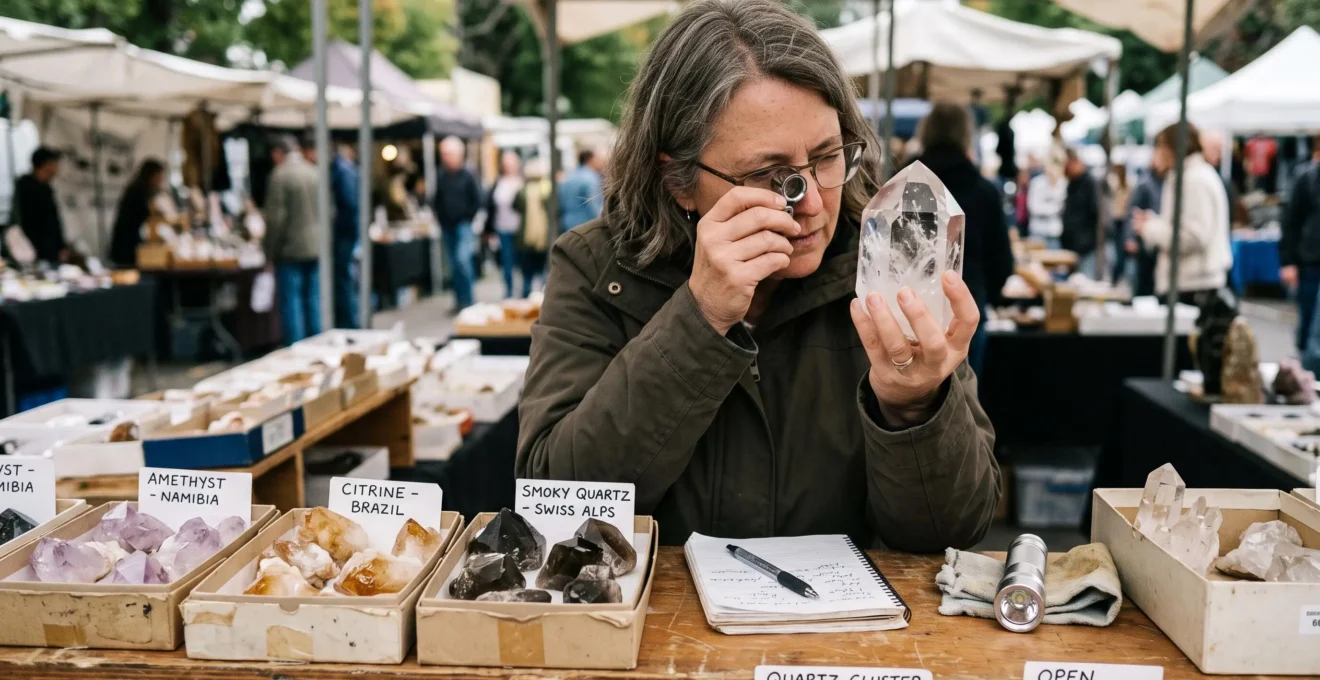
A purple crystal labelled amethyst, a golden cluster sold as natural citrine and a dark point described as smoky quartz might all belong to the same mineral species. Their colours tell part of the story, but they do not necessarily reveal whether the specimen has been heated, irradiated, dyed or coated.
The fastest practical approach to identifying macrocrystalline quartz is to work in layers. First, establish whether the material is consistent with quartz by examining its crystal habit and physical properties. Next, inspect its body colour, transparency and zoning in neutral daylight. Finally, examine inclusions and suspicious surface effects with a 10x loupe.
These checks help collectors separate reasonable variety identifications from treatment claims that require stronger evidence. They are particularly useful when comparing pieces at mineral fairs, evaluating online purchases or correcting labels in an existing collection.
The important distinction is between identifying what a stone is and proving how it acquired its appearance. The first is often possible at home; the second may require documentation or professional gemological examination.
Macrocrystalline quartz identification at a glance
- Confirm the mineral first: quartz has Mohs hardness 7 and commonly forms six-sided prisms with pyramidal terminations.
- Use daylight, transparency and colour zoning to distinguish amethyst, citrine and smoky quartz, but never treat colour as proof of natural origin.
- Inspect inclusions and coatings with a 10x loupe, then record treatment claims separately from the variety name.
- Why Is Quartz Variety Labelling So Messy at Fairs and Online, Even With Honest Sellers?
- How to Tell Amethyst, Citrine, and Smoky Quartz Apart Using 3 Simple Checks
- Display Cluster vs Facetable Quartz: Which Purchase Makes More Sense Under £100?
- The Mislabel Trap: Buying Coated or Treated Quartz as a ‘Rare Natural Variety’
- When Should You Label Quartz Specimens: At Purchase, After Cleaning, or After Display Setup?
- How to Narrow a Stone Down to Quartz Using Streak, Habit, and One Hardness Test
- How to Check for Bubble Clusters Using a 10x Loupe and One Torch Angle
- Do Gas Bubbles Always Mean Glass, or Can Natural Gems Have Them Too?
Why Is Quartz Variety Labelling So Messy at Fairs and Online, Even With Honest Sellers?
Quartz variety labels are inconsistent because mineralogical names, descriptive terms and commercial names serve different purposes. One seller may identify a specimen by its colour, another by its crystal habit, and another by a recognised trade name. These descriptions can coexist without proving dishonesty, although treatment claims and assertions of natural origin require separate verification.
Quartz is a mineral species composed of silicon dioxide, SiO2. Names such as amethyst, citrine and smoky quartz identify recognised varieties primarily associated with appearance. Commercial terms such as golden healer, candle quartz and strawberry quartz often emphasise visual features, inclusion patterns or selling traditions rather than separate mineral species.
A useful label therefore has three layers:
- Mineral species: quartz, the underlying mineral identity.
- Variety: amethyst, citrine, smoky quartz or another supported designation.
- Trade or descriptive name: a term such as golden healer, which may describe an appearance without establishing a unique mineralogical classification.
Confusion increases when treatments produce colours also found in nature. According to GIA’s citrine gemstone encyclopedia entry, natural citrine is rare, and most commercially available citrine results from heating amethyst. A heated specimen can genuinely be citrine while still requiring disclosure of its treatment history.
Green quartz presents a similar issue. Prasiolite may occur naturally, but green quartz can also be produced through treatment. Smoky coloration can likewise arise naturally or through artificial irradiation. A label naming the colour variety does not resolve which process occurred.
This distinction matters when comparing prices. Two sellers might accurately identify quartz but differ in how clearly they describe its treatment. A confident-sounding commercial name provides less evidence than a documented locality, clear photographs and an explicit treatment statement.
Once the mineral name and treatment claim are separated, the next useful question is what the specimen’s visible colour can reliably establish.
How to Tell Amethyst, Citrine, and Smoky Quartz Apart Using 3 Simple Checks
Amethyst, citrine and smoky quartz can usually be distinguished provisionally by checking their dominant colour, colour distribution and transparency in neutral daylight. Amethyst is violet to purple, citrine is yellow to orange, and smoky quartz is grey to brown or nearly black. These observations identify the likely variety but cannot independently establish whether the colour developed naturally.
Begin with a clean specimen, a neutral background and indirect daylight. Avoid judging colour beneath strongly yellow or coloured display lighting. Move the crystal slowly while keeping the light source consistent, so internal features can be compared without changing several viewing conditions at once.
- Check the dominant body colour. Violet or purple favours amethyst; yellow through brownish orange favours citrine; grey or smoky brown favours smoky quartz. Evaluate the interior rather than relying on reflections from polished faces.
- Inspect colour distribution. Look for angular zones, patches, bands, darker tips or changes across growth sectors. Amethyst commonly exhibits uneven violet coloration, while smoky quartz can display gradients or zones of varying darkness. Citrine can also show colour variation, so even coloration alone does not establish treatment.
- Compare transparency and internal features. Hold the specimen against a bright but diffuse light and rotate it. Determine whether apparent darkness comes from body colour, inclusions, surface coatings or a combination.
Rotating a crystal may reveal different colour intensities because of crystallographic orientation, optical effects or zoning. Amethyst can exhibit pleochroism, but a casual rotation test without controlled optical conditions should not be treated as a definitive way to distinguish naturally coloured material from heated or dyed quartz.
Consider a hypothetical collection containing a purple point with darker tips, an orange cluster with pale crystal bases and a transparent grey point. The first is consistent with amethyst, the second with citrine, and the third with smoky quartz. The orange cluster’s appearance may raise questions about heat treatment, but photographs and colour zoning cannot settle those questions conclusively.
Boundary cases deserve particular care. Smoky-amethyst may exhibit both violet and smoky coloration. Morion is a descriptive term for very dark smoky quartz. Commercial names such as lemon quartz can refer to material with different treatment histories and should not automatically be interpreted as natural citrine.
If a specimen shows conflicting colour characteristics, use a descriptive provisional label such as « quartz, violet-grey zoning; variety uncertain » rather than forcing it into a single category.
These checks can make an initial identification much more defensible, but they do not determine whether a particular specimen represents good value for the collector’s intended use.
Display Cluster vs Facetable Quartz: Which Purchase Makes More Sense Under £100?
Under a 100 £ budget, a display cluster generally makes more sense when crystal shape, visual impact and geological associations are the main priorities. Facetable quartz is more suitable when transparency, controlled colour and potential cutting quality matter most. Neither category is automatically better value: the sensible purchase depends on the characteristics that can be inspected and documented.
A display cluster may contain multiple visible points, growth variations, matrix and associated minerals. Such specimens can communicate more about crystal formation than a single polished stone. Their apparent size, however, should not substitute for checking damage, stability and possible surface treatments.
Facetable quartz places greater emphasis on usable transparent material. A rough piece may look attractive from the outside while hiding fractures, colour zoning or inclusions that limit its cutting potential. Buying existing faceted quartz reduces some uncertainties about the finished appearance, although it does not establish treatment history or natural origin.
The £100 threshold is a shopping budget, not a scientifically established valuation boundary. Actual offerings vary by variety, colour, locality, size, treatment, condition and seller. Without comparable current listings, no reliable size or carat-weight expectation can be assigned to that budget.
The following decision grid compares practical collecting priorities rather than predicted investment returns.
| Decision factor | Display cluster | Facetable quartz |
|---|---|---|
| Primary appeal | Natural crystal habit, associations and overall appearance | Clarity, attractive colour and cutting potential |
| Display impact | Often benefits from multiple visible crystals | Depends on transparency, presentation and finished cut |
| Handling risk | Exposed points and delicate matrix may be vulnerable | Loose stones need protection from chips and scratches |
| Verification difficulty | Crevices may conceal coatings or concentrated dyes | Transparent surfaces may make some inclusions easier to inspect |
| Resale considerations | Condition, provenance and specimen appeal matter | Cutting quality, colour, clarity and disclosure matter |
A useful hypothetical comparison is a visually impressive coated cluster offered for £80 versus a smaller, untreated-looking transparent quartz specimen at the same price. The cluster may be preferable as decoration. The smaller specimen may be more appropriate for studying internal features. Neither should be advertised as untreated without supporting evidence.
Be particularly cautious with aura-treated clusters and products using terms such as quantum quartz. Treatment is not inherently objectionable; paying a premium based on an unsupported natural-rarity claim is the problem.
Before purchasing, request photographs in neutral daylight and ask whether the specimen has been dyed, heated, irradiated or surface-coated. Keep any written seller response.
Once a specimen fits the budget and collecting goal, investigating artificial surface effects becomes an essential part of assessing its description.
The Mislabel Trap: Buying Coated or Treated Quartz as a ‘Rare Natural Variety’
The principal mislabelling risk with treated quartz is not the treatment itself but an unsupported claim that its appearance is naturally rare. Metal-oxide coatings, dyes, heating and irradiation can change quartz colour or surface appearance. Some treatments leave visible clues, but a loupe inspection usually supports suspicion rather than providing definitive proof of the process used.
GIA’s introduction to gemstone treatments documents surface coatings, quartz dyeing, irradiation and the vulnerability of certain thin-film coatings to scratching. These processes can produce attractive decorative material without creating a new mineral species.
Pay particular attention to the following combinations of commercial descriptions and visible characteristics:
- Aura quartz: an unusually vivid metallic or iridescent surface may indicate a deposited coating. Examine edges and crystal junctions for differences in surface appearance.
- Dyed crackle quartz: colour concentrated along networks of internal fractures can indicate dye penetration, especially when the surrounding quartz is relatively colourless.
- Intensely coloured citrine: strong orange or brownish-orange colour may warrant questions about heating, but colour intensity or uniformity cannot prove treatment.
- Angel or flame trade descriptions: determine whether the term refers to a coating, colour, crystal habit or seller-specific designation rather than assuming it denotes a naturally occurring variety.
The term fire quartz is especially ambiguous. It can describe naturally included quartz, including material with iron-oxide inclusions, and should not automatically be equated with dyed crackle quartz. The seller must clarify what the description means for the individual piece.
Clusters are harder to examine than accessible polished surfaces because mineral matrix, crevices and tightly packed crystal bases can conceal coating boundaries. Use a 10x loupe to inspect transitions between exposed faces and protected contact points. Irregular colour concentration is a warning sign, not a definitive diagnosis.
Ask one direct question: « Is the colour natural, or has this piece been heated, irradiated, dyed or coated? » A seller who cannot establish treatment history may still be selling legitimate quartz, but the uncertainty should remain explicit in the label and price assessment.
Durability also matters. Some thin-film coatings can scratch, especially along exposed edges. Certain dyes may be sensitive to cleaning conditions, while irradiation-treated quartz is not universally unstable under ordinary light. Avoid treating all processes as equally vulnerable.
Protect uncertain specimens from abrasion, excessive heat and aggressive cleaning until the treatment and appropriate care are better understood.
The most useful outcome is a documented treatment status, including uncertainty, which can then be carried forward into the specimen’s permanent collection record.
When Should You Label Quartz Specimens: At Purchase, After Cleaning, or After Display Setup?
Quartz specimens should be labelled in three stages: record the seller’s description at purchase, review the identification after safe inspection or cleaning, and finalise the display record once storage conditions are established. This preserves the original claims while allowing later observations to improve accuracy, without erasing uncertainty or inventing provenance.
At purchase, preserve the original trade name, stated variety, locality, treatment information, price and date. Photograph both the specimen and its original label. Distinguish what the seller said from what has been independently verified.
The second stage begins with inspection. Cleaning can reveal natural crystal surfaces, internal fractures or variations in appearance previously obscured by dust. However, cleaning should not be used as an improvised treatment-detection experiment: solvents, ultrasonic equipment and abrasive methods may harm coatings, fragile matrix or associated minerals.
Start with dry visual inspection and the least intrusive suitable cleaning method. If a coating is suspected, avoid unnecessarily testing its resistance by rubbing or scratching the surface.
At the display stage, record the conditions under which the specimen will be kept. Stable storage away from excessive heat, repeated handling and unnecessarily intense illumination is generally prudent when treatment history is uncertain.
Do not assume that all irradiated quartz fades in daylight or that heated citrine reverses colour under normal display conditions. Colour stability depends on material and treatment, and unsupported assumptions should not become collection records.
A useful label format is:
Species: Quartz | Variety: Citrine, provisional | Treatment: Heat treatment suspected, unconfirmed | Locality: Not verified | Recorded: 5 November 2026.
This is an illustrative label, not a documented specimen or an assertion about a particular stone.
Five actions for a traceable quartz specimen record
- Photograph the specimen alongside its original seller label; save both images with a matching specimen identifier.
- Transcribe the seller’s variety, locality and treatment claims into a dated record without changing their wording.
- Inspect the clean, dry specimen under neutral light and record three observations: body colour, zoning and visible crystal habit.
- Add a treatment-status field marked « disclosed », « suspected », « unknown » or « professionally verified », with supporting details.
- Attach the final label to the storage or display record and retain the original photographs for future comparison.
An effective record makes the difference between a confirmed mineral identity and an unverified treatment claim visible to future buyers, collectors and appraisers.
For a previously unlabelled stone, however, even the mineral species may still be uncertain. That foundational identification should come before assigning any colour variety.
How to Narrow a Stone Down to Quartz Using Streak, Habit, and One Hardness Test
To determine whether an unknown stone is consistent with quartz, examine its crystal habit, test its hardness against a suitable reference and check its streak where appropriate. Quartz commonly forms six-sided prisms with pyramidal terminations, has Mohs hardness 7 Mohs and produces a white streak. No single observation is sufficient to confirm every specimen, especially polished, massive or altered material.
Begin with crystal habit because it does not require damaging the stone. Well-formed macrocrystalline quartz commonly exhibits hexagonal prismatic crystals and characteristic terminations. Some specimens are doubly terminated, while others form massive aggregates without externally recognisable crystal faces.
The University of Minnesota’s quartz mineral reference describes quartz as silicon dioxide, with hardness 7, a white streak, conchoidal fracture and no cleavage. It also distinguishes visibly crystalline quartz from cryptocrystalline forms.
Chalcedony and agate belong within the broader quartz family but generally lack the large, readily visible individual crystals associated with macrocrystalline specimens. A coloured, banded, massive stone should therefore not automatically receive a macrocrystalline variety name.
For hardness testing, choose an inconspicuous area of a rough specimen. A known quartz reference is more informative than an ordinary glass surface because many minerals can scratch glass. A clear scratch made by the reference quartz on the unknown may indicate that the unknown is softer, although interpreting such results requires care.
Quartz can scratch common window glass and many steel objects, but neither test uniquely identifies quartz. Glass itself varies in composition and hardness, and apparent scratches may sometimes be removable material deposits. Avoid testing valuable polished specimens or using sharp tools in ways that risk injury.
The streak test needs equally careful interpretation. Quartz has a white streak, but because it is harder than many unglazed porcelain plates, it may scratch the plate rather than leave a useful streak of mineral powder. A white mark may represent damaged porcelain or debris, not a diagnostic quartz streak.
Glass imitation is another potential trap. Manufactured glass can be shaped to resemble a crystal and may show curved surfaces or bubbles, but visual appearance alone is insufficient to distinguish every example. Combine hardness, habit and magnified internal observations rather than relying on one scratch.
Once quartz is the most defensible identification, inspection of internal features can help identify possible glass imitations and clarify the remaining uncertainty.
How to Check for Bubble Clusters Using a 10x Loupe and One Torch Angle
To screen a quartz-like specimen for bubbles, hold a 10x loupe close to one eye, bring the stone into focus and illuminate it with a single small torch positioned at a low angle. Look for rounded cavities, angular fluid inclusions and repeated internal patterns. The technique improves observation, but the shape of one apparent bubble cannot conclusively establish natural or manufactured origin.
A loupe is most useful when the stone is clean, stable and translucent enough to transmit light. Begin with the torch directed obliquely through the specimen rather than straight into the eye. Keep the illumination direction fixed during the initial examination so that reflections and inclusion outlines can be compared consistently.
- Place the loupe close to the observing eye and keep the viewing position steady.
- Bring the stone towards the loupe until an interior area comes into sharp focus.
- Direct one torch beam through the specimen at a low, oblique angle, avoiding direct glare.
- Scan the interior slowly, identifying individual cavities, possible gas bubbles and other features.
- Record the observed shapes and distributions before adjusting the stone or light for a secondary examination.
Rounded gas bubbles may appear as bright or dark circular features depending on illumination. Angular cavities can be negative crystals: voids whose shape reflects the crystallographic structure of the host. Natural fluid inclusions may also contain a separate gas phase, making a small round bubble visible within a larger cavity.
Surface pits, dust and small chips may resemble inclusions when viewed from one direction. Check whether a suspicious feature remains in focus when examining deeper into the stone. A feature that follows the exterior surface rather than an internal focal plane should not automatically be interpreted as an enclosed bubble.
Gas-like or crescent-shaped features in other minerals can create additional confusion. Their interpretation depends on the host material, internal fractures and viewing conditions. Quartz itself has no cleavage, so apparent planar features should be examined rather than automatically attributed to cleavage.
The fixed torch angle is a practical starting condition, not a scientifically validated one-angle identification test. After documenting the first view, change the viewing direction if necessary to establish the shape and depth of the inclusion. A single two-dimensional view may make an angular cavity look rounded.
A negative result also proves very little. Clear quartz can contain few visible inclusions, while manufactured glass can contain no obvious bubbles. The absence of detectable spheres at 10x does not establish natural origin.
The observation becomes most meaningful when interpreted alongside the specimen’s hardness, growth features and possible treatment history.
Key takeaways before interpreting bubbles
- A rounded inclusion is a clue requiring context, not an automatic verdict of glass.
- The shape of the enclosing cavity and its relationship to growth or fracture features can be more informative than the bubble alone.
- When visual observations conflict, preserve the uncertain identification instead of assigning a confident natural-origin label.
Do Gas Bubbles Always Mean Glass, or Can Natural Gems Have Them Too?
No. Gas bubbles occur in manufactured glass, but natural gemstones can also contain gas trapped within fluid inclusions. The useful distinction is not simply whether a round feature exists, but how it is enclosed, where it occurs and whether it accompanies natural growth structures. Bubble observations must be combined with other evidence before identifying a quartz specimen.
During natural crystal formation, mineral-forming fluids can become trapped in microscopic cavities. Changes in the fluid’s conditions may allow a separate gas phase to develop inside the inclusion. These are commonly described as two-phase inclusions when liquid and gas are present together.
A natural quartz crystal can therefore contain a rounded gas bubble inside an angular cavity. The outer cavity may resemble a small crystal shape, while the internal bubble appears circular under magnification.
By contrast, manufactured glass may contain rounded gas bubbles associated with curved flow structures. Such a combination can raise suspicion, particularly when the specimen also lacks credible quartz crystal habit or shows physical properties inconsistent with quartz.
Some synthetic gemstones, including material produced by flame-fusion methods, can also contain rounded bubbles. Consequently, bubbles do not identify a single manufacturing process or prove that an object is ordinary glass.
There are important limitations. Natural fluid inclusions do not always have easily visible angular boundaries, and not every spherical feature in a gemstone can be classified confidently with a 10x loupe. Curved patterns and bubble-like features also require careful interpretation because their appearance can depend on the viewing direction and surrounding material.
The most useful diagnostic distinction is between three possibilities:
- Possible manufactured glass: rounded bubbles accompanied by curved flow features and other properties inconsistent with quartz.
- Possible natural fluid inclusion: a gas bubble enclosed within a larger cavity, potentially with angular boundaries and related growth structures.
- Indeterminate observation: a rounded feature whose depth, cavity shape or relationship to surrounding structures cannot be established.
For an indeterminate specimen, return to the layered identification process. Confirm the material’s likely mineral species, inspect crystal morphology, document its dominant colour and zoning, and compare the inclusion pattern with the remaining evidence.
A specimen that passes these checks may be confidently described as consistent with quartz, while its natural origin or treatment history remains unverified. For an expensive purchase, a disputed provenance claim or a specimen with contradictory properties, professional gemological examination is the appropriate next step.
For the next unlabelled specimen in your collection, photograph the crystal in neutral daylight, inspect it with a loupe and write down the observed features separately from the seller’s claims. A precise provisional label is more useful than a definitive-sounding name unsupported by evidence.
Can natural citrine be confirmed using colour alone?
No. Yellow-to-orange coloration supports identification as citrine when the mineral is quartz, but it cannot establish whether the colour is natural or heat-induced. Treatment documentation or specialist examination may be needed to support a natural-origin claim.
Does a quartz crystal need a visible hexagonal point to be genuine?
No. Quartz can occur as well-formed crystals, broken crystal fragments or massive material without externally visible crystal faces. Crystal habit is particularly useful when preserved, but its absence does not disqualify a specimen from being quartz.
Can a 10x loupe prove that quartz has not been treated?
No. A loupe may reveal dye concentration, coating irregularities or internal features that warrant investigation. However, some heat and irradiation treatments cannot be established or excluded through ordinary magnified visual inspection.
Should a collector remove an inaccurate seller label?
Preserve the original label as part of the specimen’s history, but distinguish it from the current identification. A revised collection record can state the supported species, provisional variety, known or suspected treatment and reliability of the stated locality.
When is professional identification worth requesting?
Professional examination is most useful when the specimen is valuable, its identity affects a purchasing decision, or its treatment or origin is disputed. Non-destructive laboratory methods may provide evidence unavailable from daylight observation, hardness checks and a hand loupe.