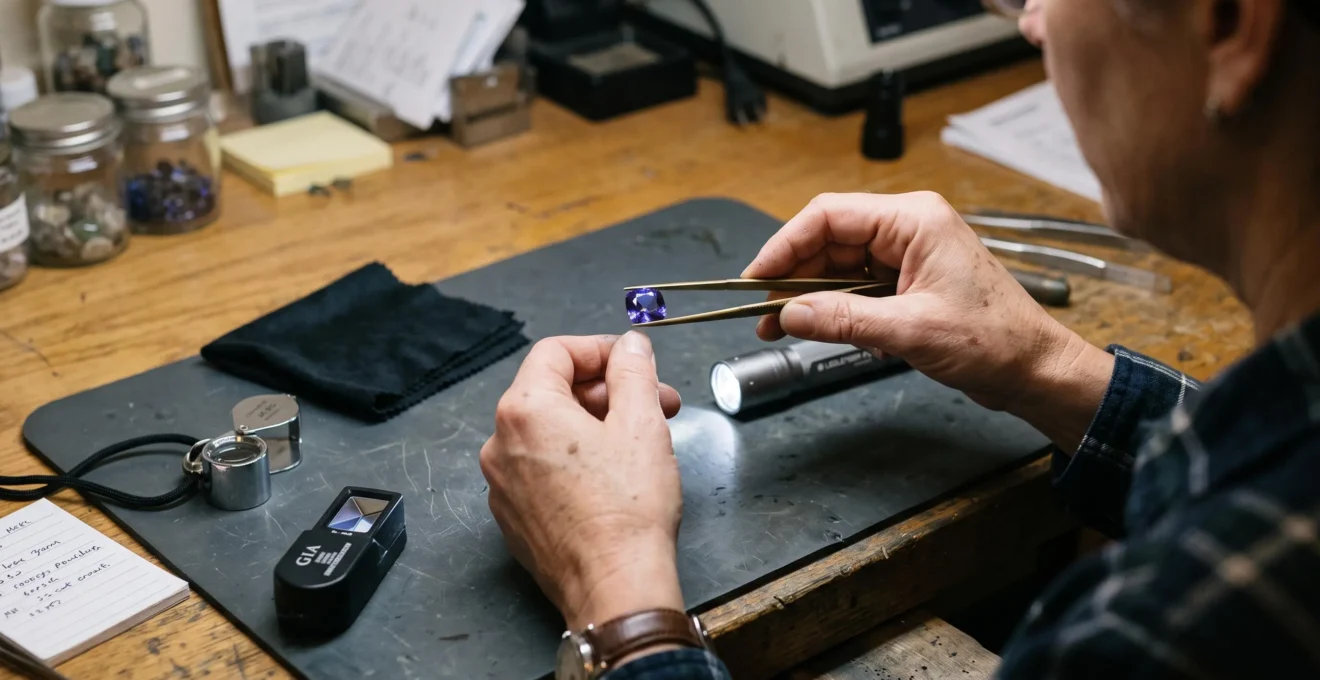
Two gemstones can look almost identical under a jewellery counter’s lighting and behave very differently when examined from another angle. A blue stone might be sapphire, tanzanite or iolite. Its colour alone rarely settles the question, but its reaction to light can quickly eliminate some possibilities.
Pleochroism is often the fastest useful optical clue when a suitable gemstone can be tilted under a focused light. For a more objective comparison, a measured refractive index (RI) is generally more discriminating, provided the stone and equipment permit a reliable reading. Neither property identifies every gemstone on its own.
The practical advantage is that collectors can begin with a clean stone, a small torch and a 10× loupe. A short examination can reveal directional colour differences, possible facet doubling and inclusions worth investigating. It can also reveal when further testing is necessary.
The purpose is not to turn every collector into a laboratory gemologist. It is to make the first observation more informative, reduce mistaken assumptions and recognize when the evidence is too weak to support a purchase.
Gemstone optical identification: the essentials
- Fastest visual clue: Check pleochroism by tilting a transparent gemstone under consistent lighting. A directional colour change can narrow the possibilities.
- Stronger numerical test: A properly measured refractive index can eliminate candidates whose known RI ranges do not match.
- Critical limitation: Home optical tests cannot reliably settle every question about identity, natural versus synthetic origin, or treatment history.
- Why Is Colour the Least Reliable Trait for Identification Compared With Optical Behaviour?
- How to Do a 4-Minute Optical Check at Home Using a Loupe and One Torch?
- Refractive Index vs Pleochroism: Which Tells You More When the Stone Is Mounted?
- The Misread That Makes People ‘See’ Birefringence That Isn’t There
- When Are Optical Clues Enough to Buy, and When Should You Stop and Get a Lab ID?
- How to Use RI Ranges to Narrow 5 Lookalike Stones Down to 2 in Under 3 Minutes?
- Refractometer vs Polariscope: Which Tool Solves More Problems for a Beginner on a Budget?
- How Do You Get a Reliable Refractometer Reading When the Stone Is Small or Mounted?
Why Is Colour the Least Reliable Trait for Identification Compared With Optical Behaviour?
Colour is a weak standalone identification criterion because different gemstone species can share almost identical hues, while lighting, treatments and viewing orientation change how those hues appear. Optical behaviour is often more informative because properties such as refractive index and pleochroism reflect the stone’s interaction with light. However, no optical property is universally diagnostic without supporting evidence.
Imagine three transparent blue gemstones on a display tray: tanzanite, blue sapphire and iolite. From directly above, their colours may overlap enough to confuse an inexperienced buyer. Looking at the stones from different directions can reveal differences that the initial face-up comparison conceals.
According to GIA’s description of tanzanite pleochroism, tanzanite can show blue and violet colours when tilted. Its appearance also responds to illumination: cooler lighting can emphasize blue, while warmer lighting can emphasize violet or purple.
Iolite provides another useful example. Its directional colours can differ substantially, sometimes approaching a colourless or yellow appearance from certain orientations. Blue sapphire can also show pleochroism, so the presence of directional colour variation does not automatically distinguish tanzanite from sapphire.
Colour treatments further complicate identification. Heating can change the visible colour components of tanzanite, while diffusion and irradiation are relevant to the appearance of certain other gemstones. The colour seen in a shop is therefore not necessarily an untreated mineral’s original appearance.
A practical ranking of observations helps collectors choose what to examine first. It is a workflow, not a scientifically established universal hierarchy of accuracy.
| Property | What it reveals | Main limitation |
|---|---|---|
| Body colour | Initial group of plausible gemstones | Strong overlap between species and sensitivity to illumination |
| Lustre and transparency | Surface appearance and transmission of light | Influenced by polish, cutting and condition |
| Pleochroism | Directional differences in colour | May be weak or hidden by viewing orientation |
| Dispersion | Separation of light into spectral colours | Appearance depends heavily on cut and lighting |
| Refractive index | Numerical optical measurements for comparison with reference ranges | Requires suitable equipment, contact and interpretation |
Rather than choosing a gem solely because its colour resembles a known specimen, start with its visual behaviour and move toward measurements when available. This approach reduces the influence of shop lighting and prior expectations.
The next step is to translate that principle into a short examination that works without a professional laboratory.
How to Do a 4-Minute Optical Check at Home Using a Loupe and One Torch?
A four-minute home optical check can provide useful identification clues by combining consistent lighting, directional colour observation, a cautious doubling test and 10× magnification. It works best with a clean, loose, transparent gemstone. The result should be a shortlist of plausible identities, not a definitive identification or an assessment of natural versus synthetic origin.
Prepare a neutral background, a small white-light torch, a clean 10× loupe, tweezers and a sheet printed with fine straight lines. Wipe away fingerprints and dust with a material suitable for the gemstone. Keep the light source and background consistent so changes in appearance are easier to interpret.
- 0:00–0:45 — Establish the visible colour. Examine the stone under ordinary white illumination, then with the torch. Record the dominant hue, transparency and whether the lighting noticeably changes its appearance. A lighting-dependent shift is not, by itself, pleochroism.
- 0:45–1:45 — Check directional colour. Hold the torch steady and gently rotate and tilt the stone. Look for repeatable colour differences linked to viewing orientation. Do not mistake fixed patches of uneven colour for directional pleochroism.
- 1:45–2:30 — Look for possible doubling. Position a suitable transparent stone over a fine printed line and look through its table. Some strongly birefringent gemstones may show two distinguishable images. Reflections and facet geometry can create misleading effects.
- 2:30–3:30 — Examine under magnification. Use the 10× loupe to inspect visible inclusions, surface condition, facet junctions and possible colour concentrations. Describe observations without assigning an origin to an unfamiliar inclusion.
- 3:30–4:00 — Record the outcome. Write down which observations were repeatable, which candidate stones remain plausible and which tests were inconclusive.
The four-minute schedule is a convenient observational framework, not a validated identification time. Beginners may need longer, particularly when the stone is small, dark, heavily included or mounted.
One common mistake is interpreting every visible change as a mineral property. Rotating a stone also changes its internal reflections, the amount of light returned by individual facets and sometimes the direction from which colour zoning is seen. Repeat observations at several angles before treating a colour difference as meaningful.
The procedure is particularly limited when the mounting hides the pavilion or prevents the stone from being viewed through different directions. A negative result under those conditions offers little evidence.
Complete your five-point optical observation record
- Clean the gemstone and document the lighting conditions; produce one baseline photograph or written colour description.
- Rotate the stone through accessible viewing directions; record whether any directional colour difference is repeatable.
- Examine a fine printed line through the stone where possible; record visible doubling, no visible doubling or an inconclusive result.
- Inspect the stone at 10× magnification; record at least one observable inclusion, surface feature or the absence of a clearly visible feature.
- Compare the observations with your candidate list; produce a shortlist that separates supported possibilities from unresolved questions.
Once the observations are recorded, the next question is whether a mounted stone can provide enough access for more discriminating optical measurements.
Refractive Index vs Pleochroism: Which Tells You More When the Stone Is Mounted?
For many mounted transparent gemstones, pleochroism is the more accessible first test because it can sometimes be observed without removing the stone. Refractive index generally offers more specific numerical evidence, but a standard refractometer needs suitable contact with a polished facet. Some open settings permit a reading; others make reliable measurement impractical.
The difference is straightforward. Refractive index expresses how light propagates through a material relative to a reference medium. A conventional gem refractometer measures critical-angle behaviour at a particular facet. In a doubly refractive stone, readings can vary with orientation, and multiple measurements may be needed to characterize its optical properties.
Pleochroism, in contrast, concerns the different colours that some anisotropic gemstones transmit along different crystallographic directions. It is generally a qualitative observation unless specialized measurement methods are used.
A ring setting creates a practical access problem. Prongs may leave the crown visible while a closed back conceals the pavilion. A refractometer reading may still be possible if a sufficiently accessible, flat, polished facet can contact the instrument correctly. The presence of a mounting alone does not make measurement impossible.
| Condition | Pleochroism | Refractive index |
|---|---|---|
| Open, accessible setting | Often observable by tilting | May be measurable if a suitable facet can contact the instrument |
| Closed-back setting | May remain observable from the crown | Often difficult; depends on facet accessibility |
| Loose transparent stone | Multiple orientations can be examined | Usually the better opportunity for repeated readings |
| Opaque or very dark stone | Often limited or unavailable | May remain possible on an accessible polished facet, depending on RI range |
Consider a mounted blue stone suspected to be tanzanite. Repeatable blue and violet directional appearances could support that possibility. However, a blue sapphire can also be pleochroic, and the orientation of either stone may make its colour differences difficult to observe.
The inference becomes stronger when the observed optical behaviour is combined with other relevant evidence. Surface lustre and apparent face-up appearance may be recorded, but they are not substitutes for a measured RI. Specific gravity is a separate measurable property, not something that can reliably be inferred from how heavy a mounted stone feels.
GIA’s professional training materials describe combined use of instruments including refractometers, dichroscopes, polariscopes and magnification equipment. That complementary approach matters especially when mounting geometry restricts individual tests.
Even when the stone is loose, visual clues require careful interpretation. Apparent doubling is one of the easiest effects to misread.
The Misread That Makes People ‘See’ Birefringence That Isn’t There
The most common visual mistake is treating any doubled line or facet edge as proof of birefringence. Reflections from different facets, distortion introduced by a loupe and the geometry of a cut gemstone can imitate doubling. Genuine birefringence is a material property, and its visible effect must be distinguished from ordinary reflected or displaced images.
Birefringence occurs when light travelling through an anisotropic material can experience different refractive indices depending on its polarization and propagation direction. Under suitable conditions, this can produce two separated images when viewed through a gemstone.
Some strongly birefringent stones, including certain zircons, peridot, rutile and titanite, may display visible doubling of pavilion facet junctions or transmitted details. The effect is not equally obvious in every specimen or direction.
A collector inspecting a stone with a loupe may notice what looks like two parallel facet outlines. That is worth investigating, but it is not yet a measurement. A reflection from a neighbouring facet can produce a second apparent edge, and the loupe itself can add distortion near the edge of its field of view.
To investigate suspected doubling, look through the gemstone itself rather than interpreting reflections from its sides. Where the cut and transparency permit it, place the stone above a fine printed line or small point. Keep the observation centred, alter the viewing angle cautiously and check whether the apparent separation behaves consistently.
Even a correctly performed visual test has important limitations:
- Looking close to an optic-axis direction can make birefringent behaviour difficult to observe.
- A small stone may not provide a long enough optical path for clearly separated images.
- Strong colour, inclusions or complex facet reflections may obscure transmitted details.
- An optically anisotropic gemstone can show birefringence without producing obvious eye-visible doubling.
For this reason, not seeing doubling is not proof that a gemstone is singly refractive. Likewise, seeing a double outline is insufficient to identify its species.
A further distinction matters when comparing tanzanite and sapphire. Both can be doubly refractive; neither can be assigned or excluded solely because a beginner notices—or fails to notice—two outlines through a loupe.
The financial consequence can be significant if an ambiguous observation is treated as confirmation of a valuable identity. A visual clue should help decide which instrument or professional test is needed next, not justify a price difference by itself.
The same restraint applies to purchase decisions: useful optical clues may narrow the possibilities without resolving the most valuable questions.
When Are Optical Clues Enough to Buy, and When Should You Stop and Get a Lab ID?
Optical clues may be sufficient for a low-value purchase when the buyer understands the uncertainty and the remaining candidate stones have clearly different properties. They are not enough when a significant price depends on natural origin, treatments, synthetic status or a precise variety. For certification-dependent purchases and important resale claims, independent laboratory identification is the safer approach.
A simple three-level decision framework helps separate an acceptable collecting risk from a purchase that requires stronger evidence.
| Purchase situation | Recommended approach | Reason |
|---|---|---|
| Low-value educational specimen | Use optical screening with uncertainty disclosed | A mistaken identity may be an acceptable collecting risk |
| Valuable gem or uncertain treatment status | Seek professional assessment or an appropriate laboratory report | Visual characteristics may overlap despite major differences in value |
| Certificate-dependent purchase or resale claim | Obtain a report addressing the specific claims that matter | Independent documented findings provide stronger evidence than home observations |
Natural and laboratory-grown specimens of the same gemstone species can share essential optical properties. For example, a refractive-index measurement consistent with corundum does not, by itself, establish whether a ruby is natural or synthetic.
Inclusions can provide useful evidence, but their interpretation may require microscopy and specialized expertise. Treatments can also be difficult to recognize with basic tools.
As explained in GIA’s historical review of gemological analytical techniques, increasingly sophisticated gemstone synthesis and treatment methods have driven the use of more advanced analytical instrumentation. Traditional observation remains valuable, but difficult questions may require specialized laboratory methods.
For a high-value purchase, the practical question is whether the cost of uncertainty exceeds the cost of professional testing. There is no universal price threshold: laboratory fees depend on the institution, specimen, requested analyses and reporting service.
Organizations such as GIA, SSEF and Gübelin offer gemological laboratory services, but their report types and scopes differ. Before commissioning an examination, verify that the selected service addresses the identity, treatment, natural-versus-synthetic distinction or origin question relevant to the purchase.
For example, suppose a seller offers a blue gemstone at a price justified by a claimed high-value identity, while optical screening leaves several plausible alternatives. This is a hypothetical purchasing scenario, not a documented case. A laboratory report becomes economically relevant because the purchase price depends on a claim that the available observations have not established.
Do not attempt aggressive cleaning, destructive testing or removal from a setting merely to improve access. Some gemstones and jewellery constructions are vulnerable to handling and chemical exposure.
For lower-risk collecting, a refractive-index comparison can still improve a shortlist substantially, provided the numerical readings are obtained and interpreted correctly.
How to Use RI Ranges to Narrow 5 Lookalike Stones Down to 2 in Under 3 Minutes?
To narrow five lookalike gemstones using refractive index, obtain a reliable reading, compare it with published RI ranges for all five candidates and eliminate those whose known values are incompatible. Overlapping ranges remain unresolved. An experienced user may complete this screening quickly, but three minutes is an illustrative target, not a guaranteed identification time.
The method works because different gemstone materials interact with light differently, producing characteristic refractive-index values or ranges. The strongest use of an RI reading is often exclusion: it can show that a proposed identity is inconsistent with the observed measurement.
For a doubly refractive gemstone, the refractometer may show two shadow edges. Depending on the stone’s orientation and optical properties, rotating it and repeating readings may reveal different limiting values. The separation between appropriate readings can help assess birefringence.
An indistinct shadow edge, insufficient contact liquid or incorrectly positioned gemstone can undermine the measurement. A single poorly resolved number should never be treated as reliable enough to exclude multiple candidates.
Consider a hypothetical tray of five red or pinkish-red stones labelled as possible ruby, almandine garnet, red spinel, pink tourmaline and coloured glass. Their overlapping appearance makes colour-based identification uncertain, while numerical optical information can separate some candidates.
Hypothetical example: screening five red gemstones
A collector takes a repeatable refractometer reading on a loose red gemstone, then compares the observed shadow edge or edges against a reliable gemological reference table for the five candidates. The numerical reading is not specified here, so no particular candidate can legitimately be eliminated in advance.
Suppose the comparison leaves two candidates with compatible published RI characteristics. The collector then investigates other separating properties, including pleochroism, optical character, inclusions and, where appropriate, measured specific gravity. The reduction from five possibilities to two is the intended demonstration, not a documented experimental result.
Glass deserves particular caution because it is not a single material with one refractive index. Different glass compositions may have different values, so comparing against one assumed universal glass RI would be misleading.
Similarly, garnet compositions and tourmaline varieties can span ranges rather than one fixed number. Reference ranges must correspond to the appropriate material and must account for measurement uncertainty.
The process is fastest when the specimen is clean and loose, an accessible flat facet provides contact, the user already knows how to locate a shadow edge, and reference information is available before testing.
For beginners, repeatability matters more than speed. Record each credible reading, check whether the shadow boundary changes as expected during rotation and resist rounding an ambiguous result to match a preferred identity.
When numerical testing becomes the main objective, choosing the right first instrument can save more frustration than attempting to make every test faster.
Refractometer vs Polariscope: Which Tool Solves More Problems for a Beginner on a Budget?
A polariscope is often the more accessible starting instrument for learning optical character, while a refractometer generally provides more specific identification evidence through numerical RI readings. Neither replaces the other. The polariscope helps classify optical behaviour; the refractometer helps compare observed values with known gemstone properties, provided the stone is suitable for measurement.
A polariscope uses polarizing filters and illumination to examine how light behaves through a transparent specimen. It can help distinguish isotropic materials from anisotropic ones, although observations may be complicated by orientation, strain, inclusions and aggregate structure.
For example, spinel and garnet are isotropic in ideal optical behaviour, while many familiar gem minerals, including corundum and tourmaline, are anisotropic. This distinction can narrow the possibilities before a numerical measurement is attempted.
However, an anisotropic gemstone observed along an optic-axis direction may appear dark during rotation, potentially resembling an isotropic material. Some isotropic materials can also show anomalous effects associated with strain. Multiple orientations and careful interpretation are therefore necessary.
| Criterion | Polariscope | Refractometer |
|---|---|---|
| Main output | Observed optical behaviour and character | Numerical refractive-index readings |
| Best beginner use | Learning to separate broad optical categories | Comparing measurable stones with published RI data |
| Stone requirements | Generally requires useful light transmission | Requires accessible polished facet contact |
| Consumables | Generally no RI contact liquid | Usually requires an appropriate contact liquid |
| Typical difficulty | Simple to operate, but interpretation has pitfalls | More demanding alignment, handling and reading technique |
| Identification precision | Primarily a classification clue | Often more discriminating, but not unique for every material |
A basic polariscope may cost less than a gemological refractometer, but actual purchase prices depend on instrument design, optical quality and supplier. No universal cost or reliability comparison follows from the equipment’s function alone.
An effective combined workflow is to examine a transparent stone under the polariscope, rotate it through suitable orientations, then use the refractometer when a reliable facet contact is available. The two observations can either support one interpretation or reveal an inconsistency requiring further investigation.
The equipment list in GIA’s Gem Identification Lab Class illustrates this complementary approach. Practical training includes refractometers, polariscopes, dichroscopes, magnification tools and other instruments rather than a single all-purpose test.
The same training documentation identifies RI contact liquid rated at 1.81 and warns that handling precautions may be necessary for people with certain medical conditions or chemical sensitivities. Chemical safety instructions and the manufacturer’s guidance should be checked before use.
A refractometer becomes most valuable once the operator can obtain consistent readings, including from specimens whose small size or mounting makes contact challenging.
Key takeaways before measuring a difficult gemstone
- A numerical RI value is useful only when the observed shadow edge is sufficiently clear and repeatable.
- Small facets and obstructive mountings can prevent reliable contact even when an instrument is available.
- A reading beyond the instrument’s measurable range must be reported as a limitation, not converted into a guessed value.
How Do You Get a Reliable Refractometer Reading When the Stone Is Small or Mounted?
Reliable refractometer readings require a suitable flat polished facet, correct optical contact, controlled illumination and careful interpretation of the shadow edge. Small gemstones reduce the available contact area, while settings may obstruct access to useful facets. If the shadow edge cannot be obtained consistently, report the measurement as inconclusive rather than assigning a precise RI.
In a standard gemological refractometer, the gemstone is brought into optical contact with the instrument’s measuring surface using a suitable high-index liquid. The operator observes a shadow boundary and reads its position against the calibrated scale.
For small loose stones, select the largest accessible flat polished facet. The table is often a practical choice, although another facet may be more suitable depending on the cut and the required orientation. Use only the amount of contact liquid appropriate to the instrument manufacturer’s procedure.
Excess liquid does not compensate for a poorly aligned stone and may complicate handling. Care is also needed to protect the measuring surface from scratches when placing, rotating and removing gemstones.
Correct lighting matters. The instrument’s prescribed illumination arrangement, often using a suitable directed light source, should create a clearly distinguishable shadow edge. Keep the eye aligned with the viewing system and avoid interpreting a blurred transition as an exact reading.
With a mounted gemstone, first inspect which facets are actually accessible. An open prong setting may expose a crown facet capable of contacting the instrument, while a deep protective bezel or other mounting geometry may prevent correct positioning.
A closed pavilion does not necessarily rule out measuring an accessible crown facet. What matters is whether the chosen polished surface can meet the refractometer correctly without the setting interfering or risking damage.
If metal reaches the instrument before the gemstone achieves suitable contact, the reading should not be forced. Removing a valuable stone from jewellery is a job for a qualified professional, with the risks to the gemstone and mounting assessed beforehand.
When an adequate measurement is possible, rotate the specimen according to the instrument’s operating procedure and record any credible changes in shadow-edge position. Repeat readings to distinguish genuine optical variation from movement or poor contact.
Another limitation is the instrument’s upper measurable RI range. Many conventional gemological refractometers have a practical upper limit around the RI 1.81 range, depending on their design and contact liquid. A gemstone beyond that limit cannot be assigned a precise higher RI merely from its failure to produce an in-range reading.
For a high-index candidate, record the result as above the instrument’s measurable limit when that interpretation is justified. A suitable professional technique or laboratory examination may be necessary to continue.
Finally, observe the contact liquid’s safety precautions. Avoid skin and eye exposure, use appropriate ventilation where required, consult the safety documentation and follow any special warnings relevant to chemical sensitivities or medical conditions.
A reliable approximate reading is better than false precision. If the facet is tiny, the boundary is unclear or the mounting restricts contact, describe those conditions alongside the observed value rather than presenting an unsupported exact result.
For your next unfamiliar gemstone, start with a clean specimen, note its directional colour behaviour and record only the observations you can repeat. Compare them with reliable reference information, then seek professional identification whenever the remaining uncertainty could materially affect what you pay or claim about the stone.
Can two different gemstones have the same refractive index?
Yes. Different gemstone materials can have overlapping refractive-index ranges. A matching RI is useful evidence, but it does not automatically establish a unique identity. Additional optical, physical or laboratory observations may be needed to distinguish candidates.
Can pleochroism disappear after a gemstone is heat treated?
Heat treatment can alter the visible colour components of certain gemstones and consequently change how their directional colours appear. In tanzanite, heating commonly reduces yellow-green or brownish contributions. However, treatment-related changes in appearance should not be interpreted as a universal elimination of pleochroism.
Does a stone that stays dark in a polariscope have to be glass or spinel?
No. An anisotropic crystal observed along an optic-axis direction may behave in a way that resembles an isotropic material during a particular observation. Strain effects and the specimen’s structure can also complicate interpretation. Rotate and reorient a suitable specimen before drawing conclusions.
Can a loupe reveal whether a sapphire is natural or laboratory-grown?
A loupe may reveal inclusions or other features worth investigating, but it cannot reliably determine natural or laboratory-grown origin in every sapphire. Natural and synthetic corundum share fundamental mineral properties, while confident identification may require expert microscopy and additional analytical techniques.
Is a gemstone laboratory report the same as a value appraisal?
No. A gemological report addresses the characteristics covered by its examination, such as gemstone identity or selected treatment and origin questions. An appraisal concerns value for a stated purpose. Buyers should confirm the exact scope of either service rather than assuming that identification automatically establishes market value.