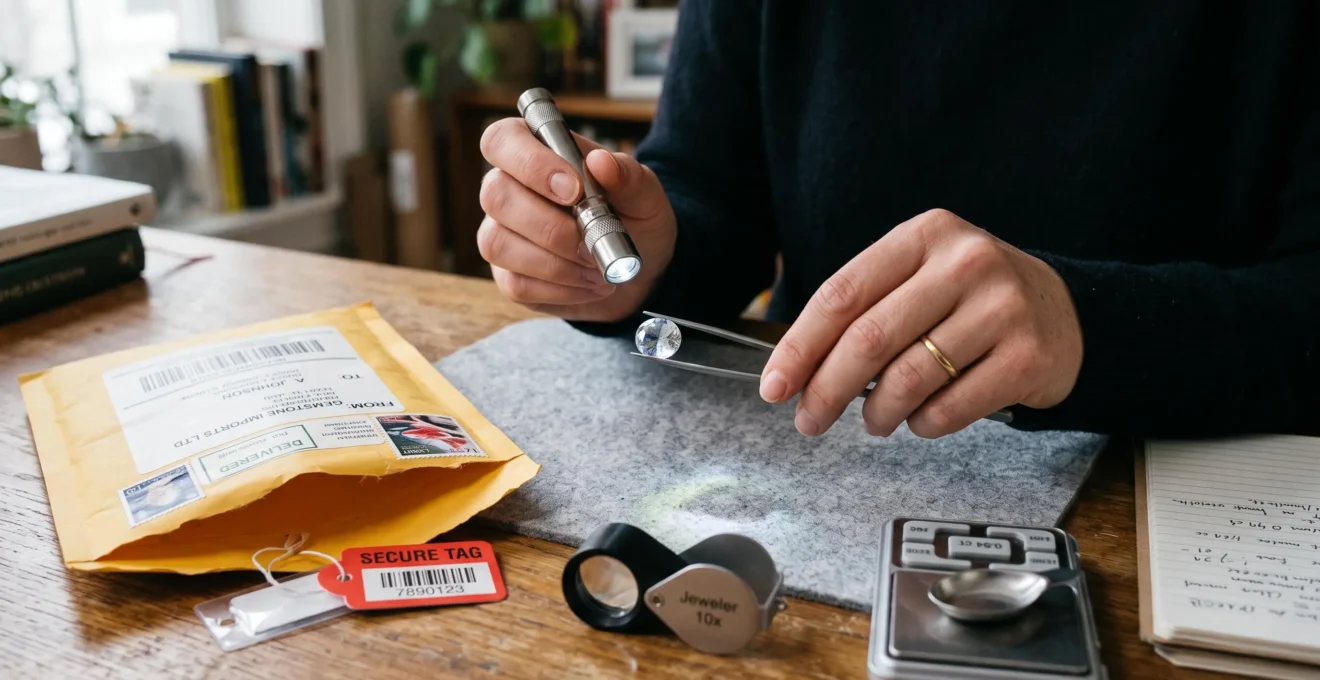
The most useful gemstone test is not necessarily the most sophisticated. When an online purchase arrives with a limited return period, the priority is to gather reliable evidence without scratching the stone, altering its condition or compromising your ability to return it.
Start with the listing and its supporting documents. Then examine the gemstone under controlled lighting using a torch and a 10× loupe. If the results leave competing identifications plausible, consider optical instruments, ultraviolet fluorescence or specific gravity measurements where appropriate. Each test should answer a specific question rather than simply produce another observation.
This approach can expose inconsistencies, narrow the possible gemstone species and help determine whether independent laboratory verification is justified. It cannot reliably establish every treatment, geographic origin or natural-versus-laboratory-grown distinction at home.
The practical goal is therefore enough evidence to make a timely buying decision, not an unsupported promise of laboratory-level certainty.
Non-destructive gemstone testing: the essentials
- Begin with documentation, visual inspection and a loupe before introducing specialist equipment.
- Use independent observations to narrow possible identities; never treat UV fluorescence, magnetism or facet doubling as definitive proof.
- Check the return deadline before opening the parcel, and escalate unresolved high-value purchases to an independent laboratory while a practical remedy remains available.
- Why Do Scratch Tests Create More Problems Than Certainty for Most Gem Buyers?
- How to Do a 20-Minute Non-Destructive Test Routine the Day Your Gem Arrives?
- £50 Tool Kit vs £200 Tool Kit: Which Non-Destructive Tools Actually Change Your Accuracy?
- The False-Proof Mistake: Treating UV or Magnet Response as Definitive Identification
- In What Order Should You Run Non-Destructive Tests to Avoid Chasing the Wrong Answer?
- How to Authenticate an Online Gem Listing Using a 7-Point Evidence Checklist?
- How to Do a 4-Minute Optical Check at Home Using a Loupe and One Torch?
- Which Optical Property Is the Fastest Way to Tell Two Lookalike Gems Apart?
Why Do Scratch Tests Create More Problems Than Certainty for Most Gem Buyers?
Scratch tests are a poor choice for purchased gemstones because they can permanently damage a finished stone while providing limited identification evidence. A gemstone that scratches glass is not automatically genuine, natural or correctly described. For buyers facing a return deadline, optical examination and other non-destructive screening methods are safer starting points.
The familiar scratch test relies on relative hardness: a harder material can scratch a softer one under suitable conditions. This principle is useful in mineral identification, but it becomes risky when applied to a polished gemstone that must remain in its received condition.
A successful scratch may mark the test surface, while an unsuccessful or poorly controlled attempt can damage the gemstone itself. Brittle stones can also chip or fracture when pressure is applied. The International Gem Society’s article on destructive scratch testing specifically warns against performing such tests on finished stones.
Hardness is not identity. Several different gemstones and simulants can scratch ordinary glass. Observing that behaviour does not establish whether a stone is natural, synthetic, treated or even the species claimed in its listing.
Conversely, a genuine but relatively soft stone, such as fluorite, may be damaged by an inappropriate test. Tanzanite also requires careful handling because its physical durability cannot be reduced to its Mohs hardness alone.
Professional mineral testing may occasionally involve hardness assessments on suitable rough samples. That does not make a scratch test appropriate for a finished gem with potential resale or return value.
Replace the scratch-test question with a more specific investigation:
- Could this be glass? Examine inclusions, surface features and optical behaviour under magnification.
- Which mineral species is plausible? Compare refraction, pleochroism and other relevant gemmological properties.
- Does its density match the claimed material? Consider a controlled specific gravity measurement if the stone and return conditions permit it.
- Is the gem natural or treated? Check available documentation and seek laboratory analysis when standard observations cannot settle the question.
These alternatives are not individually conclusive, but they avoid deliberately trying to damage either the gemstone or a test surface. Some also require specialised equipment or experienced interpretation.
Preserving the stone’s condition gives you more options. The next step is to organise those safer observations into a routine that fits inside your actual return period.
How to Do a 20-Minute Non-Destructive Test Routine the Day Your Gem Arrives?
A practical 20–minute arrival routine has three stages: document the unopened parcel and its contents, inspect the gemstone under controlled lighting, and perform only the instrumental checks you can interpret reliably. Finish by recording discrepancies and deciding whether to keep, return or seek professional verification before the seller’s deadline.
The 20-minute schedule below is a buyer’s organisational framework, not a laboratory-validated identification procedure. Its purpose is to protect evidence and reveal obvious inconsistencies without unnecessary handling.
Before minute zero: confirm the return deadline, how returns must be initiated, and whether inspection, detached tags or opening sealed packaging affects eligibility. Requirements differ among sellers and jurisdictions; do not assume a general right to test the stone in any manner.
| Time | Action | Evidence to retain |
|---|---|---|
| 0–3 minutes | Photograph the unopened parcel, shipping label and seals. | Images of packaging condition and delivery details. |
| 3–6 minutes | Record the unboxing where permitted; preserve labels, tags, certificates and packaging. | Continuous video and photographs of supplied documents. |
| 6–10 minutes | Compare the stone with the listing under neutral lighting; inspect it with a torch and loupe. | Notes on colour, apparent transparency, inclusions and visible damage. |
| 10–16 minutes | Perform a relevant non-contact optical test; add a safe instrumental check only if justified. | Observations, instrument details and any inconclusive results. |
| 16–20 minutes | Compare findings with the description and decide on the next action. | A dated keep, return or laboratory-verification decision. |
Throughout the routine, leave attached tags in place. Do not clean, mount, resize, scratch, polish or modify the gemstone. Avoid liquids, immersion or handling that the seller’s conditions prohibit. If opening the packaging itself could compromise a return, obtain written clarification first.
Professional identification often requires more than a quick visual inspection. GIA’s coloured gemstone laboratory testing procedures describe the use of refractometers, polariscopes, dichroscopes, spectroscopes and, where appropriate, specific gravity measurements. More advanced analysis may be needed to resolve origin or treatment questions.
That distinction matters: a home routine screens for inconsistencies; it does not reproduce a full gemmological examination.
Your five-action arrival-day evidence checklist
- Save the seller’s return conditions and order details; produce a dated screenshot showing the applicable deadline.
- Record the unopened parcel and permitted unboxing; save a photo or video folder containing the package, labels and gemstone.
- Inspect the stone under neutral light with a torch and loupe; create an observation sheet separating what you see from what you infer.
- Compare the observations with the listing and supplied report; produce a short discrepancy list, including any unresolved questions.
- Choose keep, return or independent verification; record the decision and any required seller contact before the deadline.
Use the following decision checkpoint after completing the inspection:
- Consider keeping: the paperwork matches, there are no material discrepancies, and the remaining uncertainty is acceptable for the purchase.
- Initiate a return: a significant representation appears inconsistent, damage is present, or the seller cannot address a material concern within the available period.
- Seek independent verification: the value or claim justifies specialist assessment, but the unresolved issue cannot be settled with reliable home methods.
Contact the seller before relying on laboratory testing, because the turnaround time, shipping arrangements and relevant return conditions may make testing impractical. An inspection plan is only useful when it fits the commercial deadline.
Once the basic inspection is organised, the next question is whether buying additional tools will meaningfully improve your ability to distinguish the most likely gemstone candidates.
£50 Tool Kit vs £200 Tool Kit: Which Non-Destructive Tools Actually Change Your Accuracy?
A £50 gemstone-testing budget is best directed towards reliable magnification, controlled lighting and safe handling. A £200 budget may justify additional optical tools, especially for repeat buyers, but spending more does not guarantee better identification. Accuracy depends primarily on selecting the right discriminating test and interpreting its limitations.
These are illustrative spending bands rather than verified retail kit prices. Actual tool costs vary by supplier, specifications and country, so neither budget should be treated as a guaranteed shopping list.
A 10× loupe and a consistent torch setup can reveal useful features without much complexity. A polariscope or dichroscope may add meaningful evidence when optical behaviour distinguishes the leading candidates. Other instruments can create more interpretive problems than they solve.
Evaluate equipment by the information it can actually add, rather than by the number of instruments in the case.
| Tool | Practical contribution | Main limitation |
|---|---|---|
| 10× loupe | Reveals inclusions, surface damage, facet features and possible doubling. | Many natural, synthetic and treated stones require additional evidence. |
| White-light torch | Supports examination of transparency, zoning, reflections and internal features. | Lighting conditions and visual interpretation can be misleading. |
| Polariscope | Helps investigate optical character and distinguish some singly and doubly refractive materials. | Requires technique; anomalous responses and aggregates can complicate interpretation. |
| Dichroscope | Reveals pleochroism in suitable gemstones. | Weak effects, viewing direction and certain stones can limit usefulness. |
| UV lamp | Provides fluorescence observations that may support a particular hypothesis. | Responses overlap among materials and vary with composition or treatment. |
| Suitable scale and hydrostatic setup | Can support specific gravity assessment of appropriate loose stones. | Immersion, measurement errors and handling risks may conflict with return conditions. |
| Refractometer | Can provide refractive index measurements useful for mineral identification. | Technique, calibration, contact conditions and specialist materials matter. |
| Spectroscope | Can reveal absorption features useful for some identifications. | Interpretation is specialised; many observations are inconclusive. |
The main bottleneck is test selection. If the question is whether a stone behaves as singly or doubly refractive, an appropriate optical test may provide more useful evidence than an expensive UV lamp. If the question concerns a treatment that requires laboratory spectroscopy, neither home budget may resolve it.
A sensible buying decision therefore depends on frequency and risk:
- Occasional buyer: prioritise a loupe, torch, protective mat and documentation workflow; avoid collecting instruments without a defined purpose.
- Repeat buyer specialising in one gem family: consider a polariscope or dichroscope after learning which properties distinguish the materials encountered most often.
- High-value or disputed purchase: request independent gemmological verification rather than assuming another consumer instrument will close the uncertainty.
There is no evidence in the supplied technical sources establishing a universal purchase-price threshold at which a £200 kit becomes worthwhile. The relevant comparison is the cost of verification against the financial exposure and consequences of an incorrect identification.
Desktop refractometers and spectroscopes may be useful for trained enthusiasts, but owning them does not confer professional interpretation skills. For an unfamiliar stone with an imminent return deadline, spending the extra budget on a suitably scoped independent report may be the better choice.
The value of a tool also depends on knowing when its response is ambiguous. UV lamps and magnets illustrate why an apparently convincing reaction can still lead to the wrong conclusion.
The False-Proof Mistake: Treating UV or Magnet Response as Definitive Identification
UV fluorescence and magnetic response are screening clues, not definitive identification tests. Different gemstones can produce similar reactions, while stones of the same species may respond differently because of trace elements, growth conditions or treatment. A matching reaction supports a possibility; it does not establish species, natural origin or authenticity.
Consider UV fluorescence. A stone may glow under longwave or shortwave ultraviolet illumination because particular components absorb energy and re-emit it as visible light. That behaviour can be informative, but it is not exclusive to a single gemstone identity.
Natural diamonds do not all fluoresce, and some natural and laboratory-grown diamonds display overlapping responses. A non-fluorescent result therefore does not prove that a stone is synthetic, just as fluorescence does not prove that it is natural.
Ruby provides another example. Some natural rubies from low-iron environments can fluoresce strongly, while the absence of an expected fluorescence pattern does not necessarily exclude a treatment. GIA’s practical UV gemstone testing guide explains these limitations and distinguishes retail screening from advanced laboratory examination.
UV safety also matters. Never look directly into a UV source or expose unprotected eyes and skin. Follow the equipment instructions and use suitable protective eyewear, especially with shortwave UV equipment. Do not purchase hazardous equipment merely to complete a return-window inspection.
Magnetism presents a similar interpretation problem. Some gemstones respond to a magnet because they contain magnetic elements, including certain transition metals. Such a response is not evidence that the stone must be a counterfeit or simulant.
Even a visibly attracted gemstone may require optical measurements and other examinations before identification. A weak or absent response can be equally inconclusive.
Record the results in a simple evidence matrix:
| Observation | What it may indicate | What it cannot establish alone |
|---|---|---|
| Strong fluorescence | Compatibility with certain materials or compositions. | Natural origin, species or absence of treatment. |
| No visible fluorescence | No detectable reaction under the conditions used. | That the stone is fake, untreated or naturally formed. |
| Magnetic attraction | Presence of a measurable magnetic response. | That the stone belongs to one particular species. |
| No obvious magnetic attraction | No detectable attraction under the test conditions. | That the stone lacks relevant trace elements or is authentic. |
Use the wording “consistent with” rather than “confirms” when logging these observations. A useful screening result should narrow a hypothesis, not override conflicting evidence from other reliable measurements.
For example, a hypothetical red stone displaying strong fluorescence could still have several plausible identities or origins. The sensible next step is to compare its optical characteristics and documentation, not to accept the glow as a certificate of authenticity.
The safest way to avoid this trap is to decide which test to perform next based on the specific candidates still under consideration, rather than on whichever instrument happens to be available.
In What Order Should You Run Non-Destructive Tests to Avoid Chasing the Wrong Answer?
Run gemstone tests from low-risk observation to targeted discrimination: verify the documentation, inspect the stone under controlled lighting, use magnification, then select the instrumental test most likely to separate the remaining candidates. Only escalate when a result could change your decision. A fixed random battery of tests creates more observations without necessarily improving certainty.
The sequence matters because early impressions can distort later interpretations. If a buyer sees a fluorescent red gem and immediately assumes it is ruby, ambiguous inclusions or optical effects may subsequently be interpreted to support that assumption.
A better process starts with competing hypotheses and records observations before assigning an identity.
- Define the claim. Write down the advertised species, natural or laboratory-grown status, stated treatments and supporting documents.
- Inspect visually. Examine colour, transparency, zoning, visible damage and inclusions under controlled lighting.
- Use a loupe. Look for growth features, facet doubling and other optical observations that may distinguish plausible materials.
- Select one discriminating test. Choose a polariscope, dichroscope or other appropriate method only when its expected result differs meaningfully between candidates.
- Add an independent measurement where justified. UV or magnetic screening may provide supporting evidence; density or refractive index measurements may be more discriminating for suitable stones but require appropriate equipment and handling.
- Make a decision or escalate. Stop when further home testing is unlikely to resolve the remaining uncertainty safely.
A hypothetical reddish transparent gemstone illustrates how this works.
Hypothetical example: identifying a reddish gemstone
An online listing describes a loose reddish gemstone as natural ruby. The buyer considers ruby, red spinel and other visually similar materials as possible candidates rather than accepting the advertised name immediately.
First, magnification and suitable optical testing investigate whether the stone is consistent with a singly refractive or doubly refractive material. A credible result may help distinguish spinel from corundum, although observation conditions and anomalous optical effects require care.
Next, the buyer considers UV fluorescence. A strong red glow would not, by itself, establish ruby identity or natural origin. If permitted and technically appropriate, a reliable density measurement could add another physical observation.
Even if the tests support corundum, they do not establish that the stone is natural rather than laboratory-grown or that all treatments have been disclosed. The decision then becomes whether the paperwork is sufficient or laboratory verification is needed.
This branching approach is more informative than using UV, magnetism and a scale in an arbitrary order and attempting to reconcile all the results afterwards.
Two consistent observations are a checkpoint, not a certificate. Independent tests that support the same candidate can justify stopping a low-stakes home screening routine, but they cannot automatically resolve questions about synthesis, treatment or geographic origin.
For a material claim that remains uncertain, or where the consequences of error are substantial, stop handling the stone and seek independent professional assessment. Continuing to experiment can introduce damage or handling risks without resolving the central question.
Ideally, the competing hypotheses should already be defined before the parcel arrives. That requires examining the seller’s listing and supporting evidence with the same discipline used during physical inspection.
How to Authenticate an Online Gem Listing Using a 7-Point Evidence Checklist?
Authenticate an online gemstone listing by checking seven evidence categories: seller credibility, laboratory documentation, treatment disclosure, photography, price consistency, return terms and responsiveness to technical questions. No single category guarantees authenticity. Together, they reveal whether the seller’s claims are sufficiently documented and whether the purchase can be verified safely after delivery.
Perform this review before placing the order. It can prevent situations where the stone arrives without adequate documentation or where the return terms make independent testing impractical.
The seven-point listing evidence checklist is a pre-purchase evaluation framework. Record a pass, unresolved question or material red flag for each category.
| Evidence point | Verification action | Potential red flag |
|---|---|---|
| 1. Seller history and specialisation | Review business identity, relevant experience, sales history and independently available buyer feedback. | Unverifiable identity or material inconsistencies in seller information. |
| 2. Laboratory report | Identify the issuing laboratory and check the report number through its official verification service, where available. | Altered, unverifiable or mismatched documentation. |
| 3. Treatment disclosure | Request explicit written statements on known treatments and natural or laboratory-grown status. | Contradictory statements or refusal to clarify material claims. |
| 4. Photography and visible features | Request clear, stone-specific photographs and video under controlled lighting, including relevant inclusions or zoning. | Only generic imagery or pictures inconsistent with the stated stone. |
| 5. Price consistency | Compare similar verified stones, accounting for species, quality, weight, treatment and documentation. | An unusually low price combined with unsupported premium claims. |
| 6. Return policy | Read the actual conditions, deadlines, exclusions and permitted inspection procedures. | Unclear terms that prevent meaningful verification or remedy. |
| 7. Seller communication | Ask specific questions about the gemstone and preserve the written replies. | Evasive, inconsistent or technically unsupported answers. |
A named report from a recognised organisation such as GIA, IGI or GRS can provide important evidence, but the report must correspond to the specific stone. Verify the report number where the laboratory offers that service, then compare the reported weight, measurements and descriptive characteristics with the listing and, later, the delivered gemstone.
An authentic report number alone cannot prove that the physical stone being sold is the one described in that report. The scope of the document also matters: not every report establishes origin or evaluates every possible treatment.
For imagery, request a short video showing the stone moving under consistent lighting, ideally with views that reveal characteristic internal features. Ask for dimensions and weight so they can be checked against the advertised description.
Differentiate between warning levels. A missing laboratory report on an inexpensive stone may be a manageable limitation if the claims are modest and the return terms are clear. An unverifiable report associated with an expensive gemstone sold as a rare natural example is a substantially more serious concern.
A seller’s reluctance to disclose treatments or explain inconsistent paperwork may justify avoiding the purchase altogether. A simple absence of specialist testing, by contrast, may justify requesting more information or agreeing on conditions before paying.
The strongest listing review also anticipates what can be inspected on arrival. If the stone’s advertised identity depends on an optical feature, establish whether the photographs and descriptions give you enough information to plan an appropriate observation.
Once the delivered stone has been compared against that evidence, a short loupe-and-torch examination provides the simplest practical starting point for investigating any visible discrepancy.
How to Do a 4-Minute Optical Check at Home Using a Loupe and One Torch?
A four-minute optical check uses a torch and a jeweller’s loupe to examine transparency, colour distribution, surface condition and internal features. Start with the gemstone in its received condition, illuminate it from behind and then from the front, and inspect accessible facets under magnification. Record observations without claiming a definitive identification.
Work over a soft, stable surface in a clean, well-lit area. If handling is allowed, use an appropriate gemstone holder or suitable tweezers without applying excessive pressure. Leave any return tags and protective packaging intact wherever required.
Do not clean the gemstone before documenting its condition or verifying the seller’s handling requirements. An apparent mark could be part of the delivery evidence, and unnecessary cleaning could change the condition in which the item was received.
For a loose gemstone that can be safely examined, divide the optical check into four short stages:
- Minute 1 — Initial observation: compare colour, apparent transparency, shape and visible condition under neutral lighting with the seller’s images.
- Minute 2 — Backlighting: direct a suitable white-light torch through the stone and observe colour zoning, internal features and variations in transparency.
- Minute 3 — Front lighting: examine lustre, reflections, facet junctions and any obvious surface damage while changing the viewing angle.
- Minute 4 — Loupe examination: inspect accessible girdle and pavilion areas for inclusions, possible bubbles, growth structures, facet-edge doubling and polishing features.
Do not force the stone into a position that could cause it to slip or collide with the work surface. A mounted stone can still be examined in place, but the setting may conceal important areas and prevent reliable assessment of some features. Removing it from the setting is not part of this routine.
Interpret each finding cautiously. Curved growth striae may be useful evidence when distinguishing certain flame-fusion synthetic materials from natural counterparts, but their absence does not establish natural origin. Straight growth features are not universally diagnostic either.
Rounded gas bubbles can suggest glass or certain synthetic growth processes in the appropriate context. However, isolated rounded inclusions can be misidentified, and not every glass imitation displays easily visible bubbles.
Crystalline inclusions may support the assessment of natural growth in some situations, but they do not automatically prove natural origin. Reliable interpretation often requires examining multiple features together.
Doubled facet edges can be particularly informative because they may reveal double refraction. Viewing direction, stone size and cutting geometry affect visibility, so a missing effect is not proof that a gem is singly refractive.
The correct outcome of this examination is an observation record: what was seen, where it appeared and which candidate explanations remain possible. Avoid labelling uncertain features as confirmed identification evidence.
For example, record “possible doubling visible through a pavilion facet” rather than “confirmed natural gemstone.” This distinction makes later professional verification more useful and avoids building conclusions on ambiguous visual impressions.
If this quick examination leaves two plausible gemstones under consideration, the next step is to focus on the optical property most likely to distinguish them rather than extending the visual inspection indefinitely.
Key takeaways before choosing your next optical test
- Identify the two most plausible candidates before deciding which optical property to examine.
- Consider whether the property’s expected difference is large enough to observe with your equipment and experience.
- Treat an unclear optical result as unresolved; never let time pressure turn an uncertain observation into proof.
Which Optical Property Is the Fastest Way to Tell Two Lookalike Gems Apart?
Visible double refraction is one of the fastest useful optical clues when comparing gemstones with clearly different refractive behaviour. Under suitable conditions, a loupe may reveal doubled facet edges in a strongly birefringent stone. However, this effect is not always visible, and it cannot independently establish a gemstone’s full identity or origin.
Light behaves differently in singly and doubly refractive gemstone materials. In a doubly refractive crystal, light travelling in most directions splits into two rays with different refractive indices. The difference between those indices is called birefringence.
Some gemstones exhibit enough birefringence for doubled facet edges or inclusions to become visible through magnification. Other gemstones display much weaker effects, and certain viewing directions can make doubling difficult or impossible to observe.
Examples include zircon, which can show conspicuous doubling in suitable orientations, and peridot, where facet doubling may also be observable. Spinel and diamond are ordinarily classified as singly refractive materials. These examples illustrate useful distinctions but are not sufficient to establish every stone’s identity.
The practical ranking below prioritises accessibility and possible discrimination for a home buyer. It is a qualitative guide, not a scientifically validated measurement of identification accuracy per minute.
| Property | When it is useful | Important limitation |
|---|---|---|
| 1. Refraction and visible facet doubling | When candidate gemstones differ substantially in birefringence and the effect is observable. | Small stones, weak birefringence and unfavourable viewing directions can hide it. |
| 2. Pleochroism | When an appropriate gemstone shows different colours along different optical directions. | The effect can be weak or difficult to detect without a dichroscope. |
| 3. Dispersion and coloured flashes | When examining materials with visibly different spectral light separation under suitable illumination. | Cut, lighting and observer experience strongly influence the appearance. |
| 4. UV fluorescence | When a known fluorescence pattern can provide supporting screening evidence. | Responses overlap between materials and cannot establish identity alone. |
Choose the property that separates the actual candidates. Visible doubling is not automatically the best test for every pair. When two possible materials share broadly similar refractive behaviour, another property may provide greater discrimination.
For example, a strongly birefringent candidate compared with an ordinarily singly refractive material presents a potentially useful optical distinction. In contrast, distinguishing natural from laboratory-grown stones of the same mineral species may require entirely different evidence because their fundamental optical properties can be similar.
Facet doubling also has substantial practical limitations. It may be hidden in small gemstones, difficult to observe through the table, or obscured by cutting geometry. Viewing along an optic axis can suppress visible doubling even in a doubly refractive gemstone.
Practice first with stones whose identities are reliably known. Compare different orientations and record what genuinely changes, rather than learning the appearance of doubling on an unknown purchase where the answer is already financially important.
When one optical observation supports a candidate, seek an independent, relevant corroborating observation if one can be obtained safely. A reliable density measurement may add useful evidence for an appropriate loose stone. UV fluorescence may support a hypothesis, but only if it genuinely discriminates the candidates and its limitations are understood.
Agreement between two methods increases confidence only to the extent that the methods are informative, correctly performed and sufficiently independent. It is not a substitute for specialist analysis when the unresolved question concerns treatment, natural origin or a high-value representation.
Record the strongest observation, the remaining uncertainty and the deadline for action. Then decide whether the available evidence justifies keeping the gemstone, whether the discrepancy supports a return, or whether independent gemmological verification is necessary while a practical remedy is still available.
Can a gemstone be authenticated at home without damaging it?
Home observation can help identify inconsistencies and narrow possible gemstone species without deliberately damaging the stone. A loupe, controlled lighting and appropriate non-destructive instruments can provide useful evidence. However, determining natural or laboratory-grown origin, treatments or geographic origin may require professional laboratory methods. Home screening should not be represented as complete authentication.
Can I use water to measure specific gravity during the return period?
Specific gravity measurements may be useful for suitable loose gemstones, but immersion is not automatically safe or permitted. Porous, fractured, assembled or otherwise sensitive materials can be affected by liquids, and hydrostatic testing requires appropriate equipment and technique. If the stone’s construction or the seller’s handling conditions are uncertain, avoid immersion and request professional advice.
Does a matching laboratory report number prove the delivered gemstone is genuine?
No. A valid report number helps establish that a corresponding laboratory record exists, but it does not independently prove that the delivered stone matches that record. Compare weight, measurements and other documented characteristics. An independent gemmologist may be needed to confirm the correspondence and assess claims outside the report’s scope.
What if the gemstone laboratory cannot provide results before the return deadline?
Contact the seller promptly in writing, explain the unresolved identification concern and ask whether a return extension or a verification arrangement is available. Do not assume laboratory submission pauses the return deadline. If agreement cannot be obtained, use the applicable contractual and consumer remedies within their deadlines rather than allowing an unresolved examination to exhaust your options.
Is a gemstone that passes two non-destructive tests safe to keep?
Two reliable, relevant and independent observations can improve confidence, but they do not guarantee authenticity. The decision depends on what the tests actually establish, the claims made in the listing and the financial significance of an error. A high-value natural-origin or treatment claim may still require specialist verification even when routine optical and physical observations appear consistent.