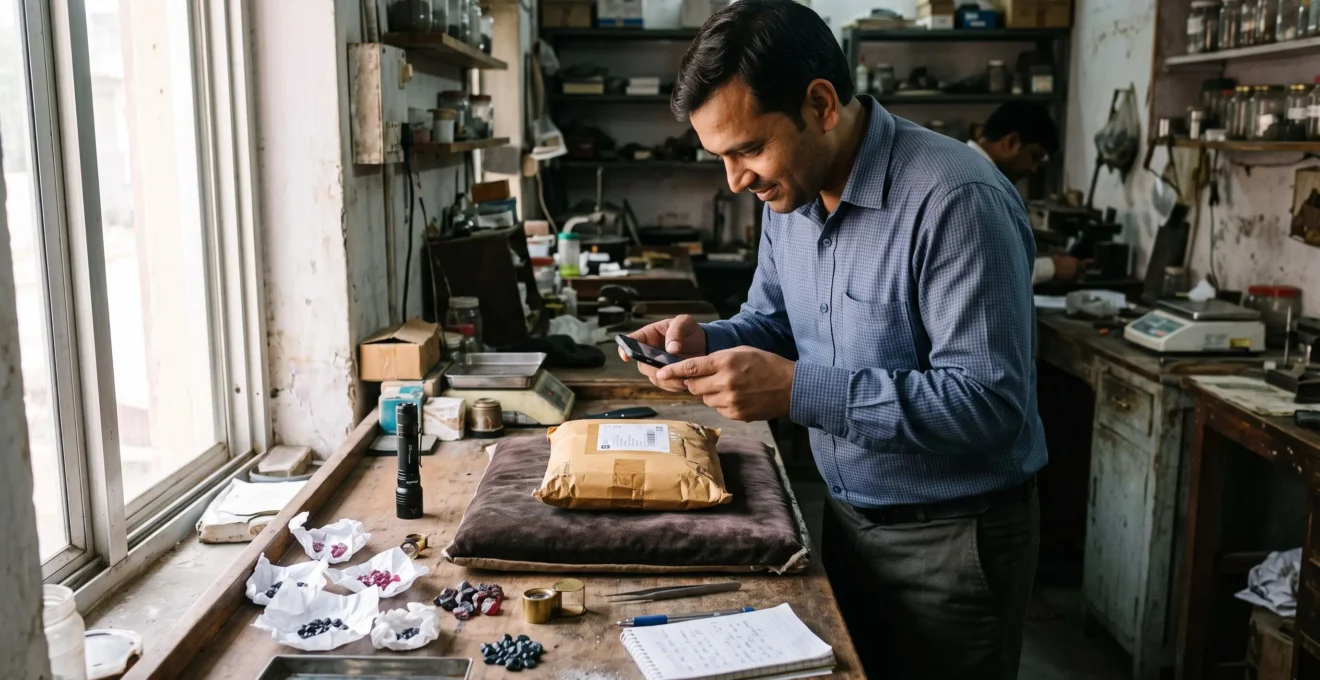
A gemstone’s extraction history can influence its condition long before a buyer examines it. Blasting, drilling and mechanical excavation may damage crystals, while careful removal from a mineral pocket can help preserve the natural structure of rough material. These differences matter because fractures, inclusions and damaged crystal faces can restrict cutting options and affect the value of the finished stone.
However, a damaged crystal does not automatically reveal how it was extracted. Natural fractures, handling incidents and transport damage can produce overlapping signs. Likewise, a seller’s description of a stone as hand-mined or mine-direct does not independently establish its origin, environmental impact or quality.
For buyers comparing stones from the same locality, three questions deserve separate attention: how the material was extracted, how it was handled afterwards, and what evidence supports its declared origin. Understanding these distinctions helps prevent paying a premium for an attractive provenance story while overlooking the physical condition and documentation of the actual stone.
What gemstone extraction really changes
- Extraction techniques can damage valuable crystals, but visible chips and fractures do not reliably identify the mining method.
- Traceability depends on documented movement through the supply chain, not simply on labels such as hand-mined or mine-direct.
- Cutting potential, gemstone quality and geographic origin all influence value, but an origin claim requires independent supporting evidence before it justifies a premium.
- Why Do Some Stones Arrive With « Fresh » Chips That Weren’t Visible in Seller Photos?
- How to Ask About Extraction and Handling in 5 Messages Without Starting an Argument?
- Direct-from-Mine Parcel vs Dealer-Curated Stones: Which Is Safer if You Want Consistent Quality?
- The Ethical Assumption Mistake: « Hand Mined » Does Not Automatically Mean Low Impact or Low Damage
- When Should You Care About Extraction Details: Before You Shortlist or Only After Lab ID?
- Blast-Adjacent Rough vs Hand-Extracted Pockets: Which Is Better for Faceting Yield?
- The Premium Mistake: Paying More for Origin Without Any Traceability Evidence
- Is an Origin Assessment Worth Paying For, or Are You Funding a Story With No Resale Power?
Why Do Some Stones Arrive With « Fresh » Chips That Weren’t Visible in Seller Photos?
A gemstone can arrive with a chip that was not apparent in the seller’s photographs because photographs cannot reveal every internal fracture or weakness. Extraction-related damage, pre-existing natural fractures and subsequent handling can all contribute to a stone’s condition. Blasting and mechanical breaking can damage crystals, but the appearance of a new chip alone cannot establish when or how the damage occurred.
The distinction matters particularly when buying rough material. According to the Gemological Institute of America, blasting, drilling and breaking up gem-bearing pegmatites can damage valuable crystals. This is especially relevant to pegmatites containing minerals such as tourmaline, beryl, spodumene and topaz, where valuable crystals may occur in unpredictable pockets.
The GIA’s technical article on gem-bearing granitic pegmatites explains why miners must consider the possibility of damaging crystals when selecting extraction techniques. Its findings concern pegmatite deposits, however, and should not be generalized to every gemstone deposit.
A critical distinction is that **a visible chip is not a reliable mining-method fingerprint**. A straight angular break may be consistent with mechanical damage, but it can also involve natural cleavage or later impact. A rounded flake does not prove thermal shock from a torch or washing process. Without documented observations and appropriate examination, these interpretations remain hypotheses.
For buyers, the practical priority is to establish whether the damage existed before shipment. A receiving inspection should document the parcel’s condition and compare the actual stone with the original photographs.
A useful receiving protocol is straightforward:
- Photograph the sealed package before opening it, including visible external damage.
- Open the parcel over a cushioned surface to reduce the risk of additional accidental impacts.
- Inspect the rough stones with a flashlight, paying attention to existing fractures, cleavage planes and crystal edges.
- Complete the inspection within 24–48 hours and compare the stones against the seller’s original photographs.
- Keep the photographs, packaging and written observations together if a discrepancy needs to be discussed.
One damaged stone should also prompt a closer examination of the rest of the parcel. It does not prove that every stone shares the same defect, but a common extraction or handling history makes parcel-level inspection more relevant than assessing the visible loss in isolation.
The economic consequence is potentially broader than the cost of replacing one chipped stone. Fractures can restrict cutting orientation, reduce recoverable weight or make a previously attractive rough crystal less suitable for a particular design. That is why parcel inspection belongs at the beginning of a quality assessment.
How to Ask About Extraction and Handling in 5 Messages Without Starting an Argument?
The most effective way to investigate gemstone extraction is to ask specific, neutral questions about successive stages of the supply chain. Rather than accusing a seller of using damaging techniques or making unsupported ethical claims, buyers can establish how the material was removed, separated, cleaned, transported and documented. Five short messages provide a practical framework for identifying missing information without turning an ordinary purchase into a confrontation.
The sequence should move from extraction to evidence.
**Message 1: How was the material brought out of the ground?**
Ask whether the pocket was excavated manually, mechanically or with blasting. The objective is to understand the general extraction method, not to obtain an assurance that the stone is undamaged.
**Message 2: How was the crystal separated from its host rock?**
Ask whether miners used hand tools, mechanical equipment or another method. This distinction matters because breaking up a gem-bearing rock can damage crystals that were initially intact.
**Message 3: How was the rough cleaned or prepared?**
Ask whether cleaning involved water, heat, chemicals or acid treatment. Do not assume that a particular cleaning process was used simply because a stone has a particular surface appearance.
**Message 4: Who handled the material between extraction and sale?**
Ask whether the parcel passed through a local collector, cooperative, wholesaler, cutting centre or dealer. Each additional intermediary can make it harder to establish the original source.
**Message 5: Can you share a photograph of the original parcel or lot?**
Request a photograph that helps connect the individual stones to the material being offered. A parcel photograph can provide useful context, although it does not independently authenticate a mine or locality.
The wording can influence the usefulness of the response. For example, asking how a particular pocket was mined is more neutral than opening with an accusation about blasting. A buyer interested in cutting quality can explain that the information helps determine the most appropriate cutting approach.
Typical seller descriptions also require careful interpretation:
| Seller’s wording | What it establishes | What remains unverified |
|---|---|---|
| Traditional mining | A general description of the mining approach. | Actual tools, extraction conditions and handling damage. |
| We source from local miners | The seller claims a relationship with local suppliers. | Direct knowledge of the original extraction and intervening traders. |
| Ethically mined | An ethical sourcing claim. | Labor conditions, environmental practices and supporting documentation. |
| Mine-direct | A claimed direct relationship with a mining source. | Whether the seller actually purchased from the mine or through intermediaries. |
These expressions are not universal definitions or proof of particular practices. The OECD explains that mineral supply chains can involve numerous formal and informal intermediaries, making provenance difficult to establish. Its case study on responsible mineral sourcing also emphasizes that traceability must form part of broader risk-based due diligence.
A useful distinction is therefore between what the seller personally observed and what they learned from someone further upstream. A seller who openly acknowledges limited visibility may provide a more realistic account than one who makes sweeping guarantees without evidence.
Avoid combining an aggressive price negotiation with an extensive sourcing interrogation. Keep the technical questions focused on the material and discuss commercial terms separately. This makes it easier to compare answers without confusing a seller’s willingness to negotiate with the reliability of their documentation.
Five practical checks before committing to a parcel
- Ask how the material was extracted and save the seller’s written answer.
- Ask how crystals were separated from host rock and record the method described.
- Request cleaning and treatment information, retaining the response in the purchase record.
- Map the known intermediaries between mine and seller in a simple supply-chain note.
- Request an original parcel photograph and save it alongside the individual stone photographs.
The value of this approach is not that every seller will possess complete records. It is that the buyer can identify what is known, what is reported second-hand and what remains unverified before deciding whether the purchase is worth the risk.
Direct-from-Mine Parcel vs Dealer-Curated Stones: Which Is Safer if You Want Consistent Quality?
Dealer-curated stones are often the more practical option for buyers seeking consistent faceting rough because selection and sorting can remove some unsuitable material before sale. Mine-direct parcels may offer a closer connection to extraction and access to unusual specimens, but they can contain greater variation. Neither channel guarantees superior quality: the deciding factors are the seller’s actual involvement, the condition of the stones and the evidence available for the parcel.
The two purchasing models optimize different things.
A mine-direct parcel can provide access to material close to its original extraction context. This can be valuable when a buyer is looking for unusual crystal formations, rare mineral combinations or specimens that retain their natural matrix.
However, the buyer may receive the material before extensive grading or sorting. The condition of the parcel can reflect the geological pocket, the extraction process and the handling that occurred immediately after recovery. If multiple stones originate from the same extraction event, shared conditions may affect more than one specimen.
Dealer-curated stock follows a different model. A dealer can select, sort and reject stones that do not meet a particular quality threshold. The buyer therefore receives a parcel that may be more consistent in appearance, size or cutting suitability.
This selection has an economic consequence: **the dealer’s price can include the cost of culling material that the buyer never sees**. Comparing a mine-direct price with a curated price without accounting for selection work can therefore produce a misleading assessment of value.
The differences become clearer when the purchasing decision is matched to the intended use.
| Decision factor | Mine-direct parcel | Dealer-curated parcel |
|---|---|---|
| Provenance proximity | Potentially closer to extraction, if the relationship is genuine. | May involve additional intermediaries. |
| Quality consistency | Can vary considerably within the parcel. | Selection can improve uniformity. |
| Extraction risk | May reflect shared extraction and handling conditions. | Can combine material from different batches. |
| Price structure | May reflect the original parcel rather than extensive grading. | May incorporate sorting, rejection and selection costs. |
| Best use case | Rare material, unusual specimens and matrix collectors. | Buyers seeking more consistent faceting rough. |
For buyers interested in consistent cutting material, dealer curation can reduce the burden of sorting unsuitable stones. For collectors seeking unusual specimens, the absence of extensive selection may actually be an advantage.
A particular caution applies to online sellers describing stock as mine-direct. A social-media seller may be offering wholesale material repackaged through several intermediaries.
Three checks help assess the claim:
- Can the seller identify a specific mine or mining district?
- Can they explain when the parcel was extracted or acquired?
- Do the original parcel photographs show the stones in a plausible extraction or sorting context, including any remaining host rock?
These details support a more informed assessment but do not independently prove provenance. The OECD’s guidance on intermediary-heavy mineral supply chains is particularly relevant when assessing the difference between direct sourcing and a seller’s description of their stock.
For resale-oriented buyers, the strongest approach is to preserve both the purchasing channel information and the available parcel documentation. A consistent parcel without a credible sourcing history and an unusual specimen with a well-documented chain offer different forms of value.
The Ethical Assumption Mistake: « Hand Mined » Does Not Automatically Mean Low Impact or Low Damage
Hand-mined gemstones are not automatically more ethical, environmentally responsible or physically undamaged than mechanically extracted stones. The expression describes an aspect of the labor or extraction method, but it does not independently establish environmental performance, worker conditions or crystal integrity. These are three separate questions that buyers should evaluate using different evidence.
The first question concerns labor. A stone extracted manually may involve small-scale miners, individual workers or an organized cooperative. However, the word hand-mined does not establish how workers are paid, whether working conditions are safe or whether appropriate protections exist.
The second question concerns environmental impact. Manual excavation can still involve substantial disturbance, water diversion, sediment release or poor site rehabilitation. Conversely, the presence of machinery does not automatically demonstrate that a particular operation has caused greater environmental damage.
The third question concerns the physical condition of the gemstone. Carefully removing a crystal from a pocket can help preserve its faces and structure. However, manual hammering or careless separation can also damage valuable rough. The extraction method must therefore be assessed in relation to the geology, tools and actual handling practices.
These distinctions prevent an important purchasing mistake: **ethical sourcing and gemstone quality are not interchangeable assessments**.
For pegmatite deposits, the GIA explains that mechanical breaking, drilling and blasting can damage valuable crystals. This establishes a genuine extraction-related concern, but it does not prove that every manually extracted stone is better preserved or that every mechanized operation produces damaged material.
Environmental and social claims require their own verification. Buyers can ask:
- What is known about miner compensation and how it compares with local working arrangements?
- Can the seller identify the mine, cooperative or mining organization?
- What information is available about water use and sediment management?
- Is there any documented site rehabilitation or environmental management process?
- Who is responsible for checking labor and environmental risks within the supply chain?
These are useful due-diligence questions, not a universal certification test. A seller’s response may identify areas of transparency or gaps, but an unsupported statement about wages or environmental performance should not be treated as independent verification.
The OECD’s responsible mineral sourcing framework is useful here because it distinguishes traceability from responsible business conduct. Knowing where material travelled does not, by itself, establish that the extraction operation respected environmental or human-rights standards.
The absence of operational details is therefore relevant. A seller who repeatedly uses the phrase ethically mined but cannot identify the mining source, explain the supply chain or provide any information about risk management has supplied a marketing statement rather than a documented account.
For buyers who care about both provenance and responsible sourcing, hand-mined should be treated as the beginning of a discussion. Credible purchasing decisions depend on what can actually be documented, not on whether a description sounds reassuring.
When Should You Care About Extraction Details: Before You Shortlist or Only After Lab ID?
Extraction questions should be asked before shortlisting a gemstone, while laboratory identification should generally follow once a promising stone has been selected. The two checks address different risks: extraction information concerns sourcing and handling, whereas laboratory identification establishes gemological characteristics such as species and, where applicable, treatment. Waiting for a laboratory report to answer mining-history questions confuses two separate forms of evidence.
The distinction is important because a laboratory report cannot reconstruct an undocumented extraction history.
A gemological laboratory can identify the material and assess certain treatments. Depending on the stone and the laboratory service, it may also provide a geographic-origin opinion. However, identifying a gemstone as a particular species does not establish whether it was recovered manually, mechanically or through blasting.
A geographic-origin opinion is also not a mining-history certificate. It concerns the geographic source assessment of the material, not the individual extraction event or the identity of every intermediary.
GIA explains that its identification and geographic-origin assessments rely on different evidence. In its analysis of colored gemstone value factors, the institute describes how geographic-origin determinations compare inclusions, chemical composition and spectroscopic characteristics with reference material of known origin.
The practical buying process should therefore have two stages.
**Stage 1: Extraction and sourcing screening before shortlisting**
Review the seller’s description, ask about extraction and handling, request parcel photographs and identify gaps in the chain of custody. Look for visible fractures, damaged edges and inconsistencies between photographs and the offered material.
The aim is to eliminate unsuitable sellers or parcels before committing to further expenditure.
**Stage 2: Laboratory identification after shortlisting**
Once a stone meets the initial physical and commercial requirements, consider laboratory identification to verify the species and assess treatment claims. If geographic origin has meaningful commercial relevance, establish whether an additional origin assessment is appropriate.
This sequence prevents a common misunderstanding: a laboratory can confirm that a stone is a genuine emerald, sapphire or other gemstone without establishing whether its extraction history was carefully documented.
The economic distinction is equally important. Asking sourcing questions and reviewing photographs generally requires time rather than a laboratory fee. A laboratory report may provide valuable gemological information, but it cannot restore a crystal damaged during extraction or transportation.
For buyers intending to resell, retaining pre-purchase correspondence and parcel photographs can preserve useful information about the sourcing chain. Those records complement a laboratory report rather than replace it.
A clean laboratory result and a documented sourcing history answer different questions. Keeping both records where commercially justified produces a more complete account of the gemstone than either document alone.
Key decisions before paying an origin premium
- Establish whether the claimed locality is supported by evidence rather than relying on the seller’s description.
- Separate laboratory geographic-origin opinions from documentation of the actual extraction and trading history.
- Assess the gemstone’s quality and likely cutting potential independently of its locality claim.
Blast-Adjacent Rough vs Hand-Extracted Pockets: Which Is Better for Faceting Yield?
Hand-extracted pocket material can offer advantages for faceting because careful removal may preserve crystal faces, cleavage relationships and orientation options. Blast-adjacent rough can carry extraction-related damage that complicates cutting decisions. However, there is no universal yield percentage that separates the two categories, and a cheaper damaged-looking crystal can sometimes remain commercially attractive if a skilled cutter can work around its weaknesses.
The main concern with blasting is the possibility of mechanical damage to valuable crystals. The GIA’s research on gem-bearing pegmatites identifies blasting, drilling and mechanical breaking as operations that can damage crystals within the host rock.
The potential consequences depend on the geological setting, the position of the crystal and the extraction process. Damage cannot be assumed to be evenly distributed throughout a parcel. Equally, it cannot be quantified from a photograph without further examination.
A rough crystal’s exterior does not necessarily reveal the full extent of internal fractures. A cutter therefore needs to consider the relationship between visible surfaces, inclusions, existing weaknesses and the intended finished design.
Hand extraction offers a different set of possibilities. When miners carefully remove material surrounding a pocket, the original crystal faces may remain intact. This can give the cutter more freedom when choosing orientation, preforming and the final shape.
However, hand extraction is not a guarantee of better faceting yield. Natural fractures, internal inclusions and crystal geometry can still limit the finished stone. The condition of the rough material matters more than the label attached to its extraction method.
For buyers comparing rough material, several observations can help organize the initial assessment:
- Surface condition: Look for visible damage, chips, irregular breakage and areas that appear disturbed.
- Internal features: Examine inclusions and fractures where transparency permits, while distinguishing natural features from suspected external damage.
- Crystal orientation: Consider whether the remaining crystal faces offer useful cutting orientations.
- Parcel context: Ask whether the seller knows how the stones were separated from the host rock and whether their position relative to any blasting operation is known.
A frosted surface or a pattern of internal reflections should not be treated as a universal shock halo. Neither feature independently proves that a stone was blast-adjacent. A reliable diagnosis requires more than a visual impression, and the available sources do not establish a standard photographic test for identifying blast damage.
The economic trade-off can nevertheless favor either option.
A cutter with experience assessing fractures may purchase inexpensive rough with visible limitations and select an orientation that retains commercially useful material. Another buyer seeking predictable results may prefer cleaner, more carefully extracted material, even at a higher purchase price.
The GIA’s emerald quality guidance provides an additional illustration of why cutting decisions matter. Emerald fractures and inclusions influence orientation, design and the weight that can be retained. The institute explains these considerations in its emerald quality reference. Its observations concern emeralds specifically, not every gemstone variety or extraction method.
For buyers who can assess rough material confidently, lower-priced parcels may present worthwhile opportunities. For less experienced buyers, a more consistent and carefully inspected selection can reduce the uncertainty involved in estimating cutting potential.
The Premium Mistake: Paying More for Origin Without Any Traceability Evidence
Paying more for a gemstone because an invoice names a prestigious locality is risky when the claim has no supporting documentation. A locality name can be commercially important, but a seller’s declaration is not independent proof of geographic origin. Buyers should distinguish the claimed source, the laboratory’s geographic-origin opinion and the documented movement of the individual stone through the supply chain.
Origin can influence the value of colored gemstones. Certain localities have strong reputations and are recognized by specialist markets. Kashmir sapphire is an example discussed by the Gemological Institute of America, where geographic origin can significantly affect the perceived value of otherwise comparable stones.
However, **origin does not replace quality**. A gemstone from a prestigious locality does not automatically become valuable if its color, clarity, size or cutting characteristics are poor.
The distinction between a locality claim and an independently supported origin assessment is particularly important because gemstones can pass through multiple trading and cutting centres before reaching a retail buyer.
A stone may be extracted in one country, transported to another for processing, sold through an international wholesale market and eventually marketed under a locality description that the final seller cannot independently verify.
The OECD identifies fragmented mineral supply chains and numerous intermediaries as important obstacles to provenance verification. Precious-stone supply chains also present risks associated with illicit trade and financial crime.
This makes traceability particularly relevant when the purchase price includes a geographic-origin premium.
A practical assessment should examine three levels of evidence.
**1. Seller-level documentation**
Look for information identifying the mine or district, the supplier, the extraction or acquisition period and any parcel documentation. These details help establish the seller’s account of the material’s history.
**2. Independent laboratory opinion**
Determine whether a recognized gemological laboratory has issued a geographic-origin opinion for the individual stone. A standard identification report should not be confused with a geographic-origin assessment.
**3. Gemological consistency**
Consider whether the inclusions, chemical characteristics and other available gemological evidence are consistent with the claimed locality. This assessment is best interpreted by a qualified laboratory rather than inferred from a seller’s photographs.
The three levels answer different questions. Seller records concern the supply chain, laboratory opinions concern gemological origin and physical characteristics provide supporting evidence. None should be mistaken for a complete record of the mining operation.
The GIA also recognizes that geographic-origin results can be inconclusive when the available evidence cannot distinguish between possible sources. This is a reason to avoid treating a prestigious locality name as a guaranteed outcome.
The resale implications are straightforward. A buyer who pays a substantial premium based only on a verbal claim may struggle to justify that additional cost to a future purchaser. A coherent record supported by appropriate laboratory documentation gives a later buyer more information with which to assess the claim.
A prestigious origin can be a legitimate value factor, but its commercial relevance depends on the gemstone segment, the actual quality and the strength of the evidence. Without these elements, the buyer may be paying for a description rather than a defensible characteristic.
Is an Origin Assessment Worth Paying For, or Are You Funding a Story With No Resale Power?
A laboratory geographic-origin assessment can be worth paying for when the gemstone’s value and market segment justify the additional expense. This is particularly relevant to colored stones for which recognized localities influence commercial pricing. A seller’s verbal account of a mine or district is different: it may provide useful context, but it is not an independent expert assessment and does not automatically create resale value.
The first step is to distinguish two meanings of origin assessment.
A gemological laboratory’s geographic-origin opinion is based on scientific examination. Depending on the stone and available reference information, the laboratory may evaluate inclusions, chemical composition and spectroscopic characteristics to determine whether the material is consistent with a particular geographic source.
A seller’s origin narrative is a different type of information. It may describe a named mine, mining district, cooperative or local trading relationship. Its credibility depends on the seller’s knowledge and the documentation available to support the account.
Neither should be confused with a complete extraction record.
A laboratory opinion does not establish the precise mining method or the identity of every person who handled the gemstone. Conversely, a well-documented extraction history does not independently establish the gemstone species or geographic origin.
The GIA’s discussion of colored gemstone value factors illustrates why these distinctions matter. Geographic origin can significantly influence the value of certain stones, including Kashmir sapphire, but the laboratory’s assessment can also be inconclusive when different deposits share overlapping characteristics.
Origin therefore has different commercial importance across gemstone categories.
For certain rubies, sapphires, emeralds and tourmalines, recognized localities may be commercially relevant. In other segments, buyers may place substantially greater emphasis on color, transparency, clarity, size and cutting quality.
A useful decision framework separates the purchase into three questions:
- Does the market value origin? Establish whether buyers in the relevant gemstone segment actually recognize and pay for the claimed locality.
- Is the stone valuable enough to justify the assessment? Compare the potential commercial benefit with the laboratory fee and the overall purchase price.
- Can the origin claim be independently supported? Check whether the laboratory offers an appropriate geographic-origin service and whether the seller’s records add meaningful provenance information.
A laboratory assessment may be unnecessary when the stone’s value is modest, when origin has little influence on the market segment or when the assessment fee approaches the plausible commercial benefit.
Equally, paying for an origin report does not guarantee that the laboratory will identify a specific locality. An inconclusive result is a legitimate scientific outcome, not evidence that the stone is necessarily misrepresented.
The distinction becomes especially important for future resale. A buyer who expects to recover an origin premium should consider what evidence a later purchaser will receive.
A useful documentation package may include:
- The seller’s original locality declaration and purchase invoice.
- Available parcel photographs and information about extraction and handling.
- Records identifying known intermediaries or suppliers.
- A laboratory identification report.
- A separate geographic-origin opinion, where justified and available.
Together, these records provide a more coherent account of the gemstone than a locality name on an invoice. They still do not prove every aspect of the mining operation, but they help distinguish documented information from commercial claims.
For collectors and dealers, the strongest buying strategy is therefore to evaluate extraction, gemological identity, geographic origin and market demand independently before combining them into a final price assessment.
The important principle is that **a report can strengthen a defensible origin claim, but it cannot turn an undocumented extraction story into verified provenance**.
For a significant purchase, the next sensible step is to assemble the seller’s sourcing information, examine the rough material and identify which laboratory services are relevant before agreeing to an origin premium. This creates a defensible basis for both the initial purchase and any future resale discussion.
Can you tell whether a gemstone was blast-mined by looking at its cracks?
Not reliably. Blasting and mechanical breaking can damage gem-bearing crystals, but fractures can also be natural or result from later handling. The appearance of a chip, internal reflection or frosted surface does not independently establish the extraction method. Reliable assessment requires examination alongside available extraction and parcel documentation.
Does hand-mined automatically mean a gemstone is ethically sourced?
No. Hand-mined describes an extraction approach, not a complete assessment of worker conditions, environmental impact or responsible sourcing. Buyers should ask for information about the mining organization, labor arrangements, water use and environmental management. Traceability is useful, but it does not independently establish that every sourcing risk has been addressed.
Is a mine-direct gemstone always better quality than dealer-curated stock?
No. Mine-direct parcels can provide closer access to extraction material but may contain greater variation. Dealer-curated stock can offer more consistent selection because unsuitable stones may already have been rejected. The better option depends on the intended use, the seller’s reliability, the physical condition of the parcel and the buyer’s ability to assess rough gemstones.
Does a gemstone laboratory report prove where a stone was mined?
Not necessarily. A standard identification report establishes gemological characteristics but does not automatically include geographic origin. A separate origin assessment may be available for certain gemstones. Even then, a laboratory opinion is not a complete record of the extraction operation or the stone’s journey through the supply chain.
Should geographic origin increase the price of every colored gemstone?
No. Geographic origin can influence prices in certain colored-stone markets, but its importance varies by gemstone type and quality. A prestigious locality does not compensate automatically for poor color, clarity or cutting characteristics. Buyers should establish whether the market recognizes the locality premium and whether the supporting evidence justifies the additional cost.